
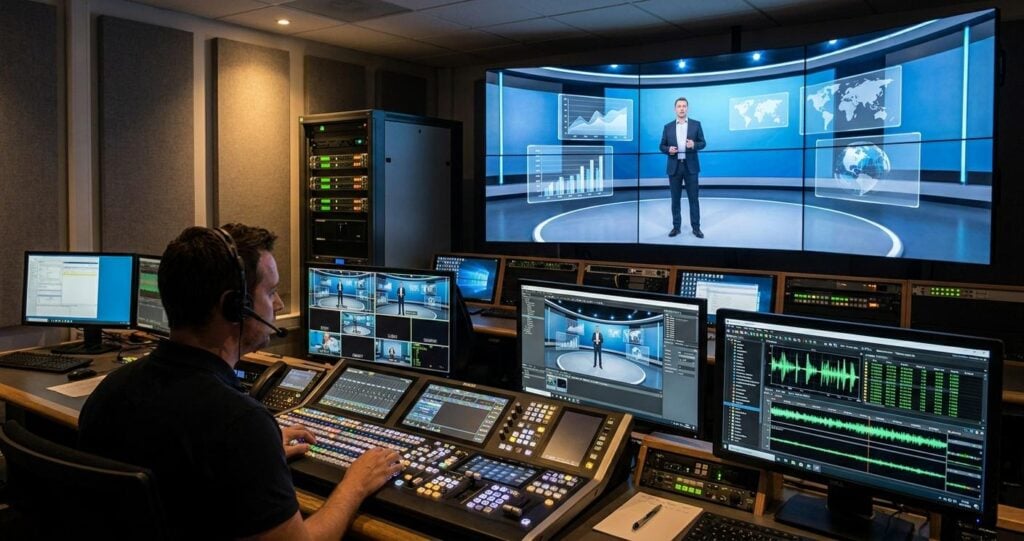
The landscape of B2B event streaming and hybrid production is undergoing a profound transformation, driven by the imperative to deliver unparalleled engagement and immersive experiences. While traditional streaming approaches excel at content delivery, the modern enterprise demands more; it seeks to transcend passive viewing and foster active participation. Extended Reality (XR), encompassing Virtual Reality (VR), Augmented Reality (AR), and Mixed Reality (MR), is emerging not merely as a novelty, but as a sophisticated, enterprise-grade technical solution for redefining storytelling in the digital age. For corporate event planners, AV professionals, and IT directors, understanding the intricate technical underpinnings and production workflows of XR is paramount to leveraging its full potential in B2B applications, from high-stakes product launches to global corporate summits. Spring Forest Studio specializes in architecting and executing these complex XR-driven productions, ensuring robust streaming infrastructure and impeccable technical delivery that elevates narrative impact and audience retention in a competitive digital ecosystem. This article will delve into the technical architecture, production methodologies, and infrastructural considerations that position XR as an indispensable tool for advanced B2B storytelling.
The Technical Foundation of XR in Live Production
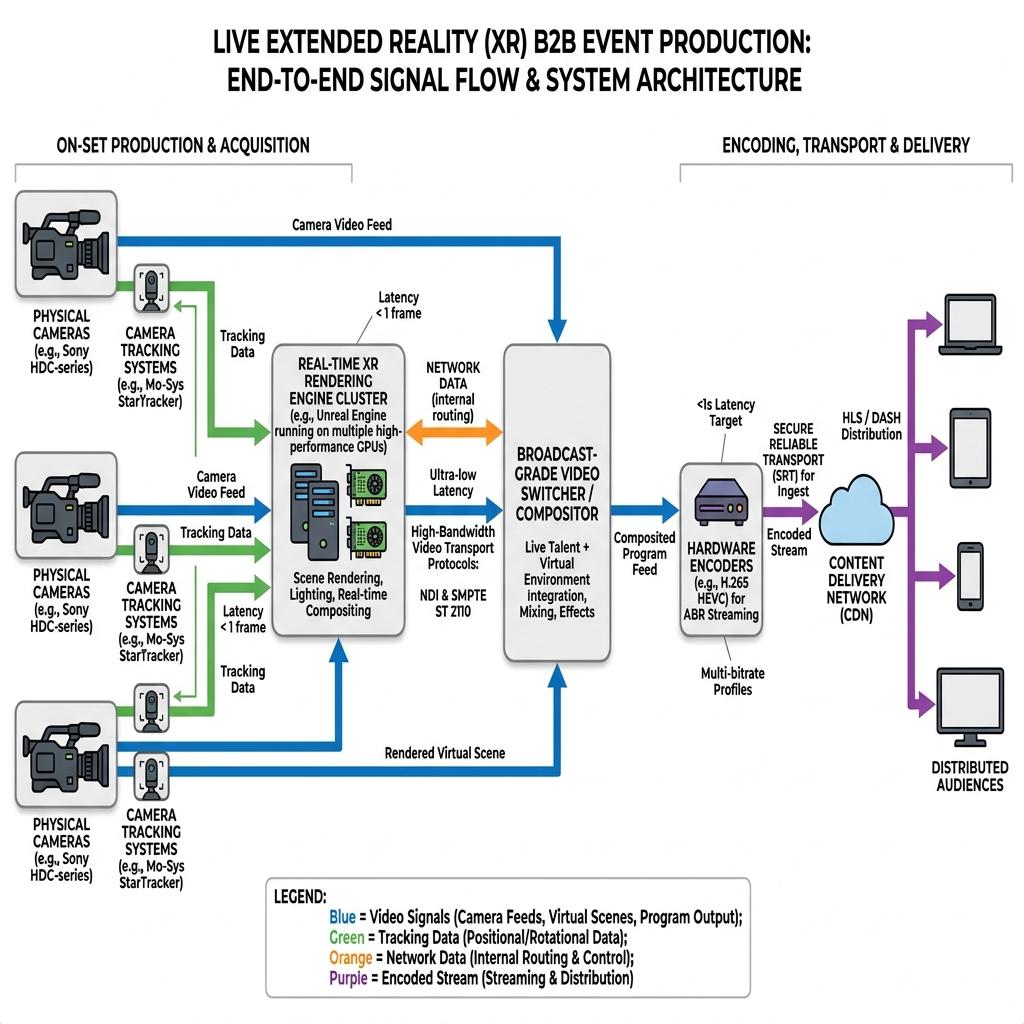
Implementing XR in a live B2B production environment demands a converged, high-performance technical stack, fundamentally distinct from standard video production. The core challenge lies in the real-time synthesis of physical and virtual elements, requiring precise synchronization and ultra-low latency processing. This involves sophisticated graphical rendering, accurate positional tracking, and high-bandwidth video transport.
Real-time Rendering Engines and Graphics Processing Units (GPUs)
At the heart of any live XR production is a powerful real-time rendering engine, typically Unreal Engine or Unity 3D, running on a dedicated cluster of high-end Graphics Processing Units (GPUs). These engines are responsible for generating the photorealistic virtual environments and assets that interact with the live foreground talent and physical set elements. Critical specifications include GPU memory (e.g., 24GB GDDR6X or more per card), CUDA cores, and render output capabilities (e.g., 4K/UHD at 60 frames per second, or higher for multi-camera outputs). The rendering pipeline must support advanced shaders, dynamic lighting, reflections, and ray tracing in real time to achieve visual fidelity indistinguishable from a physical set. The output from these render engines is a composited video feed, often with an alpha channel, which is then fed into a video switcher.
Advanced Tracking Systems and Calibration
Precise positional tracking of cameras, and sometimes talent or props, is non-negotiable for believable XR integration. Optical tracking systems, utilizing infrared markers and specialized cameras (e.g., Mo-Sys StarTracker, Stype Follower), or electromagnetic tracking systems (e.g., FreeD protocol compatible devices), provide sub-millimeter accuracy and millisecond latency. These systems generate real-time positional and rotational data (x, y, z, yaw, pitch, roll) which is fed directly into the rendering engine. Critical to successful deployment is the meticulous calibration process, which maps the physical studio space, camera lens characteristics (distortion, field of view), and tracker offsets into the virtual environment. This calibration ensures that virtual objects maintain their correct perspective and scale relative to the physical camera movements, eliminating parallax errors and maintaining visual congruence. Calibration routines are often automated but require expert oversight to achieve broadcast-grade accuracy, especially for dynamic camera movements on jibs, dollies, or cranes.
High-Bandwidth Video Transport Protocols (SRT, NDI, SMPTE ST 2110)
The integration of physical camera feeds, augmented reality overlays, and the final composited program output requires robust, low-latency video transport. For internal studio routing and inter-device communication, protocols like NDI (Network Device Interface) and SMPTE ST 2110 are paramount. NDI|HX offers compressed 4K/UHD video over standard Gigabit Ethernet, suitable for many studio applications, while full-bandwidth NDI provides visually lossless performance. For uncompressed or minimally compressed video over IP networks, SMPTE ST 2110 is the industry standard for broadcast facilities, providing separate elementary streams for video (ST 2110-20), audio (ST 2110-30), and ancillary data (ST 2110-40), often over 10 Gigabit or 25 Gigabit Ethernet infrastructure, ensuring absolute minimal latency and maximum fidelity. When transmitting the final program feed to remote production hubs or content delivery networks (CDNs), the Secure Reliable Transport (SRT) protocol is preferred over legacy RTMP. SRT offers AES 128/256-bit encryption, packet loss recovery through retransmission, and dynamic latency adjustment, making it ideal for maintaining video quality and integrity over unpredictable internet connections for enterprise-grade B2B streaming.
XR Workflows for Immersive Hybrid Events
Hybrid events, by their nature, bridge the physical and virtual realms. XR significantly enhances this bridge, allowing for a seamless, visually rich experience that engages both on-site and remote audiences simultaneously. The workflow for integrating XR into hybrid event production is a complex orchestration of hardware, software, and human expertise.
Blending Physical and Virtual Stages: Chroma Keying vs. LED Walls
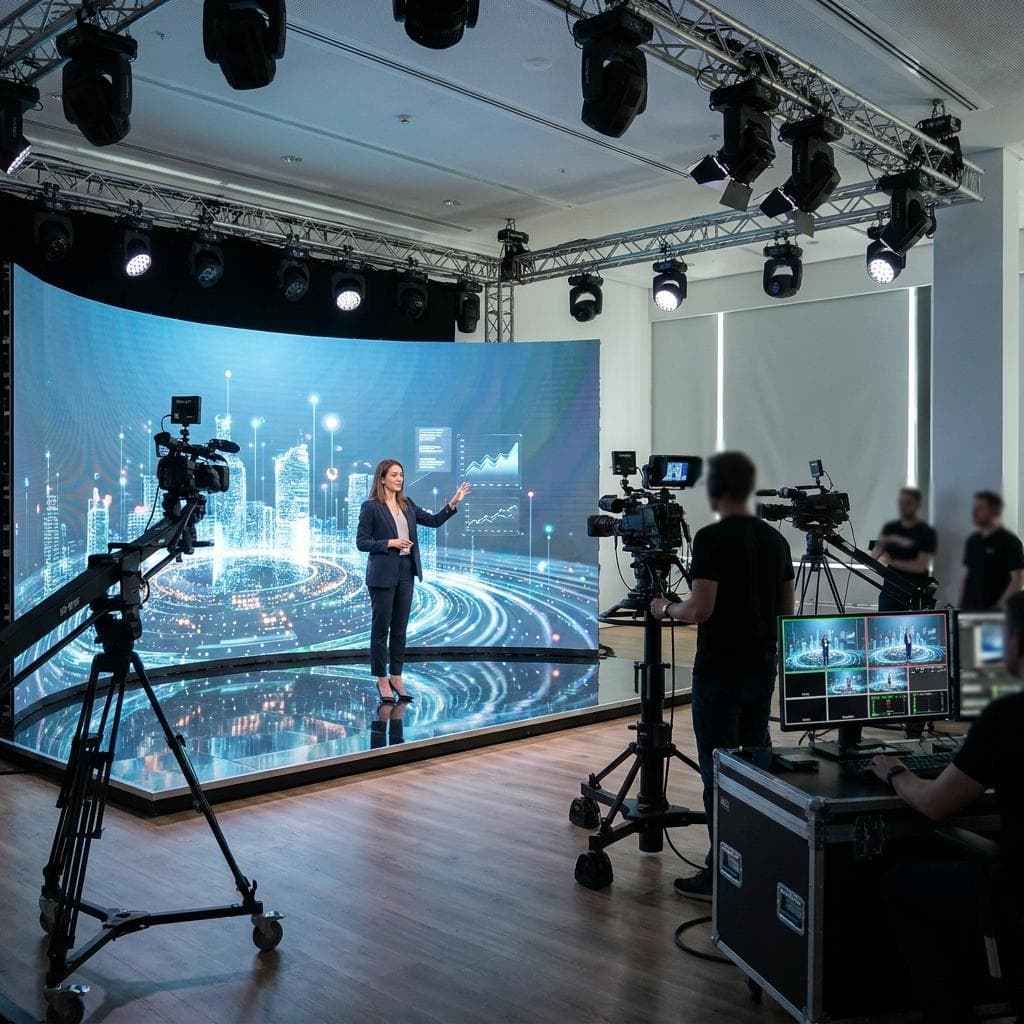
Two primary methods facilitate the blending of physical talent with virtual sets: chroma keying and LED volumes. Chroma keying, typically using a green or blue screen, allows for the talent to be extracted from their background and composited into a fully virtual environment rendered by the XR engine. This method offers extreme flexibility in virtual set design but demands meticulous lighting, uniform background illumination (e.g., ±2 IRE across the screen), and precise keying algorithms to avoid spill and artifacting. Modern real-time keyers within video switchers (e.g., Ross Carbonite, Grass Valley K-Frame) or dedicated hardware (e.g., Ultimatte) offer sophisticated sub-pixel processing. Alternatively, LED volumes provide an “in-camera” visual effect, where the virtual environment is displayed on high-resolution LED screens surrounding the talent. This eliminates the need for chroma keying, provides realistic reflections on props and talent, and allows for dynamic lighting changes that naturally affect the physical foreground. Crucially, the content displayed on the LED wall must be perspective-corrected in real-time by the rendering engine, based on the camera’s position and lens, to maintain spatial congruence. This often requires LED panels with high refresh rates (e.g., >3840 Hz) and low pixel pitch (e.g., P1.5 to P2.6) to prevent moiré patterns and ensure optimal visual quality for broadcast-grade outputs.
Multi-Camera Integration and Virtual Camera Systems
A robust XR hybrid production necessitates a multi-camera setup. Each physical camera (e.g., Sony HDC-series, ARRI AMIRA, Blackmagic URSA Broadcast) feeding into the system must be tracked independently and its feed synchronized with the virtual environment. Video switchers manage these multiple camera inputs, enabling seamless transitions between physical and virtual shots. Beyond physical cameras, virtual camera systems can be deployed within the XR engine itself. These are not physical cameras but virtual perspectives within the 3D environment, which can be dynamically controlled (e.g., via a game controller or virtual joystick) to provide additional angles, fly-throughs of the virtual set, or close-ups on virtual elements, all rendered in real-time. This expands creative possibilities without additional physical hardware, optimizing resource allocation for complex event designs.
Interactive Elements and Audience Engagement through XR
XR extends beyond static virtual sets, enabling dynamic interactive elements that significantly boost audience engagement, particularly in hybrid formats. Presenters can interact with holographic data visualizations, manipulate 3D models in real-time, or walk through expansive virtual product showrooms. For remote audiences, integration with enterprise communication platforms (e.g., Microsoft Teams, Zoom, Webex) allows for real-time data feeds, Q&A sessions where audience questions appear as virtual graphics, or even virtual avatars of remote participants interacting within the XR space. Technical implementation requires robust APIs and data integration layers to synchronize audience input with the XR engine’s output, maintaining ultra-low latency for a truly responsive experience. This level of interaction requires secure data pipelines and a scalable backend architecture capable of handling concurrent audience interactions without compromising the integrity or performance of the live XR feed.
Enterprise-Grade Infrastructure for XR Streaming
The successful deployment of XR in B2B event streaming hinges upon a meticulously designed and robust enterprise-grade infrastructure. This is not merely about bandwidth; it encompasses network architecture, processing power, and sophisticated encoding strategies.
Network Architecture and Latency Management
For high-fidelity XR production, a dedicated, low-latency network infrastructure is critical. This typically involves 10 Gigabit Ethernet (10GbE) or 25 Gigabit Ethernet (25GbE) for internal studio networks, connecting tracking systems, render engines, video switchers, and media servers. Precision Time Protocol (PTP, IEEE 1588) is essential for frame-accurate synchronization across all IP-based devices, ensuring that video, audio, and tracking data remain perfectly aligned. Latency management is paramount; end-to-end latency from camera sensor to program output displayed on the virtual set should ideally be below 100 milliseconds, with sub-50ms being desirable for interactive XR. This requires optimized signal paths, high-speed switching, and minimal processing overhead at each stage. QoS (Quality of Service) policies must be rigorously implemented across the network to prioritize XR traffic, preventing jitter and packet loss that would degrade the immersive experience. For hybrid events leveraging multiple physical locations, dedicated fiber optic links or high-capacity VPN tunnels with guaranteed bandwidth become necessary to extend this low-latency environment.
Cloud-Based vs. On-Premise XR Processing
Enterprise clients face a strategic decision regarding the deployment of XR processing resources: on-premise or cloud-based. On-premise solutions offer maximum control, ultra-low latency, and dedicated hardware performance, ideal for permanent studios or large-scale, mission-critical events where data sovereignty is a concern. This typically involves rack-mounted GPU servers with redundant power supplies and high-speed storage arrays (e.g., NVMe SSDs in RAID configurations). Cloud-based XR processing leverages powerful virtualized GPU instances from hyperscale providers (e.g., AWS, Azure, Google Cloud). This offers unparalleled scalability, allowing resources to be spun up or down based on event demands, reducing upfront capital expenditure. However, cloud deployments introduce inherent network latency, which must be carefully managed. Edge computing solutions, positioning cloud resources closer to the production venue, can mitigate some of these latency challenges. Hybrid approaches, where render engines operate on-premise for critical, low-latency tasks and cloud resources handle ancillary processing, asset management, or distributed audience rendering, offer a compelling balance of control, scalability, and cost-efficiency. Secure network connectivity to cloud providers, often via AWS Direct Connect or Azure ExpressRoute, is mandatory for reliable enterprise-grade operations.
Encoding, Transcoding, and Adaptive Bitrate Streaming for XR
The final, composited XR program feed must be meticulously encoded for distribution. H.264 (AVC) and H.265 (HEVC) are the predominant codecs. H.265 offers superior compression efficiency, delivering higher quality at lower bitrates, crucial for 4K/UHD XR content. Bitrate management is a delicate balance: too low, and visual artifacts degrade the immersive experience; too high, and bandwidth requirements become prohibitive for global audiences. Typical target bitrates for broadcast-quality 1080p60 XR range from 8-15 Mbps, while 4K60 might require 20-50 Mbps, depending on content complexity. For broad audience reach and varied network conditions, adaptive bitrate (ABR) streaming is essential. This involves transcoding the main program feed into multiple renditions (e.g., 1080p, 720p, 480p) at different bitrates. When delivering via HTTP Live Streaming (HLS) or Dynamic Adaptive Streaming over HTTP (DASH), the client player automatically selects the optimal rendition based on available bandwidth, ensuring a smooth playback experience. Enterprise streaming platforms often integrate hardware encoders (e.g., from Elemental Technologies, Haivision) for dedicated processing power and maximum efficiency, or utilize cloud-based transcoding services for scalable, on-demand processing.
Scalability, Redundancy, and Quality of Service in XR Deployments
For enterprise-level B2B events, the stakes are high. XR deployments must therefore be engineered with robust scalability, redundancy, and stringent quality of service (QoS) measures to guarantee uninterrupted, high-quality delivery to global audiences.
Failover Strategies and Redundant Systems
No single point of failure can be tolerated in mission-critical XR productions. Redundancy must be built into every layer of the architecture, from power supplies in GPU servers to network switches, video routers, and encoders. Active-standby or N+1 redundancy configurations are standard. For instance, main and backup render engine clusters, synchronized via shared storage or real-time data replication, can ensure that if one system fails, the other can take over immediately, often with automated failover mechanisms. Similarly, redundant signal paths (e.g., dual NDI streams over diverse network routes, or SDI backups) and dual streaming encoders feeding separate CDNs mitigate risks. Continuous health monitoring of all hardware and software components, using SNMP or custom API integrations, is critical for proactive issue detection and rapid response. The goal is a seamless, imperceptible transition for the audience in the event of a component failure.
Monitoring and Quality Assurance for XR Feeds
Comprehensive monitoring and quality assurance (QA) are vital throughout the XR production and streaming workflow. This includes technical monitoring of video and audio signals (waveform, vectorscope, audio loudness meters adhering to ITU-R BS.1770-4), network performance (latency, jitter, packet loss), and system resource utilization (CPU, GPU, memory). Dedicated multiviewer systems display all critical feeds, including raw camera inputs, rendered XR layers, program output, and confidence monitors for the live stream. For virtual elements, real-time feedback loops from the creative director and technical operators are essential to ensure the virtual environment aligns with artistic vision and technical specifications. End-to-end stream monitoring, often involving third-party services, tracks quality metrics from the ingest point through the CDN to the end-user, providing insights into potential bottlenecks and performance degradations.
Integration with Enterprise Communication Platforms
In a hybrid B2B context, XR productions often need to integrate seamlessly with existing enterprise communication and collaboration platforms such as Microsoft Teams, Zoom, Webex, or custom corporate intranets. This typically involves delivering the high-fidelity XR program feed as a virtual camera input or a dedicated RTMP/SRT stream into these platforms. Technical challenges include maintaining video quality and frame rates within the platform’s limitations, ensuring proper audio routing with mix-minus feeds for remote presenters, and managing bandwidth egress from the production facility. For two-way interaction, the production system must also be able to ingest remote participant video and audio feeds from these platforms, which can then be displayed within the XR environment (e.g., a virtual panel discussion with remote speakers appearing as holographic projections). Secure API integrations and careful configuration of firewall rules are paramount for enabling this interoperability while maintaining enterprise security standards.
Conclusion
Extended Reality stands as a transformative technology, offering unparalleled avenues for immersive storytelling in the B2B event space. From the meticulous synchronization of real-time rendering engines and advanced tracking systems to the robust architectural demands of high-bandwidth video transport and enterprise-grade networking, the successful deployment of XR requires profound technical expertise. By understanding and meticulously implementing solutions for blending physical and virtual stages, optimizing network latency, selecting appropriate encoding strategies, and building in comprehensive redundancy, enterprises can harness XR to create truly captivating and unforgettable experiences for their audiences. Spring Forest Studio’s technical team possesses the deep industry knowledge and practical experience to navigate these complex production ecosystems, transforming ambitious XR concepts into flawlessly executed live and hybrid events that deliver tangible engagement and measurable impact. XR is not just a visual enhancement; it is the ultimate technical tool for crafting compelling narratives that resonate deeply in the digital age, setting new benchmarks for corporate communication and engagement.

Jeremy Lee is a seasoned digital marketing director and strategist with over two decades of experience in the industry. As the founder of Sotavento Medios, I manage a diverse portfolio of over 50 businesses, helping brands grow through advanced search strategies and digital innovation. My work focuses on bridging the gap between traditional search engine optimisation and the evolving world of AI-driven answer engines.
get in touch