
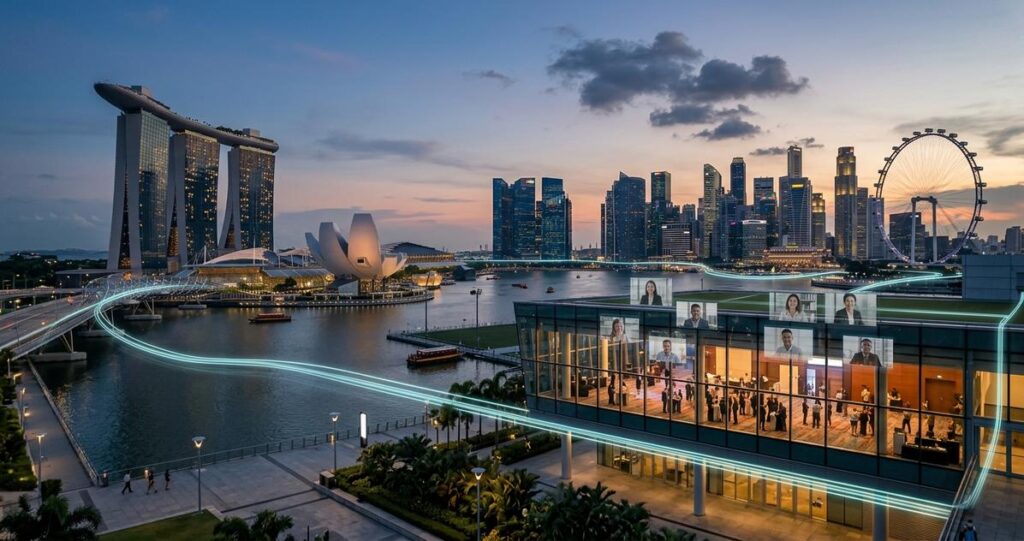
Singapore has built a reputation as a regional leader in hybrid infrastructure because it combines physical, digital, and organisational systems in a way that is unusually coordinated for a city-state. For businesses, institutions, and event organisers, “hybrid infrastructure” does not just mean having both online and offline capabilities. It means designing environments, workflows, connectivity, power resilience, security, and operational processes so that in-person and remote participation can work together reliably. In a market like Singapore, where speed, trust, and operational precision matter, that capability has become a strategic advantage.
This leadership did not happen by accident. Singapore’s compact geography, strong regulatory environment, advanced connectivity, and culture of long-term planning have all supported the development of infrastructure that can handle high demands and frequent adaptation. The same qualities that support finance, logistics, healthcare, and public services also support hybrid event production, remote collaboration, cloud-enabled operations, and cross-border communications. For organisations serving Singapore-based audiences, including B2B event teams and production specialists, understanding this ecosystem helps explain why the country has become a benchmark for hybrid readiness in the region.
Hybrid infrastructure matters because modern operations rarely happen in a single place. A conference may involve a physical venue, live-streamed sessions, remote speakers, digital registration, on-site networking, and post-event content distribution. A healthcare service may use teleconsultation for selected cases while maintaining in-person assessments where needed. A business may run distributed teams across offices, homes, and regional hubs. Singapore’s infrastructure supports these overlapping demands better than many markets because it is built for reliability, interoperability, and scale within a dense urban environment.
Why Singapore’s infrastructure model fits hybrid operations
Singapore’s infrastructure advantage begins with planning. As a city-state with limited land and a highly concentrated population, it has long had to optimise space, connectivity, and resource use. That has encouraged integrated development rather than fragmented growth. Roads, rail, buildings, data systems, and utilities are designed with a strong emphasis on coordination, which is exactly what hybrid operations require. When physical and digital layers must work together without friction, integration matters as much as capacity.
Another key factor is the country’s emphasis on resilience. Singapore is exposed to risks that can affect operations, including tropical weather, supply chain disruptions, and global market volatility. In response, many systems are built with redundancy, contingency planning, and maintenance discipline. For hybrid infrastructure, this means stronger expectations around backup connectivity, stable power supply, managed facilities, and structured recovery processes. These features are not just technical luxuries. They are the foundation for dependable live production, remote participation, and mission-critical digital services.
Singapore also benefits from a highly connected business environment. Many regional headquarters, multinational firms, and professional service providers operate here because the country offers a stable legal framework, efficient administration, and strong access to international networks. Hybrid infrastructure thrives in such an ecosystem because enterprises need environments that can support global clients, distributed teams, and cross-border events without compromising quality. The market rewards systems that are dependable and scalable, and Singapore has consistently invested in those qualities.
Dense urban planning supports coordinated systems
Dense urban planning can be challenging, but it also creates opportunities. In Singapore, proximity between venues, transport nodes, office towers, and technology infrastructure allows for efficient deployment of services. Event teams can move equipment, personnel, and speakers across short distances with less logistical friction. Businesses can connect meeting spaces, broadcast studios, and collaboration hubs more easily than in geographically dispersed cities.
This matters for hybrid use cases because infrastructure is not only about hardware. It also includes the practical sequence of how people, equipment, and signals move through a system. A well-planned district can support fibre connectivity, transportation access, power continuity, and venue readiness in a more predictable way. That predictability reduces operational risk and improves the experience for both in-person and remote participants.
Connectivity, cloud adoption, and the digital backbone of hybrid systems
Hybrid infrastructure depends heavily on digital connectivity. Without reliable networks, even the best physical venues or workflows cannot support live interaction, remote collaboration, or seamless content delivery. Singapore’s digital backbone has been strengthened over time through sustained public and private investment in broadband, mobile connectivity, and enterprise-grade network services. For organisations, this creates the conditions needed for stable video transmission, low-latency communication, and real-time coordination.
Cloud adoption has also played a significant role. Hybrid operations often rely on cloud platforms for registration systems, content management, collaboration tools, analytics, and streaming workflows. Cloud-based architecture allows teams to scale resources up or down depending on event size or business demand. In practice, this means a company can run a small internal webcast in the morning and a regional product launch in the afternoon using the same underlying digital ecosystem, provided it is configured properly.
Singapore’s position as a regional business hub also encourages hybrid systems that are designed for international reach. Many organisations based here serve Southeast Asia and beyond, so they need infrastructure that can handle multi-location participation. This includes platforms that support remote presenters, virtual breakout rooms, on-demand replay, secure file transfer, and multilingual communication. A hybrid model is only effective when the digital layer is stable enough to extend the physical event or workflow beyond one site.
Reliable streaming and low-friction collaboration are business essentials
For B2B event streaming and hybrid production, connectivity is not simply an IT issue. It shapes audience trust, brand perception, and commercial outcomes. When a session freezes, audio drops, or slide sharing fails, participants quickly lose confidence. Singapore’s infrastructure environment is attractive because it helps reduce those risks through robust networks, professional facilities, and a workforce familiar with operational standards.
Collaboration tools also function better in an environment where enterprise connectivity is strong. Remote panels, live Q&A, simultaneous interpretation, and multi-camera production all depend on stable bandwidth and disciplined technical workflows. This is one reason Singapore stands out in the region. The country’s infrastructure supports not just digital access, but the practical execution of complex hybrid formats.
Policy, standards, and institutional trust strengthen the ecosystem
Infrastructure leadership is not only about cables, buildings, and servers. It also depends on governance. Singapore has developed a strong reputation for policy clarity, administrative efficiency, and long-term public investment. That environment gives businesses and institutions greater confidence when they commit to hybrid models that require technology procurement, data handling, and operational coordination across teams. When rules are clear and implementation is consistent, organisations can plan more confidently.
Standards matter because hybrid systems often involve sensitive information and high-stakes communications. Event registration may involve personal data, corporate data, and sometimes payment information. Healthcare services may involve protected clinical data. Enterprise operations may involve intellectual property or confidential strategic material. Singapore’s general approach to regulatory oversight and data governance encourages organisations to treat these issues seriously, with a focus on security, accountability, and continuity.
Trust is especially important in a hybrid environment. Participants who attend in person and online expect the same level of professionalism. Speakers want reliable rehearsal processes. Sponsors expect accurate branding and audience delivery. Technical teams need clear workflows for contingency planning. Singapore’s institutional culture supports this kind of discipline because it rewards precision and penalises avoidable operational failures. That creates a market where hybrid standards tend to be higher than average.
Business continuity is built into expectations
In many settings, business continuity refers to the ability to keep essential services running during disruption. In Singapore, continuity planning is not just a theoretical exercise. It is embedded in the way organisations think about operations. This includes backup systems, alternative venues, remote access arrangements, and clear escalation paths. Hybrid infrastructure benefits directly from this mindset because hybrid models are most valuable when they can absorb disruptions without collapsing.
For example, an executive town hall can be designed with a primary venue, a backup speaker feed, redundant connectivity, and recorded fallback content. A product launch can include pre-tested presentation files, secondary audio paths, and a remote moderation team. These are not dramatic features, but they are essential to reliable delivery. Singapore’s business environment encourages this kind of preparation because reliability is considered part of professional excellence.
How Singapore’s event and production ecosystem supports hybrid growth
One of the clearest examples of hybrid infrastructure in action is the events and live production sector. Singapore has developed a mature ecosystem of venues, technical vendors, AV specialists, stream producers, interpreters, and support services that can work together under demanding schedules. This matters because hybrid events require more coordination than traditional in-person events. There are additional layers for camera operation, audio mixing, encoding, streaming platforms, interactive moderation, and post-event content handling.
For organisers in Singapore, the advantage is the ability to access integrated services in a market that values professional execution. Many venues are equipped for corporate conferences, town halls, product launches, and training sessions with hybrid extensions. Production teams are familiar with the technical and logistical realities of working in a fast-paced business environment. This reduces the learning curve for organisations that want to adopt hybrid formats without sacrificing quality.
Spring Forest Studio and similar professional B2B event streaming and hybrid production providers operate within this environment by helping organisations translate infrastructure into audience experience. The real value of hybrid infrastructure is not the presence of technology alone. It is the ability to combine venue readiness, broadcast quality, content strategy, and participant engagement into a single coherent experience. Singapore’s ecosystem is strong because these elements are increasingly treated as part of one operational system rather than isolated tasks.
Practical implications for organisers in Singapore
Organisers planning hybrid events in Singapore should think beyond basic livestreaming. The most effective approach is to design for parity between audiences, so both physical and remote participants can receive clear audio, timely visuals, and meaningful interaction. That means checking venue acoustics, camera sightlines, network stability, speaker readiness, and moderator workflows well before event day.
It also means building contingency plans. If a keynote speaker is delayed, can the session continue with a recorded backup or remote handoff? If a network issue arises, is there a secondary line or a local recording workflow? If the audience joins from multiple time zones, can the content be reused on demand? Singapore’s hybrid infrastructure makes these choices practical because the ecosystem supports them, but the strategy still needs to be deliberate.
What Singapore-based organisations can learn from the region’s leader
Singapore’s leadership in hybrid infrastructure offers a useful model for organisations that want to improve their own operations. The first lesson is that hybrid success depends on system thinking. It is not enough to buy a camera, subscribe to a platform, or rent a venue. The entire chain, from connectivity and venue readiness to staffing, security, and user experience, has to be designed together.
The second lesson is that reliability is a competitive advantage. In a region where businesses often serve cross-border audiences, the organisations that deliver consistently gain trust. This applies to events, internal communications, training, and external engagement. Hybrid infrastructure turns reliability into a visible brand asset because participants experience it directly.
The third lesson is that local context matters. Singapore’s infrastructure strengths are closely tied to its urban form, governance, and business culture. Other markets may not replicate the exact same conditions, but they can still adopt the underlying principles, including redundancy, integration, standards-based planning, and user-centred design. These principles are transferable even when the implementation differs.
For Singaporean readers, the practical takeaway is simple. If your organisation relies on communication, engagement, or service delivery across physical and digital channels, hybrid infrastructure is no longer optional. It is part of operational readiness. Whether you are planning a board meeting, a client forum, a medical education session, or a regional product launch, the quality of the infrastructure will shape the quality of the outcome.
Singapore leads the region not because it is perfect, but because it has consistently aligned planning, connectivity, resilience, and professionalism around real-world needs. That alignment is what makes hybrid systems work. For businesses and institutions that want to deliver dependable experiences in a changing environment, Singapore remains one of the strongest places in Asia to do it well.

Jeremy Lee is a seasoned digital marketing director and strategist with over two decades of experience in the industry. As the founder of Sotavento Medios, I manage a diverse portfolio of over 50 businesses, helping brands grow through advanced search strategies and digital innovation. My work focuses on bridging the gap between traditional search engine optimisation and the evolving world of AI-driven answer engines.
get in touch