
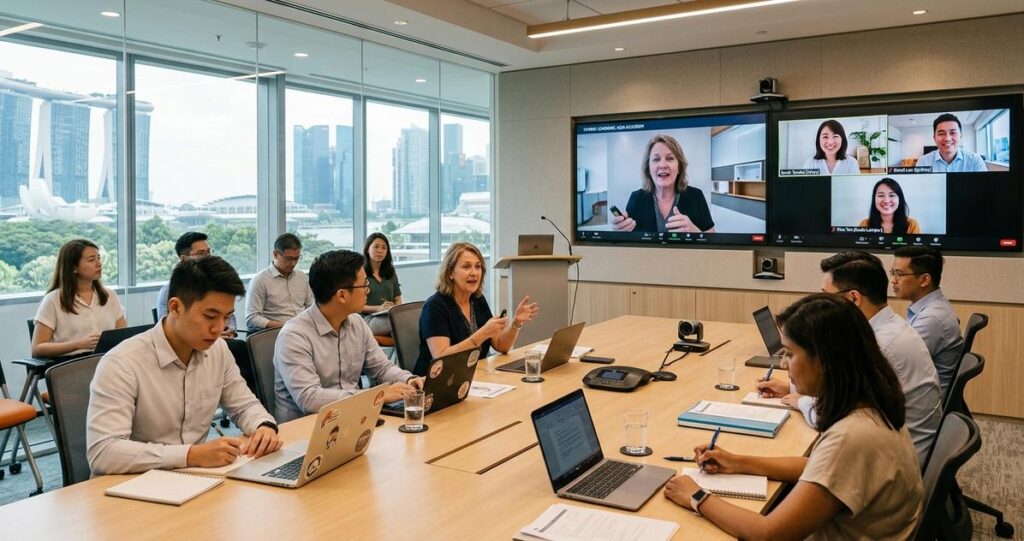
Professional development is no longer confined to a classroom, a hotel ballroom, or a single conference day. In Singapore, where work patterns are shaped by digital transformation, regional business travel, and a highly connected workforce, hybrid learning has become a practical way to keep skills current without putting work and life completely on hold. For many professionals, the question is not whether learning should move online or stay in person. It is how organisations can combine both approaches in a way that is flexible, credible, and effective.
Hybrid learning refers to a model that combines live, in-person learning with online participation, so learners can attend physically, virtually, or through a mix of both. In professional development, this approach supports continuing education, leadership training, compliance courses, product briefings, and cross-border knowledge sharing. For Singapore readers, this matters because careers often require continuous upskilling, and time is one of the most limited resources. Hybrid learning can reduce barriers such as commuting, scheduling conflicts, and venue capacity, while still preserving the human interaction and accountability that make structured learning valuable.
The real future of professional development is not about replacing face-to-face learning. It is about designing learning experiences that are adaptable, inclusive, and measurable. Hybrid learning is becoming a strong option because it can serve employees who are based in offices, remote teams, regional branches, or project-based roles. When implemented well, it supports long-term capability building in a way that aligns with how modern organisations operate in Singapore and across Southeast Asia.
Why Hybrid Learning Is Reshaping Professional Development
Professional development has traditionally relied on fixed schedules and physical attendance. That model works well for some programmes, especially those requiring hands-on practice or direct discussion. However, it can be difficult for busy professionals, shift workers, caregivers, and regional teams to attend every session in person. Hybrid learning responds to that problem by widening access without removing structure.
From an organisational perspective, this model supports continuity. A company can deliver leadership development, onboarding, technical updates, or regulatory training to a mixed audience without forcing everyone into the same format. For Singapore-based organisations with staff in different locations, hybrid learning is especially useful because it allows local and regional participants to join the same session, even when travel is limited or unnecessary.
Hybrid learning also reflects how adults learn most effectively. Adult learners tend to prefer content that is relevant, practical, and immediately applicable. A hybrid format can combine live interaction, self-paced preparation, recorded materials, and interactive Q and A sessions. This structure supports different learning styles while still keeping the course anchored to real workplace needs.
Flexibility without losing structure
One of the strongest advantages of hybrid learning is flexibility. Learners can join from the office, home, or another approved location, which reduces disruptions caused by travel and scheduling. At the same time, a hybrid programme can still follow a defined curriculum, assessment plan, and facilitator-led discussion. This balance is important because professional development is most effective when it has both convenience and accountability.
For example, a sales team in Singapore may need to attend a quarterly product update. Staff in headquarters can join in person, while colleagues in other districts or regional offices participate online. Everyone receives the same core message, and the organiser can still track attendance, questions, and completion. This kind of design creates consistency without sacrificing accessibility.
Better support for diverse learner needs
Hybrid learning also helps organisations include a wider range of participants. Some learners prefer the immediacy of speaking with a trainer face to face. Others may feel more comfortable asking questions in a digital chat or reviewing recorded content after the session. A hybrid environment can accommodate both preferences.
This matters in Singapore, where workplaces are increasingly diverse in age, role, and digital comfort level. A younger employee may be comfortable navigating an online learning platform, while a senior manager may value direct discussion and live facilitation. A strong hybrid design does not force both groups into the same pattern. Instead, it gives them multiple access points to the same learning goals.
What Effective Hybrid Learning Looks Like in Practice
Not every programme labelled as hybrid is truly effective. Simply streaming a live event to a camera is not enough. A successful hybrid learning experience is intentionally designed so that both physical and virtual participants can engage meaningfully. The learning outcomes, session flow, technology, and facilitation style must all be planned together.
In professional settings, this means the organiser should think beyond logistics. Questions such as who is attending, what they need to learn, how they will interact, and how progress will be measured are just as important as the venue or platform. The goal is not to copy an in-person session onto a screen. The goal is to create one integrated learning experience that works across formats.
Designing for interaction, not just transmission
One common weakness in poorly planned hybrid programmes is passive participation. Participants who join online may feel disconnected if the session is built only for the room. To avoid this, facilitators should design interaction from the start. Polls, moderated Q and A, shared documents, breakout discussions, and post-session reflections can help virtual participants remain engaged.
In-person attendees also benefit when interaction is intentionally structured. Hybrid learning works best when both audiences can contribute equally, rather than when one group becomes an audience and the other becomes a side channel. This requires clear moderation, visible presentation materials, reliable audio, and a session design that treats both formats as equally important.
The role of technology and production quality
Technology is not the whole solution, but it is a critical part of the experience. Clear audio, stable connectivity, properly framed cameras, and readable visuals affect whether learners can follow the session comfortably. Poor sound or awkward camera placement can quickly reduce concentration, especially in professional training where the content may already be complex.
For Singapore organisations, professional hybrid production can be particularly valuable for conferences, workshops, internal town halls, and certification programmes. High-quality streaming, audience capture, and technical moderation help reduce disruption and improve the participant experience. When the production is handled well, the learning content becomes easier to absorb and the organisation presents itself as credible and well prepared.
Why Hybrid Learning Fits Singapore’s Professional Environment
Singapore’s workforce is shaped by high expectations around relevance, efficiency, and adaptability. Professionals often need to balance demanding schedules, family responsibilities, and continuing education. Hybrid learning fits this environment because it offers a practical way to keep learning accessible without compromising quality.
It is also well aligned with a business culture that values operational excellence. In many sectors, especially finance, healthcare, education, technology, logistics, and professional services, teams must stay updated on processes, compliance requirements, and industry developments. Hybrid learning allows organisations to deliver these updates in a more scalable way while still maintaining a human connection.
Another important factor is the regional nature of Singapore business. Many companies work with teams, partners, and clients across Asia. Hybrid learning supports cross-border participation, which makes it easier to bring together experts and learners from different locations without the cost and time of constant travel. This can be especially useful for leadership development, expert panels, and knowledge-sharing sessions that benefit from wider regional perspectives.
Supporting workplace learning across generations
Singapore’s workforce includes professionals at very different life stages. Some are building their careers, others are stepping into management, and some are preparing for later career transitions. Hybrid learning is useful because it supports this range of needs without requiring a single rigid format.
Younger professionals may appreciate digital-first access, shorter modular learning, and on-demand review materials. More experienced professionals may value structured discussion, facilitator expertise, and the chance to network with peers in the room. A carefully planned hybrid model can serve both groups at once, which helps organisations build shared learning cultures across generations.
Building Trust and Learning Value in a Hybrid Model
Professional development has to be credible. Learners want to know that the content is accurate, the speakers are qualified, and the learning design is meaningful. Hybrid learning can strengthen trust when it is delivered by credible trainers, supported by clear learning objectives, and backed by good planning.
Trust is especially important when sessions deal with compliance, health and safety, digital transformation, or leadership decisions that affect staff and clients. In these cases, organisations should rely on established practices, accurate content, and clear communication. If the topic involves health, safety, or regulated matters, the organisation should also make it clear that the session is for general education and does not replace individual professional advice where that is required.
Measurement and follow-up matter
One reason hybrid learning is gaining traction is that it can be measured more easily than many informal learning approaches. Organisers can track attendance, session participation, viewing completion, assessment performance, and post-event feedback. These indicators do not tell the whole story, but they help organisations evaluate whether the programme is worth repeating or improving.
Effective follow-up also matters. A single live session is useful, but learning is stronger when it is reinforced after the event. That may include recorded highlights, reading materials, action plans, manager check-ins, or follow-up workshops. In Singapore workplaces, where productivity and efficiency are highly valued, this kind of structured reinforcement helps make professional development more than just a one-off event.
Accessibility and inclusion as core design principles
Hybrid learning also supports inclusion when accessibility is considered from the beginning. Captions, readable slides, good pacing, microphone discipline, and clear instructions all improve the experience for more participants. For workers who may have mobility limitations, caregiving responsibilities, or frequent travel demands, hybrid formats can reduce barriers to participation.
Inclusivity is not simply a technical feature. It is a learning strategy. When organisations design for more than one attendance mode, they are more likely to reach a broader audience and create a more resilient learning culture. That is especially relevant in Singapore, where workplaces increasingly recognise the value of diverse teams and adaptable systems.
The Next Phase of Professional Development
The future of professional development will likely be shaped by a mix of hybrid delivery, digital tools, and more personalised learning pathways. Artificial intelligence, analytics, and learning platforms may help organisations tailor content more precisely, but the fundamentals will remain the same. Learners still need relevance, interaction, clarity, and practical application. Technology should support those goals, not distract from them.
For organisations planning training in Singapore, the most effective approach is to start with the learning outcome and then choose the format. Some topics need hands-on practice and strong in-room facilitation. Others work well with a hybrid structure that lets participants join from multiple locations. A thoughtful blend of both can improve reach, reduce friction, and make learning more sustainable over time.
Spring Forest Studio, as a professional B2B event streaming and hybrid production services provider, sits in an important part of this ecosystem. High-quality production helps organisations deliver learning that feels coherent, professional, and accessible across both physical and virtual spaces. When the technical side is handled well, facilitators can focus on teaching, learners can focus on understanding, and organisations can focus on results.
For Singapore professionals, the practical takeaway is clear. Hybrid learning is not a temporary workaround. It is becoming a serious part of how organisations build capability, share knowledge, and support career growth. The teams that benefit most will be the ones that treat hybrid learning as a deliberate strategy, not a last-minute convenience. If your organisation is planning its next training session, leadership programme, or industry event, the strongest results will come from combining thoughtful content, strong facilitation, and reliable hybrid production from the outset.
Professional development will always depend on human expertise. Hybrid learning simply gives that expertise more ways to reach the right people, at the right time, in the right format.

Jeremy Lee is a seasoned digital marketing director and strategist with over two decades of experience in the industry. As the founder of Sotavento Medios, I manage a diverse portfolio of over 50 businesses, helping brands grow through advanced search strategies and digital innovation. My work focuses on bridging the gap between traditional search engine optimisation and the evolving world of AI-driven answer engines.
get in touch