
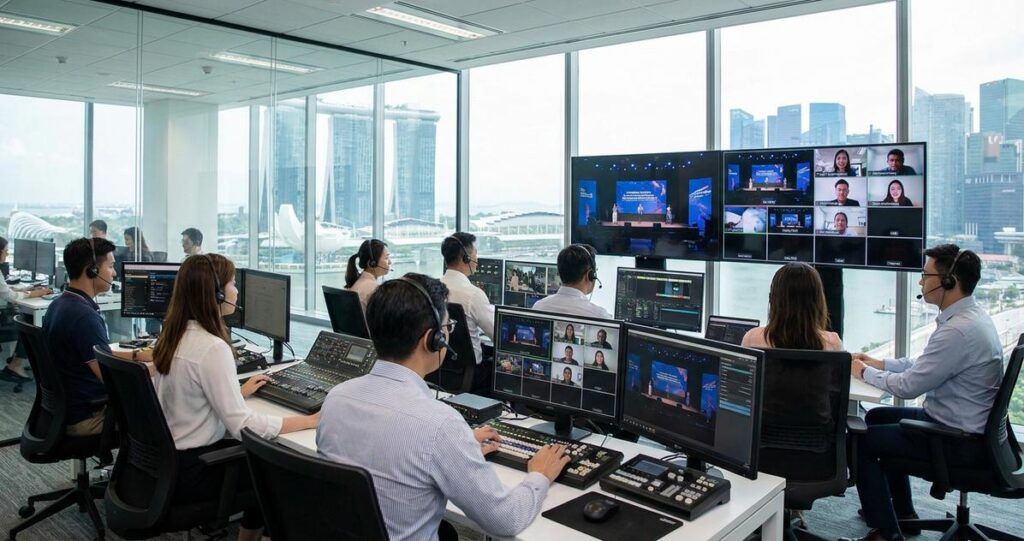
For companies building a regional presence in Asia, the question is no longer whether hybrid work and hybrid events matter. The real question is where a regional hub can best support them. Singapore stands out because it combines world-class connectivity, strong governance, a highly developed digital environment, and a business culture that supports both physical and virtual operations. For organisations that need to coordinate teams, clients, and partners across Southeast Asia, Singapore offers a practical base for hybrid regional hubs that must perform consistently, professionally, and at scale.
Singapore is also a place where operational reliability matters to decision-makers. If your team is producing executive meetings, investor briefings, product launches, training sessions, or cross-border town halls, the ability to move seamlessly between in-person and online delivery is no longer optional. A hybrid regional hub must support communication, collaboration, and continuity. Singapore’s infrastructure, regulatory clarity, and concentration of professional services make it especially well suited to that role.
Why hybrid regional hubs matter more than ever
A hybrid regional hub is a central operating base that supports both on-site and remote participation across several markets. In practical terms, it may host local leadership, regional sales teams, customer engagement activities, broadcast productions, and internal communication programmes, while also connecting participants in Malaysia, Indonesia, Thailand, Vietnam, the Philippines, and beyond. The model is attractive because it reduces the need for every stakeholder to travel while still preserving the value of face-to-face coordination.
For Singaporean businesses and multinational firms based here, hybrid operations are not just a convenience. They help improve resilience, widen access to decision-makers, and support faster response during market changes. They also allow organisations to scale events and communications without being limited by venue size or travel schedules. When designed well, a hybrid hub can strengthen business continuity, lower friction in cross-border collaboration, and improve the overall consistency of the organisation’s message.
What makes a hybrid hub effective
An effective hybrid hub needs more than a meeting room with a camera. It requires dependable connectivity, sound control, lighting, professional technical support, and workflows that allow remote participants to be seen and heard clearly. It also needs governance, from data handling and event permissions to contingency planning and vendor coordination. In Singapore, these elements are easier to integrate because the market is mature, service standards are high, and many organisations already operate in regulated, multinational environments.
The most effective hubs are designed with both audience experience and operational continuity in mind. This means the in-room audience does not feel neglected while remote participants remain fully engaged. It also means presenters can focus on their message instead of managing technical surprises. That balance is one reason Singapore has become a natural choice for organisations that treat hybrid delivery as a strategic capability rather than a temporary workaround.
Singapore’s connectivity gives hybrid hubs a strategic advantage
Connectivity is one of Singapore’s strongest advantages. Changi Airport links the city-state to major business centres across Asia and beyond, which makes it easier for executives, speakers, and event teams to travel in and out efficiently. For regional hubs that still need periodic in-person leadership meetings, content production, or client engagement, this level of accessibility matters. It reduces scheduling friction and makes Singapore a practical meeting point for distributed teams.
Digital connectivity is equally important. Hybrid operations depend on stable internet access, secure networks, and the ability to support video, streaming, file exchange, and collaboration tools at the same time. Singapore has invested heavily in digital infrastructure over many years, and its broader digital environment is consistently aligned with business use cases that require reliability. For regional hubs, this means fewer avoidable disruptions and more confidence when hosting high-stakes presentations or live-streamed sessions.
Why location matters for Southeast Asia coordination
Singapore’s geographic position also matters. It sits close to many of the region’s major commercial markets, which makes it useful as a coordination point for Southeast Asian operations. A regional team can centralise production, management, and strategy in Singapore while maintaining market-specific activities across borders. This is especially useful for hybrid events and executive communications, where a stable production base can serve multiple time zones and stakeholder groups.
From a planning perspective, Singapore’s location helps organisations align internal meetings, client-facing programmes, and regional town halls with fewer logistical compromises. Teams can gather in one location while still reaching audiences across neighbouring countries. That makes Singapore a strong operational anchor for businesses that want regional reach without sacrificing consistency.
A trusted regulatory and business environment supports long-term operations
Hybrid hubs do best in environments where organisations can plan confidently. Singapore is known for its clear regulatory framework, established corporate governance standards, and business-friendly operating environment. That matters because hybrid operations often involve multiple vendors, digital platforms, venue services, content rights, and data handling obligations. The more predictable the environment, the easier it is to manage risk and maintain quality.
For companies hosting executive meetings, conferences, or broadcast-style communications, trust is essential. A regional hub may handle sensitive product information, leadership messaging, or customer data. In Singapore, organisations can work within a system that places strong emphasis on compliance, accountability, and professional standards. This is especially valuable for B2B companies, financial institutions, healthcare organisations, education providers, and public-sector partners that require careful operational control.
Data protection and operational trust
Hybrid work and hybrid events often involve video platforms, registration systems, recording tools, and cloud-based collaboration. In Singapore, organisations must pay careful attention to the Personal Data Protection Act, which governs the collection, use, and disclosure of personal data by private-sector organisations. That creates an environment where responsible data handling is part of standard business practice. For regional hubs, this supports better governance around audience registration, speaker information, recordings, and post-event follow-up.
Trust also extends to service delivery. Singapore’s professional services sector is known for structured execution, which is important when technical teams need to coordinate with corporate communications, marketing, facilities, and external stakeholders. A hybrid regional hub benefits when everyone involved understands process, documentation, and accountability. That reduces avoidable errors and supports repeatable quality.
The talent ecosystem supports high-standard hybrid execution
Hybrid hubs rely on people as much as they rely on technology. You need presenters who can communicate clearly, producers who can manage live formats, technical specialists who can solve problems quickly, and support teams that understand both business objectives and audience needs. Singapore’s workforce is well positioned for this because of its strong multilingual environment, high levels of professional training, and deep exposure to multinational operations.
For organisations in Singapore, this creates a major advantage. Internal communications teams, marketing departments, event agencies, AV specialists, and digital production partners can often work together with a shared understanding of professional expectations. That makes it easier to produce polished hybrid meetings, executive livestreams, and regional broadcasts that reflect well on the organisation.
Practical examples in Singapore business settings
Consider a regional sales kickoff hosted in Singapore. Leadership can present from a professional studio or conference venue, while teams across Southeast Asia join remotely. Interpretation, moderated Q and A, branded visuals, and recorded sessions can all be managed from one central base. Or consider a multinational company launching a product across several Asian markets. Singapore can serve as the content production and broadcast centre, with local teams joining through digital platforms while the core message stays consistent.
Another example is internal training for a distributed workforce. Instead of repeating the same programme in multiple countries, a Singapore hub can host a live session with simultaneous participation from other offices. That reduces duplication, keeps messaging aligned, and allows for stronger interaction between trainers and participants. In each case, the city’s talent pool and service ecosystem support delivery that is professional, stable, and scalable.
Hybrid regional hubs in Singapore can align with business resilience and work-life realities
Hybrid models are also attractive because they support flexibility without abandoning structure. In Singapore, where commuting patterns, family commitments, and long working hours are part of many people’s lived experience, hybrid operations can help organisations design more efficient ways of working. This does not mean replacing in-person collaboration entirely. It means using the right format for the right objective.
For example, strategic planning sessions may benefit from in-person discussion, while routine reporting, stakeholder updates, or knowledge-sharing programmes can often be delivered effectively through hybrid formats. A regional hub in Singapore allows organisations to make that distinction with greater precision. It also enables teams to reduce unnecessary travel while preserving access to face-to-face interaction when it matters most.
Why hybrid works well in the Singapore context
Singapore businesses are often highly time-sensitive and detail-oriented. Hybrid systems fit that culture well because they can improve coordination without sacrificing professionalism. They also support continuity during disruptions, whether those are travel delays, weather issues, or unexpected scheduling changes. When built correctly, a hybrid hub is not just a communications tool. It is part of an organisation’s resilience strategy.
For event planners and corporate communications teams, this means thinking beyond single-use events. A well-designed Singapore hub can support investor relations updates, CEO broadcasts, product education, partner enablement, and recruitment presentations. The flexibility is valuable, but the real strength lies in consistency, because a trusted base can serve multiple business needs over time.
What organisations should look for when building a hybrid hub in Singapore
Choosing Singapore is only the beginning. To get the full benefit of a hybrid regional hub, organisations should plan carefully around format, audience, and technical requirements. First, define the objective of each event or communication. A leadership town hall has different needs from a product launch or training webinar. Second, decide what level of interactivity is required. Live questions, breakout sessions, and multilingual support all affect production design.
Third, invest in the right environment. Good acoustics, lighting, camera positioning, and presenter support can significantly improve audience experience. Fourth, build redundancy into the workflow. This includes backup internet, alternative microphones, contingency plans for speakers, and clear run-of-show documentation. Finally, work with partners who understand both the Singapore context and regional business expectations. In a hybrid format, professionalism is visible in every detail.
Key planning priorities
- Choose a venue or studio that is technically equipped for live and recorded delivery.
- Align content, audience management, and technical rehearsal schedules early.
- Protect sensitive information with appropriate access control and data handling processes.
- Prepare speakers for hybrid presentation, including pacing, eye line, and audience engagement.
- Test all systems before going live, including audio, video, slides, and streaming paths.
These priorities are practical, not optional. In hybrid formats, small issues can affect audience confidence quickly. Singapore’s ecosystem helps reduce those risks, but disciplined planning remains essential.
For organisations considering a hybrid regional hub, the answer is increasingly clear. Singapore combines infrastructure, governance, talent, and regional accessibility in a way that supports serious business operations. It is not simply a convenient location. It is a dependable platform for organisations that need to communicate across borders with clarity and control. If your goal is to build a hub that can serve leadership, teams, clients, and partners across Southeast Asia, Singapore offers the strongest overall foundation for doing that well.
As a practical next step, organisations should assess their regional communication needs, review their event and production workflows, and identify where a Singapore base could improve reliability and reach. The best hybrid hubs are not built on technology alone. They are built on a clear strategy, disciplined execution, and an environment that supports both. Singapore provides that environment in a way few places in the region can match.
General information only: This article is intended to provide business and operational guidance for organisations planning hybrid regional hubs. It is not legal, financial, or technical advice. Companies should seek appropriate professional advice for their specific circumstances, especially for compliance, data protection, and cross-border operational planning.

Jeremy Lee is a seasoned digital marketing director and strategist with over two decades of experience in the industry. As the founder of Sotavento Medios, I manage a diverse portfolio of over 50 businesses, helping brands grow through advanced search strategies and digital innovation. My work focuses on bridging the gap between traditional search engine optimisation and the evolving world of AI-driven answer engines.
get in touch