
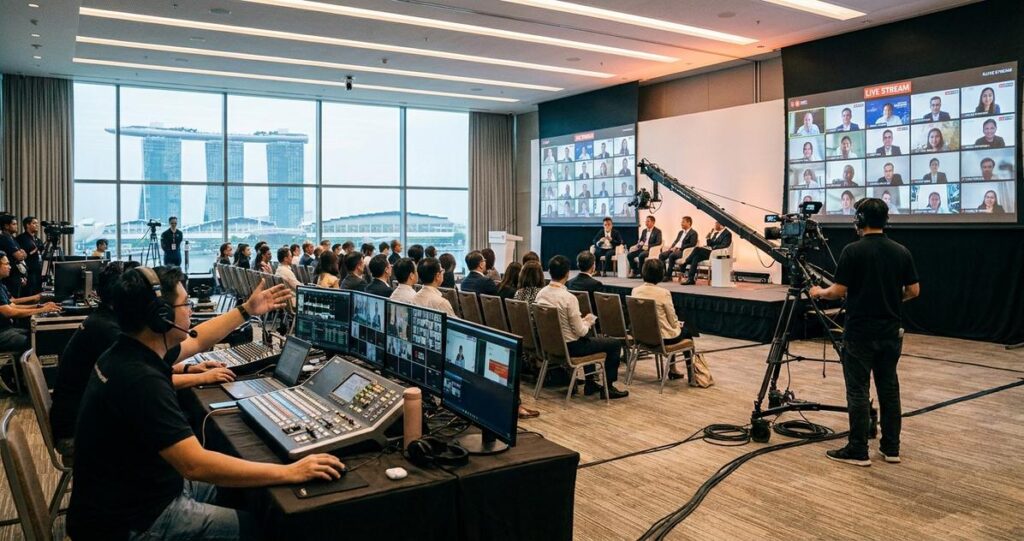
Hybrid events have become a practical choice for many organisations in Singapore, especially when they need to reach people who can attend in person and those who cannot. The producer’s role is what keeps both audiences connected, informed, and engaged without one group feeling like an afterthought. In a city where business schedules are tight, teams are often regional, and attendees may join from offices, homes, or overseas markets, the success of a hybrid event depends on much more than simply putting a camera in the room.
A hybrid event is not just a livestream of a physical event. It is a designed experience for two different audience environments at the same time. The in-person audience responds to the room, the stage, the atmosphere, and the networking. The online audience responds to screen framing, audio clarity, pacing, chat interaction, and the ease of joining. A producer has to serve both, while protecting the overall flow of the event. That requires technical planning, editorial judgment, and strong coordination with speakers, clients, technical crews, and venue teams.
For Singapore-based organisations, this matters across corporate town halls, product launches, government briefings, training sessions, and association conferences. Hybrid formats can improve access and flexibility, but they also increase complexity. If audio fails, if slide transitions lag, if speakers address only the room, or if online participants cannot follow along, the event loses credibility quickly. A strong producer helps prevent that by thinking ahead about audience needs, event objectives, and operational details from the first planning meeting to the final cue.
Why managing two audiences is different from managing one
In a physical-only event, the production team mostly focuses on what happens in the room. In a hybrid event, the producer must design for two separate attention patterns. The audience sitting in the venue can see the stage, read body language, and hear room energy directly. The virtual audience depends on cameras, microphones, screen sharing, and a stable platform to experience the event in a way that still feels intentional and complete.
This creates a core production challenge. If the event is too tailored to the room, online viewers may feel disconnected. If the event is too focused on the livestream, the in-person audience may feel that the physical experience has been reduced to a backdrop for a webcast. The producer’s job is to balance both without creating a split identity.
Different needs, different cues
The in-person audience needs clear signage, smooth registration, visible stage action, comfortable timing, and reliable venue support. The virtual audience needs audio that is consistently intelligible, presentation slides that are legible on smaller screens, and transitions that make sense even when they cannot see the full room. These are not identical needs, and they should not be treated as if they are.
A producer must also account for attention span and context. Someone joining from a laptop at lunchtime may watch while multitasking. Someone in the ballroom expects a more immersive setting. This does not mean lowering standards for either group. It means presenting information in a way that respects each audience’s viewing conditions.
The producer as the bridge
The producer acts as the bridge between content, technology, and audience experience. This includes shaping the run sheet, coordinating speaker flow, advising on stage movement, monitoring time, and ensuring the technical team knows exactly when to switch cameras, bring up slides, or open audience Q and A. In practice, this means the producer is not only managing logistics. The producer is protecting the event’s meaning and clarity.
For Singapore events, where corporate audiences often expect efficiency and professionalism, this role is especially important. A hybrid event that feels disorganised can affect how the organisation is perceived. On the other hand, a well-produced event can make remote attendees feel included while preserving the value of the live venue experience.
Planning the experience before event day
Hybrid success begins long before the event opens. The producer has to define what each audience should gain from attending, then build the format around that goal. This stage includes understanding the audience mix, the content type, the speaker style, the platform requirements, and the venue limitations. Without this groundwork, even strong technical execution may not deliver a coherent experience.
Singapore venues vary widely, from hotel ballrooms and convention centres to office auditoriums and studio-style spaces. Each setting affects camera placement, acoustics, internet reliability, lighting, and audience sightlines. A producer should work with the technical director early to identify constraints and make decisions that suit both the physical environment and the online delivery channel.
Designing for audience parity
Audience parity means giving both groups a meaningful version of the event, even if their experiences are not identical. The producer should ask: what will the in-room audience see, hear, and do, and what will the online audience see, hear, and do? If the live audience gets networked breaks, the online audience may need moderated chat interaction, structured polls, or separate virtual break content to stay engaged.
Parity does not mean copying every element. Some parts of a physical event, such as informal networking, cannot be replicated perfectly online. Instead, the producer can create alternatives. For example, a moderated Q and A session, breakout rooms, or a virtual host can help maintain participation for remote attendees.
Building the run sheet with both audiences in mind
A hybrid run sheet should include more than speaker names and time stamps. It should specify camera cues, slide handovers, music playback, audience interaction moments, backup plans, and responsibilities for each team member. The producer should also build in buffer time. Hybrid events often take longer than expected because audio checks, speaker transitions, and platform interactions require careful coordination.
In Singapore, where schedules are often tightly planned and venue turnover times may be short, buffer time is not a luxury. It is part of risk control. A producer who plans for realistic transitions is better able to protect the attendee experience if a speaker arrives late, a file does not load properly, or a live demo needs a last-minute adjustment.
Technical decisions that protect both audience experiences
Hybrid events live or die by technical reliability. A producer does not need to be the engineer, but the producer must understand enough about the technology to make informed decisions and to ask the right questions. This includes cameras, microphones, encoders, switching, lighting, internet redundancy, and platform selection. The goal is not to impress with technology. The goal is to make technology invisible to the audience.
Audio comes first
For virtual audiences, audio quality is usually more important than video quality. Poor audio makes speech hard to follow, reduces concentration, and quickly frustrates viewers. A producer should prioritise clear speech pickup through lapel microphones, handheld microphones, or appropriately positioned boundary microphones, depending on the event format.
Room acoustics matter too. Large venues with hard surfaces can create echo and reverberation, which affect both the room audience and the livestream. Sound checks should be done with actual speakers, not just a signal test. If the event includes panel discussions, the producer should confirm that each participant can be heard clearly even when they speak at different volumes or turn their heads away from the microphone.
Camera framing and screen design
For online viewers, camera framing should support comprehension, not just coverage. Wide shots help establish the room, but close shots help capture expression and clarity during speaking segments. The producer should work with the camera team to ensure that the layout matches the rhythm of the event. For example, a keynote may need a stable podium shot, while a panel discussion may need alternating camera angles that keep the conversation visually active.
Slides also require adaptation. Text that looks fine on a ballroom screen may be too small for a phone or laptop. The producer should review presentation design in advance and encourage speakers to use simple visuals, clean typography, and minimal text density. This is not just a design preference. It is an accessibility and usability issue.
Platform stability and backup planning
Platform choice should be based on the audience, the interaction model, and the organisation’s security and privacy needs. Some events may require registration control, moderated questions, or enterprise-grade meeting permissions. The producer should confirm platform functionality early, including screen sharing, polling, chat moderation, captions if required, and recording settings.
Equally important is the backup plan. In hybrid production, backup means more than having a spare cable. It may include secondary internet access, backup microphones, stored presentation files, redundant recording, and a clear escalation path if the main platform fails. These precautions are standard professional practice because they reduce the chance that a single point of failure affects both audiences.
Keeping speakers aligned with two audience realities
Speakers often need guidance to perform well in a hybrid setting. Many are used to speaking to a room, where they can draw energy from direct audience reaction. In a hybrid event, they must also remember the remote viewers who cannot see side conversations, room jokes, or off-mic remarks. The producer helps shape speaker delivery so that both audiences can follow the message clearly.
Briefing for hybrid delivery
A speaker briefing should cover pacing, microphone use, eye-line, slide timing, and how to respond to questions from both audiences. Speakers should be advised to say names, describe visuals, and avoid references that only make sense to people physically present. For example, saying “as you can see here” without explaining the image is unhelpful for viewers on a small screen.
The producer should also coach speakers to pause slightly between points to allow interpretation, captioning, or translation if the event requires it. In Singapore, many events involve multilingual or regional audiences. Clear articulation and structured delivery help reduce misunderstandings and support inclusivity.
Moderating live interaction
Questions from the room and online audience should be managed fairly. If one group receives all the interaction time, the other group may feel overlooked. The producer, or a designated moderator, should establish a balanced system for collecting, selecting, and sequencing questions. That might include microphones in the room, moderated chat questions online, or a blended Q and A queue.
For corporate and public sector events in Singapore, this balance is particularly important because audiences often expect professionalism and transparency. A well-run hybrid Q and A shows that the organiser respects both forms of participation.
Measuring whether the event worked for both audiences
A producer’s responsibility does not end when the stream ends. Post-event review helps determine whether both audiences were served effectively. This review should cover attendance patterns, technical performance, speaker timing, audience engagement, and any feedback from stakeholders. The producer can then identify what helped and what hindered the experience.
Common indicators of success include smooth transitions, low technical disruption, strong audience retention, clear audio, and positive feedback on usability. These indicators are not the same as marketing claims or inflated engagement numbers. They are practical signs that the event functioned as intended.
What to review after the event
The production debrief should ask several questions. Did the physical audience stay engaged throughout the session? Did remote viewers have enough visual and audio clarity? Were questions handled fairly? Did the schedule hold? Were there points where the format favoured one audience over the other?
This review is valuable in Singapore’s event environment, where organisers often plan recurring forums, training cycles, or annual conferences. Lessons from one event should inform the next. That may mean changing camera positions, simplifying slide decks, adjusting the run sheet, or improving moderator scripts.
Using feedback without overreacting
Not every comment requires a format overhaul. Some feedback reflects personal preference rather than a production flaw. The producer should look for patterns, not isolated opinions. If several attendees say the audio was unclear or the online pace felt too fast, that is a meaningful signal. If one participant disliked the opening music, that may not indicate a wider problem.
Evidence-based improvement means combining direct feedback, technical logs, and team observations. That approach supports trust, accuracy, and professionalism, especially for organisations that use hybrid events to communicate with clients, staff, members, or the public.
Managing two audiences is ultimately about respect. The producer respects the people in the room by protecting the energy and quality of the live experience. The producer respects the online audience by giving them a clear, usable, and engaging event that does not feel secondary. When those two goals are balanced properly, hybrid events become more than a compromise. They become a strategic format that extends reach without sacrificing quality.
For organisations in Singapore, the practical takeaway is straightforward. Treat hybrid production as its own discipline, not as a temporary add-on to a physical event. Start planning early, brief speakers carefully, prioritise audio and platform stability, and design every major moment with both audiences in mind. If the event includes health, legal, financial, or safety content, use qualified professionals to review the material and ensure it is appropriate for the intended audience. With the right producer guiding the process, hybrid events can deliver clarity, credibility, and a better experience for everyone involved.
Jeremy Lee is a seasoned digital marketing director and strategist with over two decades of experience in the industry. As the founder of Sotavento Medios, I manage a diverse portfolio of over 50 businesses, helping brands grow through advanced search strategies and digital innovation. My work focuses on bridging the gap between traditional search engine optimisation and the evolving world of AI-driven answer engines.
get in touch