
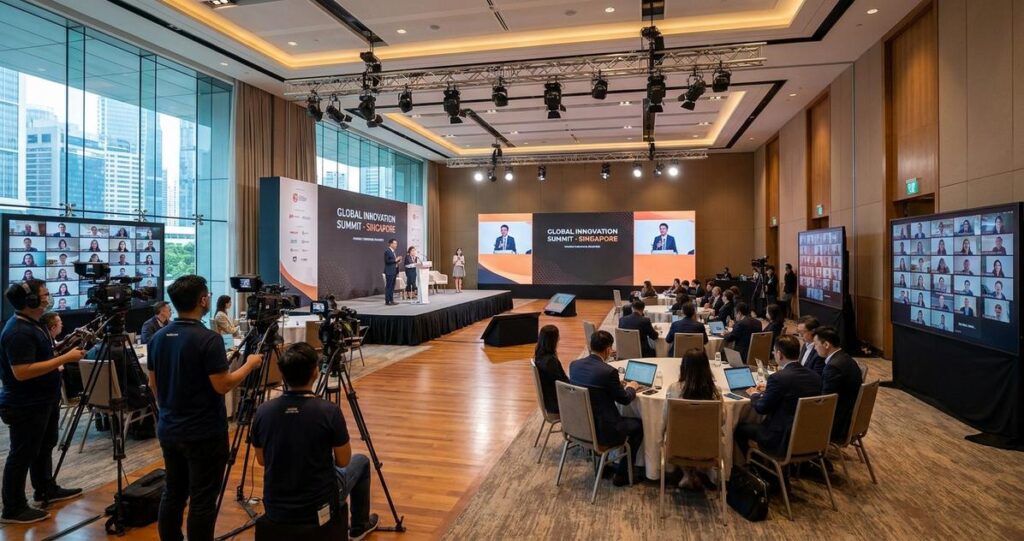
Hybrid summits have become a familiar format for organisations in Singapore that need to bring people together across offices, countries, and time zones. Whether the audience includes senior leaders at Marina Bay, partners in Jurong, or delegates joining from overseas, the central challenge is the same, how do you make the in-room experience and the remote experience feel equally coherent, credible, and engaging? That challenge is not just about technology. It is about synchronisation, the careful alignment of timing, sound, visuals, speaker delivery, audience participation, and production control so the summit feels like one connected event rather than two separate ones.
For Singapore-based companies, associations, universities, and public sector teams, hybrid summits often serve a practical need. They allow participation from regional offices, support travel efficiency, and widen access for stakeholders who cannot attend in person. But hybrid format success depends on more than simply adding a livestream camera to a ballroom. If the virtual audience hears audio late, sees slides that do not match the speaker’s words, or misses the energy in the room, trust in the event drops quickly. Synchronisation is the discipline that prevents those gaps and preserves the value of the summit for everyone involved.
In a city where expectations for punctuality, professionalism, and technical reliability are high, a well-synchronised hybrid summit reflects directly on the organiser’s competence. It also matters because Singapore audiences are diverse, multilingual, and often highly accustomed to polished corporate and institutional events. Getting synchronisation right is therefore both a technical and reputational priority.
Why synchronisation matters in hybrid summits
Synchronisation in a hybrid summit refers to the precise coordination of all live and digital components so that the in-room and remote experiences remain aligned. This includes speech audio, camera switching, slide playback, speaker timing, captions, audience Q and A, interpretation if used, and transitions between programme segments. In practice, synchronisation is what allows a remote participant in another country to understand the event at the same pace and with the same context as someone sitting in the ballroom.
When synchronisation is strong, the summit feels seamless. The keynote speaker’s slide changes match the verbal content, the applause is captured naturally for virtual attendees, and panel discussions feel coherent despite being mediated through multiple devices and feeds. When synchronisation is weak, even a well-designed agenda can feel disjointed. The audience notices delays, accidental overlaps, or moments where the remote feed no longer reflects what is happening on stage. These issues are not minor. They can reduce comprehension, distract from the message, and make participants feel excluded.
For organisers in Singapore, there is also a practical business case. Hybrid summits often involve stakeholders from regional headquarters, government-linked bodies, international clients, and specialist vendors. Clear synchronisation helps ensure key messages are delivered accurately across all audiences. It supports better participation, better retention of information, and a smoother record of proceedings for post-event use.
The difference between live, near-live, and delayed delivery
Not all hybrid programmes use the same delivery method. A live hybrid summit streams the event in real time, with minimal delay. A near-live setup may introduce a short buffer to stabilise transmission or allow moderation control. A delayed or asynchronous format allows remote participants to watch recorded segments later. Each model has different synchronisation requirements. In a true live summit, latency, which is the time delay between capture and playback, must be managed carefully because even a short delay can make interactive segments awkward. In near-live delivery, the buffer may improve reliability but needs to be transparent to moderators so that questions, polls, and transitions remain well timed.
The technical pillars of a well-synchronised summit
Synchronisation depends on a production workflow that treats every signal as part of one system. That means audio, video, graphics, internet connectivity, and show calling must be planned together from the outset. Hybrid summits usually fail when one part of the system is designed in isolation. For example, excellent lighting cannot compensate for unsynchronised sound, and strong broadband cannot rescue a poorly rehearsed programme flow.
Audio as the first priority
In most hybrid events, audio is more important than video for comprehension. Viewers can tolerate a lower-resolution image better than they can tolerate unclear sound. For that reason, microphones, mixers, echo control, and speaker placement deserve special attention. If panelists in the room are speaking across a long table, each voice needs proper pickup without excessive background noise. If audience microphones are used for Q and A, their placement and gain levels must allow remote viewers to hear questions clearly. The remote audience should never need to guess what was said in the room.
Audio synchronisation also includes lip sync, the alignment of sound with visible speech. Even a small mismatch can feel distracting. In a summit setting, that means the production team should test all audio paths, including presentation playback, wireless microphones, video inserts, and interpretation feeds if they are part of the programme.
Camera strategy and visual continuity
Hybrid summit cameras are not just for recording. They guide the remote audience’s attention, help establish the rhythm of the session, and support the meaning of each moment. A single static camera can work for simpler programmes, but a multi-camera setup is usually more effective for plenaries, panels, and executive sessions. The key is not simply having more cameras, but switching between them in a way that matches the programme flow.
For example, a camera focused on the speaker should cut cleanly to a wide shot when applause begins, then return to the speaker after the transition. During panels, switches should follow the person speaking rather than cutting randomly. This type of visual synchronisation helps remote attendees understand who is talking and reduces confusion. It also supports a more polished, broadcast-quality experience without making the event feel overproduced.
Slides, graphics, and on-screen timing
Slide decks in hybrid summits need stricter control than in a purely in-room presentation. If a speaker advances slides too quickly or refers to a chart before it is visible on screen, the virtual audience falls behind. Production teams should therefore confirm slide timing in rehearsal, ideally with the speaker and the operator in the same workflow. Animated graphics, lower-thirds, sponsor logos, and agenda titles must also appear at the right time and disappear cleanly so they do not block essential content.
Where multiple languages are involved, synchronisation becomes even more important. Singapore summits frequently include regional participants, and some events use interpretation or translated captions. In these cases, the production team must ensure the translated feed remains accurately aligned with the live programme. Captions should match the spoken content as closely as possible, and any delay should be managed so it does not reduce readability.
Human synchronisation, not just machine synchronisation
The best hybrid summits are not controlled by technology alone. They depend on human coordination between the event producer, technical director, stage manager, speaker liaison, captioning team, and moderators. Even if the equipment works perfectly, the event can still feel out of sync if speakers arrive late, run over time, or are unclear about when to pause for transitions. Human synchronisation is the invisible discipline that keeps the programme moving.
Speaker briefing and rehearsal
A thorough speaker briefing is one of the most effective ways to prevent synchronisation problems. Presenters should know how long they have, when the camera will be on them, how to pause for slide changes, and how remote questions will be handled. Rehearsal is especially important for keynote sessions, panel discussions, and executive openings where the first few minutes set the tone for the entire summit. In Singapore, where many organisations value precision and professionalism, a short but focused rehearsal can make a major difference to the perceived quality of the event.
Rehearsal should include timing checks, audio checks, visual checks, and contingency practice. For instance, what happens if a speaker’s laptop cannot connect, or if a remote panellist loses audio? The team should not improvise these answers on the day. They should be built into the run-of-show so every stakeholder knows the next step.
Moderator discipline and audience flow
Moderators play a central role in synchronisation because they control pacing, transitions, and question flow. A good moderator keeps the room and the livestream aligned by signalling when to move from one segment to another and by preventing long pauses that can feel awkward online. If audience questions are being collected from both the room and the chat, the moderator should ensure fair balance so neither group feels neglected.
This matters in Singapore because hybrid summits often include participants who expect efficient, respectful time management. A moderator who keeps the event moving while giving speakers enough room to complete their points helps preserve engagement and maintain trust.
Planning for Singapore conditions and audience expectations
Singapore offers advantages for hybrid event production, including strong venue infrastructure and a highly connected business environment. Still, event teams need to plan for local realities rather than assume the venue alone will solve synchronisation issues. Internet quality, venue acoustics, room layout, and audience composition all influence how smoothly a summit runs.
Venue selection and connectivity checks
Before confirming a venue, organisers should assess the site’s capacity for reliable network connectivity, backup options, and camera placement. A ballroom may look ideal for an executive summit, but if the audio echoes badly or the internet path is unstable, the remote experience may suffer. It is also wise to test signal paths early, including wired connections for production equipment where possible, rather than relying solely on wireless links. This is particularly useful for live streaming, where stability matters more than convenience.
In Singapore’s event environment, many venues are already experienced with corporate and conference production. Even so, each summit has unique requirements. The technical team should conduct a site visit, confirm power distribution, assess sightlines, and identify where cameras, speaker podiums, screens, and audience microphones will be placed. Synchronisation begins with layout planning, not on event day.
Accessibility and inclusive participation
Synchronisation also supports accessibility. Clear captions, legible graphics, consistent audio levels, and smooth transitions help participants who may be joining from a mobile device, a quiet office, or a noisy shared environment. For audiences that include older participants or people who are less comfortable with fast-moving digital interfaces, a well-paced production makes the event easier to follow. In Singapore, where hybrid summits often involve stakeholders from a wide age range and professional background, inclusive design is part of quality control.
If interpretation, live captions, or translated materials are used, the production plan should account for their timing and visibility from the outset. Accessibility features work best when they are integrated into the event structure, not added at the end.
Common synchronisation mistakes and how to avoid them
Some problems recur in hybrid summits because organisers underestimate how tightly everything must fit together. One common issue is starting the event before the remote audience has fully connected, which can make the opening feel rushed or fragmented. Another is letting speakers change their slides without coordinating with the operator, which creates mismatches between what is said and what appears on screen. A third is treating the livestream as a passive output rather than an active audience experience, which leads to weaker engagement and lower attention.
There is also a tendency to assume that a successful rehearsal guarantees a successful event. Rehearsals are essential, but live conditions can still differ because of room energy, speaker nerves, network load, or last-minute changes. The team should therefore have a clear show-calling process, backup devices, and a communication channel between floor staff and technical operators. If a keynote runs long, the moderator should know which agenda item can be shortened without undermining the summit’s purpose.
Another avoidable mistake is overcomplicating the format. Hybrid summits work best when the audience journey is simple and deliberate. Too many transitions, unnecessary graphics, or overused effects can create timing problems and distract from the message. The aim is not to impress with complexity, but to create harmony between all parts of the event.
For organisations seeking professional support, this is where experienced event streaming and hybrid production partners add value. A skilled production team understands not only how to capture the event, but how to keep the room, the remote feed, and the agenda moving in step. That is the real art of synchronisation.
When planning your next hybrid summit, start with the experience you want your audience to have, then work backwards into production design. Confirm the run-of-show early. Test every audio and video path. Brief speakers carefully. Build in contingency time. Most importantly, treat in-room and virtual participants as one audience with one shared event narrative. When synchronisation is done well, the summit feels effortless, even though the coordination behind it is highly detailed.
For Singapore organisations that rely on hybrid summits to connect teams, customers, and stakeholders across borders, this approach is more than a technical preference. It is a standard of professionalism. A summit that is synchronised with care communicates clarity, respect, and confidence, which are exactly the qualities audiences remember long after the closing remarks.
General information only: This article provides broad guidance on hybrid summit production and event synchronisation. For event-specific planning, technical design, accessibility requirements, or compliance considerations, engage qualified professionals and confirm venue and stakeholder requirements before execution.
Jeremy Lee is a seasoned digital marketing director and strategist with over two decades of experience in the industry. As the founder of Sotavento Medios, I manage a diverse portfolio of over 50 businesses, helping brands grow through advanced search strategies and digital innovation. My work focuses on bridging the gap between traditional search engine optimisation and the evolving world of AI-driven answer engines.
get in touch