
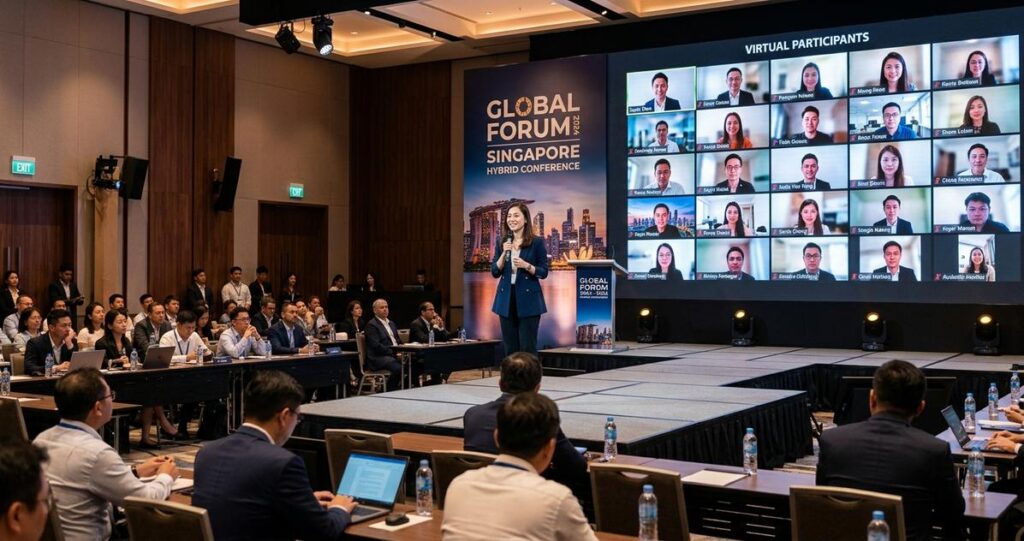
Hybrid events have become a practical choice for many organisations in Singapore, from public agencies and professional associations to multinational companies and trade bodies. They allow in-person attendees and online participants to join the same session without requiring everyone to be in the same room. That flexibility matters in a city where schedules are tight, travel time is real, and audiences expect convenience. Yet the format also creates a common challenge: the Q&A session can easily become uneven, confusing, or dominated by only one group if it is not managed well.
This is where a professional moderator becomes essential. A moderator does far more than read out questions. They guide the flow of discussion, balance participation between the room and the virtual audience, protect the speaker’s time, and help ensure that questions are handled clearly and respectfully. In a hybrid setting, those responsibilities become more complex because the moderator must work across two audiences, two attention spans, and often two sets of technical constraints. For Singapore-based events, where audiences are typically diverse in language preference, professional background, and digital familiarity, that role is even more important.
For organisations planning events such as medical forums, industry briefings, town halls, continuing education sessions, product launches, or corporate panels, the quality of the Q&A often shapes the audience’s overall impression. A strong moderator can make a discussion feel organised, responsive, and credible. A weak one can leave attendees feeling ignored or frustrated. Understanding why professional moderation matters is the first step to making hybrid events work properly.
What makes hybrid Q&A more challenging than in-person sessions
A hybrid Q&A session combines the dynamics of a live room with the unpredictability of a virtual platform. In a physical venue, a moderator can usually see who wants to speak, hear side reactions, and manage the atmosphere in real time. In a hybrid format, those cues are incomplete. Online attendees may submit questions through chat, Q&A software, polling tools, or email, while in-room attendees may raise their hands or pass notes to staff. Without structure, questions can pile up, be duplicated, or disappear entirely.
The practical challenge is not just technical. It is also editorial. The moderator must decide which questions are relevant, how to group similar themes, whether a question needs clarification, and how to keep the conversation fair when time is limited. That requires judgement, not just coordination. A moderator who understands the subject matter can identify the most useful questions, while also avoiding unnecessary repetition or overly narrow tangents that disrupt the session.
Two audiences, one conversation
In a hybrid event, the speaker is addressing a single topic, but the audience is split across two environments. In-person participants may be more inclined to speak up directly, while online attendees may hesitate unless they are invited in a structured way. If the moderator does not actively bridge this gap, the virtual audience can feel like spectators rather than participants. That weakens engagement and reduces the value of the online experience.
A professional moderator deliberately alternates between channels, acknowledging both groups and making the session feel unified. For example, they may invite one question from the room, then one from the virtual queue, then return to the room again. This simple structure helps maintain balance and signals that both audiences matter.
Time pressure and question overload
Hybrid events often attract more questions than the agenda can accommodate. This is especially true for topics that are technical, regulatory, or directly relevant to attendees’ work. In Singapore, where many corporate and professional audiences value efficiency, a session that drifts beyond its schedule can quickly lose credibility. The moderator needs the confidence to keep the conversation moving while still allowing meaningful discussion.
Professional moderators are trained to summarise long questions, combine similar ones, and politely move the discussion forward. They also know when to park a question for follow-up after the event, rather than forcing the speaker to answer every point live. That balance protects the quality of the programme and respects the time of everyone involved.
Why professional moderators improve audience experience and engagement
Engagement is not just about asking more questions. It is about making participants feel heard, informed, and included. A professional moderator helps create that experience by shaping the tone, pacing, and accessibility of the Q&A. When done well, the audience does not notice the mechanics behind the session. They simply feel that the event is flowing naturally and that their input is welcomed.
In Singapore, this matters because audiences are often mixed in seniority and communication style. A room may include executives, technical staff, public sector officers, healthcare professionals, and younger digital participants all at once. Some prefer concise answers. Others want more depth. A skilled moderator can adapt the discussion without losing coherence.
Creating psychological safety for questions
People ask better questions when they feel comfortable doing so. In any setting, attendees may worry that their question sounds basic, repetitive, or too sensitive. A professional moderator lowers that barrier by framing the session in a welcoming way, reassuring participants that all relevant questions are valid, and setting clear expectations for how questions will be handled.
This is particularly useful in events involving health, workplace policy, finance, or technology, where attendees may be cautious about speaking publicly. The moderator’s role is not to pressure people into speaking, but to create a respectful environment where the audience can participate without hesitation.
Reducing confusion and repetition
Hybrid Q&A sessions often generate overlapping questions from different channels. Without moderation, the speaker may end up answering the same theme multiple times while missing other important concerns. A professional moderator listens for patterns, groups related questions, and presents them in a cleaner form. This makes the discussion easier to follow and more useful for the audience.
That editorial work also helps the speaker. Instead of trying to decipher scattered, incomplete, or duplicated questions, the speaker can focus on providing thoughtful answers. The result is a better use of time and a more polished event overall.
The moderator’s role in technical and communication management
Hybrid Q&A success depends on more than speaking skills. It also depends on operational control. The moderator works closely with the production team, event host, and speaker support staff to ensure that questions are received, prioritised, and delivered smoothly. In a professional event environment, this coordination can prevent avoidable problems that would otherwise disrupt the session.
For Singapore organisations that run events in hotels, convention centres, offices, campus venues, or studio settings, this coordination is especially important. Venue layouts vary, internet reliability can differ, and audience behaviour changes depending on whether the event is internal, public-facing, or industry-specific. A professional moderator understands how to work within these conditions.
Managing the question pipeline
In a hybrid event, questions may arrive through multiple channels, including live chat, moderated Q&A tools, microphone queues, and written cards. The moderator needs a system for sorting these inputs quickly and fairly. They may work with a producer or assistant moderator who screens for duplicates, off-topic comments, or questions that need clarification.
This process is not about censorship. It is about preserving relevance and clarity. If a question is unclear, the moderator can rephrase it before handing it to the speaker. If a question is inappropriate for the live setting, they can redirect it to the right follow-up channel. That helps the event remain professional and focused.
Protecting speaker flow
Many speakers, even experienced ones, are not equally comfortable handling live audience interruptions. In a hybrid setting, the constant switching between in-room and online questions can break concentration if not managed properly. The moderator acts as a buffer, allowing the speaker to stay focused on the content while still keeping the conversation interactive.
Good moderators also understand pacing. They know when the speaker needs a moment to think, when to move on, and when to invite a brief clarification. This protects the quality of the answers and reduces the risk of rushed or incomplete responses.
Why Singapore events benefit especially from skilled moderation
Singapore’s event landscape is distinctive. Audiences are highly accustomed to efficient, well-run programmes, and many events are conducted in English while serving participants who may be comfortable in different languages or speaking styles. In such an environment, moderation is not a decorative role. It is a core part of the event experience.
Professional moderation is especially valuable in Singapore because events often bring together participants from different sectors and seniority levels. A government briefing, a corporate seminar, or a professional association panel may include people with very different expectations about formality, responsiveness, and depth of detail. A moderator who understands these differences can adapt the session without making anyone feel excluded.
Supporting multilingual and multicultural audiences
Even when the main language is English, Singapore audiences may include people who are more comfortable with different accents, terminology, or communication styles. A skilled moderator speaks clearly, uses plain language where possible, and checks understanding when needed. If a technical term or industry phrase is introduced, the moderator can help bridge the gap by asking for a short explanation or restating the point in simpler terms.
This improves access without diluting expertise. It also supports a more inclusive event, which is important for organisations that value broad participation.
Aligning with professional and regulatory expectations
In sectors such as healthcare, finance, legal services, education, and public administration, audiences often expect careful handling of information. Questions may touch on policy, compliance, privacy, or other sensitive areas. A professional moderator helps keep the discussion within the agreed scope and can steer the exchange away from speculation or unsupported claims.
That discipline supports trust. It reassures the audience that the event is being managed responsibly and that the speakers are addressing questions in a controlled, credible setting.
What to look for in a professional hybrid moderator
Choosing the right moderator can make the difference between a smooth session and a fragmented one. The best moderators combine subject awareness, communication skill, and event discipline. They do not need to be subject-matter experts in every case, but they should understand the topic well enough to ask intelligent follow-up questions and identify what matters most to the audience.
Key qualities that matter
- Clear and concise communication, especially under time pressure.
- Ability to manage both in-person and virtual participation fairly.
- Confidence in handling sensitive, repetitive, or off-topic questions.
- Strong listening skills and the ability to rephrase questions accurately.
- Comfort working with event producers, speakers, and technical crews.
- Awareness of audience tone, timing, and cultural expectations.
It also helps if the moderator prepares thoroughly before the event. A pre-event briefing should cover the session objectives, speaker backgrounds, likely audience concerns, question-handling rules, and escalation points for technical issues. That preparation is not optional. It is part of what makes the moderation professional.
Preparation that improves outcomes
Before the event, the moderator should review the agenda, understand the audience profile, and clarify how questions will be collected and prioritised. If the event is being streamed, they should also know how the online platform displays questions, how to identify virtual attendees, and what backup process exists if a technical issue interrupts the flow.
In Singapore, where corporate events are often run on tight schedules, this preparation reduces last-minute friction. It also helps the moderator respond calmly if the session becomes lively or if the audience raises unexpected concerns.
Professional moderators are essential to hybrid Q&A success because they do the work that audiences rarely see but immediately feel. They create balance between two participation channels, maintain clarity when questions become complex, and help the speaker deliver answers that are organised and useful. For Singapore organisations, that matters not only for engagement, but also for credibility, accessibility, and respect for time.
If you are planning a hybrid event, treat moderation as a strategic part of production, not an afterthought. Brief the moderator properly, align them with the event goals, and give them the authority to guide the flow of questions. When that happens, the Q&A becomes more than a closing segment. It becomes one of the strongest parts of the entire event, because both the room and the online audience feel included, informed, and heard. For events involving sensitive or professional subject matter, attendees should always use the session for general information and seek independent professional advice where appropriate.
Jeremy Lee is a seasoned digital marketing director and strategist with over two decades of experience in the industry. As the founder of Sotavento Medios, I manage a diverse portfolio of over 50 businesses, helping brands grow through advanced search strategies and digital innovation. My work focuses on bridging the gap between traditional search engine optimisation and the evolving world of AI-driven answer engines.
get in touch