
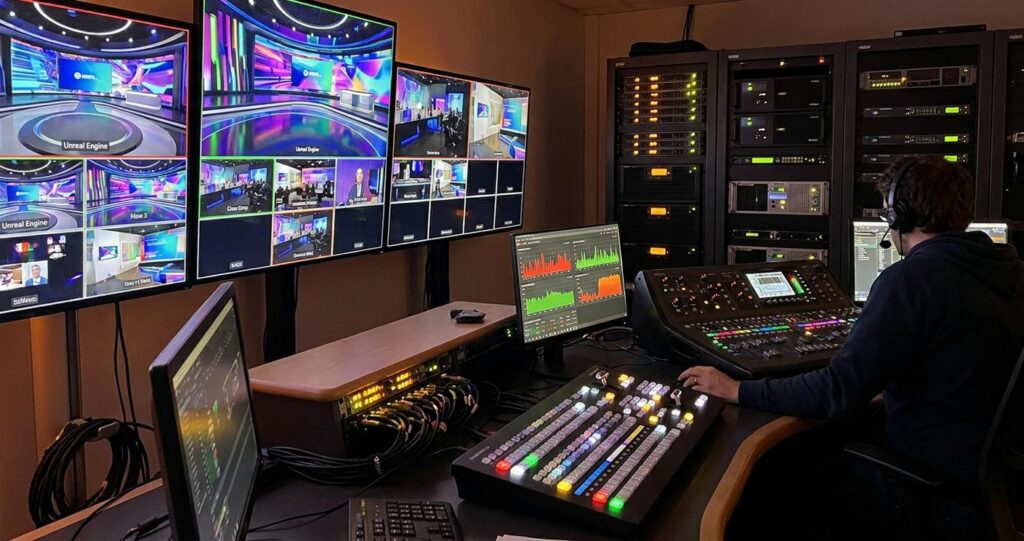
The perception of Unreal Engine as solely a gaming development platform is rapidly evolving within the professional B2B event streaming and hybrid production landscape. While its origins are deeply rooted in interactive entertainment, the sophisticated real-time rendering capabilities, robust virtual production toolsets, and expansive plugin ecosystem of Unreal Engine have propelled it into a critical role for enterprise-grade visual communication. For corporate event planners, AV professionals, and IT directors, understanding the profound technical implications and operational advantages of integrating Unreal Engine is paramount for delivering truly immersive, dynamic, and impactful live and hybrid events.
Traditional corporate events often struggle with static presentations and limited engagement, leading to a disconnect with both physical and remote audiences. Unreal Engine provides a powerful antidote to these challenges, enabling the creation of photorealistic virtual environments, extended reality (XR) stages, and interactive content that elevates the production value and audience experience to unprecedented levels. At Spring Forest Studio, our technical team leverages these advanced capabilities to transform conventional broadcasts into captivating, interactive journeys, addressing the complex requirements of modern B2B event streaming and hybrid production.
Beyond Pixels: Unreal Engine’s Core Capabilities in B2B Virtual Production
Unreal Engine’s strength lies in its ability to render complex 3D environments, visual effects, and dynamic content in real-time, a capability that transcends its gaming heritage. For B2B applications, this translates into immediate, responsive visual adjustments that are crucial for live event flexibility and narrative coherence.
Real-Time Rendering for Immersive Experiences
The engine’s advanced real-time rendering pipeline allows for the creation of incredibly detailed and visually stunning environments. This includes sophisticated lighting models, physically based rendering (PBR) materials, and volumetric effects that bring virtual sets to life with a level of fidelity previously restricted to post-production. For corporate presentations, product launches, or annual general meetings, presenters can interact with dynamic data visualizations, walk through virtual product models, or present against a backdrop that changes seamlessly in response to presentation flow, all rendered instantly without pre-caching or lengthy processing times. The ability to dynamically alter scene elements, lighting, and camera perspectives in real-time empowers a level of spontaneity and visual storytelling impossible with static backdrops.
Virtual Sets and Extended Reality (XR) Stages
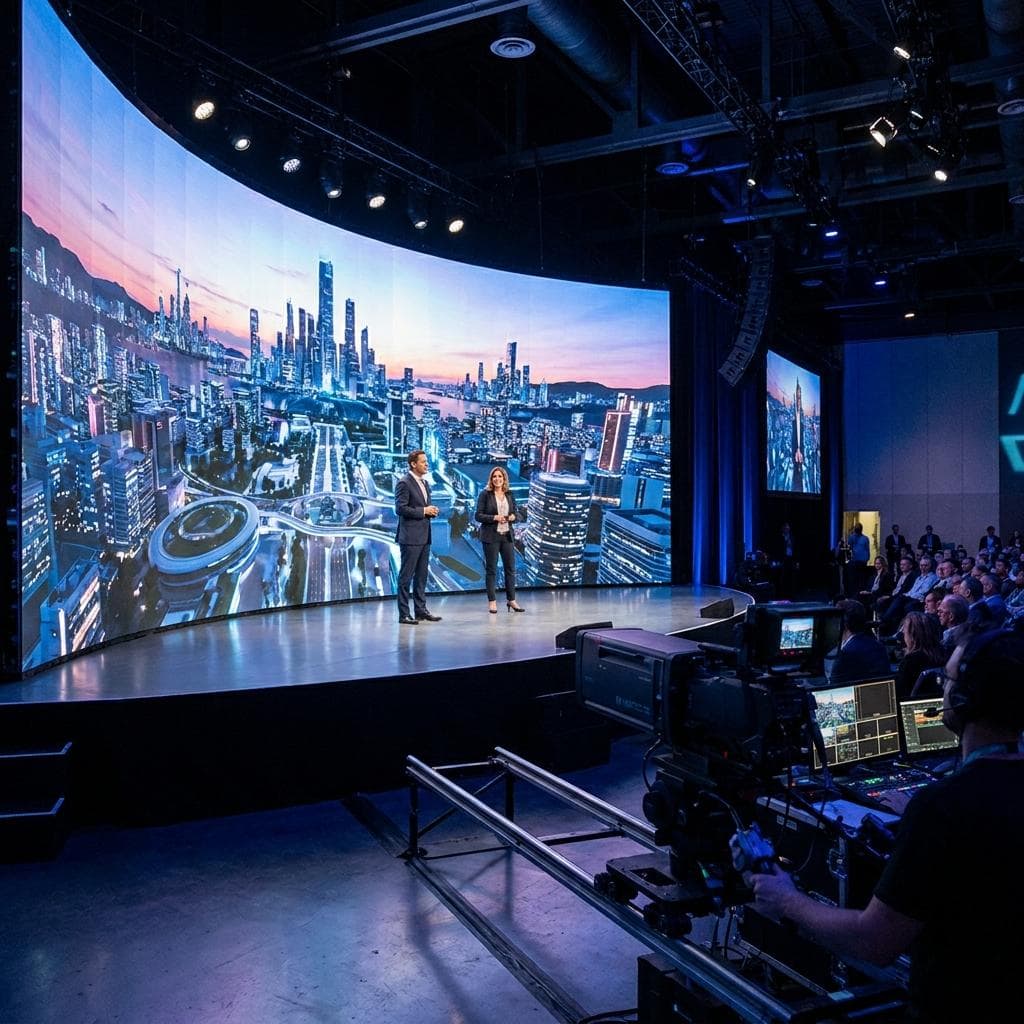
Unreal Engine is at the forefront of virtual set technology. Companies are now deploying massive LED video walls and chroma key green screen studios, often referred to as XR stages, where presenters are seamlessly composited into photorealistic virtual environments generated by Unreal. This allows for limitless creative possibilities, from appearing to present from a futuristic city skyline to walking through a detailed digital twin of a manufacturing facility. These virtual sets support multi-camera perspectives, allowing broadcast engineers to cut between different virtual angles that correspond with physical camera positions, creating a cohesive and expansive visual narrative. The integration with camera tracking systems, adhering to standards like FreeD, ensures perfect synchronization between the physical camera’s movement and the virtual environment’s perspective, maintaining a consistent sense of depth and realism for the viewer.
Data Integration and Dynamic Content
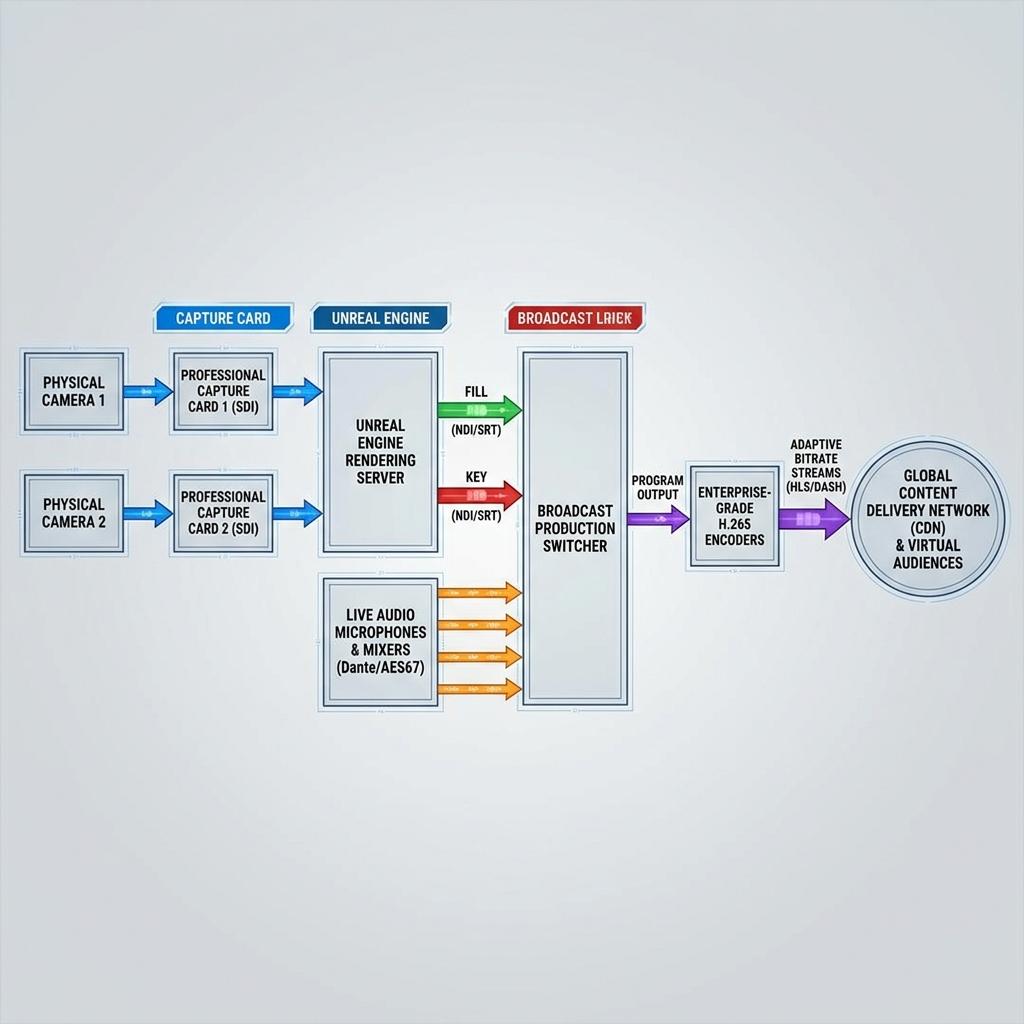
One of Unreal Engine’s most powerful, yet often underutilized, capabilities in B2B contexts is its ability to integrate with live data feeds. Through custom APIs and plugins, Unreal can pull real-time business intelligence data, stock market feeds, analytics dashboards, or even custom event registration metrics directly into the virtual environment. This allows for dynamic graphics, charts, and interactive elements that update instantly during a live event. Imagine a keynote speaker discussing quarterly earnings, with dynamic graphs animating and updating in real-time on the virtual set behind them. This level of data integration provides unparalleled flexibility and allows for highly customized, responsive visual content that directly supports the narrative of corporate communication. Protocols like Network Device Interface (NDI) and Secure Reliable Transport (SRT) are critical for robust, low-latency transport of video and associated metadata into and out of the Unreal ecosystem, ensuring a fluid workflow between live cameras, Unreal servers, and the broadcast switcher.
Architecting the Future: Enterprise Streaming Infrastructure for Unreal-Powered Events
Deploying Unreal Engine for B2B event streaming requires a meticulously planned and robust infrastructure, extending far beyond a typical gaming PC. It demands broadcast-grade hardware, high-bandwidth networking, and sophisticated signal management to ensure reliability and broadcast quality.
High-Performance Workstations and GPU Acceleration
The computational demands of real-time photorealistic rendering necessitate specialized hardware. Enterprise-grade Unreal Engine workstations are typically equipped with multiple high-end Graphics Processing Units (GPUs), such as NVIDIA Quadro or RTX series, often interconnected via NVLink for shared memory and enhanced processing power. These systems also feature powerful multi-core Central Processing Units (CPUs), substantial amounts of high-speed Random Access Memory (RAM), and ultra-fast Non-Volatile Memory Express (NVMe) Solid-State Drives (SSDs) to handle the immense data throughput required for rendering complex scenes, textures, and visual effects at broadcast-critical frame rates (e.g., 29.97p, 50p, 59.94p). Redundant power supplies and enterprise-grade cooling solutions are also standard to ensure continuous operation during extended live productions.
Network Infrastructure and Latency Management
A high-performance network backbone is absolutely critical. Uncompressed or lightly compressed video streams, along with control data, demand significant bandwidth. A typical setup utilizes 10 Gigabit Ethernet (10GbE) or even 40 Gigabit Ethernet (40GbE) fiber optic networks within the production facility. Quality of Service (QoS) protocols are implemented to prioritize video and audio traffic, minimizing jitter and packet loss. For transmitting high-resolution video into and out of the Unreal environment, uncompressed IP standards like SMPTE ST 2110 or highly efficient codecs like NDI (Network Device Interface) are employed. Managing latency, often measured in milliseconds (ms), is paramount for synchronizing live camera feeds with virtual elements and ensuring a seamless experience for the remote audience. Network configurations must account for ingress and egress bandwidth, ensuring sufficient headroom for peak loads.
Video Input/Output and Signal Flow
Integrating live camera feeds into Unreal Engine involves professional capture cards from manufacturers like Blackmagic Design DeckLink or AJA Corvid, which support Serial Digital Interface (SDI) or HDMI 2.1 inputs, handling resolutions up to 4K/UHD (Ultra-High Definition) at various frame rates. These cards ingest the raw video into the Unreal environment. Outputting the program feed from Unreal typically involves generating a key and fill signal, which allows a broadcast switcher to composite the virtual elements with the live camera feed accurately. This output can be via SDI, NDI, or dedicated IP streams. Meticulous signal flow management, often utilizing matrix switchers and routers compliant with industry standards, ensures clean signal paths and the ability to quickly re-route signals in a live production scenario. Color grading and the application of Look-Up Tables (LUTs) are often performed post-Unreal rendering to ensure consistent colorimetry across all broadcast elements, adhering to standards set by the Society of Motion Picture and Television Engineers (SMPTE).
Encoding, Transcoding, and Distribution
Once the final program feed is generated, it must be encoded for distribution. Enterprise-grade hardware encoders or robust software encoders (e.g., using H.264/AVC or H.265/HEVC codecs) are used to compress the video efficiently while maintaining high visual fidelity. Bitrate management is a critical factor, with resolutions like 1080p often requiring bitrates of 8-20 Mbps for high-quality streaming, and 4K/UHD demanding 20-50+ Mbps, depending on content complexity and motion. Adaptive Bitrate (ABR) streaming is standard practice, creating multiple renditions of the stream at varying resolutions and bitrates to cater to diverse audience internet connections. Content Delivery Networks (CDNs) are essential for global distribution, ensuring low-latency and high-bandwidth delivery to a distributed audience. Protocols such as Real-Time Messaging Protocol (RTMP) and its secure variant RTMPS, HTTP Live Streaming (HLS), and Dynamic Adaptive Streaming over HTTP (DASH) are commonly employed for reliable and scalable delivery to endpoint devices.
Hybrid Realities: Integrating Physical and Virtual Audiences with Unreal Engine
The true power of Unreal Engine in B2B events shines in hybrid productions, where it seamlessly blends physical and virtual elements to create a unified and engaging experience for both in-person and remote attendees.
Seamless Blending: Chroma Keying and LED Volumes
For chroma keying, precise lighting, camera calibration, and real-time compositing within Unreal Engine are paramount. The engine’s keying algorithms efficiently remove the green background, allowing presenters to be placed within the virtual set with accurate reflections and shadows. LED volumes, however, represent a more advanced integration. By displaying the Unreal-generated environment on large LED screens that surround the physical stage, the virtual world appears to extend infinitely behind and around the presenter, providing accurate perspective and reflections directly in-camera. This significantly enhances realism and reduces the complexity of post-production compositing, providing a more immediate and immersive experience for both the presenter and the live audience.
Multi-Camera Production and Switching Systems
A typical hybrid event utilizing Unreal Engine will involve multiple physical cameras capturing presenters and physical stage elements, alongside virtual cameras within the Unreal environment. Broadcast-grade video switchers from manufacturers such as Ross Video, Grass Valley, or Blackmagic Design ATEM play a central role. These switchers are capable of ingesting multiple SDI or NDI sources, including the program feed (key and fill) from the Unreal engine, and seamlessly cutting or transitioning between them. Multiview monitoring systems, essential for production teams, display all camera feeds, program output, preview output, and graphics, allowing for real-time decision-making and precise execution of camera moves and visual transitions. Audio/video synchronization across all these sources, adhering to industry standards, is meticulously managed to prevent lip-sync issues.
Interactive Elements and Audience Engagement
Unreal Engine provides robust tools for developing interactive elements that enhance audience engagement for both physical and virtual attendees. This can include real-time polling displayed as dynamic graphics within the virtual set, interactive Q&A sessions where questions from platforms like Slido or Mentimeter are integrated and visualized on screen, or even virtual avatars that represent remote participants within the virtual space. The engine’s extensibility allows for bespoke interactive experiences, personalizing content delivery and fostering a more dynamic exchange of information. This level of interaction transforms passive viewing into active participation, a key objective for successful B2B communication.
Audio Production for Immersive Environments
Audio is just as critical as video. Professional audio mixing consoles (e.g., Yamaha, DiGiCo, Avid) are used to manage multiple microphones, playback sources, and ambient sound effects from the virtual environment. Digital audio networking protocols like Dante or AES67 (Audio over IP) facilitate the routing of high-quality, low-latency audio signals across the production infrastructure. Talkback systems ensure seamless communication between the director, camera operators, Unreal operators, and presenters. Meticulous audio-video synchronization is achieved through genlock and precise delay management, guaranteeing that the audio accompanying the complex Unreal-generated visuals is perfectly aligned, providing a cohesive and professional broadcast experience.
Beyond the Hype: Practical Implementation and Scalability for Corporate Events
While the technical capabilities are impressive, successful deployment of Unreal Engine in B2B event streaming hinges on optimized workflows, robust redundancy, and strategic integration into existing enterprise ecosystems.
Workflow Optimization and Production Teams
Implementing Unreal Engine for B2B events demands a specialized production team. This includes virtual production artists skilled in Unreal Engine development, real-time operators who manage the live environment, and experienced broadcast engineers who integrate Unreal into the broader streaming infrastructure. Collaborative workflows, often involving pre-visualization (pre-vis) sessions to block out camera movements and scene changes, are essential. This pre-planning minimizes on-the-fly adjustments and ensures a smooth, predictable live production. Training and experience in this rapidly evolving field are crucial for delivering high-quality, professional results consistently.
Redundancy, Failover, and Quality of Service (QoS)
For any enterprise-grade live event, redundancy is non-negotiable. This extends to Unreal Engine systems, where primary and backup machines are configured for instantaneous failover. Redundant network paths, backup power supplies (Uninterruptible Power Supplies – UPS), and mirrored streaming encoders are standard practice. Implementing comprehensive Quality of Service (QoS) across the network ensures that critical real-time video and audio data are prioritized, even under heavy network load. Continuous monitoring with professional dashboards and telemetry tools is essential to identify potential issues before they impact the live broadcast, allowing for proactive intervention and maintaining broadcast reliability.
Cloud vs. On-Premise Unreal Workflows
The decision between cloud-based and on-premise Unreal workflows depends on several factors. On-premise solutions offer maximum control, lowest latency, and often better security for sensitive corporate content, but require significant upfront hardware investment and dedicated technical staff. Cloud-based solutions, leveraging powerful virtual machines and cloud-render farms (e.g., NVIDIA CloudXR, Amazon EC2 with GPU instances), offer scalability and flexibility, reducing CapEx. However, they introduce potential latency challenges and bandwidth costs, which must be carefully managed for live, interactive events. A hybrid approach, where core rendering occurs on-premise and distribution leverages cloud CDNs, often provides the optimal balance for enterprise clients.
Enterprise Platform Integration
Integrating Unreal-generated content into widely used enterprise platforms like Microsoft Teams, Zoom Events, or Webex for hybrid meeting segments is a critical requirement. This typically involves feeding the high-quality program output from the Unreal-driven production switcher as a virtual camera input into these platforms. Ensuring stable, high-resolution input and managing the platform’s specific encoding and distribution limitations are key. This allows the sophisticated visuals created with Unreal Engine to enhance virtual breakout rooms, keynote presentations, and internal communications within familiar corporate environments, extending the reach and impact of the immersive content.
The integration of high-end Unreal Engine technology into B2B event streaming and hybrid production represents a paradigm shift, moving beyond traditional broadcast methods to create deeply immersive and engaging experiences. Spring Forest Studio stands at the forefront of this evolution, offering the technical expertise and infrastructure required to harness Unreal Engine’s full potential for enterprise clients. By understanding the intricate technical demands of real-time rendering, robust network architectures, and seamless hybrid integration, businesses can unlock unparalleled levels of visual fidelity and audience engagement for their most critical communications.
Consult with Spring Forest Studio for your next-generation enterprise streaming and hybrid production needs, and discover how advanced virtual production can redefine your corporate events.

Jeremy Lee is a seasoned digital marketing director and strategist with over two decades of experience in the industry. As the founder of Sotavento Medios, I manage a diverse portfolio of over 50 businesses, helping brands grow through advanced search strategies and digital innovation. My work focuses on bridging the gap between traditional search engine optimisation and the evolving world of AI-driven answer engines.
get in touch