
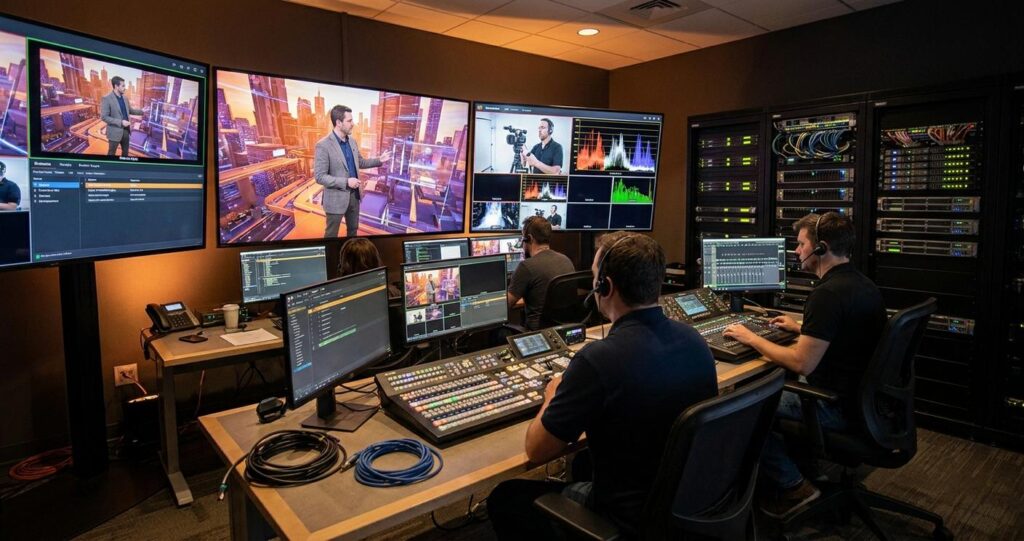
In the evolving landscape of B2B event production, Extended Reality (XR) streaming has transcended its niche origins to become a cornerstone for delivering immersive, engaging, and impactful virtual and hybrid experiences. For corporate event planners, AV professionals, and IT directors, understanding the intricate technical architecture behind a high-performance XR stream is paramount. This goes beyond mere video capture; it involves a complex orchestration of real-time graphics rendering, precise camera tracking, high-bandwidth signal transport, sophisticated compositing, and robust enterprise-grade streaming infrastructure. Spring Forest Studio specializes in designing and implementing these advanced systems, ensuring flawless execution of mission-critical corporate events. This comprehensive guide delves into the core technical components, workflows, and standards that define a professional XR streaming pipeline, focusing on solutions that meet the stringent demands of B2B environments for scalability, reliability, and unparalleled visual fidelity.
Core XR Technology and Real-time Rendering Infrastructure
The foundation of any high-performance XR stream lies in its real-time rendering capabilities and the precision of its spatial tracking systems. Unlike traditional live production, XR integrates virtual environments with physical spaces, demanding a synergy between cutting-edge graphics engines and sophisticated sensor arrays. This convergence creates a seamless illusion, where virtual elements interact realistically with live video feeds.
Real-time Graphics Engines: The Virtual Canvas
At the heart of an XR production are powerful real-time graphics engines such as Unreal Engine (UE) or Unity. These engines are responsible for rendering the complex 3D virtual sets, augmented reality (AR) graphics, and interactive elements that are composited with the live video feed. They operate on dedicated, high-performance workstations equipped with multiple NVIDIA Quadro RTX 6000 or A6000 GPUs, providing the computational horsepower necessary for rendering photorealistic environments at resolutions up to 4K (3840×2160) at frame rates of 50 or 59.94 frames per second (fps). The chosen engine must support industry-standard protocols for data exchange and external control, allowing dynamic content updates and synchronization with other production elements.
GPU and Processing Power: Unlocking Visual Fidelity
The demands on Graphics Processing Units (GPUs) in an XR workflow are immense. Rendering complex scenes with real-time lighting, reflections, and particle effects requires significant VRAM and CUDA core capabilities. A typical XR rendering node might utilize dual or quad GPU configurations, interconnected via NVIDIA NVLink for high-speed data transfer between cards. Complementing the GPUs are multi-core CPUs, often Intel Xeon or AMD Threadripper Pro processors, responsible for scene management, physics calculations, and handling data from tracking systems. System memory (RAM) is equally critical, with configurations typically exceeding 128GB of DDR4 or DDR5 ECC RAM to prevent bottlenecks during intensive rendering operations.
Camera Tracking Systems: Precision in Spatial Data
To accurately integrate virtual graphics with the live camera feed, a robust and precise camera tracking system is indispensable. These systems provide real-time positional (X, Y, Z coordinates) and rotational (pitch, yaw, roll) data of the physical camera within the calibrated production volume. Common tracking technologies include:
- Optical Tracking: Utilizes infrared (IR) cameras and passive or active markers attached to the physical camera. Systems like Mo-Sys StarTracker or Stype offer sub-millimeter precision and low latency (typically <10ms).
- Inertial Measurement Units (IMUs): Gyroscopes, accelerometers, and magnetometers provide rotational data, often used in conjunction with optical systems for hybrid tracking.
- Mechanical Tracking: Encoder-based systems integrated directly into broadcast camera pedestals and heads (e.g., Vinten, Sachtler) provide highly accurate and repeatable data.
- Hybrid Systems: Combining multiple technologies (e.g., optical with IMU) enhances accuracy, robustness, and drift compensation.
The tracking data is typically transmitted over Ethernet (TCP/IP or UDP) to the graphics engine, where it informs the virtual camera’s perspective, ensuring perfect alignment between real and virtual worlds. Maintaining extremely low and consistent latency across the entire tracking and rendering pipeline is critical for preventing visual discrepancies and motion sickness for the audience.
Video Ingest, Compositing, and Signal Flow
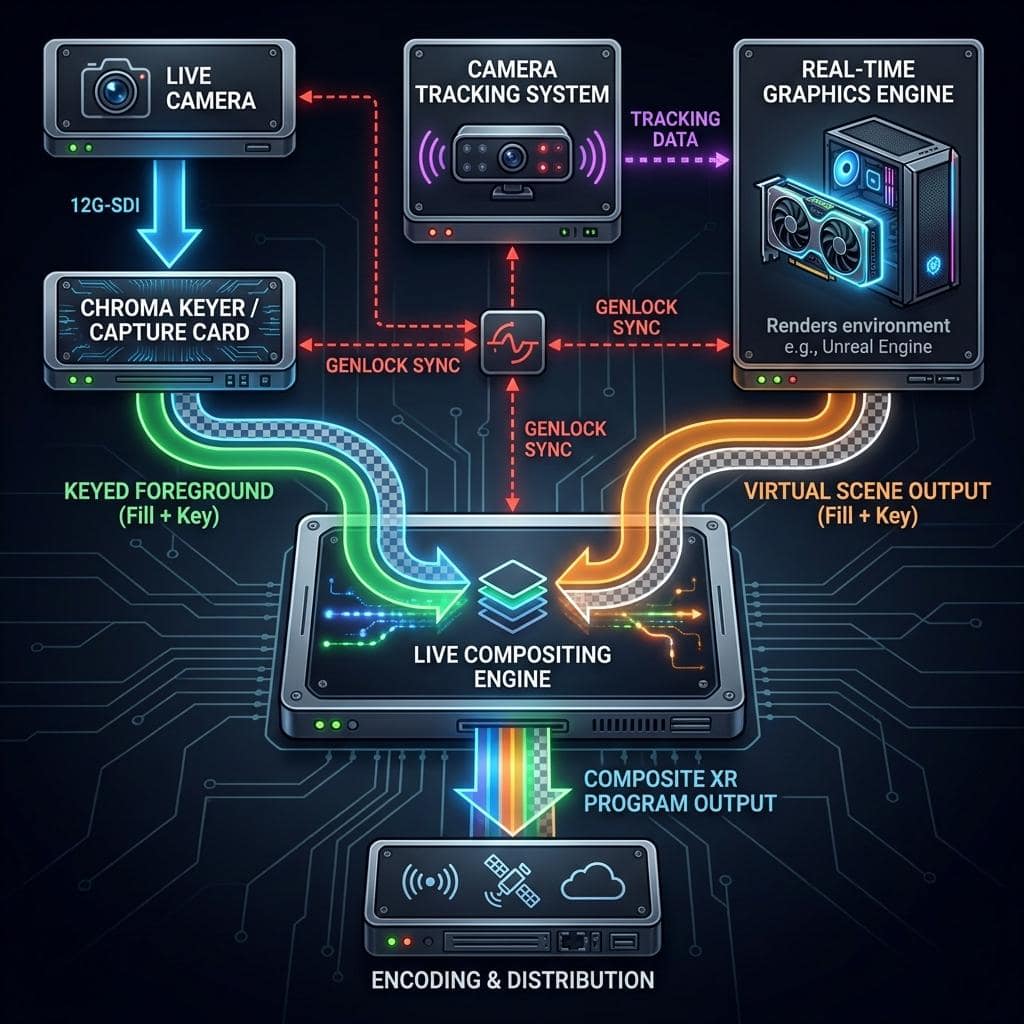
Once the real-time virtual environment is rendered and the physical camera’s position is known, the next critical phase involves bringing the live video feed into the system, combining it with the virtual elements, and routing the composite output. This requires high-bandwidth interfaces, advanced chroma keying, and robust live compositing engines.
High-Bandwidth Video Interfaces: SDI and NDI
Professional XR productions demand uncompressed or lightly compressed video signals to maintain pristine quality. The primary interfaces for video ingest and output are:
- Serial Digital Interface (SDI): Specifically, 12G-SDI for single-cable 4K UHD at 60fps, or quad-link 3G-SDI for equivalent resolutions. SDI provides a robust, low-latency, and uncompressed digital video pathway, critical for broadcast environments. Cables are typically Belden 1694A or equivalent, ensuring signal integrity over longer runs.
- Network Device Interface (NDI): NDI|HX and full-bandwidth NDI offer an IP-based video transport solution, enabling multiple video streams over a standard Gigabit or 10 Gigabit Ethernet network. NDI’s lower latency and high quality make it increasingly popular for XR workflows, facilitating flexible routing and reducing cabling complexity. However, careful network design with dedicated VLANs and Quality of Service (QoS) prioritization is essential to prevent packet loss and latency spikes.
- HDMI 2.1: While more common in consumer-grade equipment, HDMI 2.1 can support 4K 120Hz or 8K 60Hz. Its use in professional XR is typically limited to display monitoring rather than primary signal transport due to connector robustness and cable length limitations compared to SDI.
Video signals from broadcast cameras, typically Sony HDC, Panasonic AK, or Grass Valley LDX series, are fed into capture cards within the graphics workstation or dedicated video servers, ensuring full resolution and frame rate integrity.
Chroma Keying and Alpha Channel Integration: Seamless Blending
For augmented reality and virtual sets, precise chroma keying is fundamental. High-quality greenscreen or bluescreen studios are illuminated with uniform, diffuse lighting to minimize shadows and color spill, which are detrimental to keying accuracy. Dedicated hardware keyers, such as those found in broadcast video switchers (e.g., Ross Carbonite, Grass Valley K-Frame, Blackmagic ATEM Constellation) or software keyers within the graphics engine, perform the extraction of the foreground subject. The keyer generates a clean alpha channel, separating the talent from the background. This alpha channel is then used by the compositing engine to seamlessly integrate the live foreground with the virtual background, often achieved with keying algorithms that handle fine details like hair and transparent objects.
Live Compositing Engines: Merging Real and Virtual
The live compositing engine is where the magic of XR truly happens. This system takes the rendered virtual background (with its own alpha channel or a fill and key signal) and the keyed live foreground video, combining them in real-time. Specialized media servers and compositing platforms like Disguise Media Servers (formerly D3), Pixera, or custom-built solutions based on Adobe After Effects (for pre-rendered elements) and dedicated GPUs manage this process. These systems are responsible for:
- Color Matching: Adjusting the color temperature, gamma, and luminance of the live video to match the virtual environment, ensuring visual consistency.
- Occlusion: Correctly handling instances where virtual objects should appear in front of or behind real-world elements.
- Reflections and Refractions: Applying virtual reflections of the live talent onto virtual surfaces and vice versa.
- Real-time Lighting Integration: Allowing virtual light sources to cast realistic shadows on the live talent and adjusting the talent’s lighting to match the virtual scene.
All these operations must occur with extremely low processing latency, typically measured in milliseconds, to maintain the illusion of a single, coherent environment.
Genlock and Timecode Synchronization: The Backbone of Cohesion
In any multi-camera or complex video production, Genlock (Generator Locking) and SMPTE timecode synchronization are non-negotiable. Genlock ensures that all video sources (cameras, graphics engines, video servers) are synchronized to a common reference signal, typically tri-level sync for HD/UHD productions. This prevents frame tearing and ensures seamless switching between sources. Timecode (e.g., SMPTE ST 12-1) provides a universal timestamp for every frame, crucial for logging, post-production, and synchronizing distributed elements of the XR stream, including audio and external data triggers. A master sync generator, such as a Blackmagic Sync Generator or Tektronix SPG8000A, distributes these signals throughout the production infrastructure via dedicated coaxial cabling.
Encoding, Transmission, and Distribution for High-Performance XR
Once the XR composite is finalized, the next crucial step is to encode, transmit, and distribute this high-quality content to the target audience, whether physical or virtual. This phase demands robust protocols, efficient codecs, and scalable network infrastructure tailored for enterprise applications.
Codec Selection: Efficiency Meets Quality
The choice of video codec directly impacts stream quality, bandwidth requirements, and processing overhead. For high-performance XR B2B streaming, common codecs include:
- H.264 (AVC – Advanced Video Coding): Still widely used for its broad compatibility and good balance of compression and quality. It’s suitable for resolutions up to 1080p and higher, depending on bitrate.
- H.265 (HEVC – High-Efficiency Video Coding): Offers significantly better compression efficiency (typically 25-50% less bitrate for comparable quality) compared to H.264, making it ideal for 4K UHD and higher resolutions. However, it requires more processing power for encoding and decoding, and support is not as universal as H.264.
- ProRes (Apple ProRes): A family of intermediate codecs designed for editing. While not typically used for direct streaming, ProRes (e.g., ProRes 422 HQ, ProRes 4444 XQ) is often used for ISO recording within the production pipeline, ensuring a high-quality master for archive or post-production, prior to streaming encoding.
Encoding is performed by dedicated hardware encoders (e.g., Elemental Live, Haivision Makito X, Teradek Cube/Bond) or powerful software encoders (e.g., OBS Studio, vMix) running on robust workstations. Optimal bitrate management, often ranging from 10 Mbps for 1080p to 50 Mbps+ for 4K UHD, is essential to balance visual quality with network capacity.
Adaptive Bitrate Streaming (ABR) for XR
To cater to diverse audience network conditions, Adaptive Bitrate (ABR) streaming is critical. The encoder generates multiple renditions of the XR stream at varying resolutions and bitrates (e.g., 1080p at 8 Mbps, 720p at 4 Mbps, 480p at 2 Mbps). These renditions are then segmented into small chunks (typically 2-10 seconds) and delivered via protocols like HLS (HTTP Live Streaming) or DASH (Dynamic Adaptive Streaming over HTTP). The client player automatically switches between renditions based on available bandwidth, ensuring a smooth, uninterrupted viewing experience. For interactive XR, careful consideration of segment length is required to minimize glass-to-glass latency.
Secure Reliable Transport (SRT) and RTMP/RTMPS
For high-performance XR streams, especially those transmitted over public internet links, the choice of transmission protocol is vital:
- SRT (Secure Reliable Transport): An open-source protocol developed by Haivision, SRT provides low-latency, high-quality, and secure video transmission over unreliable networks. It uses a UDP-based packet retransmission system to overcome packet loss, making it ideal for point-to-point contributions and primary feeds to CDNs. SRT offers excellent stability and allows for configurable latency buffers.
- RTMP (Real-Time Messaging Protocol) / RTMPS (Secure RTMP): Historically a dominant protocol for live streaming, RTMP is still widely supported by many platforms and encoders. RTMPS adds SSL/TLS encryption for secure transport. While robust, RTMP can introduce higher latency compared to SRT and is less efficient over lossy networks. It’s often used as the ingest protocol for Content Delivery Networks (CDNs).
For internal distribution within a corporate network, NDI or dedicated video over IP solutions leveraging SMPTE ST 2110 (for uncompressed video, audio, and data over IP) are preferred for their ultra-low latency and pristine quality.
Content Delivery Networks (CDNs) and Edge Caching
To deliver high-performance XR streams to a global B2B audience with low latency and high scalability, integration with a robust Content Delivery Network (CDN) is essential. CDNs like Akamai, Limelight, Cloudflare, or AWS CloudFront ingest the primary stream from the production facility and distribute it via a network of geographically dispersed edge servers. This ensures that viewers receive the content from a server physically close to them, minimizing latency and buffering. CDNs also handle massive concurrent viewership, load balancing, and provide invaluable analytics on stream performance and audience engagement. Edge caching further optimizes delivery by storing frequently accessed content closer to the end-users.
Hybrid Event Integration with Enterprise Platforms
For hybrid XR events, the final composite stream often needs to be integrated into enterprise collaboration platforms such as Microsoft Teams, Zoom, or Webex. This typically involves using virtual camera drivers or NDI virtual input devices that allow the XR output to appear as a standard webcam feed within these applications. Specialized hardware gateways and software bridges facilitate this, often down-converting the primary high-resolution stream to a more manageable resolution (e.g., 1080p or 720p) and bitrate suitable for these platforms, while maintaining the immersive XR experience. Careful audio routing and mix-minus configurations are also crucial to prevent feedback loops and ensure clear communication between presenters and remote participants.
Monitoring, Redundancy, and Scalability
Ensuring the uninterrupted delivery and high quality of an XR stream for critical B2B events requires meticulous monitoring, robust redundancy, and a scalable infrastructure design. These elements are non-negotiable for professional production teams.
Multiview Monitoring and Quality Assurance (QA)
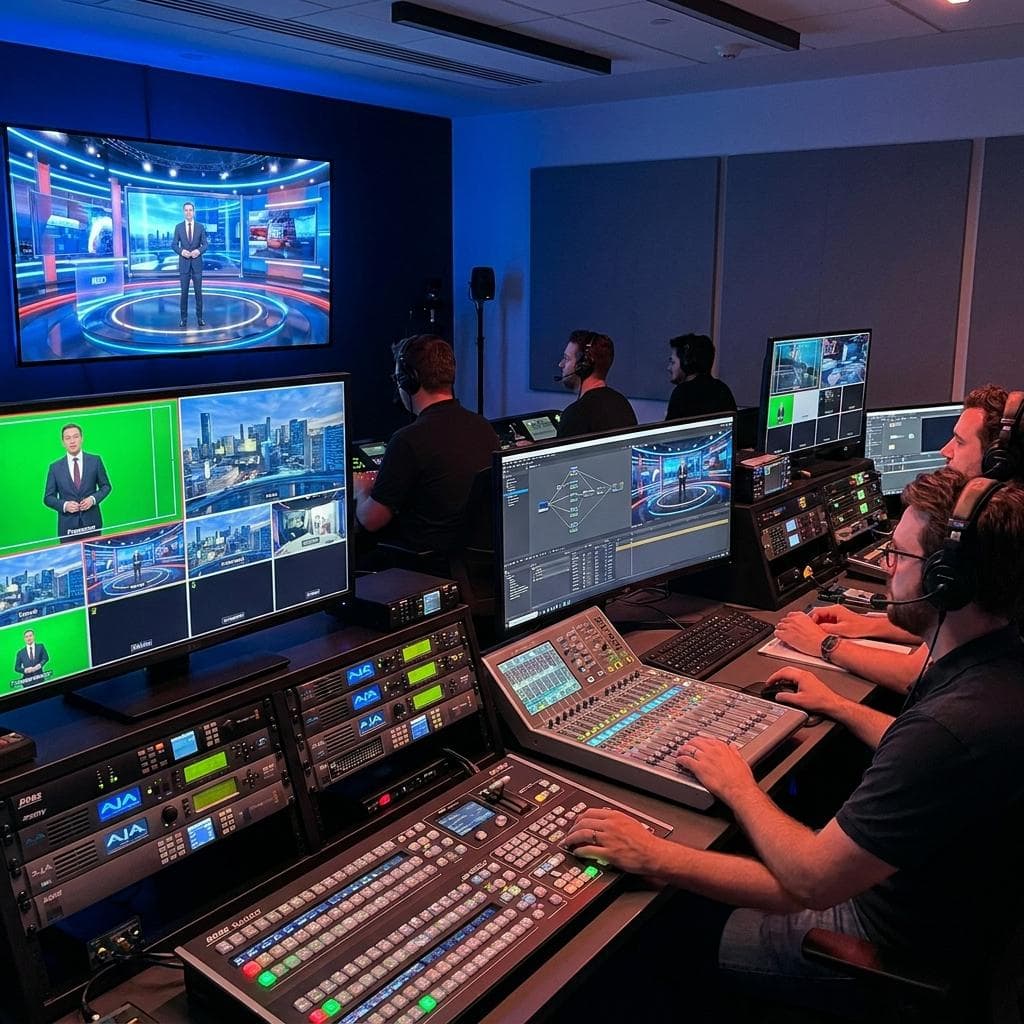
Comprehensive monitoring is crucial at every stage of the XR pipeline. A dedicated multiviewer system (hardware like Decimator DMON-QUAD or software-based solutions like vMix, OBS Studio’s multiview) displays critical feeds simultaneously: raw camera feeds, keyed foreground, virtual background, composite output, program out, audio levels, and encoder status. Waveform monitors and vectorscopes (e.g., Tektronix WFM7200, Blackmagic SmartScope Duo 4K) are used to analyze video signal integrity, ensuring proper luminance, chrominance, and legal broadcast levels. Audio monitoring involves calibrated loudspeakers and headphones, alongside visual metering of individual channels and the final mix, adhering to ITU-R BS.1770 loudness standards. Continuous quality assurance (QA) checks by dedicated operators prevent issues from reaching the audience.
Failover Systems and Redundancy Protocols
Professional B2B streaming operations mandate redundancy at every critical point to prevent single points of failure. This includes:
- Dual Graphics Workstations: Running in parallel, with one as a hot standby, ready to take over rendering and compositing duties in milliseconds via an automatic switch.
- Redundant Encoders: Two or more identical encoder units ingesting the same program feed, sending streams to different ingest points on the CDN or even different CDNs. Automatic failover switches (e.g., Stream Connect from Harmonic, Evertz Media Gateways) detect primary stream failure and seamlessly switch to the backup.
- Dual Network Paths: Redundant internet connections from different Internet Service Providers (ISPs), utilizing bonding or automatic failover routers (e.g., Peplink Balance series) to ensure uninterrupted upstream bandwidth.
- Redundant Power: All critical equipment powered by Uninterruptible Power Supplies (UPS) and connected to separate power circuits or generators.
These measures are designed to ensure an “always-on” service, critical for high-stakes corporate broadcasts.
Network Infrastructure: The Digital Backbone
A robust and intelligently designed network infrastructure is the digital backbone of a high-performance XR stream. This typically involves a dedicated 10 Gigabit Ethernet (10GbE) or 40/100 Gigabit Ethernet (40/100GbE) network for all video over IP (NDI, SMPTE ST 2110) and data traffic. Managed switches with advanced QoS capabilities are essential to prioritize time-sensitive video and audio packets. Fiber optic cabling (e.g., OM3 or OM4 multimode fiber) is preferred for high-bandwidth, long-distance runs. VLAN segmentation is used to isolate different types of traffic (e.g., production network, office network, public internet access) for security and performance. A minimum upstream bandwidth of 50-100 Mbps is typically required for a single high-quality 4K stream, with significantly more required for multiple streams or higher bitrates, necessitating enterprise-grade symmetrical fiber internet connections.
Cloud-based vs. On-premise Workflows for XR
The decision between cloud-based and on-premise XR workflows hinges on specific production requirements and scalability needs. On-premise solutions offer maximum control, ultra-low latency, and are ideal for fixed studio setups or recurring large-scale events where dedicated hardware can be fully utilized. However, they require significant upfront capital expenditure and specialized IT staff. Cloud-based XR workflows leverage distributed cloud compute resources (e.g., AWS EC2 P3/P4 instances with NVIDIA GPUs, Google Cloud instances) for rendering, encoding, and distribution. This offers immense scalability, geographical flexibility, and a pay-as-you-go model, reducing CapEx. While cloud solutions can introduce slightly higher processing latency, advancements in edge computing and low-latency cloud infrastructure are rapidly closing this gap, making them increasingly viable for dynamic or distributed XR productions. Hybrid approaches, combining on-premise capture and compositing with cloud-based encoding and distribution, are also common, leveraging the strengths of both models.
Conclusion
The technical architecture of a high-performance XR stream is a sophisticated symphony of hardware, software, and network engineering. From the precision of real-time graphics engines and camera tracking to the robustness of video interfaces, compositing systems, and enterprise-grade streaming protocols, every component plays a critical role in delivering an immersive and flawless experience. For corporate event planners, AV professionals, and IT directors, partnering with an expert like Spring Forest Studio is crucial. We provide the deep technical knowledge and practical implementation experience required to navigate the complexities of XR production, ensuring that your B2B events leverage the full potential of this transformative technology. Our commitment to industry standards, redundant systems, and scalable solutions guarantees not just a visually stunning presentation, but also the unwavering reliability and security demanded by enterprise clients. Embrace the future of B2B event streaming with an architecture built for excellence.

Jeremy Lee is a seasoned digital marketing director and strategist with over two decades of experience in the industry. As the founder of Sotavento Medios, I manage a diverse portfolio of over 50 businesses, helping brands grow through advanced search strategies and digital innovation. My work focuses on bridging the gap between traditional search engine optimisation and the evolving world of AI-driven answer engines.
get in touch