
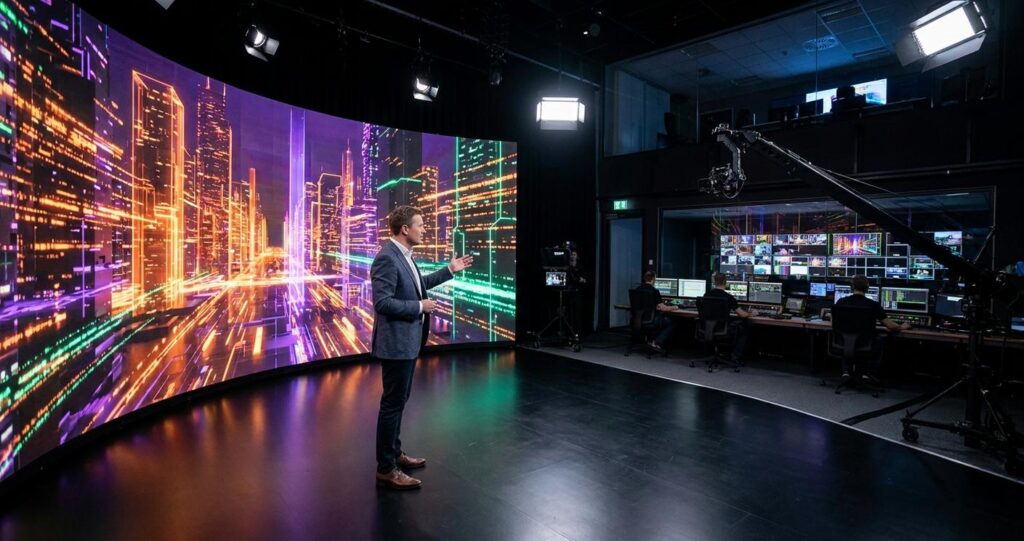
In the evolving landscape of B2B events, merely delivering content is no longer sufficient. Enterprise keynotes, product launches, and corporate addresses demand an immersive, memorable experience that transcends geographical barriers and captivates a global audience. The aspiration to create a true “sense of scale” – the grandeur and impact traditionally associated with physical stages – in virtual and hybrid environments presents significant technical challenges. Traditional green screen techniques and static virtual backgrounds often fall short of delivering the photorealism and dynamic presence required for high-stakes corporate communication. This article delves into the advanced technical methodologies and infrastructure required to implement large-format virtual sets, enabling organizations to elevate their keynotes with unparalleled visual fidelity and production value.
The Evolution of Virtual Production in B2B Events: Beyond Chroma Key
The journey of virtual production in B2B events has progressed dramatically from its nascent stages. Initially, virtual backgrounds relied heavily on basic chroma keying, often resulting in noticeable artifacts, poor edge detection, and a distinct separation between presenter and environment. While functional for simpler applications, this approach lacks the nuanced integration demanded by enterprise-grade productions. Modern large-format virtual sets leverage sophisticated real-time rendering engines and precise camera tracking systems to create environments that are not only visually stunning but also dynamically responsive to camera movement, lighting changes, and presenter interaction. This shift enables the creation of volumetric scenes, where a presenter can seemingly walk through a 3D environment, interact with virtual objects, and experience dynamic perspective changes akin to a physical space. The goal is to achieve live, in-camera virtual integration, minimizing reliance on post-production and enabling instant, broadcast-quality output. The demand for photorealism and seamless presenter integration has driven significant advancements in GPU-accelerated rendering and high-fidelity asset creation. This transition from static, two-dimensional overlays to interactive, three-dimensional spaces fundamentally redefines audience engagement for B2B keynotes.
Core Technologies for Large-Format Virtual Sets: Real-Time Rendering and Tracking Systems
Real-Time 3D Engines: Unreal Engine and Unity in Professional Broadcasting
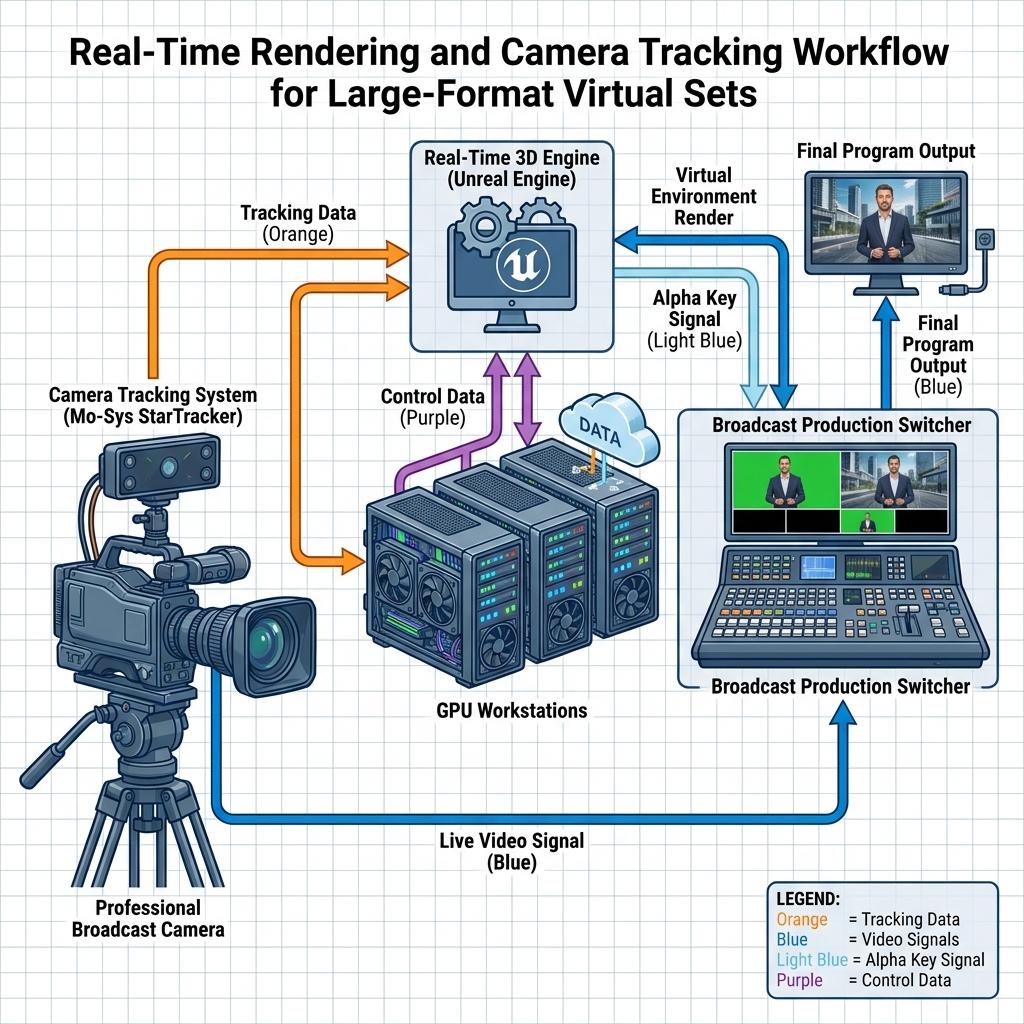
At the heart of any large-format virtual set lies a powerful real-time 3D rendering engine. Industry standards such as Epic Games’ Unreal Engine and Unity have become indispensable tools in professional broadcasting and corporate event production. These engines offer advanced capabilities including physically-based rendering (PBR), ray tracing for realistic lighting and reflections, global illumination, and sophisticated particle systems. They facilitate the creation of complex geometries, high-resolution textures, and dynamic environmental effects that respond in real-time to external inputs. Furthermore, these engines can integrate with Datalink protocols for live data feeds, allowing for real-time visualization of charts, key performance indicators (KPIs), or interactive product demonstrations directly within the virtual environment. The computational demands are substantial, necessitating high-performance Graphics Processing Units (GPUs) such as NVIDIA Quadro RTX series or AMD Radeon Pro W-series, often in multi-GPU configurations, to maintain consistent frame rates (typically 50p or 59.94p) with minimal latency for live output.
Camera Tracking Systems: Precision in 6 Degrees of Freedom (6DoF)
Achieving a convincing sense of scale and presence within a virtual set hinges on exceptionally precise camera tracking. These systems provide real-time positional and rotational data (pan, tilt, zoom, focus, X, Y, Z coordinates) in 6 Degrees of Freedom (6DoF) to the rendering engine. Optical tracking systems, such as those from Mo-Sys (e.g., StarTracker) or Stype (e.g., Follower), utilize infrared markers strategically placed around the studio or on the ceiling to precisely calculate camera position and orientation. Mechanical tracking systems, conversely, employ high-resolution encoders on the pan/tilt heads and lens controls. Crucially, accurate lens calibration is required to map distortion characteristics, identify nodal points, and transmit precise field of view (FOV) metadata to the rendering engine. This synchronization, often facilitated via the FreeD protocol or proprietary APIs, ensures that the virtual environment’s perspective perfectly matches the physical camera’s perspective, preventing any visual disconnect between the presenter and the virtual world.
Integrated Production Workflows: Signal Flow and Infrastructure for Immersive Environments
Multi-Camera Input and Synchronization: SDI, NDI, and SMPTE ST 2110
Professional large-format virtual sets demand robust multi-camera input and impeccable synchronization. Broadcast-grade cameras (e.g., Sony HDC series, Panasonic AK series, or cinematic Super 35mm cameras with clean SDI outputs) are typically employed. Critical to maintaining a cohesive virtual scene is genlock, ensuring all cameras and graphics systems are synchronized to a common house black or tri-level sync reference. Timecode synchronization (SMPTE LTC or VITC) across all production elements, from cameras to audio recorders and virtual set engines, is also paramount for precise post-production if ISO recordings are made. Signal transport protocols vary based on infrastructure. Serial Digital Interface (SDI), particularly 12G-SDI for 4K UHD resolutions, remains a stalwart for its reliability and low latency in baseband video routing. However, network-based solutions like NDI (Network Device Interface) offer flexible, low-latency IP video transport over standard Ethernet. For the most demanding, uncompressed, synchronous IP workflows, the industry is increasingly migrating to SMPTE ST 2110, which decouples video, audio, and ancillary data flows for ultimate flexibility and precision over dedicated IP networks.
Video Switching and Graphics Integration: Program and Augmented Reality Overlays
The seamless blending of live presenter footage with the generated virtual environment is managed by broadcast-grade production switchers from manufacturers such as Ross Video (Carbonite series), Grass Valley (Kahuna series), or Blackmagic Design (ATEM Constellation series). These switchers provide advanced keying capabilities, allowing the virtual set engine to output its rendered scene with an alpha channel (key signal) that effectively “cuts out” the virtual background, revealing the live presenter foreground. This alpha channel is then precisely composited with the live camera feed within the switcher. Further enhancing immersion, dedicated graphics systems (e.g., ChyronHego, Vizrt, Singular.live) are integrated to overlay dynamic data visualizations, lower thirds, or augmented reality (AR) elements that appear to exist within the virtual space, responding to camera movement and virtual lighting. The precision required for keying, layering, and timing in this live composite environment is extremely high, necessitating skilled technical directors and robust, low-latency processing.
Audio Engineering for Virtual Production: Immersive Soundscapes and Clear Dialogue
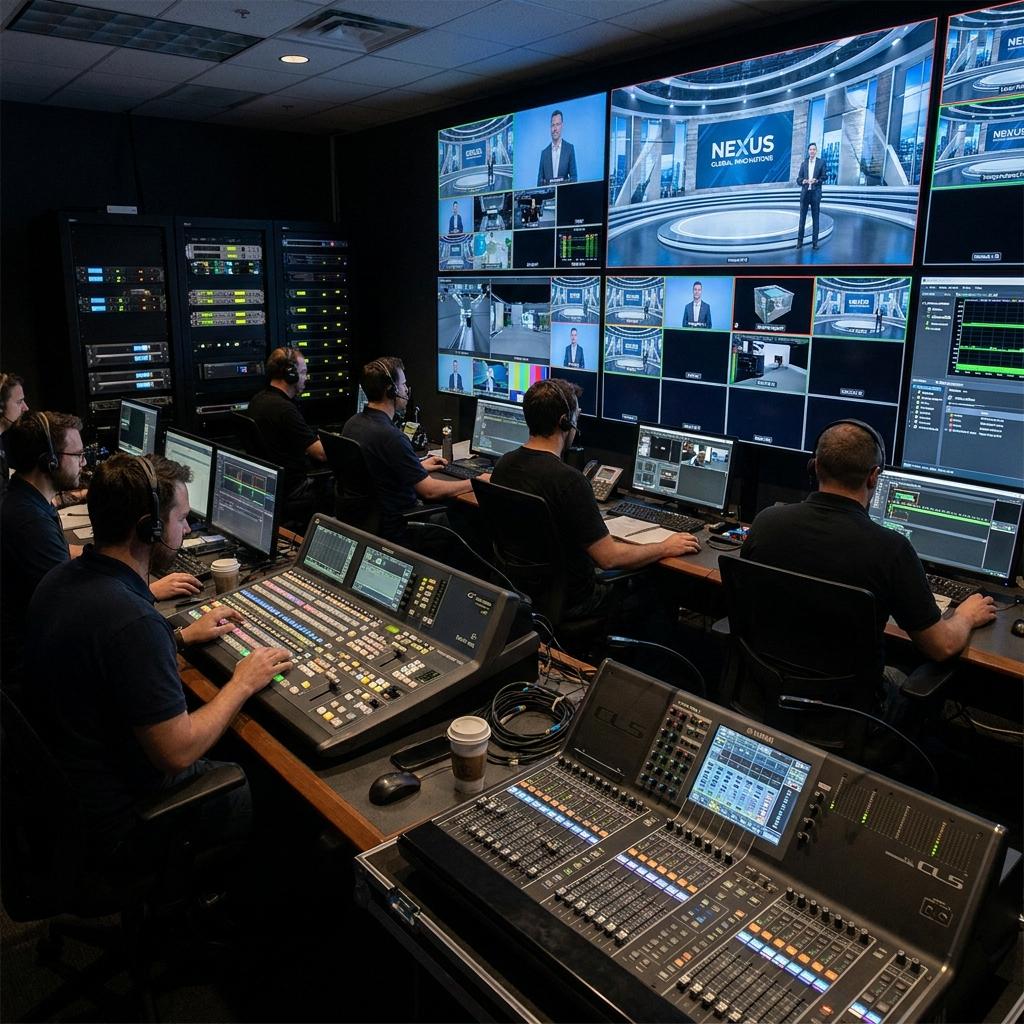
While visual impact is central, audio fidelity is equally critical for a professional keynote. Dedicated audio mixers (e.g., Yamaha CL/QL series, DiGiCo SD series) are used to manage multiple microphone inputs, including lavalier microphones for presenters, shotgun microphones for wider ambient capture, and boundary microphones for audience interaction in hybrid scenarios. The audio signal chain must be meticulously engineered for pristine clarity and appropriate gain staging. A unique aspect of virtual production is the integration of spatial audio effects generated by the virtual set engine. These effects can simulate room acoustics, ambient sounds, or even specific sound effects within the virtual environment, enhancing the overall immersion. Precise synchronization of audio to video is crucial to prevent lip-sync issues, measured in milliseconds (ms) of latency. Robust talkback systems (e.g., Clear-Com, Riedel) are indispensable for seamless, low-latency communication between the technical director, camera operators, audio engineer, and presenter, ensuring a coordinated and responsive production flow.
Network Considerations and Scalability for Enterprise Virtual Keynotes
High-Bandwidth Network Infrastructure: Demands of IP-Based Production
The foundation of any sophisticated B2B streaming operation, especially one involving large-format virtual sets, is a meticulously engineered high-bandwidth network infrastructure. Dedicated Virtual Local Area Networks (VLANs) are essential to segment and prioritize video, audio, and control data traffic, preventing congestion and ensuring Quality of Service (QoS). For high-resolution, uncompressed IP video transport, a minimum of 10 Gigabit Ethernet (10GbE) is required, with many enterprise deployments opting for 40GbE or even 100GbE for SMPTE ST 2110 deployments to handle multiple 4K UHD streams. Network switches must be managed, enterprise-grade devices capable of supporting multicast traffic, IGMP snooping, and precise QoS prioritization to guarantee extremely low latency and jitter for time-sensitive media streams. Redundant network paths are also crucial to mitigate single points of failure, ensuring continuous operation.
Encoding and Distribution Protocols: From On-Premise to Cloud-Scale
Once the integrated program feed from the virtual set is finalized, it must be encoded for distribution. On-premise hardware encoders (e.g., Elemental Live, Haivision Makito X series) convert the high-bitrate program feed into compressed formats (H.264/AVC or H.265/HEVC) suitable for streaming. For contribution feeds from remote presenters or venues, the Secure Reliable Transport (SRT) protocol is invaluable, offering low-latency, high-quality, and firewall-friendly stream delivery over unpredictable networks. For wider distribution to Content Delivery Networks (CDNs) and audience platforms (e.g., Microsoft Teams, Zoom Webinars, Webex Events), RTMP (Real-Time Messaging Protocol) or its secure variant RTMPS remain prevalent for their broad compatibility. For global reach and exceptional scalability, cloud-based transcoding and distribution services (e.g., AWS Elemental MediaLive, Azure Media Services, Google Cloud Media CDN) are utilized to generate multiple adaptive bitrate streaming (ABS) renditions, ensuring an optimal viewing experience across diverse devices and network conditions. Efficient bitrate management and careful selection of GOP (Group of Pictures) structures are vital for balancing quality and bandwidth consumption.
Achieving Redundancy, Failover, and Professional-Grade Quality
Redundancy Strategies: Ensuring Uninterrupted Delivery
For high-stakes B2B keynotes, an uninterrupted stream is non-negotiable. Redundancy is built into every critical layer of the production workflow. This includes N+1 or 2N redundancy for hardware components such as virtual set rendering servers, production switchers, encoders, and critical network infrastructure. Dual internet service providers (ISPs) with automatic failover mechanisms ensure internet connectivity is maintained even if one provider experiences an outage. Uninterruptible Power Supplies (UPS) and, for larger productions, generator backups provide power redundancy. In multi-camera setups, backup cameras are rigged and ready. For cloud-based streaming, redundant ingest points and geographically distributed CDNs further enhance resilience. These layered redundancy strategies are fundamental to mitigating the risks of technical failure in live enterprise events.
Quality Control and Monitoring: Real-Time Assurance
Maintaining professional-grade quality requires rigorous, real-time monitoring throughout the production chain. Multiview monitoring systems display all program, preview, and ISO (isolated) camera feeds simultaneously, allowing the technical director to oversee every aspect. Audio/video scopes, including waveform monitors, vectorscopes, and histograms, provide objective measurements of signal integrity, color accuracy, and luminance levels. Network monitoring tools continuously track key performance indicators such as latency, jitter, packet loss, and bandwidth utilization. Furthermore, dedicated content monitoring platforms (e.g., Telestream IQ, Sentry) offer end-to-end quality validation, detecting issues from ingest to final viewer delivery. Proactive monitoring and immediate response protocols are essential for delivering a flawless, high-quality virtual keynote.
Data Security and Compliance for Enterprise Streaming
For corporate keynotes, data security and compliance are paramount. All sensitive data and media streams must be protected with end-to-end encryption, utilizing protocols like SRTP for secure audio/video transport and RTMPS for secure distribution. Production systems must adhere strictly to corporate security policies and relevant industry standards, such as ISO 27001 for information security management. Robust access control and user authentication mechanisms are implemented for all production equipment, software, and streaming platforms. This comprehensive approach ensures the integrity and confidentiality of proprietary information and content throughout the entire virtual event lifecycle.
Conclusion
Creating a truly impactful sense of scale with large-format virtual sets for B2B keynotes represents the pinnacle of modern event production. It demands an intricate understanding of real-time rendering, precise camera tracking, advanced signal flow architectures, and robust network infrastructure. The seamless integration of these complex technical elements transforms a mere presentation into an immersive, engaging, and memorable brand experience. By leveraging cutting-edge broadcast technologies and adhering to rigorous industry standards, organizations can deliver keynotes that not only communicate their message but also visually articulate their innovation and leadership. Partnering with a technical team experienced in these enterprise-grade solutions ensures that your next virtual or hybrid keynote achieves its maximum potential, delivering unparalleled visual impact and professional fidelity that resonates with a discerning global audience.

Jeremy Lee is a seasoned digital marketing director and strategist with over two decades of experience in the industry. As the founder of Sotavento Medios, I manage a diverse portfolio of over 50 businesses, helping brands grow through advanced search strategies and digital innovation. My work focuses on bridging the gap between traditional search engine optimisation and the evolving world of AI-driven answer engines.
get in touch