
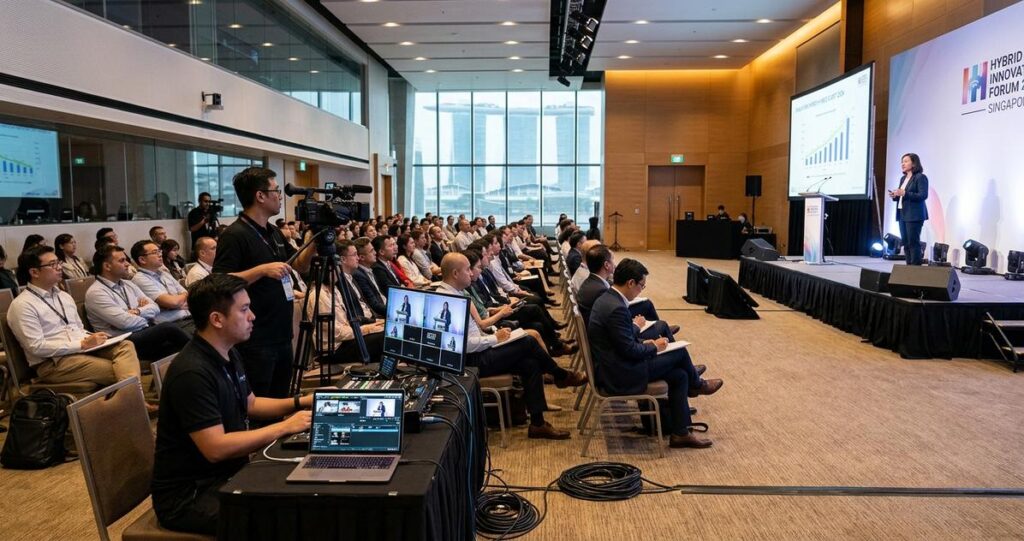
Hybrid events bring together in-person and virtual audiences, but success depends on more than cameras, microphones, and streaming software. In Singapore, local knowledge can shape nearly every part of the experience, from venue selection and connectivity to audience expectations, regulatory considerations, and contingency planning. A technically sound production team may still struggle if it does not understand the practical realities of hosting events in Singapore, where venue logistics, transport timing, weather patterns, multilingual audiences, and workplace norms all influence the final outcome. For organisations planning corporate forums, conferences, town halls, product launches, or training sessions, this local context is often the difference between a smooth event and one that feels disjointed.
Hybrid events are especially demanding because they must serve two audiences at once. People on site expect clear sightlines, sound that is easy to follow, and a schedule that respects local business culture. Virtual participants expect stable streaming, clean audio, and an experience that does not make them feel like they are receiving a secondary version of the event. In Singapore, where audiences are accustomed to high service standards and efficient execution, even small oversights can affect the credibility of the event and the organisation behind it. This is why working with a team that understands Singapore’s event environment is not a nice extra. It is a practical requirement for consistency, reliability, and audience trust.
Why Singapore’s event environment demands local expertise
Singapore is a highly connected city with a dense network of convention centres, hotels, office towers, and integrated event venues, but that does not make event delivery simple. Hybrid production involves moving equipment, coordinating venue access, managing network dependencies, and complying with venue and building rules. Local expertise helps production teams anticipate details that may not be obvious to outsiders, such as loading bay access times, lift restrictions, fire safety procedures, and the reality that venue layouts can change the camera plan, stage design, and audience flow.
Singapore’s pace of business also shapes expectations. Many events are tightly scheduled, with limited setup windows and strict rehearsal timings. A team that knows the local environment can plan around these constraints more effectively, reducing the risk of delays. This matters even more for hybrid events, because a delay does not only affect the room. It can affect remote speakers, global attendees in different time zones, and staff who are waiting to start a programme on schedule.
Venue operations and building logistics
In Singapore, a production team often needs to work within the operational rules of hotels, convention halls, and commercial buildings. These rules can affect truck access, equipment unloading, security screening, and after-hours setup. A local team understands how to coordinate with venue contacts, security personnel, and technical staff in a way that keeps the event moving. This reduces the chance of last-minute surprises such as blocked access routes, limited rigging options, or insufficient time for technical checks.
Venue familiarity also improves the quality of hybrid production design. A team that knows common venue types in Singapore can quickly identify whether the room has built-in LED walls, fixed lighting limitations, acoustic challenges, or network constraints. That knowledge helps them decide where to place cameras, how to manage audience microphones, and whether the event needs additional audio reinforcement or dedicated internet infrastructure.
Weather, transport, and timing realities
Singapore’s tropical climate is another practical factor. Sudden rain can affect guest arrivals, equipment transport, and outdoor or semi-outdoor pre-event activities. Even when the main programme is indoors, wet-weather planning matters because equipment cases, catering logistics, and visitor flow can all be affected. A local production partner is more likely to build in weather contingencies, buffer time, and practical routing plans.
Transport patterns also matter. While Singapore has an efficient public transport system, peak-hour congestion and venue-specific drop-off points can still influence punctuality. For hybrid events, this is particularly relevant when speakers, interpreters, or VIP guests need to arrive on time for a live segment. Local knowledge helps teams schedule arrivals more realistically and reduce avoidable stress for organisers and participants.
How local knowledge improves the hybrid experience for both audiences
The main challenge in hybrid events is not simply delivering content, but delivering it well to two different groups with different needs. On site, participants want a polished event that feels natural and interactive. Online, viewers want clarity, steady pacing, and minimal friction. Local knowledge improves both sides of the experience because it helps the production team tailor technical and operational choices to the Singapore context.
In Singapore, audiences are often multilingual and culturally diverse. Many events involve English as the main working language, but some may also require Mandarin, Malay, or Tamil support, or at least clear communication that can be understood by a broad professional audience. This does not always mean formal interpretation is needed, but it does mean event planners should think carefully about pronunciation, slide design, subtitle usage, and whether certain terminology should be explained more clearly for non-specialist attendees.
Audience expectations and communication style
Singaporean corporate audiences generally value efficiency, professionalism, and clear structure. A local team understands that an event should start with purpose, progress without unnecessary filler, and respect the audience’s time. For hybrid events, this means designing the run sheet carefully, keeping transitions tight, and ensuring that speakers are well briefed on how to interact with both in-room and virtual participants.
It also means planning the visual and audio experience with discipline. A speaker who is understandable in the room may not automatically be clear on stream if the microphone placement is poor or if the room acoustics are not managed well. Local production teams that regularly work in Singapore venues are more likely to recognise these issues early and recommend practical fixes before the event begins.
Language, subtitles, and accessibility considerations
Accessibility is an important part of hybrid event design. While every event has different requirements, local knowledge helps teams determine what is realistic and useful in Singapore. For example, live captions may be beneficial for attendees who are hearing-impaired, those joining in noisy environments, or those who are not fully fluent in the primary presentation language. Simple visual design choices, such as readable fonts, high contrast slides, and clear speaker labelling, also improve comprehension.
In Singapore’s multilingual setting, accessibility is not only about disability inclusion. It is also about making the event intelligible to a broad audience with different language backgrounds and professional levels. A local team can advise on practical ways to present information clearly without overcomplicating the programme.
Compliance, permissions, and technical standards in Singapore
Hybrid events in Singapore must be planned with attention to venue rules, safety practices, and data handling considerations. While the exact obligations depend on the event type, size, venue, and content, local familiarity helps organisers approach compliance more confidently. This matters because a technically successful event can still create avoidable problems if permissions, safety arrangements, or privacy expectations are handled poorly.
Singapore venues typically operate with structured procedures for safety, equipment handling, and event management. Working with a production partner who understands these procedures can save time and reduce the chance of non-compliance. For corporate events, this is especially important when the event includes senior leadership, external partners, or public-facing content that may be recorded and reused later.
Safety planning and venue coordination
Safety is a core consideration in any event, especially where equipment, cables, temporary structures, and crowds are involved. Local teams are better positioned to coordinate with venue management on practical matters such as cable routing, emergency access, power distribution, and equipment placement. They are also more likely to understand when to recommend additional staffing, such as floor support or technical monitoring, to reduce operational risk during live segments.
In hybrid productions, safety also includes protecting the continuity of the livestream. A cable trip, power interruption, or microphone failure can disrupt the event for both on-site and remote viewers. Local experience helps teams build redundancies where they matter most, such as backup microphones, signal checking, and contingency plans for equipment swaps.
Data privacy and recording awareness
Many hybrid events involve recording, live streaming, or collecting attendee information through registration systems. In Singapore, organisers should think carefully about how participant data is handled and how recordings will be used after the event. The Personal Data Protection Act, commonly known as the PDPA, sets expectations for how personal data should be collected, used, and disclosed. Event organisers should make sure that consent, notices, and storage practices are handled appropriately for the event’s purpose.
Local knowledge is useful here because it helps organisers understand that compliance is not just a legal box to tick. It affects trust. Attendees are more likely to feel comfortable participating when they know the event has clear privacy practices and that their images, comments, or questions are being managed responsibly.
Operational planning that reflects Singapore realities
Good hybrid event production depends on careful planning, but local knowledge makes planning more relevant. A team that knows Singapore can create schedules and production checklists that match local venue practices, transport timing, and audience habits. That can make the whole event run more smoothly, from load-in to closing remarks.
Practical planning often begins with internet and audio. Hybrid events live or die by connectivity and sound quality, so a local production partner will usually prioritise dedicated network checks, signal redundancy, and room acoustics before worrying about cosmetic details. This is especially important in Singapore, where many events take place in highly polished venues that still require additional technical support for reliable livestreaming.
Reliable connectivity and network planning
Stable internet is fundamental for any hybrid event. Even in a city with strong digital infrastructure, event organisers should not assume that the venue’s general network will automatically be adequate for live streaming. Local production teams often know which venues support event-grade connectivity well and which ones require additional planning, such as bonded internet, backup lines, or a separate network for production equipment.
These decisions are not merely technical. They affect audience confidence. If a virtual attendee experiences buffering, dropped audio, or delayed interaction, the event feels less professional. A team with local experience can often identify and mitigate these risks before the programme starts.
Speaker management and rehearsal discipline
Singapore-based events often involve busy executives, regional leaders, and international presenters who may have limited preparation time. A local team understands how to run concise but effective rehearsals, giving speakers just enough guidance to perform confidently without overloading them. This is especially useful for hybrid formats, where speakers need to know when to address the in-room audience, when to look toward the camera, and how to manage Q and A across both channels.
Rehearsal discipline also helps with pacing. Virtual audiences are less forgiving of long pauses, technical drift, or unclear transitions. A locally experienced production crew can keep the flow tight while still allowing the event to feel human and responsive.
Choosing the right partner for hybrid events in Singapore
For organisations planning hybrid events, the choice of production partner should go beyond equipment lists and generic promises. The best partner is one that understands how events actually work in Singapore, including venue operations, audience expectations, compliance responsibilities, and the realities of live production. That kind of local knowledge is practical, not decorative. It shows up in smoother rehearsals, clearer communication, faster problem-solving, and a better overall experience for attendees.
When evaluating a partner, organisers can ask a few useful questions. Has the team worked in Singapore venues similar to yours? Do they understand the technical needs of hybrid formats, including audio, camera placement, and streaming stability? Can they explain how they handle wet-weather contingencies, schedule changes, and speaker support? Do they have a clear approach to privacy, recording, and event safety? The answers will reveal whether the team truly understands the local context or is simply applying a one-size-fits-all production model.
It is also worth looking for a partner that communicates clearly. In a hybrid event, the production team works closely with organisers, venue staff, speakers, and remote participants. A local team that is responsive and familiar with Singapore business norms can make coordination far more efficient. That efficiency matters because live events leave little room for confusion once the programme begins.
Hybrid events in Singapore succeed when technical quality, operational discipline, and audience understanding come together. Local knowledge supports all three. It helps teams plan better, respond faster, and design events that feel polished for both in-room and online participants. For organisations that want their message to land clearly, especially in a demanding corporate environment, local expertise is not just helpful. It is one of the most reliable ways to protect the event experience from avoidable mistakes and create a result that reflects well on the brand.
If you are planning a hybrid event in Singapore, start with the venue, the audience, and the practical realities of the city itself. Build your production plan around those factors, not around assumptions. The more your event team understands the local environment, the more likely your hybrid event will feel seamless, professional, and credible from the first minute to the last.
Jeremy Lee is a seasoned digital marketing director and strategist with over two decades of experience in the industry. As the founder of Sotavento Medios, I manage a diverse portfolio of over 50 businesses, helping brands grow through advanced search strategies and digital innovation. My work focuses on bridging the gap between traditional search engine optimisation and the evolving world of AI-driven answer engines.
get in touch