
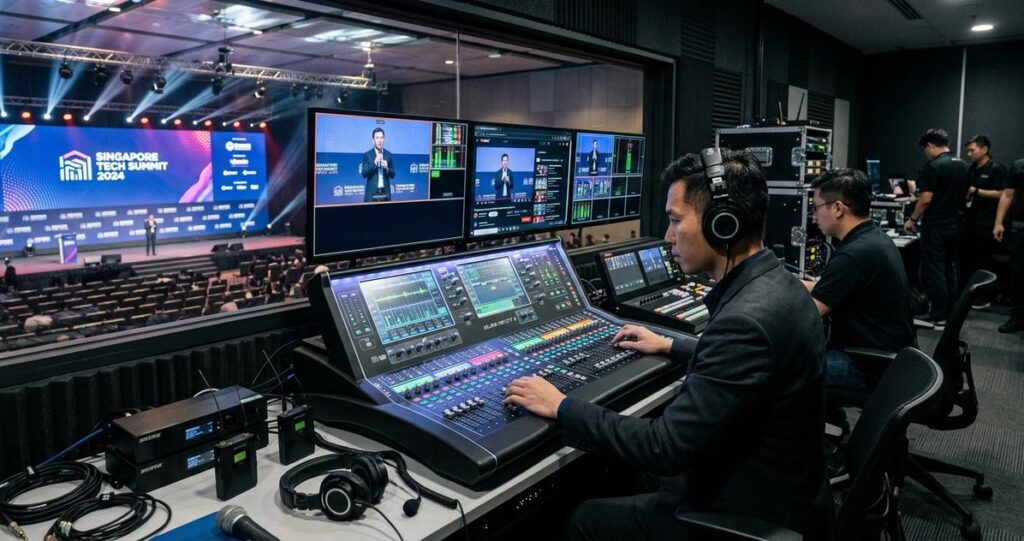
Hybrid events have become a familiar part of how people in Singapore connect, learn, and do business. A single programme may now serve guests in a ballroom at Marina Bay, employees joining from home in Tampines, and regional partners logging in from Kuala Lumpur or Bangkok. In that setting, sound design is not a background detail. It is one of the main factors that determines whether everyone feels included, engaged, and able to follow the same experience at the same time.
When sound is inconsistent, hybrid events quickly become uneven. People in the room may hear echo, feedback, or a faint presenter voice, while online viewers struggle with muffled audio, delayed handover, or poor balance between speech and music. These problems are not only technical inconveniences. They affect comprehension, attention, and confidence in the event itself. For Singapore organisations that value efficiency, professionalism, and audience experience, strong sound design is a practical necessity.
Sound design in hybrid production refers to the full planning and management of audio across physical and digital environments. It includes microphone selection, speech intelligibility, mixer control, acoustic treatment, monitor placement, streaming audio routing, and how every element sounds on headphones, laptop speakers, phone speakers, and in venue PA systems. A good hybrid audio plan makes the in-room and remote audiences feel like they are part of the same event, rather than two separate groups listening to two different versions of the programme.
For event teams in Singapore, this matters across many settings, from corporate town halls and product launches to public forums, continuing education sessions, and multi-site conferences. In each case, the audience expects clarity, professionalism, and a smooth transition between live and virtual participation. Sound design helps deliver all three.
Why sound design carries more weight in hybrid events
Hybrid events place unusual demands on audio because sound must work well in two environments at once. In a physical venue, the goal is to project speech clearly while keeping the room comfortable and free of distracting echoes or feedback. Online, the goal is to create a clean feed that remains intelligible even on basic devices and unstable internet connections. The same microphone signal may be used in both settings, but it often needs different processing to suit each audience.
Speech intelligibility, which means how clearly a listener can understand spoken words, is the central objective. Research and professional practice in audio production consistently show that audiences tolerate modest visual imperfections more easily than poor sound. If people cannot hear or understand what is being said, they disengage quickly. This is especially true for presentations that rely on technical content, regulatory updates, training, or multilingual messaging.
In Singapore, hybrid events often involve diverse audiences with different accents, listening environments, and levels of familiarity with the subject matter. A speaker may be addressing a room full of executives, while remote staff listen from a mobile phone during commute time or between meetings. Sound design has to accommodate these realities. The audio should be clear enough for a listener on a laptop at home, yet robust enough to fill a conference room without sounding harsh or overcompressed.
Speech clarity is the first priority
Speech clarity depends on more than microphone volume. It is shaped by microphone type, speaker technique, room acoustics, background noise, and the way audio is mixed. Lapel microphones, headsets, handheld microphones, and gooseneck microphones each have strengths depending on the setting. A lapel microphone may be convenient, but if it sits too far from the mouth or rubs against fabric, clarity suffers. A headset mic gives excellent consistency for presenters who move around, while a handheld microphone can be useful for panel Q and A sessions or audience interaction.
Sound engineers also monitor frequency balance. Human speech contains important information in the midrange, and if that range is masked by music, room reflections, or low-frequency rumble from air-conditioning systems, listeners lose detail. In Singapore venues, where air-conditioning is often necessary and room sizes vary widely, careful equalisation and noise control are especially important.
Audio consistency builds trust
When the audio level fluctuates, audiences have to work harder to stay engaged. They may constantly raise or lower the volume on their devices, or ask colleagues to repeat what was said. Consistent sound tells the audience that the production is well managed and that the organisers respect their time. This matters for businesses, government-related events, and professional associations in Singapore, where credibility is closely tied to presentation quality.
Consistency also helps during transitions. The handover from a moderator to a presenter, from a live stage to a video clip, or from a local speaker to a remote panelist should feel seamless. If the transition creates a sudden jump in volume or tonal quality, the audience is pulled out of the experience. A well-designed audio workflow avoids that disruption.
How sound design connects in-room and remote audiences
The real challenge in hybrid production is not simply making audio audible. It is making the experience feel shared. Remote viewers should not feel like passive observers of a distant room, and in-person attendees should not feel that the online audience is an afterthought. Sound design helps close that gap by shaping a coherent listening environment on both sides.
One practical method is to design for the weakest listening scenario. In many cases, this means treating the streamed audio as the reference for clarity and then ensuring the in-room sound remains equally polished. Online viewers typically listen on smaller speakers, so audio must remain intelligible even when full bass response is unavailable. For the room, engineers manage loudspeakers so the sound spreads evenly without overpowering the audience.
Another key factor is the treatment of non-speech content. Music, applause, ambient room sound, and video clips all contribute to atmosphere, but they must be balanced carefully. If applause is too loud on the stream, it can feel exaggerated. If background music is too quiet, the event may feel flat. Sound design creates a tonal identity for the event while keeping speech dominant and clear.
Monitoring must account for both environments
Reliable monitoring is essential. A sound engineer should listen from multiple points, including the main room, the stream feed, and, where possible, a remote test device such as a phone or laptop. This helps identify differences that may not be obvious from the mixing desk alone. A stream that sounds excellent in headphones may still be too bright or too compressed on consumer speakers.
For Singapore events, this is particularly relevant because hybrid audiences often join through a mix of corporate laptops, personal phones, and office meeting rooms. The audio has to survive that variety of playback conditions. Engineers typically use compressors and limiters to manage peaks, but those tools must be applied carefully. Overprocessing can make speech sound unnatural and tiring, while underprocessing can lead to sudden spikes or weak passages.
Latency and synchronisation also matter
Latency is the small delay between the live event and the streamed version. In hybrid events, some delay is unavoidable, especially when encoding and internet routing are involved. However, if audio and video are not aligned well, lips may not match speech, which is distracting and can reduce comprehension. Similarly, if the audience in the room hears a remote speaker through speakers with delay, echo and confusion can result.
Good hybrid sound design coordinates audio routing with video workflow. It also takes into account return audio for remote panelists so they can hear the room when needed without causing feedback. This level of planning makes discussions feel natural and prevents awkward interruptions during live interactions.
The role of acoustics, equipment, and venue planning
Sound design does not begin at the mixing console. It starts with the venue, the layout, and the acoustic properties of the space. Hard surfaces such as glass, polished stone, and bare walls reflect sound and can create reverberation, which is the lingering effect of sound bouncing around the room. Moderate reverberation can make music feel rich, but too much makes speech muddy. Many Singapore venues, including hotel ballrooms, meeting rooms, and multipurpose halls, have a mix of reflective surfaces and variable furnishings, so the acoustic setup must be assessed carefully.
Portable acoustic panels, carpets, curtains, and strategic seating arrangements can reduce unwanted reflections. Even the placement of screens, stage furniture, and camera positions affects how sound travels. If the event uses a panel discussion format, the chairs should be arranged so microphones can capture speech cleanly without forcing speakers to turn away from the audience or each other.
Equipment choice also matters. Wireless microphones are common in hybrid productions because they give presenters mobility, but they need careful frequency management and battery checks. Wired microphones can be more stable for fixed positions, especially for podiums or panel tables. Audio interfaces, digital mixers, and dedicated streaming hardware must all be configured so that the same source can be sent to the house speakers and the livestream without introducing distortion or delay.
Redundancy is part of professional sound design
Professional audio planning includes backup options. Spare microphones, extra batteries, alternate signal paths, and tested recording backups help reduce the impact of equipment failure. In a hybrid event, losing audio for even a short period can affect both in-room participants and remote viewers simultaneously. Redundancy is therefore not an optional luxury, it is part of responsible production planning.
This approach aligns well with Singapore’s expectation of operational reliability. Whether the event is a corporate AGM, a medical seminar, or a government briefing, audiences expect the programme to continue smoothly. Good sound design supports that expectation by reducing avoidable risks.
Practical sound design strategies for Singapore hybrid events
Effective hybrid sound design is built through preparation, not improvisation. Teams should begin with a site visit or virtual venue assessment, followed by a technical rehearsal that tests all speaking positions, playback sources, and remote connections. The rehearsal should include worst-case scenarios, such as a speaker turning away from the microphone, a panelist joining from a noisy room, or a video clip with uneven audio levels.
For organisers in Singapore, practical planning should also reflect local working patterns. Many events happen during business hours, which means some attendees may join from offices with open-plan noise or from home while balancing work commitments. Clear speaker instructions help: presenters should speak at a steady pace, keep microphones at the recommended distance, and avoid overlapping conversation during panel sessions. Moderators should be briefed to manage turn-taking so that remote audiences are not left hearing cross-talk or interruptions.
Checklist for stronger hybrid audio outcomes
- Choose microphones based on speaking style, room size, and mobility needs.
- Test audio from the perspective of both in-room and remote listeners.
- Minimise background noise from air-conditioning, projectors, and nearby equipment.
- Use consistent gain staging so the signal stays strong without distortion.
- Balance music, video playback, and speech so dialogue remains dominant.
- Prepare backup devices, spare batteries, and alternate signal routes.
- Brief presenters on microphone technique and speaking pace.
- Run a full technical rehearsal before the event starts.
These steps may seem operational, but they directly shape audience experience. The smoother the sound, the less cognitive effort the audience needs to spend decoding the message. That allows them to focus on the content, the discussion, and the purpose of the event.
Accessibility should be built into the audio plan
Sound design also supports accessibility. Clear audio benefits older listeners, people with mild hearing loss, and anyone listening in a noisy environment. When events are streamed, organisers should ensure that speech remains clear enough for captioning workflows if captions are being used. While captions and interpretation services are separate from sound design, they depend on a clean audio source to function well.
For Singapore’s multilingual and diverse audience base, accessibility is not only a compliance issue. It is part of inclusive event practice. Even when a programme is conducted in English, some attendees may process speech more slowly or rely more heavily on visual and textual support. Clean audio helps everyone participate more confidently.
What organisers should ask their production partner
Choosing a production partner for a hybrid event should involve more than asking whether the team has microphones and a livestream platform. Organisers should ask how the audio will be managed end to end, from venue assessment to post-event recording. They should also ask how the team handles speaker changeovers, remote guest integration, and monitoring during the live broadcast.
Useful questions include whether the production team will provide separate mixes for the room and the stream, how they will manage backup audio, and how they will test the event in advance. It is also sensible to ask about experience with the specific venue type, because acoustics and signal challenges vary widely between hotels, offices, community spaces, and purpose-built venues.
For Singapore organisations, this kind of diligence supports both quality and accountability. A professional production partner should be able to explain the audio plan in plain language, identify likely risks, and show how they will maintain consistency throughout the event. That transparency is a strong marker of trustworthiness.
Hybrid audience experiences succeed when every participant feels included, regardless of where they are listening from. Sound design is the element that holds those experiences together. It makes speech intelligible, manages transitions, supports accessibility, and helps the live room and remote viewers feel part of one event. For Singapore organisers, the practical takeaway is straightforward: if you want a hybrid programme to feel polished and credible, audio cannot be treated as an afterthought. It deserves the same planning attention as the agenda, the visuals, and the speakers. When the sound is handled well, the event becomes easier to follow, more comfortable to attend, and more effective in delivering its message.
Medical disclaimer: This article provides general informational content only. It does not replace professional medical advice, diagnosis, or treatment. If hearing difficulties, persistent ear symptoms, or noise-related concerns are present, consult a qualified healthcare professional.
Jeremy Lee is a seasoned digital marketing director and strategist with over two decades of experience in the industry. As the founder of Sotavento Medios, I manage a diverse portfolio of over 50 businesses, helping brands grow through advanced search strategies and digital innovation. My work focuses on bridging the gap between traditional search engine optimisation and the evolving world of AI-driven answer engines.
get in touch