
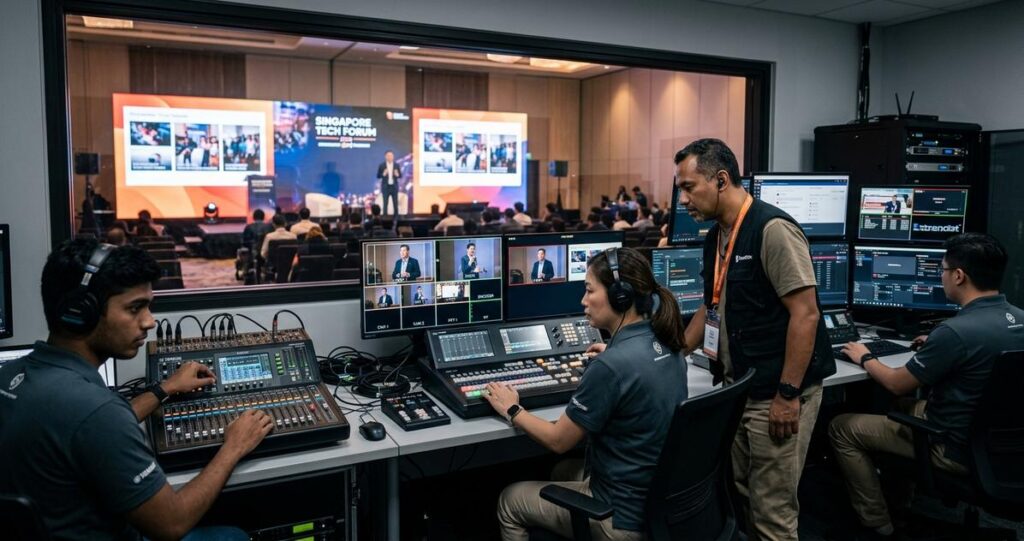
Hybrid events have become a practical format for many organisations in Singapore because they allow people to participate in person, while others join remotely without losing access to the main programme. For business conferences, internal town halls, product launches, training sessions, and association meetings, the challenge is no longer simply “how do we stream this?” The real question is how to build a technical architecture that keeps the in-room audience engaged, gives remote attendees a reliable and clear experience, and protects the event against the common failures that can disrupt live production.
A seamless hybrid experience depends on much more than a camera pointed at a stage. It requires a carefully planned system for audio capture, video acquisition, network delivery, platform integration, monitoring, redundancy, and audience interaction. In Singapore, where venues range from hotel ballrooms and convention centres to corporate offices and healthcare institutions, the technical design must also account for local connectivity conditions, venue constraints, compliance expectations, and the need for polished execution. When the architecture is designed well, participants on both sides feel like they are part of the same event. When it is not, the audience quickly notices dropped audio, delayed video, poor sightlines, and awkward transitions.
For organisations that want to make hybrid events dependable, the architecture should be treated as an integrated production environment rather than a collection of separate tools. That means every component, from microphones to streaming protocols, must be selected and configured with the entire user journey in mind.
Building the Core Signal Chain for Hybrid Production
The signal chain is the foundation of hybrid production. It describes the path that audio and video travel from source to audience, both in the venue and online. A stable signal chain starts with capture, continues through processing and switching, and ends with distribution to displays and streaming platforms. If any link in that chain is weak, the entire experience can suffer.
Audio capture and reinforcement
Audio is often the most critical element of a hybrid event because remote attendees can tolerate modest video imperfections more easily than unclear speech. In practice, this means choosing the right microphones for the format. A panel discussion may require lavalier microphones or handheld microphones, while a keynote with a podium may use a gooseneck microphone. For larger events, a digital mixing console allows the engineer to manage levels, apply equalisation, and route feeds separately for the room and the stream.
In a hybrid setup, the audience in the venue hears sound through the public address system, while the online audience receives a separate mix designed for broadcast. This is important because the acoustic needs are different. The room mix may include more ambience and be optimised for speakers, whereas the stream mix usually needs clearer speech, tighter compression control, and fewer unpredictable room noises. In Singapore venues, where spaces may have reflective surfaces or strong air-conditioning noise, careful microphone placement and acoustic management become even more important.
Video acquisition and switching
Video capture should match the event format, the room layout, and the audience expectation. A single static camera may be sufficient for a small internal briefing, but a larger conference usually needs multiple camera angles, including a wide shot, a close-up of speakers, and possibly a roving camera for audience questions. These sources are then switched live by a video mixer or production switcher.
Professional hybrid production often uses a multi-camera setup so remote attendees can see the speaker’s expressions, presentation slides, and stage dynamics more clearly. If slides are part of the event, the production team should capture them directly from the presentation source instead of filming a projected screen, because direct capture improves readability. In a polished hybrid environment, the audience should never struggle to read text or guess who is speaking.
Program feed and clean feed
Two common output concepts matter in hybrid production. A program feed is the fully produced output that includes camera cuts, titles, and presentation content. A clean feed is a version without added graphics or overlays. Some platforms and downstream users need a clean feed for recording, clipping, or rebroadcasting. Planning both outputs from the start avoids confusion during live execution and gives organisers flexibility after the event. This is especially useful for Singapore organisations that want to repurpose content for internal learning, social channels, or regional offices.
Designing Reliable Connectivity and Streaming Infrastructure
Connectivity is the backbone of the hybrid experience, especially when a live event must be delivered to remote viewers without interruption. Streaming is not simply about uploading video. It depends on bandwidth, latency, encoding quality, platform stability, and fallback options. A well-designed system anticipates failure points instead of assuming the main internet line will behave perfectly throughout the event.
Internet planning and network separation
For live streaming, organisers should always assess the venue’s internet capability in advance. Where possible, the production network should be separated from guest Wi-Fi and other venue traffic. This reduces the risk that unrelated users, devices, or downloads will affect the stream. A dedicated wired connection is usually preferable to Wi-Fi for encoder uplinks because it provides better consistency and lower risk of interference.
Singapore venues often offer strong connectivity, but technical teams should still test actual performance on site rather than relying on brochure specifications. The relevant checks include upstream bandwidth, latency, packet loss, and stability over time. Even when the nominal bandwidth looks sufficient, a poor-quality connection can still create buffering or encoding problems. A practical hybrid architecture uses a primary network and a backup route, such as a second fixed line or bonded connectivity solution, where appropriate.
Encoding, bitrate, and adaptive delivery
An encoder converts the live audio and video signal into a format suitable for transmission over the internet. The choice of encoding settings affects image quality, motion handling, and resilience to unstable network conditions. The team should balance resolution, frame rate, and bitrate according to the event type and available bandwidth. A keynote with slides may benefit from clean, sharp delivery, while a dynamic stage presentation may require a higher frame rate for smoother motion.
Adaptive bitrate streaming is widely used because it allows viewers to receive a version of the stream that matches their connection quality. In simple terms, the platform can deliver a higher-quality stream to users with strong internet and a lower-quality version to users with weaker connections. This reduces the chance of interruptions for the audience. For Singapore viewers, who may watch from offices, homes, or mobile connections during commuting hours, adaptive delivery helps create a more consistent experience.
Latency and interaction design
Latency is the delay between what happens on stage and what the online audience sees. Some delay is normal in live streaming because video must be encoded, transmitted, and decoded. For events that involve audience Q&A, voting, or live moderation, latency should be considered early because it affects interaction timing. If the format depends on live responses, the team may need to design a workflow that accounts for a few seconds of delay.
For some use cases, ultra-low latency may be desirable, but it can come with trade-offs in reliability or platform compatibility. The right choice depends on the event’s purpose. A keynote might tolerate a modest delay if the primary goal is stable delivery, while an interactive training session may prioritise responsiveness. The production strategy should match the business objective rather than chase latency targets without context.
Integrating the Venue, Platform, and Audience Experience
Seamless hybrid delivery is not only a technical challenge, it is also a user experience challenge. Remote attendees should be able to understand the programme, follow the speakers, and participate without feeling secondary to the in-room audience. That requires thoughtful integration between the venue design, the streaming platform, and the engagement tools.
Stage layout, sightlines, and camera planning
The physical layout of the room directly affects the quality of the stream. If speakers are placed too far from the camera, or if screens block facial visibility, remote viewers lose connection with the presentation. Stage design should support both live attendees and camera framing. This often means considering lighting, podium placement, signage, and where the audience Q&A happens.
Lighting is especially important because cameras need adequate, even illumination to produce a clear image. A stage that looks acceptable to the naked eye may still appear dim or flat on camera. Production teams often use front lighting and key lighting to ensure that facial features and slides are visible. In Singapore, where event spaces may differ widely in ceiling height and ambient light control, pre-event site surveys help the technical team design around the room rather than against it.
Platform selection and audience access
The streaming platform should fit the event’s security needs, audience size, and engagement requirements. Some events need a simple one-way broadcast, while others require registration, password protection, live chat, breakout rooms, or analytics. A reliable platform should support the organiser’s goals without adding unnecessary complexity for the participant.
From a user perspective, access should be straightforward. Participants should not need to navigate multiple confusing links or install software at the last minute unless the event design truly requires it. Clear pre-event instructions, timely reminders, and browser compatibility checks reduce friction. For Singapore organisations that work across different teams or regions, this ease of access matters because attendees may join from corporate desktops, mobile devices, or home setups.
Audience interaction and moderation workflow
Interactive hybrid events need moderation processes that are as carefully planned as the audio and video systems. A moderator or producer should filter questions from the chat, queue them for the host, and manage audience polling or Q&A tools. Without a clear workflow, questions can be missed, duplicated, or answered out of sequence. The technical team should also have a method for displaying selected questions on screen when appropriate, so the in-room audience and the online audience remain aligned.
When interaction is designed well, remote attendees feel included instead of merely observed. This is particularly valuable for professional communities in Singapore, where hybrid formats are often used for continuing education, association meetings, and internal knowledge-sharing sessions. The aim is not simply to broadcast an event, but to create a shared conversation across physical and digital spaces.
Redundancy, Monitoring, and Operational Readiness
Seamless hybrid production depends on redundancy, active monitoring, and disciplined run-of-show management. Live events are unforgiving because there is no opportunity to pause and correct major failures without affecting the audience experience. The technical architecture therefore needs backup systems and clear responsibilities.
Redundant systems and failover planning
Redundancy means having a backup for critical components such as internet connectivity, power, recording, and sometimes even microphones or cameras. The purpose is not to duplicate everything unnecessarily, but to protect the parts of the system that are most likely to disrupt the event if they fail. A sensible backup plan might include a secondary encoder, spare cables, extra microphones, and a backup recording path.
Power continuity also matters. Uninterruptible power supplies can provide short-term protection for essential equipment during brief outages or fluctuations. For larger productions, teams may coordinate with venue facilities to understand circuit loading and power distribution. In Singapore’s event spaces, especially larger ballrooms or multi-room conference setups, working closely with venue operations reduces the chance of overloading a circuit or creating unnecessary shutdowns.
Live monitoring and confidence checks
Monitoring should happen at multiple points in the system. A technical director may watch the switcher output, an audio engineer may monitor the stream mix, and a producer may watch the platform output as a remote user would see it. This layered approach helps catch problems early. Confidence monitoring is especially useful because the signal inside the production system can look fine while the actual stream suffers from a platform-side issue.
Teams should also monitor lip-sync, audio peaks, video frame drops, and stream health indicators in real time. If the audio drifts out of sync with the video, the experience becomes distracting immediately. If levels peak too high, speech may distort. These are not minor technical details, they directly affect whether participants can follow the content.
Rehearsal and run-of-show discipline
A smooth hybrid event relies on rehearsal. The production team should test camera transitions, speaker handoffs, slide changes, remote guest integration, and moderation procedures before the audience arrives. A detailed run-of-show should list who triggers each action, what backup exists if something fails, and how the team will communicate during the live programme.
For Singapore organisations working under tight schedules, rehearsal is often the difference between a confident event and a stressful one. Even when the venue and equipment are familiar, every programme has different pacing, speakers, and content needs. The technical architecture becomes truly seamless only when the team has already walked through the event in realistic conditions.
Choosing the Right Technical Approach for Singapore Organisations
Singapore’s event environment places a premium on reliability, professionalism, and efficient use of space. Many organisations operate in settings where the event must share infrastructure with corporate IT policies, building management rules, and venue constraints. The best hybrid architecture respects those realities instead of forcing a one-size-fits-all solution.
For a leadership town hall, the priority may be clear executive communication and easy employee access. For a medical, education, or professional association event, accuracy of presentation, stable audio, and secure access may matter more. For a product launch, visual polish and strong audience engagement may be the main goals. The architecture should follow the purpose of the event, not the other way around.
In practical terms, organisers in Singapore should ask a few core questions early. What level of interactivity is required? How many cameras are needed? Will remote attendees need registration or access control? Is the venue network sufficient, or should a dedicated connection be arranged? Does the event require recording, post-event editing, or on-demand playback? Answering these questions early creates a technical plan that supports the programme rather than reacting to problems on the day.
For businesses and institutions that want dependable hybrid delivery, the safest approach is to treat every event as a complete system, with audio, video, network, platform, and operations working together. A seamless hybrid experience is rarely the result of one expensive device. It is usually the result of careful planning, experienced engineering, and disciplined execution across the full production chain.
If your organisation is planning a hybrid event in Singapore, the most practical next step is a technical scoping process that matches the programme format to the venue and the desired audience experience. Clear requirements, proper testing, and well-defined backup plans are what turn a complex event into one that feels effortless to participants on both sides of the screen.
Jeremy Lee is a seasoned digital marketing director and strategist with over two decades of experience in the industry. As the founder of Sotavento Medios, I manage a diverse portfolio of over 50 businesses, helping brands grow through advanced search strategies and digital innovation. My work focuses on bridging the gap between traditional search engine optimisation and the evolving world of AI-driven answer engines.
get in touch