

The Unforgiving Nature of Latency in Governed Proceedings
In the world of corporate governance and statutory meetings, precision is not a luxury; it is a legal and operational necessity. When shareholder votes are cast, when board members table motions, or when annual general meetings (AGMs) are conducted in a hybrid format, the integrity of the proceeding hinges on real-time, bidirectional communication. This is where the technical discipline of latency management becomes paramount. For a corporate event planner or an IT director, understanding latency goes beyond just preventing a buffered video stream. It is about ensuring the legal validity and procedural fairness of events where outcomes have significant financial and regulatory consequences. A delay of several seconds, perfectly acceptable for a public-facing webinar, can invalidate a motion or create critical confusion during a moderated Q&A session for a statutory vote. This is not entertainment; it is a governed process executed over a complex production infrastructure.
The core challenge lies in architecting a glass-to-glass workflow where the time from an action in the room, such as a chairperson speaking, to its reception by a remote participant is minimized to a sub-second threshold. Simultaneously, the system must accommodate a return path for interaction, such as a remote vote or a question, that is equally responsive. This requires a deep understanding of the entire signal chain, from the camera sensor and microphone diaphragm to the production switcher, the encoding pipeline, network transport protocols, and the final playback device. At Spring Forest Studio, our engineering approach is built on mastering this chain to deliver hybrid event productions that meet the stringent demands of statutory proceedings, ensuring every participant, whether in-person or remote, can interact with true real-time immediacy.
Deconstructing the Latency Chain in Hybrid Event Production
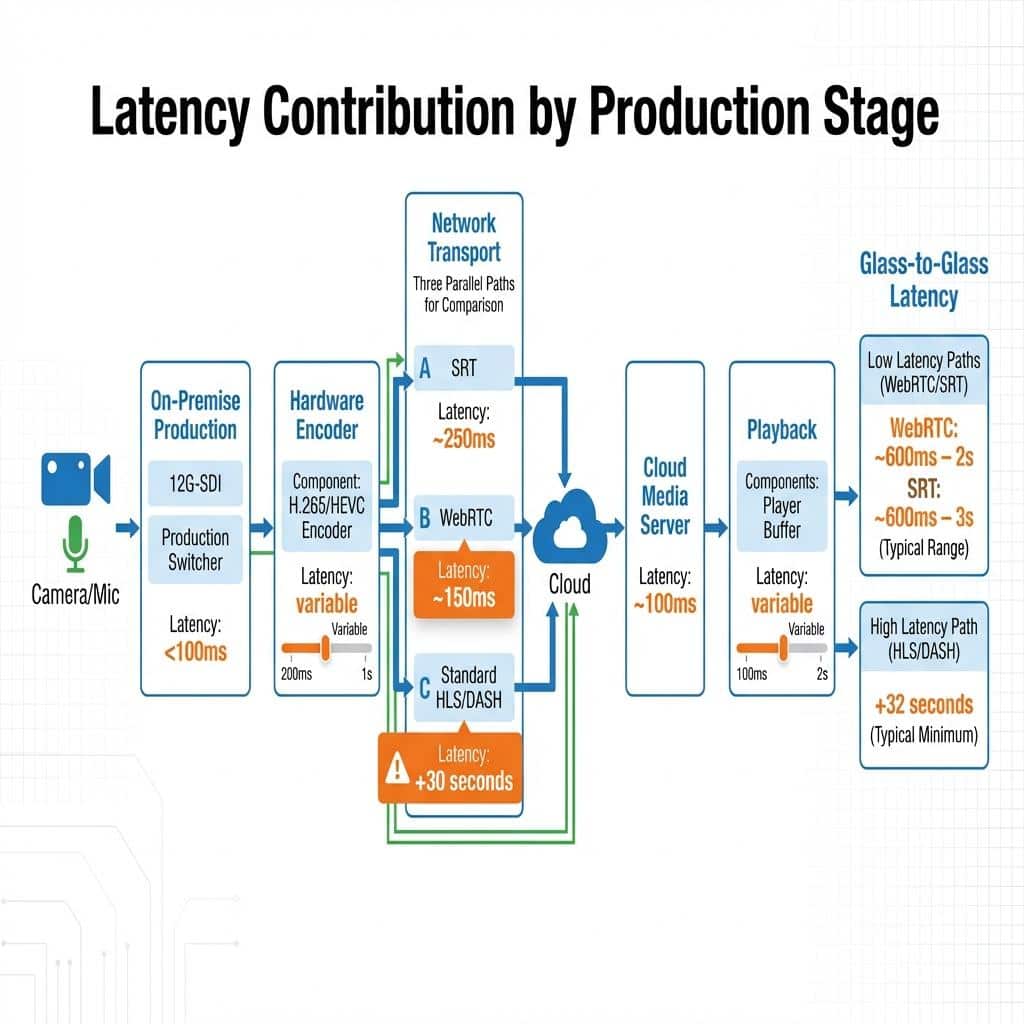
To effectively mitigate latency, one must first identify its sources. Latency is cumulative; it is introduced at nearly every stage of the live production and streaming workflow. The total delay, often referred to as glass-to-glass latency, is the sum of these individual processing steps. For legally binding events, a target of under 500 milliseconds (ms) is often the benchmark for enabling natural, conversational interaction and synchronized voting.
Photon-to-Packet: On-Premise Signal Acquisition and Processing
The journey begins the moment light hits the camera sensor. Professional broadcast cameras have minimal processing delay, typically under one frame (about 16.7ms for 59.94fps). The signal is then transported, commonly via Serial Digital Interface (SDI), a robust baseband video transport standard. A 12G-SDI connection can carry an uncompressed 4K UHD signal at 60fps with virtually zero latency. This signal then arrives at a production switcher, like a Ross Carbonite or Blackmagic ATEM Constellation. The switcher itself introduces a small amount of processing delay, usually one to two frames, as it handles keying, effects, and routing. From the switcher, the program feed is routed to an encoder. This initial on-premise segment of the signal chain, from camera to the encoder input, typically contributes less than 100ms of latency in a well-architected system.
The Encoding and Transport Bottleneck
Encoding is often the most significant point of latency introduction. The encoder must compress the large, uncompressed SDI video signal into a more manageable format like H.264 or H.265 (HEVC) for transmission over an IP network. This process involves complex algorithms. The encoder’s configuration, specifically the Group of Pictures (GOP) size, directly impacts latency. A smaller GOP size, which means more frequent I-frames (full picture references), results in lower latency but requires higher bandwidth. For ultra-low latency applications, we often configure encoders with a very short GOP, sometimes as low as one second. The choice of transport protocol for sending the encoded video from the venue to the cloud media server or content delivery network (CDN) is the next critical decision. This is where protocols like RTMP, SRT, and WebRTC present vastly different performance characteristics.
Distribution and Playback: The Final Mile
Once the stream reaches a media server, it must be prepared for distribution to potentially thousands of remote participants. Traditional HTTP-based protocols like HLS (HTTP Live Streaming) and DASH (Dynamic Adaptive Streaming over HTTP) are designed for scalability and reliability, not low latency. They work by breaking the video into multi-second chunks. A player must download several chunks before starting playback, creating a buffer that results in latencies of 20 to 45 seconds. This is completely unacceptable for interactive voting. Therefore, statutory event workflows must bypass these protocols in favor of a low-latency distribution architecture, often leveraging WebRTC or low-latency HLS implementations, to deliver the stream to the end-user’s device. The player buffer on the client side is the final piece, which must be kept to a minimum to preserve the real-time nature of the feed.
Protocol Selection for Real-Time Interactivity
The choice of streaming protocol is the single most important factor in determining the latency profile of a hybrid event. There is no one-size-fits-all solution; the optimal choice depends on the specific leg of the journey, whether it is for contribution (from venue to cloud) or distribution (from cloud to viewer). For statutory voting, a multi-protocol approach is often required to achieve the necessary interactivity.
SRT: The Backbone for Reliable Contribution
Secure Reliable Transport (SRT) has become an industry standard for high-quality, low-latency video contribution over unpredictable networks like the public internet. Developed by Haivision, SRT is an open-source protocol that provides the reliability of TCP (Transmission Control Protocol) over the low-latency, high-performance foundation of UDP (User Datagram Protocol). It uses an intelligent ARQ (Automatic Repeat reQuest) mechanism to retransmit only the lost packets, making it far more efficient than TCP’s error correction. This allows for stable, secure transmission with latencies as low as 120ms. For a hybrid AGM, we would use SRT to transport the primary program feed from a hardware encoder at the event venue to our cloud media server. This ensures a broadcast-quality, stable signal arrives for further processing and distribution, forming the reliable backbone of the entire event.
WebRTC: The Gold Standard for Interactivity
When sub-500ms latency is the absolute requirement for real-time interaction, WebRTC (Web Real-Time Communication) is the definitive solution. WebRTC is a peer-to-peer protocol built directly into modern web browsers, designed for ultra-low latency video conferencing and data exchange. For a statutory voting event, we leverage WebRTC in two critical ways. First, for distribution to viewers, a WebRTC-based CDN can deliver the main program feed with near-instantaneous speed, allowing remote attendees to see and hear proceedings as they happen. Second, and more importantly, WebRTC provides the return path. When a remote board member needs to join the discussion, their camera and microphone feed can be brought into the main production switcher via a WebRTC connection. This allows for a seamless, broadcast-quality integration of remote participants, enabling them to engage in natural, un-delayed conversation with those on-site. This is the technology that powers true hybrid interaction.
RTMP: A Legacy Protocol for Ingest
Real-Time Messaging Protocol (RTMP) was once the dominant standard for streaming. While it is being superseded by newer protocols like SRT, it remains a common ingest option for many social media platforms and some legacy systems. RTMP is TCP-based, which can introduce latency due to its strict packet ordering and error-checking methods. Typical RTMP latency is in the 2-5 second range. For a high-stakes statutory event, we would avoid using RTMP for any critical contribution or distribution path. Its use is generally limited to scenarios where a specific endpoint only accepts RTMP ingest and a few seconds of delay is tolerable for that specific destination, which is rarely the case in governed proceedings.
Architecting the End-to-End Low-Latency Infrastructure
A successful low-latency stream for statutory voting is the result of a meticulously designed and integrated system, not just a single piece of technology. This system must account for signal acquisition, processing, transport, and bidirectional communication with absolute reliability.
Hybrid Production Control Room Design
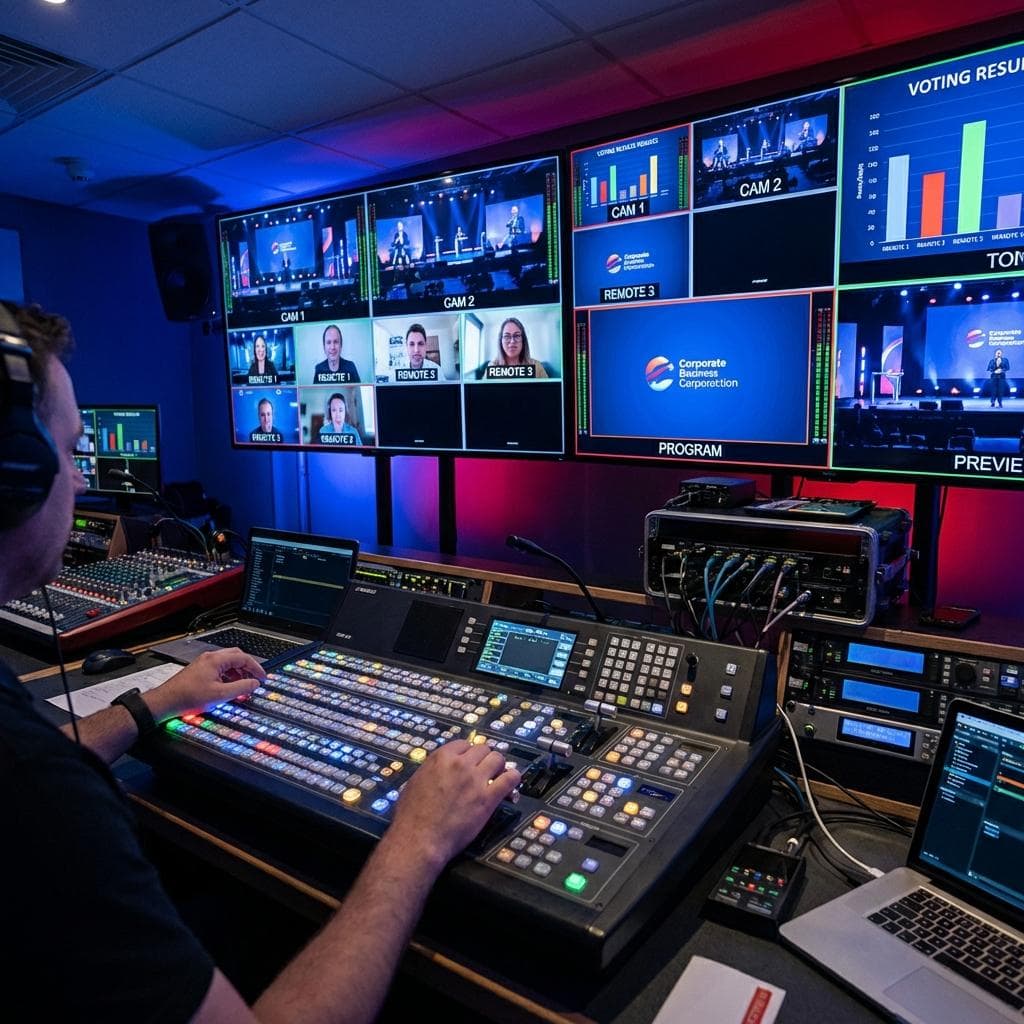
The physical production environment is the foundation. Our control rooms are built around a core of SDI and Network Device Interface (NDI) infrastructure. NDI allows for the transport of high-quality, low-latency video over a standard Gigabit Ethernet network, providing immense flexibility in routing signals from cameras, graphics systems, and WebRTC return feeds into the production switcher. A powerful video switcher is essential for managing multiple on-site cameras and remote participant feeds delivered via WebRTC. Audio is managed via a digital audio console, often using Dante for networked audio transport. A critical component is the mix-minus setup for each remote participant, which sends them a custom audio mix of the program feed minus their own microphone, preventing echoes and feedback and enabling clean, interruptible dialogue.
Redundancy and Failover Strategy
For any statutory event, failure is not an option. Our infrastructure is designed with full redundancy. This includes using primary and backup hardware encoders, often from different manufacturers to protect against firmware-level bugs. Network connectivity is achieved through bonded cellular solutions (combining multiple cellular carriers) alongside dedicated fiber internet connections, ensuring a stable path for the SRT contribution feed. In the cloud, we run redundant media server instances in different availability zones. A seamless failover system is in place, which can automatically switch to the backup path with no disruption to the end viewer. This multi-layered approach to redundancy ensures the production remains on-air even in the event of a critical equipment or network failure.
Integrating the Voting and Q&A Platform
The final piece of the puzzle is the synchronization of the ultra-low latency video stream with the interactive voting or Q&A platform. This requires close collaboration with the platform provider. The goal is to trigger voting or open a Q&A poll on the platform at the precise moment the corresponding action is seen in the video stream. With sub-second latency, this synchronization is achievable. The platform is typically delivered as a web-based overlay or an adjacent panel to the video player. API calls are used to pass data, such as voting results, back to the production team, allowing them to be displayed as on-screen graphics in real time. This tight integration closes the loop, creating a single, cohesive, and legally defensible hybrid event experience where every action and interaction occurs in the moment, without perceptible delay.

Jeremy Lee is a seasoned digital marketing director and strategist with over two decades of experience in the industry. As the founder of Sotavento Medios, I manage a diverse portfolio of over 50 businesses, helping brands grow through advanced search strategies and digital innovation. My work focuses on bridging the gap between traditional search engine optimisation and the evolving world of AI-driven answer engines.
get in touch