
Introduction: The High-Stakes Environment of R&D Streaming
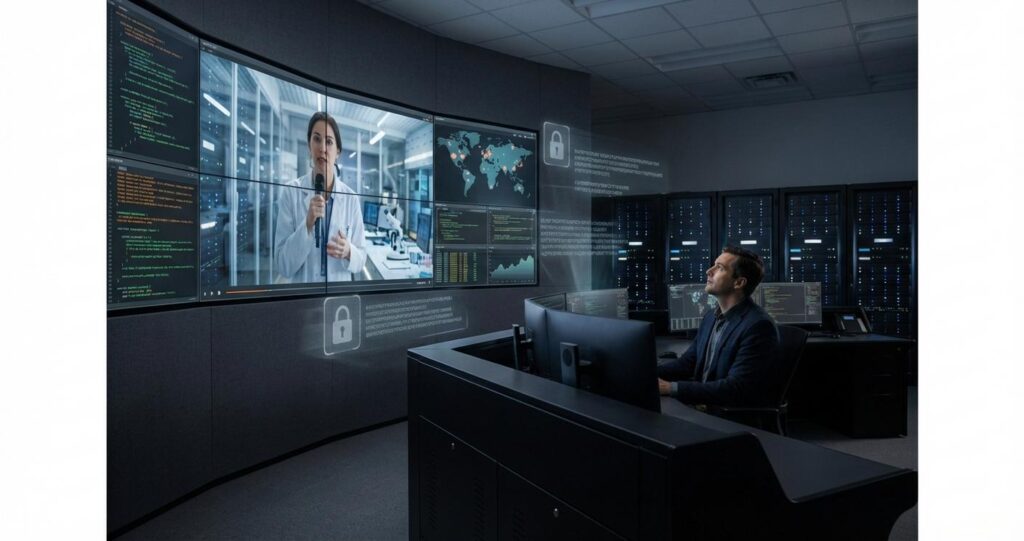
For organizations in technology, pharmaceuticals, manufacturing, and defense, the virtual research and development showcase is a mission-critical event. These are not standard corporate webcasts; they are the controlled unveiling of sensitive intellectual property, representing significant investment and competitive advantage. The financial and reputational damage from a leak, whether to a competitor or the public, can be catastrophic. Standard enterprise video conferencing platforms, while suitable for general communication, lack the robust, multi-layered security architecture required to protect high-value IP. A comprehensive security posture demands a broadcast-level approach that integrates production infrastructure, transport protocols, and enterprise-grade access control. This framework, executed by a professional production team, provides the necessary technical safeguards to ensure that pre-launch products, proprietary data, and strategic roadmaps remain confidential. This is not a matter of simple password protection; it requires a deep understanding of signal flow, encryption, and digital rights management, from the camera lens to the authenticated viewer screen.
Foundational Security: Building a Secure Streaming Architecture
The foundation of any secure streaming event is an architecture designed to minimize attack surfaces at every stage of the signal chain. Protecting intellectual property begins long before the stream reaches the public internet. It starts with the physical and network infrastructure where the content is captured and prepared for transmission. Every component, from the camera output to the contribution encoder, must be part of a controlled and secured environment.
Ingress Security: From Camera to Encoder
The initial signal path, or ingress, is the first opportunity for compromise. In a professional production environment, we prioritize hard-wired, high-bandwidth connections. The industry standards are Serial Digital Interface (SDI), a coaxial-based cabling standard capable of carrying uncompressed video data up to 12Gbps for 4K UHD signals, and increasingly, IP-based workflows like NDI (Network Device Interface). While NDI offers incredible flexibility, for a maximum-security event, the production network must be physically isolated or configured on a dedicated Virtual LAN (VLAN) with strict access control lists (ACLs) to prevent any unauthorized devices from accessing video sources. Utilizing broadcast standards like SMPTE 2110 for uncompressed video over IP offers even greater control in high-end studio environments, but requires significant network infrastructure, typically 10GbE or higher. This physically contained signal chain ensures that the raw, unencrypted video feeds are never exposed to the corporate LAN or the public internet, mitigating the risk of internal snooping or network-based attacks at the source.
Transport Protocol Selection: SRT vs. RTMPS
Once the program feed leaves the production switcher, it must be securely transported to the cloud origin or streaming platform. This is the first major handoff point and a critical security boundary. While RTMPS (Real-Time Messaging Protocol Secure) provides a TLS/SSL encryption layer, the superior choice for high-value contribution feeds is Secure Reliable Transport (SRT). SRT is an open-source protocol designed for high-performance, low-latency streaming over unpredictable networks. Its primary security feature is end-to-end 256-bit AES encryption, ensuring the stream is computationally infeasible to decrypt if intercepted. Beyond encryption, SRT offers robust packet loss recovery and jitter mitigation, which is critical for maintaining signal integrity from the event venue. For an R&D showcase, an SRT encoder takes the final SDI or NDI program feed and transmits it over a dedicated, high-bandwidth internet connection to a specific SRT-enabled ingest point, creating a secure tunnel for the content before it is processed for distribution.
Secure Origin and Transcoding Infrastructure
The cloud origin server is where the single, high-bitrate contribution feed is received, transcoded into multiple adaptive bitrate profiles, and prepared for delivery. Security at this stage is paramount. We recommend an origin infrastructure that allows for stringent ingress filtering. This includes IP whitelisting, which configures the server to accept an incoming stream only from the known, pre-authorized IP address of the production venue’s encoder. Geo-fencing can further restrict access, ensuring that even if credentials were compromised, an unauthorized stream could not be initiated from outside a designated geographical area. All media assets at rest within this infrastructure, including the transcoded video segments, must be protected with storage-level encryption, such as AES-256, to prevent data breaches from the storage system itself. This ensures that even if a server were compromised, the raw video files would remain encrypted and unusable.

Multi-Layered Access Control and Viewer Authentication
With a secure architecture for content transit and processing established, the next critical domain is viewer-facing security. This layer ensures that only explicitly authorized individuals can access the live stream and that they are discouraged or actively prevented from redistributing it. A multi-layered approach combines enterprise identity management with broadcast-level content protection technologies to create a formidable barrier against unauthorized viewing and piracy.
Enterprise-Grade Authentication Mechanisms
For any internal or partner-facing R&D event, access must be tied to a trusted corporate identity system. Relying on simple email lists or shared passwords is insufficient. The gold standard is integration with a Single Sign-On (SSO) provider like Azure Active Directory, Okta, or Ping Identity. SSO integration ensures that a viewer’s access is governed by their current status within the corporate directory. If an employee leaves the company, their access to the streaming platform is automatically and instantly revoked. This eliminates the security risk of orphaned accounts. For an added layer of security, Two-Factor Authentication (2FA) should be enforced, requiring viewers to verify their identity via a secondary device. Access is granted using time-limited, signed tokens, such as JSON Web Tokens (JWT), which securely transmit the user’s identity and permissions to the video player without exposing credentials.
Digital Rights Management (DRM) Implementation
Digital Rights Management (DRM) is the core technology for preventing unauthorized copying and distribution at the endpoint. Often associated with consumer media, enterprise-grade DRM is essential for protecting valuable IP. The process involves encrypting the video content and requiring the viewer’s browser or device to obtain a special license key from a trusted license server to decrypt and play it. The three primary DRM systems are Google Widevine (for Chrome, Firefox, Android), Apple FairPlay (for Safari, iOS, tvOS), and Microsoft PlayReady (for Edge, Windows). A professional streaming solution integrates these systems, allowing the encrypted content to be securely played back across all major platforms. Critically, DRM operates at the operating system and hardware level, which can block or black out most screen recording software, providing a robust defense against casual and determined content theft that simple web-based solutions cannot offer.
Granular Access Control and Forensic Watermarking
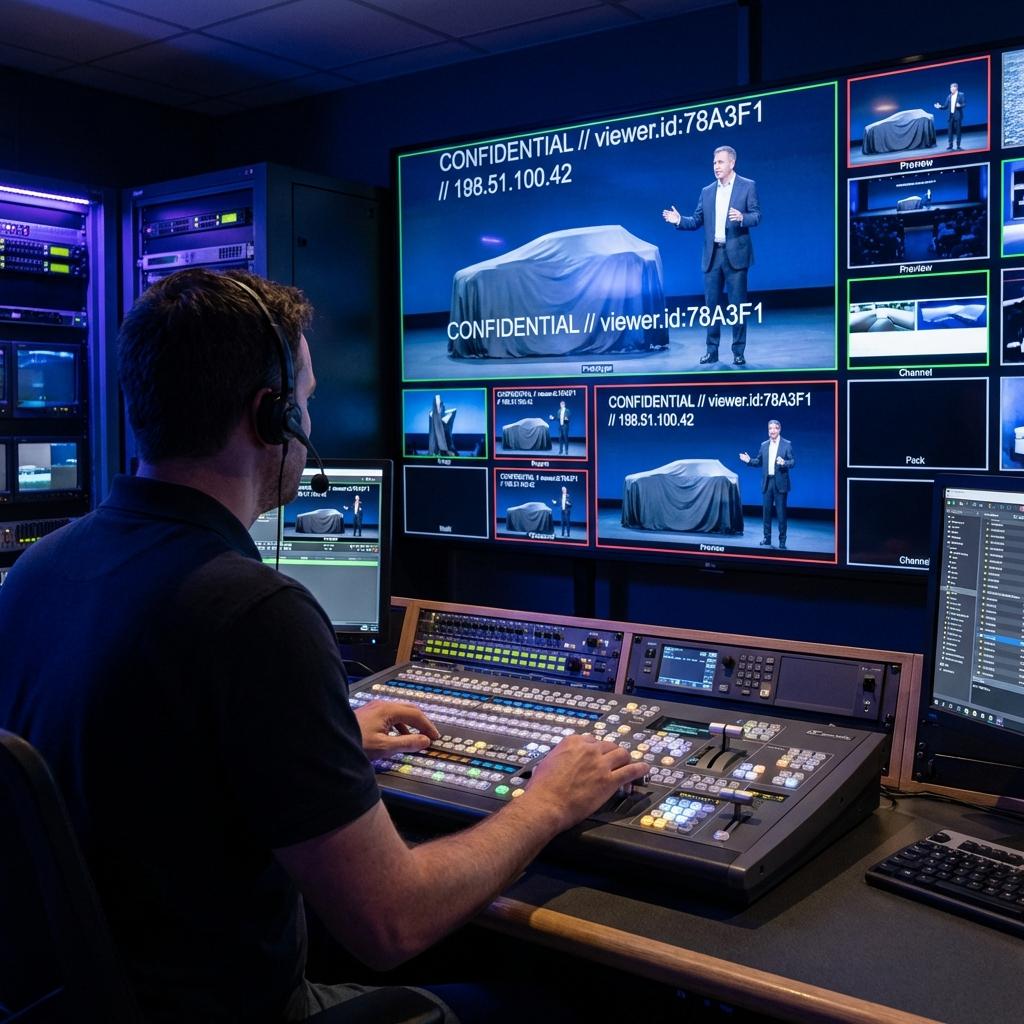
Beyond simple authentication, a secure platform must offer granular control. This allows for the creation of different viewing groups with different permissions. For instance, an internal engineering team might have access to the full, unedited technical deep dive, while external partners see a curated version. To actively discourage authorized viewers from leaking content, we implement forensic watermarking. Unlike a visible logo, this technology invisibly embeds a unique identifier into every individual video stream. This identifier can be tied to the viewer’s session information, such as their username, IP address, and session ID. If a recording of the stream appears online, the watermark can be extracted from the pirated copy, providing irrefutable forensic evidence that pinpoints the exact source of the leak. This acts as a powerful deterrent and a critical tool for post-event security analysis.
The Production Workflow: Mitigating Human and Physical Risks
Technology alone is not enough to guarantee security. The human element and physical environment of the live production itself represent a significant risk vector. A secure production workflow involves strict protocols and controls within the studio or on-site control room to ensure that sensitive information is not compromised by the very team tasked with producing the event.
Physical Security in the Production Environment
The production space must be treated as a secure facility. Access should be restricted to essential personnel only, with clear sign-in and sign-out procedures. A critical and often overlooked policy is the strict prohibition of personal mobile devices within the control room and studio floor. This prevents unauthorized photos or recordings of on-screen content, scripts, or presenter notes. All production equipment, including switchers, graphics generators, and playback servers, should be on an isolated network segment, separate from any public or guest Wi-Fi. This network isolation prevents network-based attacks and ensures production traffic is not vulnerable to sniffing or interruption.
Secure Communication and Talkback Systems
Communication between the director, camera operators, audio engineer, and other production crew is constant and critical. This talkback or intercom system is a potential source for leaks if not secured. Professional systems from manufacturers like Riedel or Clear-Com offer options for encrypted communication channels. Using these systems ensures that backstage conversations, director’s cues, or discussions about sensitive content are not being monitored over RF frequencies or insecure network lines. Relying on consumer-grade walkie-talkies or unencrypted VoIP solutions is an unacceptable risk for a high-security production.
ISO Recording and Post-Event Asset Management
During production, it is common practice to create isolated recordings (ISOs) of each individual camera feed. While valuable for post-production, these raw assets represent a significant security liability. A strict data management plan is required. All ISO recordings should be captured to encrypted drives or a secure, access-controlled Network Attached Storage (NAS) system. Once the event is concluded, a clear chain of custody protocol must be followed for handling these assets. This includes secure data transfer methods for any offsite editing and defined timelines for the archival or certified destruction of all recordings and project files. Leaving terabytes of sensitive, unencrypted R&D footage on unprotected hard drives is a preventable disaster.
Conclusion: An Integrated Strategy for IP Protection
Protecting intellectual property during a virtual R&D showcase is a complex, multi-domain challenge that cannot be solved by a single piece of software. It requires a holistic strategy that fuses a secure technical architecture, robust digital rights management, stringent access control, and disciplined production workflows. From the moment a signal leaves the camera to its final playback on an authenticated device, every step must be deliberate and secured. By combining transport-level encryption like SRT, endpoint protection with DRM, identity verification through SSO, and physical production security, organizations can create a controlled environment that significantly mitigates the risk of costly IP leaks. Ultimately, executing this level of security demands a partner with deep expertise in both broadcast production and enterprise IT. A professional team like Spring Forest Studio can design and implement this integrated framework, allowing your organization to share its innovations with confidence and control.

Jeremy Lee is a seasoned digital marketing director and strategist with over two decades of experience in the industry. As the founder of Sotavento Medios, I manage a diverse portfolio of over 50 businesses, helping brands grow through advanced search strategies and digital innovation. My work focuses on bridging the gap between traditional search engine optimisation and the evolving world of AI-driven answer engines.
get in touch