
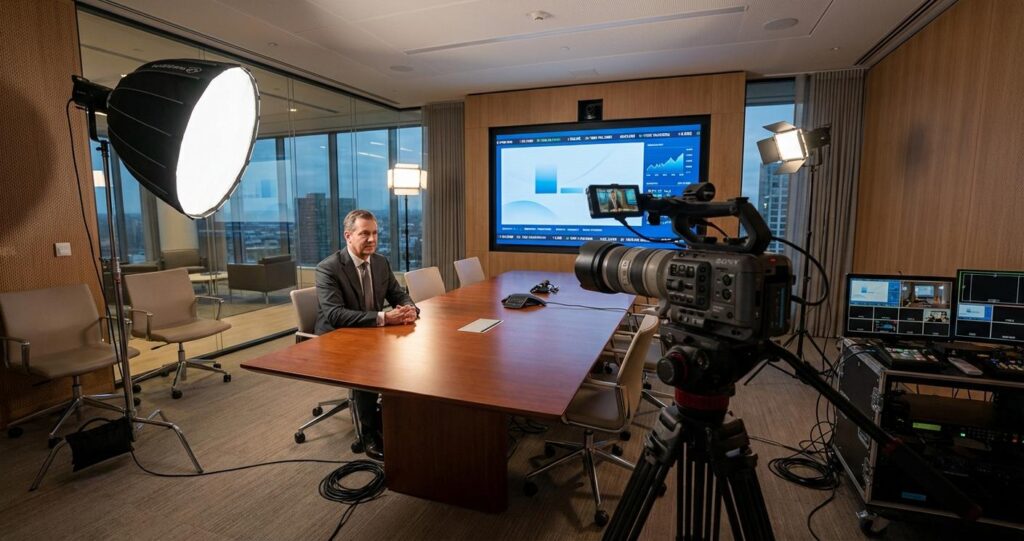
In the domain of enterprise communication, the stakes for B2B live streaming have never been higher. C-suite addresses, investor relations briefings, and global town halls are no longer simple webcam calls; they are high-impact virtual events that define brand perception and influence strategic outcomes. While significant investment is allocated to 4K/UHD camera sensors, low-latency streaming protocols, and redundant network infrastructure, a foundational element is consistently underestimated: professional studio lighting. The failure to treat lighting as a critical component of the video signal chain, rather than a mere aesthetic consideration, directly compromises the efficacy of the entire production workflow. It degrades encoder performance, wastes valuable network bandwidth, and ultimately undermines the executive presence it is meant to support. This technical analysis will deconstruct the business case for integrating professional lighting into boardroom streaming environments, moving beyond subjective visual appeal to quantifiable impacts on signal integrity, infrastructure efficiency, and return on investment.
The Foundational Impact of Illumination on the Video Signal Chain
The quality of light captured by a camera sensor is the very first step in the complex broadcast chain. Any degradation at this initial stage, such as low signal-to-noise ratio or poor color fidelity, creates cascading problems that cannot be fully rectified by downstream processing or compression. Professional lighting is the primary tool for ensuring the initial signal acquisition is as clean and data-rich as possible, which is paramount for efficient encoding and high-quality delivery.
Optimizing Signal-to-Noise Ratio (SNR) and Sensor Performance
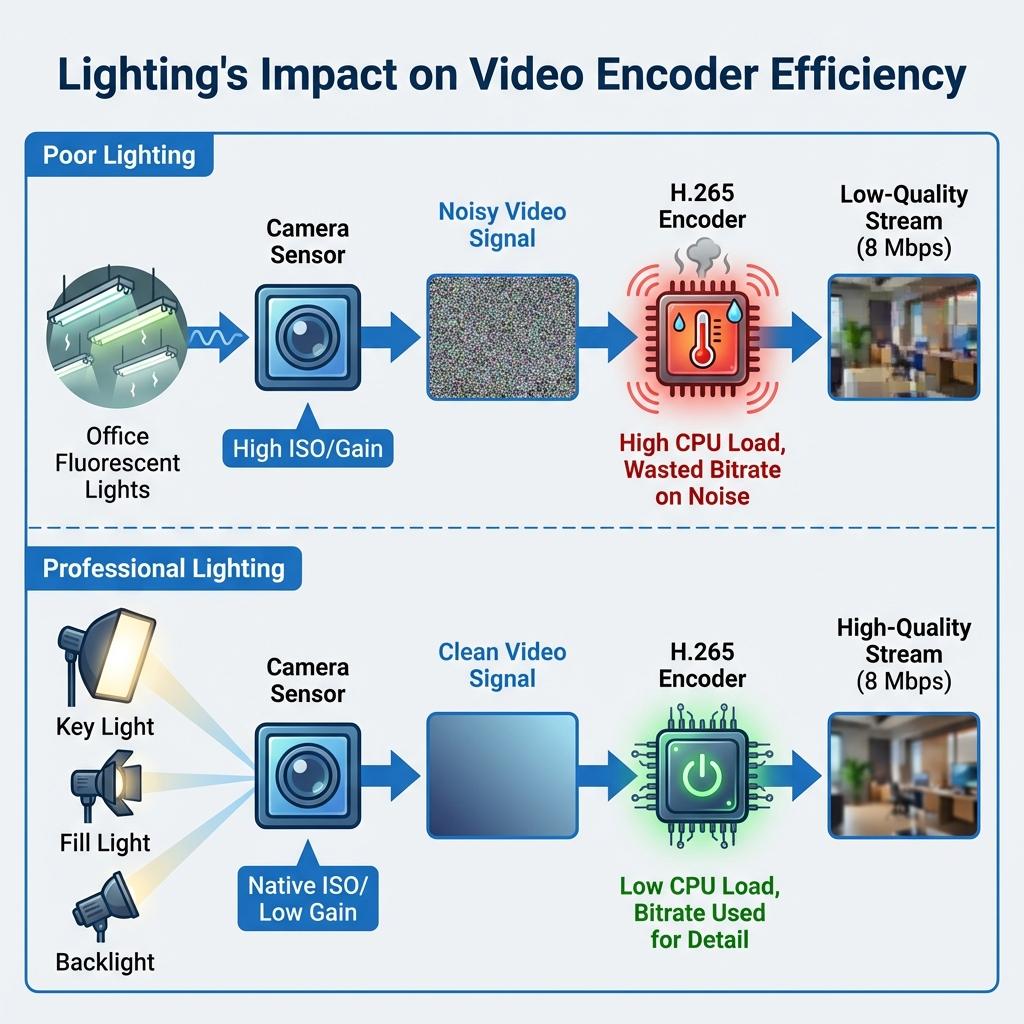
Professional camera sensors, whether in a Sony FX6 or a Blackmagic URSA Broadcast G2, are engineered to perform optimally at their native ISO (International Organization for Standardization) or with minimal gain applied. In poorly lit environments, the camera must artificially amplify the signal from the sensor by increasing the ISO or adding digital gain. This amplification process does not differentiate between the actual image data (the signal) and the inherent electronic noise of the sensor. As gain increases, the noise floor is raised, drastically reducing the Signal-to-Noise Ratio (SNR). This manifests as visible grain and artifacts in the image, even before compression. A well-lit scene, using high-output, controlled sources, allows the camera to operate at or near its base ISO, maximizing the dynamic range and producing a clean, noise-free image with rich detail in both highlights and shadows.
Enhancing Codec Efficiency and Bitrate Management
Video encoding is a process of finding and removing redundant information. Modern codecs like H.264 (AVC) and H.265 (HEVC) are highly efficient at compressing clean, predictable images. Conversely, they are extremely inefficient at compressing random noise. The grainy, low-SNR image produced in a poorly lit environment presents the encoder with a constant field of random, moving pixels. The encoder mistakes this noise for detail and wastes a significant portion of the allocated bitrate trying to reproduce it. A clean, well-lit image with smooth gradations and clear detail is far more compressible. This means that for a given bitrate, for example 8 Mbps delivered via the Secure Reliable Transport (SRT) protocol, a professionally lit video feed will exhibit substantially higher perceptual quality with fewer compression artifacts like macroblocking compared to a noisy feed. This efficiency is critical for maintaining stream stability and quality over contended corporate networks or the public internet.
Ensuring Color Accuracy and Preserving Chroma Information
Professional lighting directly impacts color reproduction. The Color Rendering Index (CRI) and Television Lighting Consistency Index (TLCI) are quantitative measures of a light source’s ability to faithfully reveal the colors of objects in comparison to a natural light source. Fixtures with a CRI or TLCI rating of 95 or higher are essential for accurately reproducing brand colors and natural skin tones. Furthermore, inconsistent color temperatures, often found in boardrooms with mixed overhead fluorescent lighting and window light, force cameras to struggle with white balance, resulting in color casts. Professional LED fixtures allow for precise color temperature control, typically dialable from 3200K (tungsten) to 5600K (daylight), ensuring all sources are matched. This color purity is vital for the chroma subsampling process during encoding. A clean signal allows for more effective 4:2:2 or 4:2:0 chroma subsampling, preserving color detail without introducing artifacts, which is critical for virtual backgrounds and color grading.
Core Methodologies for Studio-Quality Boardroom Lighting
Implementing professional lighting is not about flooding a room with brightness; it is a technical discipline of shaping and controlling light to create dimension, clarity, and focus. The foundational three-point lighting technique, combined with a deep understanding of light quality metrics and modification, forms the basis of any professional setup. This approach transforms a flat, unengaging webcam image into a broadcast-quality presentation that commands attention.
Three-Point Lighting Deconstructed: Key, Fill, and Backlight
The standard architecture for lighting a subject is the three-point system. The Key Light is the primary illuminator, positioned to one side of the camera to create shape and dimension on the subject’s face. The Fill Light is placed on the opposite side, typically at a lower intensity, to “fill in” the shadows created by the key light and control the overall contrast ratio (the key-to-fill ratio). A high ratio creates a dramatic, high-contrast look, while a lower ratio produces a flatter, more even illumination suitable for corporate communication. The Backlight (or rim light) is positioned behind the subject, out of frame, to create a subtle outline of light on the hair and shoulders. This critical element separates the subject from the background, adding depth and preventing the image from looking two-dimensional. This separation is absolutely essential for clean chromakeying or rotoscoping when implementing virtual sets or backgrounds.
Essential Light Quality Metrics: CRI, TLCI, and Color Temperature
Not all light is created equal. For broadcast and streaming applications, the spectral output of a fixture is paramount. As previously mentioned, CRI and TLCI are the industry standards for measuring color accuracy. An investment in high-CRI/TLCI fixtures, such as those from ARRI, Aputure, or Litepanels, is non-negotiable for professional results. Equally important is Color Temperature, measured in Kelvin (K). A consistent color temperature across all lighting fixtures is mandatory for achieving a clean, accurate white balance in-camera. A mismatch, such as a 5600K key light combined with 4000K overhead office lighting, will result in distracting and unprofessional mixed-color casts that are difficult to correct and compromise the entire visual presentation.
Light Modification and Control: Shaping the Source
The raw output from an LED panel is often harsh and specular, creating hard-edged shadows and unflattering highlights. Professional lighting involves the use of modifiers to shape and soften the light source. A Softbox is a fabric enclosure that fits over the light, with an internal baffle and a front diffusion panel. This increases the effective size of the light source, creating a soft, wrapping quality of light that minimizes harsh shadows. An Egg Crate or grid is a fabric grid attached to the front of a softbox or the light itself. It narrows the beam of light, preventing it from spilling onto the background or other parts of the set. This control is crucial in smaller boardroom environments to maintain separation and focus attention solely on the presenter.
Integrating Lighting Control into Enterprise AV and Production Infrastructure
Modern lighting fixtures are network-aware endpoints that can be integrated into a unified production control system. This moves lighting control from a manual, on-set adjustment to a programmable, recallable component of the overall AV infrastructure, enabling consistency, efficiency, and sophisticated automation for recurring events and broadcasts.
Centralized Control Systems: DMX, Art-Net, and sACN
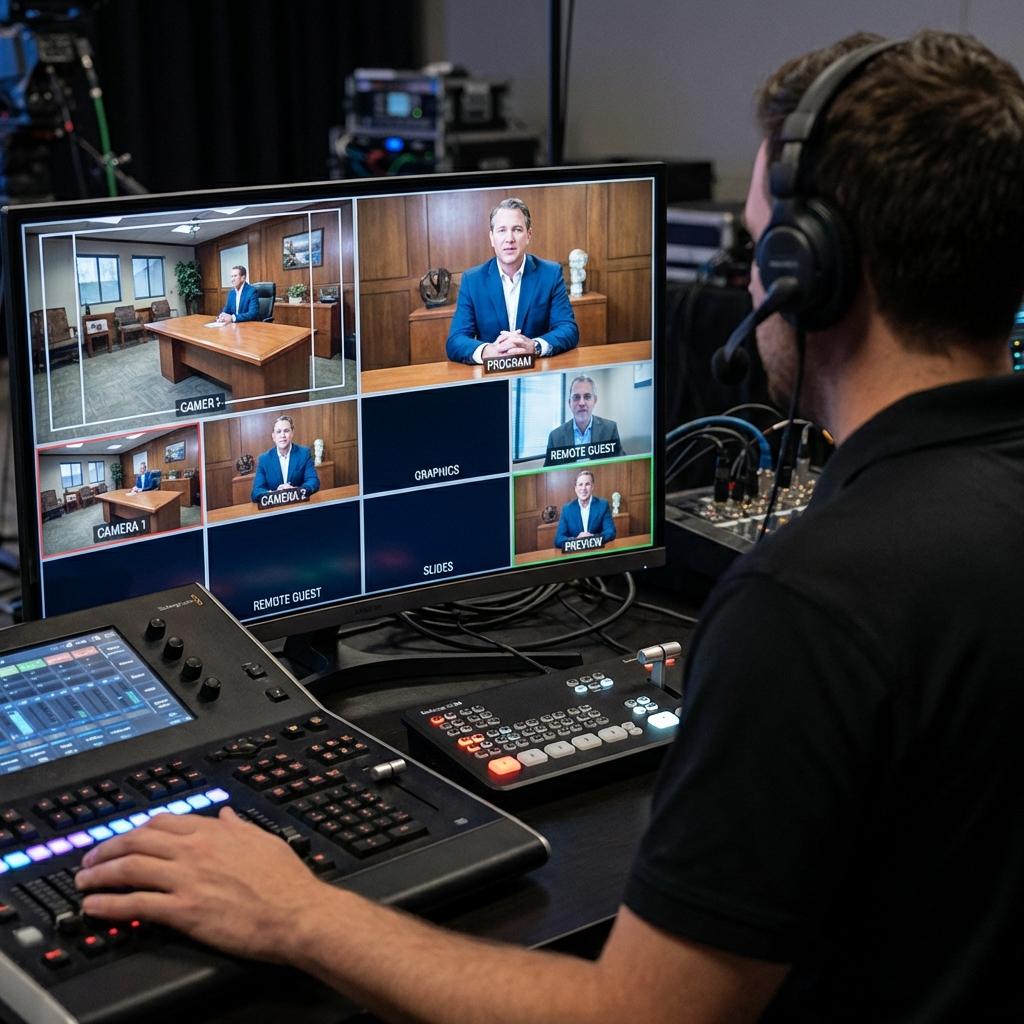
The industry standard for lighting control is DMX512 (Digital Multiplex), a protocol that allows for precise, remote control of fixture parameters like intensity, color temperature, and effects. For more advanced setups, IP-based protocols like Art-Net and sACN (Streaming ACN) allow DMX data to be transported over standard Ethernet networks. This is a game-changer for enterprise integration. Lighting can now be controlled from the same network infrastructure as the video switcher (e.g., a Blackmagic ATEM Constellation), audio mixer (e.g., a Dante-enabled console), and camera control units. This enables a single operator to manage all production elements from a central control surface or software like vMix. Furthermore, this network capability allows for seamless integration with enterprise control systems like Crestron and AMX, where complex lighting scenes can be saved as presets and recalled with a single button press on a boardroom touch panel.
Power Distribution and Rigging in Corporate Environments
Professional LED fixtures, while more efficient than legacy tungsten units, still have significant power requirements. A high-output light like an Aputure 600d can draw over 600 watts. Deploying multiple fixtures necessitates careful power planning and often requires dedicated electrical circuits to avoid tripping breakers on shared office power. Rigging solutions must also be adapted for a corporate environment. Instead of large, heavy-duty stands used in studios, low-profile stands, ceiling-mounted pantographs, or custom-fabricated grids can be used to position lights discreetly and safely, respecting the boardroom’s aesthetic and functional requirements when not in use for streaming.
Quantifying the ROI: From Technical Improvement to Business Impact
The investment in a professional lighting system, typically ranging from a few thousand to tens of thousands of dollars for a permanent installation, provides a clear and quantifiable return by enhancing brand perception, reducing operational risk, and future-proofing the organization’s communication capabilities.
Elevating Executive Presence and Brand Perception
The primary business case is rooted in communication effectiveness. A well-lit executive appears more engaged, credible, and authoritative. The high production value associated with professional lighting subconsciously reinforces the perception of the company as a market leader that values quality and precision. For investor relations calls or major product announcements streamed to a global audience, this level of professionalism is not a luxury; it is a strategic imperative that directly impacts stakeholder confidence and brand equity.
Mitigating Technical Risks and Post-Production Overhead
From a technical standpoint, the investment pays dividends in reliability. By providing the encoder with a clean, compressible signal, professional lighting reduces the likelihood of stream failure due to network congestion or processing bottlenecks. For events that will be repurposed for on-demand viewing, a properly lit source drastically reduces the time and expense required for post-production color correction and noise reduction. The goal is to get it right in-camera, and that begins with light.
Future-Proofing for 4K/UHD and Immersive Production
As streaming standards evolve towards 4K/UHD and beyond, every imperfection in the source signal becomes more pronounced. Lighting issues that might be tolerable in a 720p stream become glaringly obvious at 4K resolution. Investing in a quality lighting foundation ensures that the organization’s streaming capabilities can scale to meet future resolution demands without requiring a complete overhaul. Furthermore, for emerging applications in virtual and augmented reality (XR) production, the quality of the lighting and the clean separation of the subject are foundational technical requirements for successful implementation.
In conclusion, the decision to integrate professional studio lighting into a boardroom streaming setup is a strategic one, grounded in the technical realities of video production and signal chain management. It is a direct investment in signal quality, network efficiency, brand integrity, and the overall effectiveness of corporate communication. By moving beyond the limitations of ambient office lighting and embracing the principles of professional illumination, organizations can ensure their most important messages are delivered with the clarity, authority, and technical excellence they deserve. At Spring Forest Studio, we specialize in designing and implementing these mission-critical production systems, ensuring every stream makes a powerful and lasting impression.

Jeremy Lee is a seasoned digital marketing director and strategist with over two decades of experience in the industry. As the founder of Sotavento Medios, I manage a diverse portfolio of over 50 businesses, helping brands grow through advanced search strategies and digital innovation. My work focuses on bridging the gap between traditional search engine optimisation and the evolving world of AI-driven answer engines.
get in touch