
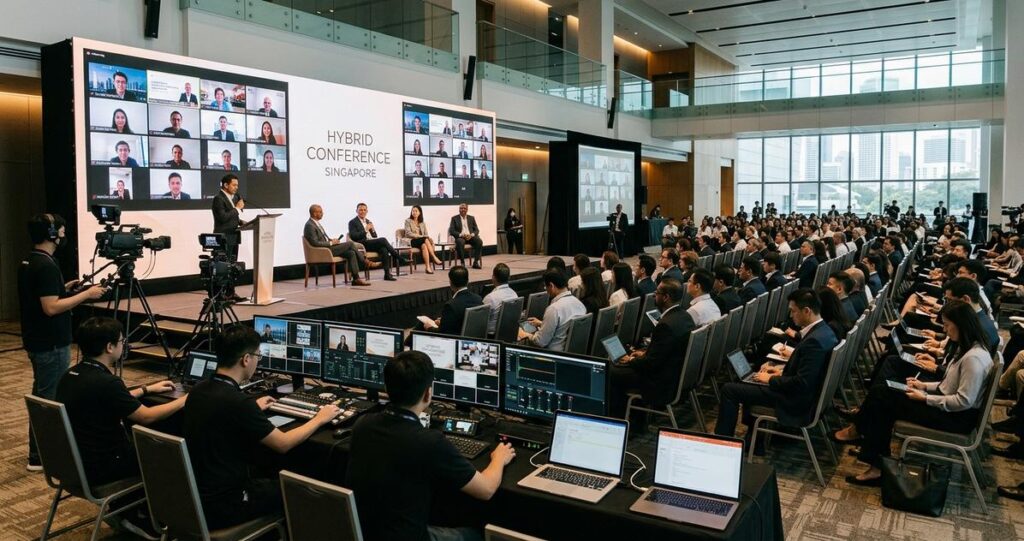
Regional associations in Singapore and across Asia are under more pressure than ever to keep members engaged, deliver timely knowledge, and remain relevant to diverse audiences spread across different cities and time zones. For many organisations, the old choice between an in-person conference and a fully virtual meeting no longer fits the way members work, travel, and collaborate. Hybrid events, where a live audience is paired with a remote audience through professional streaming and interactive digital tools, have become the practical model that meets both expectations. They combine the value of face-to-face connection with the reach and convenience of digital access, which is especially important in a region as connected, international, and schedule-sensitive as Singapore. For associations that want stronger attendance, more inclusive participation, and better long-term member value, hybrid events are no longer an experimental add-on. They are fast becoming the standard operating format.
Singapore is a natural hub for this shift. It serves as a regional meeting point for professional bodies, trade groups, medical societies, academic networks, and industry associations that draw members from Malaysia, Indonesia, Thailand, Vietnam, the Philippines, and beyond. At the same time, Singapore audiences are familiar with high standards for event delivery, clear communication, and efficient use of time. That expectation matters. A hybrid event does not simply mean placing a camera at the back of a room. It requires careful event design, reliable live streaming, structured moderation, and a digital experience that makes remote attendees feel genuinely included. When done well, it supports the core purpose of an association, which is to build knowledge, credibility, and community across borders.
Why regional associations are moving beyond the physical-only model
Traditional events still have real value. A room full of members can produce energy, informal networking, and strong professional relationships. However, physical-only events create obvious limits for regional associations. Travel costs, visa requirements, work commitments, caregiving responsibilities, and time away from the office all reduce attendance. In Southeast Asia, those barriers are amplified by geography. A speaker from Jakarta, a committee member in Kuala Lumpur, and a practitioner in Singapore may all want to participate, but not all of them can travel for every meeting.
Hybrid events reduce these barriers without sacrificing the importance of in-person interaction. They allow associations to keep flagship gatherings on-site while extending participation to members who would otherwise be excluded. This matters for governance meetings, continuing education sessions, annual general meetings, policy forums, and industry briefings. In practical terms, hybrid delivery helps associations serve two audiences at once, the local audience in the room and the regional audience online, while keeping the event unified under one programme.
Broader access supports stronger member engagement
Member engagement is not only about attendance. It is also about participation, retention, and perceived value. When an association offers remote access, members are more likely to join sessions that fit their schedule, even if they cannot attend every event physically. This is particularly relevant for professionals who travel frequently, manage shift-based work, or balance family commitments. In Singapore, where many members work in high-demand sectors such as healthcare, finance, logistics, education, and technology, flexibility is not a luxury. It is often the difference between active participation and silence.
Hybrid formats can also support different learning styles. Some attendees prefer live discussion in a conference hall, while others engage better through chat, Q and A tools, or post-event recordings. By designing for both modes, associations can improve overall reach and accessibility. That is important for regional bodies trying to maintain a cohesive membership base across different countries and levels of seniority.
What makes a hybrid event effective, not just technically possible
Many organisations assume a hybrid event is successful once the live stream works. In reality, technical transmission is only one part of the experience. Effective hybrid events are planned around content flow, audience interaction, and production quality. The goal is not to mirror the physical venue online in a passive way. The goal is to create one integrated programme that serves both audiences with equal care.
That begins with agenda design. Sessions that are too long, too dense, or too dependent on informal room dynamics may frustrate remote participants. Shorter blocks, clear transitions, moderated questions, and well-paced breaks work better. Professional live streaming also matters. Audio quality is often more important than video quality because participants can tolerate modest visuals more easily than unclear sound. Strong microphones, proper mixing, and backup connectivity help reduce disruption and protect the credibility of the event.
Interaction must be planned, not improvised
Remote participants should not feel like observers at the edge of the room. They need structured ways to ask questions, respond to polls, and contribute to discussion. That usually requires a moderator or digital host who actively bridges the in-room and online audiences. Without this role, online participation often becomes passive, and engagement drops quickly.
Associations in Singapore can benefit from treating hybrid interaction as part of programme design rather than as an extra feature. For example, a medical association hosting a professional lecture may assign one moderator to handle on-site questions and another to manage online questions. A regional trade association may use live polling to compare market priorities across different countries. A policy forum may open with a short regional survey to help the speaker tailor the discussion in real time. These approaches help remote attendees feel that their presence matters.
Production quality affects trust
Trust is central to association events, especially when the content relates to professional practice, policy updates, or continuing education. Poor audio, unstable video, awkward camera angles, and uncoordinated stage transitions can make even strong content feel unreliable. For regional associations, that can affect reputation. Members often judge the association not only by what it says, but by how it delivers information.
Professional event streaming teams help manage the practical details that audiences notice immediately. These include signal redundancy, scene switching, cue timing, backup recording, and stable platform delivery. For associations in Singapore, where members expect a polished standard aligned with the city’s broader business environment, this level of production is increasingly part of organisational credibility.
Why hybrid events fit the regional reality of ASEAN networks
Regional associations rarely operate in one country alone. Their committees, speakers, and members are often spread across multiple jurisdictions with different travel patterns, budget constraints, and digital habits. A hybrid model reflects this reality more accurately than a one-location event ever can. It creates a shared platform where local and regional members can meet without requiring the same physical presence from everyone.
This is especially useful in Singapore, where many associations serve as conveners for Southeast Asian stakeholders. Singapore’s transport connectivity makes it a convenient host city, but convenience for one group does not eliminate barriers for others. A hybrid event allows the association to retain Singapore as the anchor venue while opening participation to wider regional audiences. That can strengthen cross-border collaboration, support member recruitment, and improve the exchange of expertise across the region.
Hybrid formats help associations remain resilient
One of the clearest lessons from recent years is that event planning needs flexibility. Weather disruption, travel restrictions, health concerns, business emergencies, and last-minute schedule conflicts can all affect turnout. A hybrid structure gives associations more resilience because the event is not entirely dependent on physical attendance. Even when plans change, the programme can still proceed for remote participants.
For boards and secretariats, that resilience is valuable. It reduces the risk of cancellations, supports continuity in programme delivery, and helps maintain member confidence. In operational terms, hybrid events also make it easier to document proceedings, archive sessions, and reuse content for future learning. That can extend the life of a single event beyond the live day itself.
How regional associations in Singapore can plan hybrid events well
Good hybrid delivery starts long before event day. Associations need to define their purpose, audience mix, and participation goals. A member education seminar may need a different format from an annual conference, and a governance meeting has different requirements again. Clear planning helps determine whether the event needs live Q and A, multilingual captions, recording permissions, breakout sessions, or post-event access.
Technology should be selected based on programme needs, not fashion. Stable internet connectivity, reliable streaming software, appropriate cameras, clear microphones, and a tested backup plan are essential. Venue choice matters too. Some meeting spaces are better suited to hybrid events because they offer acoustics, lighting, internet stability, and room layout that support both audiences. In Singapore, many organisers also work closely with venue teams and production partners to coordinate AV, registration flow, and technical rehearsals.
Accessibility should be part of the brief
Accessibility is a practical requirement, not an optional extra. Hybrid events should consider captioning, readable presentation slides, clear speaker pacing, and simple navigation for online attendees. These features help not only people with accessibility needs, but also participants joining from noisy workplaces, public transport, or across different time zones. For regional associations, accessibility also includes language clarity and thoughtful moderation so that non-native English speakers can follow the discussion comfortably.
Where relevant, associations may also consider recording sessions for members who cannot attend live. This can be particularly useful for continuing education, research updates, and technical briefings. However, recording policies should be defined in advance, especially if speakers present sensitive or unpublished material.
Measure outcomes beyond attendance numbers
Attendance alone does not tell the full story of event success. Associations should review engagement data such as live participation, chat activity, question volume, session drop-off points, and post-event feedback. They should also consider whether the event helped achieve its broader goal, such as member education, cross-border networking, policy discussion, or sponsor value. These measures provide better insight into whether the hybrid format is working.
For Singapore-based associations, this kind of evaluation aligns well with the country’s culture of structured improvement and operational discipline. It also supports better planning for future events, because the team can see which sessions worked best for online participation and which parts of the programme need adjustment.
The strategic value of hybrid events for association growth
Hybrid events are not just a response to convenience. They are a strategic tool for growth. They help associations widen their reach, deepen member engagement, and present themselves as modern, regionally relevant organisations. This is especially important when associations compete for attention in crowded professional calendars. If an event is too difficult to attend, too costly to travel to, or too rigid in format, people may simply skip it. Hybrid delivery lowers that friction.
There is also a reputational benefit. Associations that run well-produced hybrid events signal that they understand how professionals work today. That signal matters in Singapore’s competitive and internationally connected environment. Members tend to notice whether an organisation is responsive, organised, and capable of supporting real participation. A consistent hybrid strategy can strengthen that perception over time.
For regional associations in particular, the model also supports long-term continuity. As membership bases become more geographically dispersed and work patterns remain more flexible, the organisations that adapt their event formats will be better positioned to stay relevant. Hybrid events make it easier to honour the value of in-person connection while still meeting the practical expectations of a regional audience.
For associations considering their next step, the question is no longer whether hybrid events are possible. The real question is whether the organisation is willing to design them properly. That means investing in thoughtful content, solid technical execution, clear moderation, and an inclusive participant experience. When those pieces come together, hybrid events do more than extend an event’s reach. They help build a stronger, more connected association across Singapore and the wider region.
General information notice: This article provides general information for association planning and event strategy. It is not medical advice. If your event involves health-related content, patient education, or clinical information, consult qualified professionals and follow applicable regulatory and institutional guidance.

Jeremy Lee is a seasoned digital marketing director and strategist with over two decades of experience in the industry. As the founder of Sotavento Medios, I manage a diverse portfolio of over 50 businesses, helping brands grow through advanced search strategies and digital innovation. My work focuses on bridging the gap between traditional search engine optimisation and the evolving world of AI-driven answer engines.
get in touch