
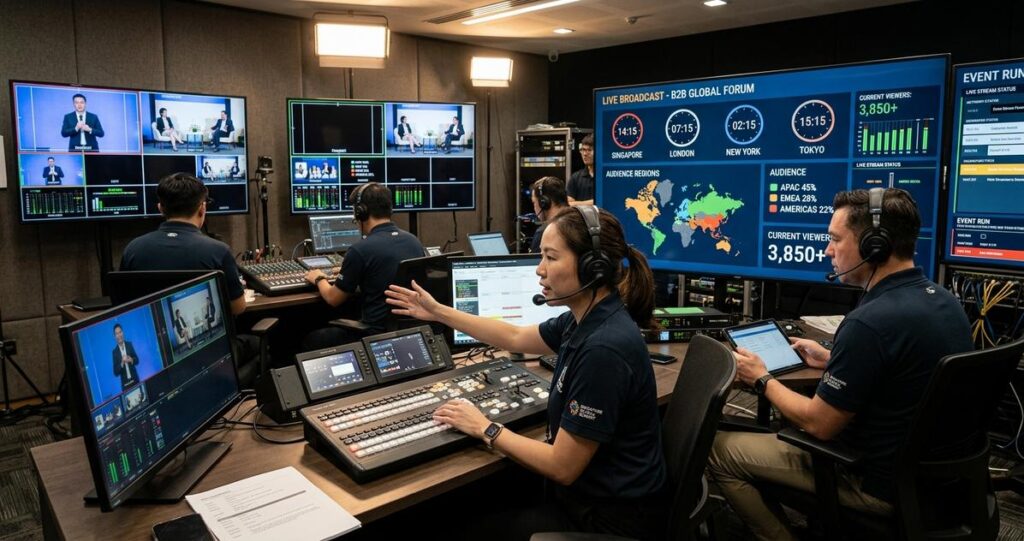
For Singapore businesses, professional associations, and event organisers, streaming to audiences across multiple time zones is now a practical requirement rather than a novelty. A product launch in Singapore may need to reach stakeholders in London before the workday ends, teams in San Francisco at the start of their morning, and clients across Southeast Asia during local business hours. The challenge is not only technical. It also involves scheduling, audience experience, production planning, legal considerations, language support, and clear communication before and after the live session.
Singapore is well placed for international virtual and hybrid events because of its connectivity, business infrastructure, and role as a regional hub. Even so, the logistics behind a multi time zone stream can become complicated quickly. If the wrong time is chosen, some viewers are forced to join before dawn or after midnight. If the content is structured poorly, global participants may drop off early. If replay access is not planned, the event may fail to serve the audience that could not attend live. The practical goal is to create a stream that is accessible, reliable, and useful for participants wherever they are located.
That requires more than simply going live once and hoping people tune in. It means treating time zones as part of the event design. It means deciding who the primary live audience is, which regions matter most, how long people should be expected to stay engaged, and how the recording will be packaged for on demand viewing. For organisers in Singapore, this approach supports better attendance, stronger stakeholder engagement, and more efficient use of production budgets.
Why multi time zone streaming needs a planning strategy
When an event is intended for several regions, the first logistics question is simple, who is the core audience for the live broadcast. If most participants are in Singapore and Malaysia, the session may begin during normal office hours in Singapore. If North America is the priority, that same timing may be inconvenient for the local team but ideal for the audience abroad. A single live session cannot usually be equally convenient for all regions, so the organiser must decide whether the event should prioritise one time zone or be built as a distributed experience with live, delayed, and on demand access.
That decision affects the entire production plan. Speaker availability, moderator shifts, captioning arrangements, technical staffing, and even catering for an in person hybrid venue may all depend on the chosen broadcast window. In Singapore, where business events often involve regional headquarters, government stakeholders, multinational teams, and partners from Europe or North America, the event team should map the audience before fixing the schedule. This audience map helps identify the most important time zones and whether a single live slot is realistic.
Mapping audience priority by region
A useful approach is to rank audiences into primary, secondary, and tertiary groups. The primary group is the region that must be served live. The secondary group can join live if the timing is acceptable, but can also rely on replay or highlights. The tertiary group may be best served through edited recordings, translated subtitles, or a later repeat session. This method prevents the team from trying to satisfy every time zone equally, which often leads to a compromise that serves no one well.
For Singapore events, this is especially relevant because the country sits in a time zone that can work reasonably well for parts of Asia-Pacific, but less comfortably for Europe and the Americas. Singapore uses Singapore Standard Time, which is UTC plus 8. A morning event in Singapore may still be suitable for Hong Kong, Perth, and some regional offices, while a late afternoon event may better suit Europe. North American participants usually require either an early morning Singapore slot or a recording made available soon after the live session.
Choosing live, replay, or hybrid attendance models
Not every event needs to be live for every viewer. A common mistake is assuming that only real time participation counts. In practice, many audiences are happy with a live premiere, a replay with chapter markers, or a hybrid format that combines live interaction for one region with recorded access for others. The right model depends on whether the event is educational, ceremonial, commercial, or internal.
For example, a leadership town hall may need live Q and A for staff in Asia, but a recorded version with a short follow up discussion may be enough for teams in Europe. A product announcement may benefit from a globally released recording, while a regulatory briefing may need a strict live session for a clearly defined audience. The logistics are easier when the organiser distinguishes between content that must happen live and content that can be consumed later.
Scheduling across Singapore, Asia-Pacific, Europe, and the Americas
Timing is the most visible challenge, but it is also the most strategic. Event teams often underestimate how much timing affects attendance, speaker energy, and viewer engagement. The same session can feel responsive and dynamic in one region, but tiring or inaccessible in another. Good scheduling begins with a realistic understanding of who will be awake, who will be at work, and who will be expected to join outside normal hours.
For Singapore-based organisers, scheduling often involves balancing three broad windows. A morning Singapore slot generally works well for East Asia and Australia, an afternoon Singapore slot may be better for South Asia and some Europe-based participants, while an evening Singapore slot can partially serve Europe and late afternoon or morning audiences elsewhere. There is no perfect universal slot, which is why a multi time zone strategy should be built around audience priority and event purpose rather than convenience alone.
Handling speaker availability across time zones
Speakers are often the limiting factor. A panel might include experts from Singapore, London, and New York, but their calendars and energy levels will not align neatly. For live events, organisers should confirm not only the local time for each speaker, but also the actual time in their own city, especially when daylight saving time is involved. Countries such as the United States, the United Kingdom, and Australia may shift clocks seasonally, which changes the time difference with Singapore.
Because of that variability, it is not enough to ask whether a speaker is available on a certain date. The production team should confirm the exact local time in each location and include that time in the call sheet, rehearsal invitation, and speaker briefing. This avoids confusion during scheduling and reduces the risk of a speaker joining at the wrong hour or missing a rehearsal. For critical sessions, many organisers also hold a short technical check at the equivalent local time of the live event so speakers can confirm audio, lighting, internet stability, and camera framing.
Accounting for daylight saving time changes
Daylight saving time is a major source of scheduling error because Singapore does not observe it, while several major business markets do. A time that works in March may not be the same in November. This matters for event invitations, website countdowns, email reminders, and calendar holds. Organisers should avoid using informal phrasing such as “8 pm UK time” without specifying the date and the exact time zone reference.
The safer practice is to state the time in Singapore Standard Time and list the corresponding local time for key regions. For international registration pages, use a time zone converter or an event platform that automatically adjusts the displayed time based on the viewer’s location. This helps reduce attendance mistakes and makes the event feel professionally managed.
Production logistics that support global audiences
Once the schedule is fixed, the production workflow has to support multiple audiences at once. That involves audio quality, graphics, latency, captions, backups, and moderation. A stream that is technically stable but inaccessible to a significant part of the audience still fails the logistics test. The production plan should account for viewers who join live, those who watch later, and those who may need language support or accessibility features.
For Singapore events, professional production often includes a control room setup, stable wired internet, backup connectivity, and a clear run of show with time stamps. Hybrid events may also require coordination between the physical stage and remote speakers in different countries. Every point in the chain, from registration to playback, should be tested under realistic conditions before the live date.
Latency, captioning, and accessibility
Latency refers to the delay between the live action and what the viewer sees. A small delay is normal in streaming, but it can create problems for interactive sessions if some participants are significantly behind others. This matters when moderators are taking live questions from different regions or when remote speakers need to respond in real time. A production team should understand the latency characteristics of the chosen platform and design the interaction accordingly.
Captioning is equally important. Captions are on screen text that displays spoken words, and they support viewers who are hard of hearing, watching without audio, or following in a second language. For Singapore audiences, where English often sits alongside Mandarin, Malay, Tamil, and other languages in professional settings, captions can improve comprehension and engagement. If a session includes technical terms, the script or slide deck should be shared with the caption provider in advance to improve accuracy.
Accessibility also includes clear slide design, legible fonts, sufficient contrast, and pacing that gives viewers time to absorb information. These basics matter even more when the audience is tired or joining outside their normal working hours. A good stream reduces cognitive effort, which helps viewers stay with the content longer.
Regional backups and failover planning
Global streaming should always include redundancy. That means backup internet access, backup audio capture, and a recovery plan if the primary platform fails. For important events, teams may record local camera and audio feeds separately so that any dropped connection does not erase the session. They may also prepare a backup host, a secondary streaming endpoint, or a pre recorded segment that can be played if a speaker loses connection.
Failover planning is especially important for Singapore events serving overseas partners because the audience may already be giving up sleep or rearranging work schedules to attend. If the stream fails, they are unlikely to wait around for long. A resilient setup protects the organiser’s credibility and makes the event feel professionally managed even under pressure.
Content design for viewers who join at different times
Not every participant will experience the event in the same way. Some will watch live and ask questions in real time. Others will catch the replay later during lunch, after work, or the next day. The content itself should therefore be designed for both live and asynchronous viewing. This is where many events lose value, because they are structured only for the audience in the room or on the live call.
Strong multi time zone content uses clear pacing and modular segments. It also avoids overreliance on live banter that may not make sense in replay. If the event includes product demonstrations, financial updates, internal announcements, or expert interviews, the organiser should think about how the material will land when viewed out of sequence or after a delay.
Structuring the event for replay value
Replay value improves when the event has clear sections, concise introductions, and obvious takeaways. Chapter markers, title slides, and transitions between topics make it easier for on demand viewers to navigate the recording. If a panel discussion runs long, the recording should still feel coherent, with clear prompts and a moderator who keeps the conversation focused.
For Singapore businesses that serve regional markets, replay value can be especially important for teams in different office hours. A headquarters briefing may happen during the Singapore workday, but a branch office in Europe may only view it the next morning. A well edited replay can preserve the message without forcing everyone to attend live.
Managing Q and A across live and asynchronous viewers
Questions are often the hardest part of a multi time zone event. If everyone is live, the moderator can take questions from chat, audio, or Q and A tools in real time. If the audience is spread across continents, however, some viewers may not be online when the session begins. One practical solution is to collect questions in advance, then reserve part of the live session for answered questions and part for follow up answers after the event.
This creates a fairer experience for people who cannot attend live. It also allows the content team to group similar questions and produce a concise post event FAQ or follow up email. For professional and regulated topics, such as healthcare, finance, or legal matters, this method helps keep answers consistent and reduces the risk of miscommunication.
Governance, compliance, and communication in a Singapore setting
When streaming across borders, the logistics extend beyond the broadcast itself. Organisers should think about privacy, consent, intellectual property, and the handling of recordings. For corporate and institutional events in Singapore, this means having a clear plan for speaker consent, attendee notifications, platform terms, and post event distribution. Different regions may have different expectations about data protection and recording practices, so transparency matters.
Singapore’s Personal Data Protection Act sets expectations around the collection, use, and disclosure of personal data. While event recording is not automatically prohibited, organisers should inform participants when the session is being captured and explain how the recording will be used, stored, and shared. If attendee names, questions, or chat comments will appear in the recording or transcript, that should be disclosed in advance where appropriate.
Consent, recording rights, and data handling
Speakers should be told whether their image, voice, slides, and name will be recorded and reused. If the recording will be edited into highlights, repurposed for marketing, or archived for internal training, that should be made clear before the event. A simple permission process can prevent later disputes and supports trust with both internal and external stakeholders.
Data handling should also be considered. Registration details, attendance logs, and chat transcripts may contain personal information. These should be stored securely, accessed only by authorised staff, and retained for only as long as needed for the event purpose. The same careful approach applies to media files and backup recordings, particularly when external vendors are involved.
Messaging across regions and languages
Even when the event is delivered in English, the audience may not all process information in the same way. Singapore is a multilingual society, and regional audiences may prefer different support materials. Simple steps such as bilingual reminder emails, clear time zone labels, glossary notes for technical terms, and translated subtitles can improve understanding. The goal is not to make every event fully multilingual by default, but to identify where language support will materially improve access and comprehension.
The event messaging should also reflect local norms. A reminder sent to a Singapore audience may be concise and direct, while a reminder for a global audience may need time zone references, platform access instructions, and a short explanation of how questions will be handled. Good communication reduces drop-off and lowers the risk of confusion on the day of the event.
For organisers in Singapore, streaming to multiple time zones simultaneously is a planning exercise as much as a technical one. The best results come from identifying the primary audience, choosing a realistic live window, designing for replay, and building in accessibility, redundancy, and clear communication. When these pieces are aligned, the event becomes easier to attend, easier to manage, and more useful for viewers around the world.
The most effective next step is to map your audience by region before fixing the schedule. From there, confirm speaker time zones, test your platform with the chosen viewing windows, prepare captioning and replay materials, and communicate the event details with precision. A globally accessible stream does not happen by accident. It comes from deliberate logistics, careful production, and respect for the time of every participant, whether they are joining from Singapore, Sydney, London, or New York.
Jeremy Lee is a seasoned digital marketing director and strategist with over two decades of experience in the industry. As the founder of Sotavento Medios, I manage a diverse portfolio of over 50 businesses, helping brands grow through advanced search strategies and digital innovation. My work focuses on bridging the gap between traditional search engine optimisation and the evolving world of AI-driven answer engines.
get in touch