
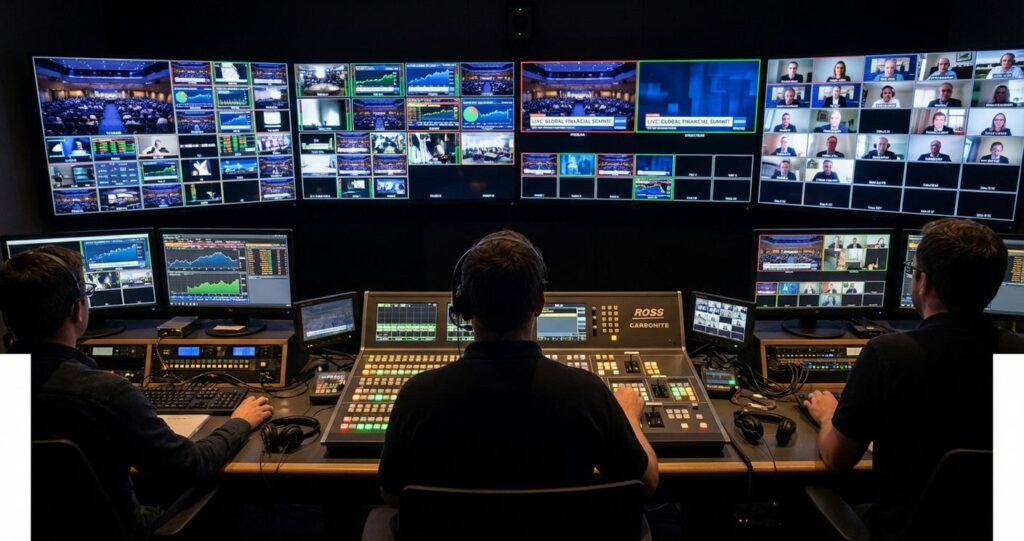
Broadcast-Grade Signal Integrity: Beyond the Webcam and HDMI
For a high-stakes Annual General Meeting (AGM), the integrity of every audio and video signal is non-negotiable. While internal AV teams are proficient with presentation technology, their infrastructure is often built around consumer or prosumer standards like HDMI and USB webcams. A professional production workflow, however, is founded on broadcast standards designed for absolute reliability and control. This distinction represents the first and most critical value of an external production partner. It’s the difference between connecting a laptop to a projector and managing a multi-source live television broadcast.
Multi-Camera Acquisition and Ingest with Synchronized Signals
An AGM requires multiple camera angles: a wide shot of the stage, a tight shot on the primary speaker, and angles on other board members for reactions or Q&A sessions. An internal setup might attempt this with mismatched DSLRs or prosumer camcorders, leading to significant challenges. Professional broadcast cameras utilize Serial Digital Interface (SDI) connections, a robust standard that supports long cable runs (up to 100 meters or more) and locking connectors to prevent accidental disconnection. Unlike HDMI, which is a point-to-point consumer interface prone to signal degradation and handshake issues (HDCP), 12G-SDI provides a stable, uncompressed signal path for resolutions up to 4K/UHD at 60 frames per second. Furthermore, all cameras in a professional production are fed a common reference signal known as genlock. This synchronizes the scanning of each camera’s sensor, ensuring that when the video switcher cuts between sources, there is no frame tearing, glitching, or signal loss, a common artifact when switching unsynchronized sources.
Professional Audio Architecture for Absolute Clarity
Audio is arguably more critical than video in an AGM. If shareholders cannot clearly hear the CEO’s address or the CFO’s financial report, the entire event is compromised. An external producer architects an audio system based on redundancy and discrete control. This typically involves a Dante (Digital Audio Network Through Ethernet) or MADI (Multichannel Audio Digital Interface) network, which allows for dozens of high-quality audio channels to be routed over standard network cable. This setup provides immense flexibility and isolates audio from potential video signal interference. Presenters are typically equipped with dual-element lavalier microphones, providing an immediate backup. A professional audio engineer at a dedicated digital mixing console manages each microphone feed independently, applying equalization (EQ) and dynamics processing to optimize for intelligibility and eliminate feedback. They create a specific “mix-minus” feed for remote participants, which includes all program audio except for their own, preventing distracting echo and feedback loops that often plague events run on standard conferencing software.
Signal Routing and Management for Complex Productions
As the source count grows, so does the complexity. An external production team brings a centralized routing system, a core component of any broadcast facility. A video router, such as a Blackmagic Design Videohub, acts as a digital patch bay, allowing any input (camera, graphics, remote feed) to be sent to any output (switcher, encoder, confidence monitor) with software-based control. This eliminates the catastrophic risk of manually re-plugging cables during a live event. The Technical Director (TD) operating the production switcher receives all sources into a multiview monitor, allowing them to see every camera, graphic, and video playback source simultaneously, alongside preview and final program outputs. This level of monitoring and control is fundamental to executing a clean, professional broadcast and is simply not achievable with basic AV setups.
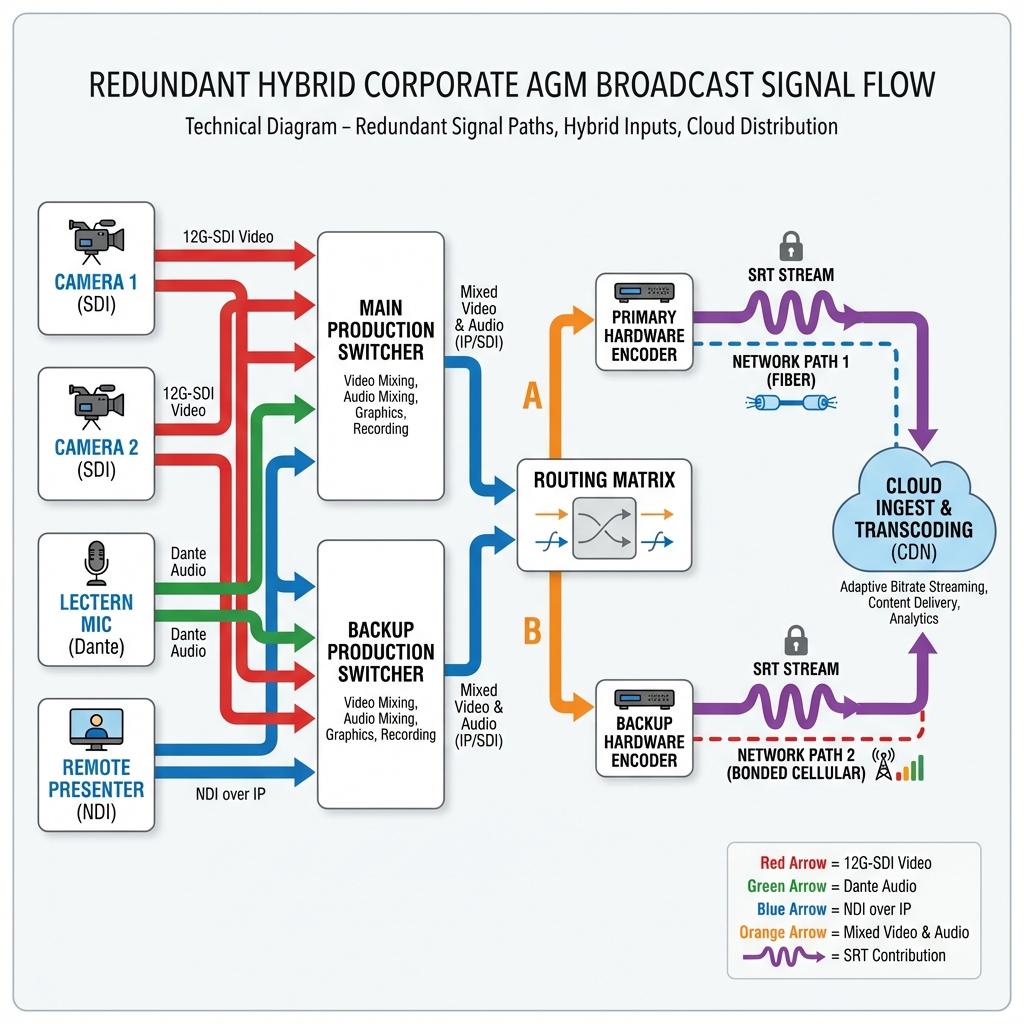
The Production Control Room (PCR) Ecosystem: Centralizing Command and Control
The operational heart of any professional live event is the Production Control Room (PCR), or a temporary “video village” built on-site. This is where an external production team centralizes all technical and editorial control, ensuring a seamless and polished output. Attempting to run an AGM without this centralized command structure means key production roles are either neglected or handled by individuals juggling multiple, conflicting responsibilities, dramatically increasing the probability of critical errors.
Hardware-Based Video Switching vs. Software Solutions
While software switchers like OBS Studio or vMix are powerful tools for smaller streams, high-stakes corporate events demand the rock-solid reliability of dedicated hardware video switchers. A professional production switcher from a manufacturer like Ross Video, Grass Valley, or Blackmagic Design has a dedicated hardware processing core. This means its operation is independent of a computer’s operating system, processor load, or software updates. The physical control surface provides the TD with tactile, immediate access to every source, transition, and keyer, enabling faster and more accurate switching than clicking with a mouse. This hardware-based approach provides the sub-frame latency required for perfect lip-sync and seamless integration of graphics and effects, ensuring the broadcast feels responsive and professional.
Encoding, Protocols, and Resilient Contribution
Getting a pristine signal out of the production switcher is only half the battle. That signal must be encoded and transported to the streaming platform reliably. This is a specialized discipline known as “contribution.” While RTMP (Real-Time Messaging Protocol) is a common ingest protocol for many platforms, it is susceptible to packet loss over unstable internet connections. Professional producers overwhelmingly prefer SRT (Secure Reliable Transport), an open-source protocol that provides forward error correction and resilience against network jitter and packet loss, ensuring a stable signal even over suboptimal networks. The encoding itself is handled by dedicated hardware encoders. These devices are purpose-built for one task: encoding a baseband video signal (SDI) into a compressed format like H.264 or the more efficient H.265/HEVC. This process is optimized for low latency and high quality, creating an adaptive bitrate (ABR) ladder—a series of streams at different resolutions and bitrates—so that viewers with varying internet speeds receive the best possible experience without buffering.
Bulletproof Redundancy and Failover Architecture
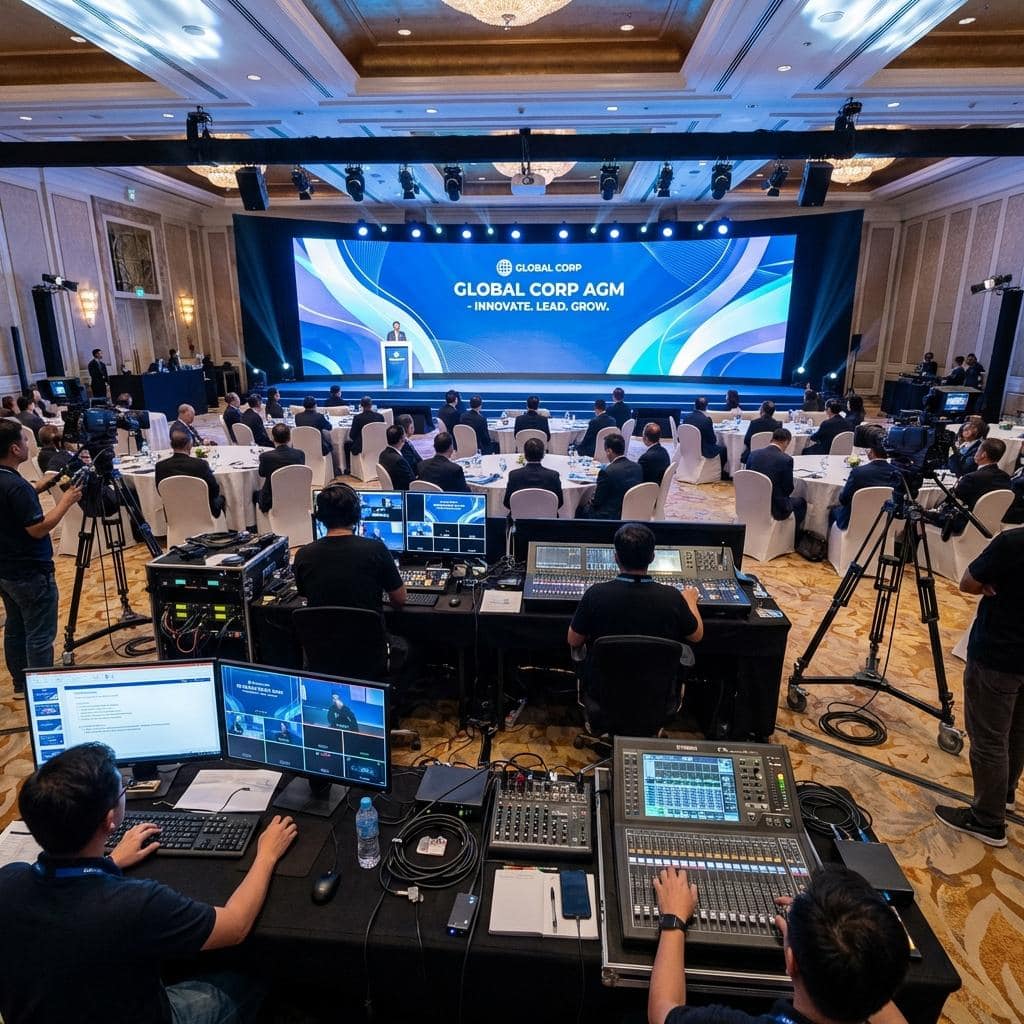
For an AGM, there is no tolerance for downtime. An external producer designs the entire workflow around redundancy. This starts with a fully redundant signal path, often labeled as a 1+1 or A/B path. This means there is a primary and a backup for every critical component: two production switchers, two graphics systems, and most importantly, two independent encoders. These encoders are fed the same program output and are configured to stream to separate geographic ingest points for the streaming provider. They are connected to the internet via two completely separate network paths: the primary venue internet line and a secondary connection, often a bonded cellular solution (e.g., LiveU) that combines multiple cellular carriers into a single, robust data link. In the event of a primary component or network failure, a monitoring system can trigger a seamless, often automatic, switch to the backup path, with the remote audience being completely unaware that an issue occurred.
Bridging the Physical and Virtual: Advanced Hybrid Event Integration
Modern AGMs are rarely purely physical events. The inclusion of remote board members, investors, and shareholders introduces significant technical complexity that extends far beyond a standard video conference call. An external producer has the specialized tools and expertise to seamlessly merge the in-person and remote components into a single, cohesive broadcast.
Native Platform Integration for Broadcast Quality
Simply pointing a camera at a screen running a Microsoft Teams or Zoom call is an unacceptable compromise on quality. Professional producers extract clean, isolated video and audio feeds (ISOs) from remote participants. This is achieved using specialized hardware like a Teams Rooms or Zoom Rooms system, which can output individual participant feeds via broadcast-standard outputs like NDI (Network Device Interface) or SDI. These high-quality feeds can then be treated like any other camera source in the production switcher, allowing for proper color correction, audio mixing, and integration into the main program. This workflow elevates remote participants from being passive viewers in a gallery view to active, fully-produced contributors in the broadcast.
Managing Remote Presenter Feeds and Talkback
Effective communication with remote presenters is paramount. An external production team establishes a “virtual green room” and a dedicated talkback system. The talkback, or IFB (Interruptible Foldback), is a one-way communication channel from the show’s director directly to an earpiece worn by the remote presenter. This allows the director to provide private cues (“You’re live in 10 seconds,” “Please look at the camera,” “Wrap up in one minute”) without being heard by the audience. This is the same system used in professional television news and is essential for keeping the event on schedule and ensuring remote speakers are confident and prepared.
Secure Q&A and Voting Platform Integration
AGMs often require secure, auditable platforms for shareholder Q&A and voting. An internal team might struggle to integrate these third-party systems cleanly. An external production team works with these platform providers to integrate their outputs directly into the broadcast as professional graphic overlays. The data from a voting platform, for example, can be fed into a broadcast graphics engine (like Chyron or Ross XPression) to generate real-time, animated graphics displaying poll results. This ensures the data is presented clearly, accurately, and in a way that matches the professional aesthetic of the rest of the broadcast, maintaining audience engagement and confidence in the process.
Conclusion: Investing in Certainty for Mission-Critical Events
The technical architecture required to execute a flawless, high-stakes corporate AGM is fundamentally a broadcast-level operation. It demands a deep expertise in video engineering, audio networking, IP transport protocols, and redundant system design that falls far outside the scope of even the most competent internal IT or AV departments. Relying on an internal team for an event of this magnitude is not a cost-saving measure; it is an acceptance of immense technical risk.
Engaging an external production partner is an investment in certainty. It provides access to a team of dedicated specialists—a Technical Director, Audio Engineer, Graphics Operator, and Stream Engineer—each focused on a specific component of the production. It secures a workflow built on broadcast-grade hardware, from genlocked SDI cameras to redundant SRT encoders. Most importantly, it establishes a robust, fault-tolerant infrastructure designed to mitigate every identifiable point of failure. For a communications event as critical as an Annual General Meeting, where shareholder confidence and corporate reputation are on the line, this level of professional execution is not a luxury. It is an essential component of success.
Jeremy Lee is a seasoned digital marketing director and strategist with over two decades of experience in the industry. As the founder of Sotavento Medios, I manage a diverse portfolio of over 50 businesses, helping brands grow through advanced search strategies and digital innovation. My work focuses on bridging the gap between traditional search engine optimisation and the evolving world of AI-driven answer engines.
get in touch