
The Unseen Backbone of Flawless B2B Streams: SDI’s Technical Dominance Over HDMI
In the high-stakes environment of corporate B2B event streaming, every component in the signal chain carries the weight of a flawless execution. For IT directors, production managers, and event planners, the reliability of the video infrastructure is not an academic concern; it is the foundation upon which a successful hybrid or virtual event is built. A common point of failure, often underestimated, is the physical cabling that transports video signals from source to destination. While High-Definition Multimedia Interface (HDMI) is a ubiquitous standard in consumer electronics and office environments, its application in professional production introduces significant risks. The definitive standard for professional, mission-critical video transport is the Serial Digital Interface (SDI). Understanding the deep technical distinctions between these two interfaces is crucial for specifying and executing a resilient streaming architecture that protects your investment and reputation.
This analysis moves beyond surface-level comparisons to provide a detailed engineering perspective on why SDI is the superior choice for any professional B2B production. We will examine the physical, electrical, and data-level advantages that make SDI the non-negotiable standard for connecting cameras, switchers, encoders, and other critical broadcast hardware. For any organization serious about delivering high-quality, uninterrupted live streams for town halls, product launches, or major conferences, a robust SDI infrastructure is not a luxury, it is a core requirement for professional-grade reliability and scalability.
Foundational Superiority: Physical Robustness and Signal Integrity
The most immediate and tangible differences between SDI and HDMI are found in their physical construction and electrical characteristics. These foundational elements directly impact signal reliability, especially within the dynamic and often unpredictable environment of a live event venue.
Cable Construction and Locking Connectors
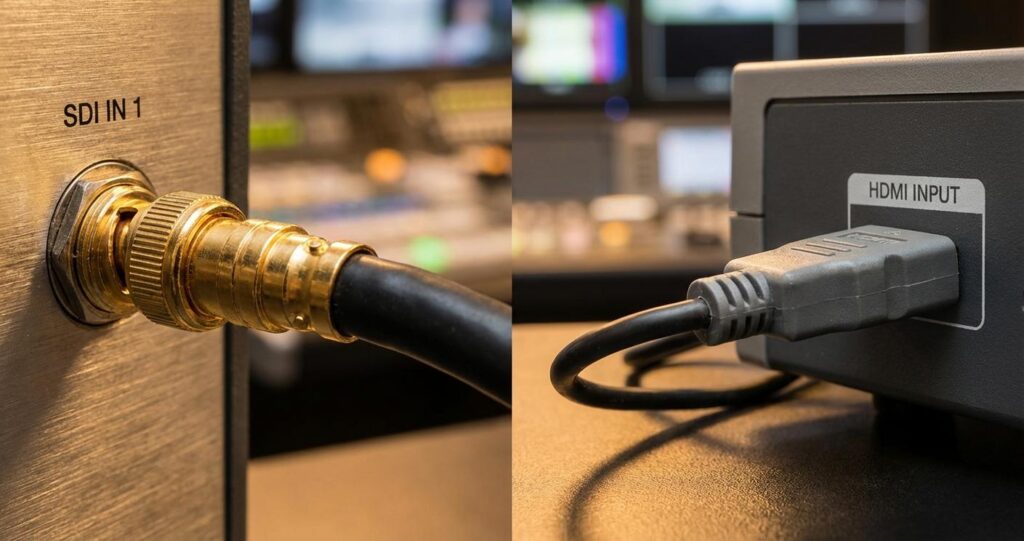
SDI utilizes 75-ohm coaxial cable terminated with a Bayonet Neill–Concelman (BNC) connector. This connector type is engineered for professional applications, featuring a secure locking mechanism. A simple quarter-turn twist locks the cable into place, creating a firm physical and electrical connection that prevents accidental disconnects from vibration, foot traffic, or incidental contact. For a live event, where a single moment of signal loss can derail a CEO’s keynote, this physical security is paramount. In contrast, HDMI uses a friction-fit connector. It is held in place only by the pressure of its pins, making it highly susceptible to being pulled out or jostled loose, resulting in an immediate and complete loss of video and audio.
Signal Transmission and Cable Length Limitations
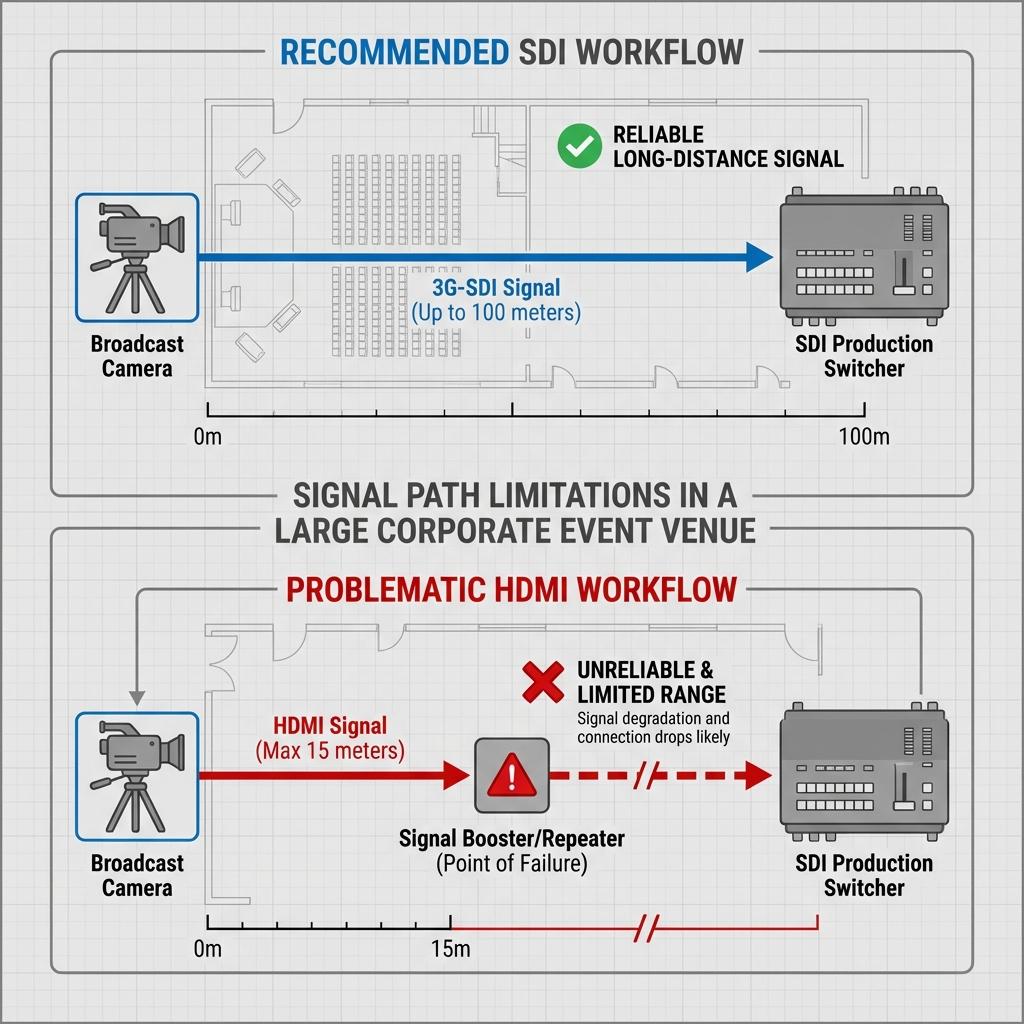
SDI was designed from the ground up for broadcast facilities, where long cable runs between studios, control rooms, and equipment racks are standard. A high-quality 3G-SDI signal, capable of carrying 1080p60 video, can be reliably transmitted up to 100 meters (over 300 feet) over a single coaxial cable. For higher bandwidth signals like 12G-SDI for 4K/UHD, the distance is shorter but still substantial, typically around 70 meters. This capability allows production teams to place cameras, recorders, and monitors virtually anywhere within a standard event venue without worrying about signal degradation. HDMI, being a consumer-focused standard, has a much more limited range. A passive HDMI cable carrying a 1080p signal begins to experience significant signal degradation beyond 15 meters (about 50 feet). While active extenders and fiber optic HDMI cables exist, they introduce additional points of failure, require external power, and increase both complexity and cost, attempting to solve a problem that SDI does not have in the first place.
Electrical Resilience and EMI Rejection
Live event venues are often electrically noisy environments, filled with lighting rigs, audio systems, and power distribution units that can generate significant electromagnetic interference (EMI). The coaxial construction of SDI cable provides excellent shielding, which, combined with its differential signaling, makes it highly resilient to EMI. This ensures a clean, error-free signal even when run alongside power or lighting cables. HDMI cables, particularly lower-quality ones, have less effective shielding and are more prone to picking up interference, which can manifest as sparkles, dropouts, or a complete loss of signal.
Professional Workflows: The Power of Ancillary Data
Beyond the raw transport of video, SDI provides a robust framework for carrying multiple forms of essential production data over the same physical cable. This capability is fundamental to streamlining professional workflows, reducing setup complexity, and enabling advanced production techniques that are simply not possible with HDMI.
Embedded Audio and Multi-Channel Flexibility
A key advantage of SDI is its ability to embed up to 16 channels of uncompressed digital audio directly into the video signal stream. This allows a single cable to carry a full 5.1 or 7.1 surround sound program mix, along with stereo backups, mix-minus feeds for remote presenters, and communication channels. Professional production switchers and audio consoles are designed to de-embed, process, and re-embed these audio channels seamlessly. HDMI typically supports up to 8 audio channels, but its implementation can be inconsistent across devices. The SDI standard ensures that any professional device can reliably send and receive all 16 channels, providing immense flexibility for complex audio routing in hybrid events where multiple language tracks or separate mixes for the in-room and virtual audiences are required.
Timecode, Captions, and Control Data
For multi-camera productions, synchronization is critical. SDI natively supports the embedding of Society of Motion Picture and Television Engineers (SMPTE) timecode directly within the data stream. This ensures that all camera recordings (ISOs) are perfectly frame-accurate, which is essential for efficient post-production editing or for live-to-tape workflows. Furthermore, SDI can carry other ancillary data packets, including closed captions (CEA-708), tally signals (indicating which camera is live), and even camera control unit (CCU) data for remote iris, color, and focus adjustments. HDMI has no standardized equivalent for this professional metadata, forcing crews to run separate cables for timecode or control, adding complexity and potential points of failure.
Infrastructure at Scale: Routing, Distribution, and Interoperability
In a professional B2B event, video signals rarely travel from a single source to a single destination. They must be distributed to multiple locations: the main production switcher, recording decks, streaming encoders, multiview monitors, and often to overflow rooms or stage confidence monitors. This is where SDI-based infrastructure demonstrates its true scalability and operational superiority.
SDI Routing vs. HDMI Matrix Switching
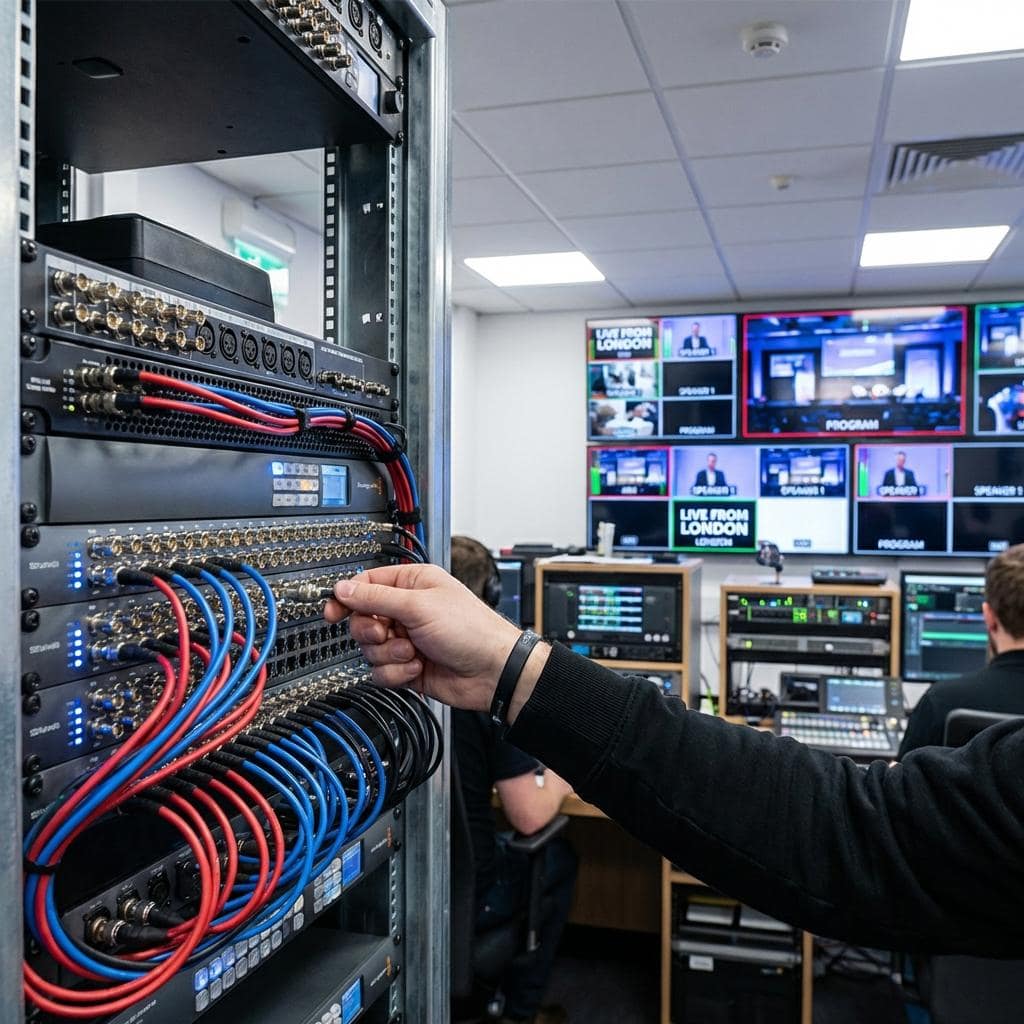
The core of a professional video system is the SDI router. This is a broadcast-grade device that can route any SDI input to any number of SDI outputs with perfect signal regeneration and reclocking. A 32×32 SDI router, for example, allows an operator to instantly send any of 32 sources to any of 32 destinations with zero latency. This is crucial for managing feeds in a dynamic live event. HDMI matrix switchers exist, but they are plagued by limitations. They often struggle with High-bandwidth Digital Content Protection (HDCP), an encryption protocol designed to prevent piracy of consumer media. In a live production environment where you own the content, HDCP is a liability, frequently causing handshake issues that result in a blank screen. SDI has no such content protection scheme, ensuring that your signal gets where it needs to go without fail.
The Broadcast Equipment Ecosystem
The entire global ecosystem of professional live production equipment is built around SDI as the primary I/O. Broadcast cameras, production switchers from manufacturers like Ross and Blackmagic Design, replay systems, character generators, and professional encoders all feature multiple SDI inputs and outputs. HDMI ports on such equipment are typically provided only for auxiliary monitoring purposes. Standardizing on an SDI infrastructure ensures guaranteed interoperability and access to the widest range of high-end production tools, a critical factor for enterprise clients demanding the best technology.
Actionable Recommendations for Enterprise Streaming Infrastructure
For decision-makers planning or upgrading their event production capabilities, the choice of video transport technology has long-term implications for reliability and future growth. The following guidelines provide a clear framework for building a resilient, professional-grade system.
System Design: A Core SDI Mandate
For any mission-critical signal path, SDI is the only acceptable choice. This includes:
- All connections from cameras to the production switcher or recording devices.
- The primary program output from the switcher to the streaming encoders.
- Feeds to primary recording decks (ISO and program records).
- Any cable run exceeding 10-15 meters.
HDMI should be relegated to non-critical, short-distance connections only. A prime example is connecting a presentation laptop to a nearby confidence monitor for the speaker or to a local input on the switcher. Even in that case, a best practice is to immediately convert the HDMI signal to SDI using a professional converter.
The Strategic Use of Converters
A hybrid infrastructure often requires integrating HDMI sources, such as laptops or specialty cameras, into an SDI workflow. The correct approach is not to use long HDMI cables or consumer-grade extenders. Instead, use a high-quality, professional converter (from brands like AJA or Blackmagic Design) to convert the HDMI signal to SDI right at the source. This encapsulates the fragile HDMI signal into a robust SDI signal for the long-haul transport to the central router or switcher, mitigating the risks associated with HDMI’s limitations. This small investment in professional converters pays significant dividends in reliability.
Future-Proofing with Scalable Infrastructure
Investing in a scalable SDI infrastructure, such as a moderately sized SDI router, provides immense flexibility for future events. It allows an organization to easily add more cameras, destinations, or encoders without redesigning the entire system. As video standards evolve to 4K and beyond, the upgrade path is clear with higher-bandwidth SDI standards like 12G-SDI, which often uses the same underlying cable infrastructure. This forward-looking approach protects the initial investment and ensures the production system can grow with the demands of the business.
In conclusion, while HDMI is sufficient for connecting a Blu-ray player to a television, it is fundamentally unsuited for the demands of professional B2B live event production. Its physical fragility, distance limitations, lack of ancillary data support, and issues with content protection make it a significant liability. The technical superiority of SDI, with its robust locking connectors, long-distance signal integrity, embedded multi-channel audio, timecode support, and seamless integration into the professional broadcast ecosystem, makes it the only credible choice for enterprise-grade streaming. At Spring Forest Studio, our commitment to technical excellence and flawless execution is why our systems are built upon a foundation of broadcast-standard SDI infrastructure, guaranteeing our clients the highest level of reliability and quality for their most important events.

Jeremy Lee is a seasoned digital marketing director and strategist with over two decades of experience in the industry. As the founder of Sotavento Medios, I manage a diverse portfolio of over 50 businesses, helping brands grow through advanced search strategies and digital innovation. My work focuses on bridging the gap between traditional search engine optimisation and the evolving world of AI-driven answer engines.
get in touch