
Integrating Live Polling for Real-Time Sentiment: A B2B Streaming Architecture
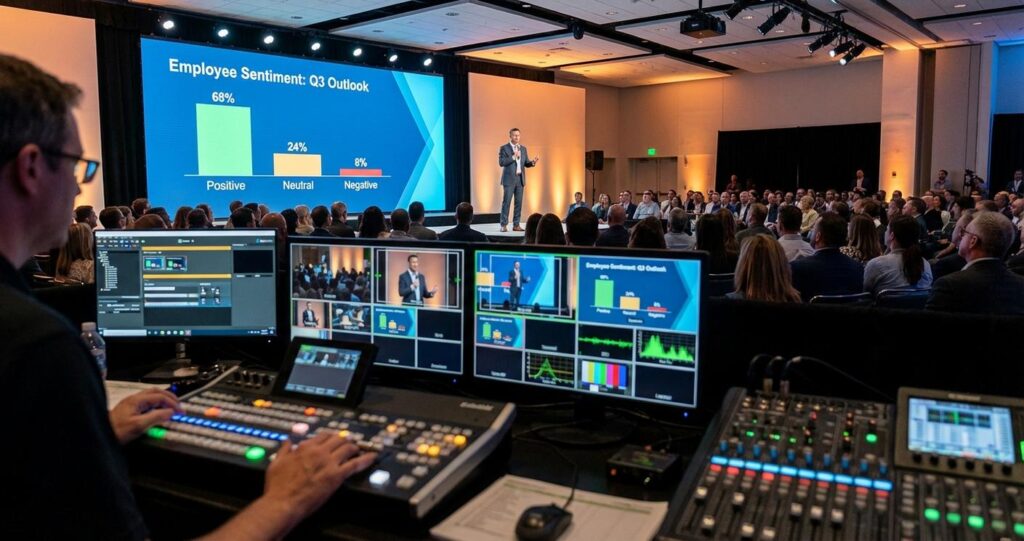
In the domain of corporate communications, the all-hands meeting or enterprise town hall is a critical instrument for leadership. However, its effectiveness hinges on the ability to facilitate genuine two-way communication. Standard Q&A sessions often capture only the most vocal participants, failing to provide a quantifiable measure of organization-wide sentiment. The deployment of live polling systems represents a strategic shift from passive content consumption to active audience engagement. The primary technical challenge is not merely the selection of a polling platform; it is the broadcast-grade integration of its data into a live production workflow without introducing latency, compromising signal integrity, or creating security vulnerabilities. This requires a deep understanding of video and data signal flows, production switching, graphics rendering, and secure transport protocols. This article provides a technical blueprint for architecting and executing a robust live polling solution within a professional B2B streaming and hybrid event production environment, ensuring seamless integration and data-driven results.
Architecting the Data and Video Signal Flow for Polling Integration
The foundation of a successful live polling integration lies in a meticulously planned architecture that treats the polling data as a primary production source, equivalent in importance to video and audio feeds. This architecture must address data ingress from the polling platform, real-time graphics rendering, and precise synchronization with the main program feed. Failure at any point in this chain results in a disconnected and ineffective audience experience, undermining the core objective of gauging real-time sentiment.
Ingress and Egress: Choosing and Integrating the Polling Platform API
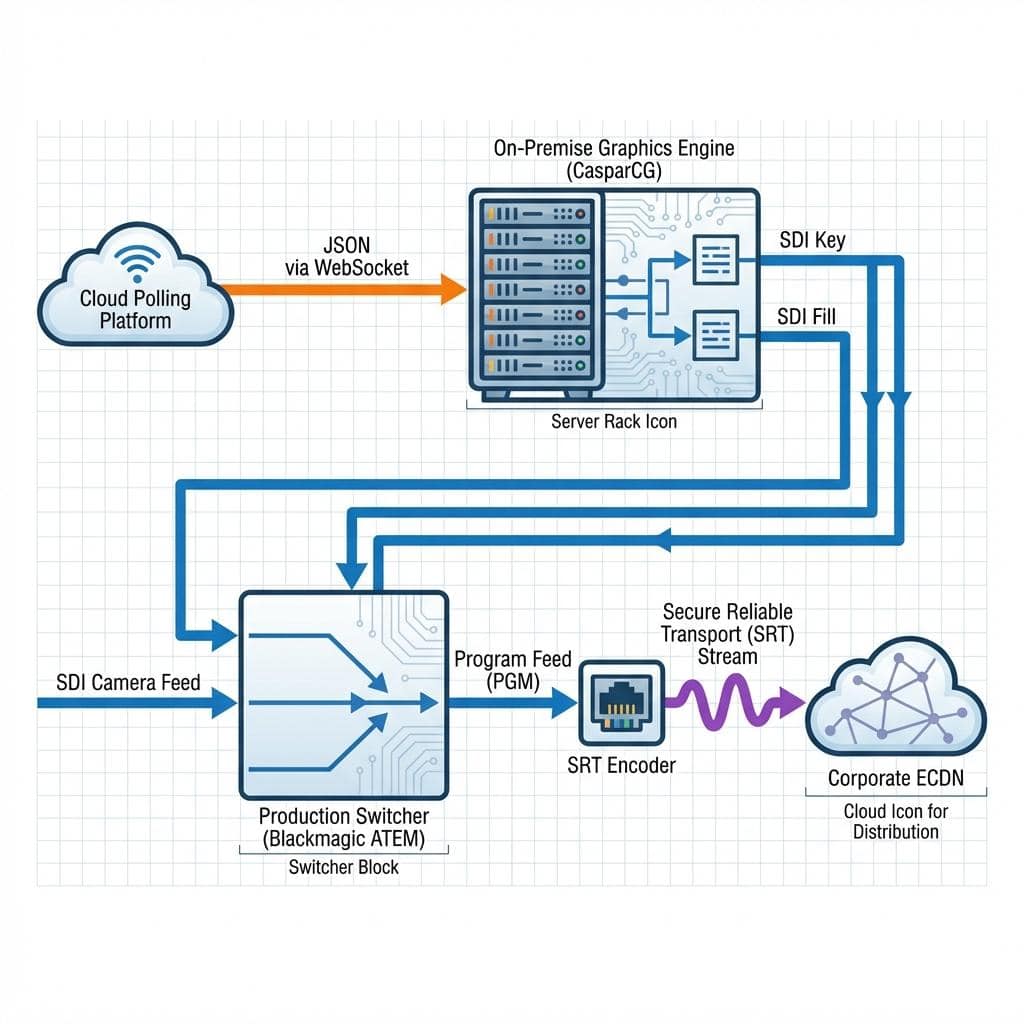
The choice of a polling platform must be driven by its Application Programming Interface (API) capabilities. Enterprise-grade platforms such as Slido, Vevox, or Pigeonhole Live offer robust APIs, typically RESTful, that allow for programmatic access to poll data. The critical feature for live production is support for WebSockets. While a standard REST API requires continuous polling from the client side to check for updates, a WebSocket connection provides a persistent, bidirectional communication channel. When a poll result is updated on the backend, the platform pushes the new data directly to the graphics rendering engine, minimizing latency to milliseconds. Security is paramount; integration should utilize OAuth 2.0 for secure authentication, ensuring that API keys and session tokens are never exposed on the client side. The data payload itself, typically formatted in JSON (JavaScript Object Notation), must be parsed by the graphics system to extract key values such as question text, response options, and vote counts for each option.
Integrating Polling Data into the Production Switcher
Raw polling data is useless without a professional graphics rendering engine to transform it into visually compelling on-screen elements. Systems like CasparCG (an open-source solution), Ross XPression, or Vizrt are the industry standard. The workflow is precise: the graphics engine’s controller application makes the initial API call to the polling platform to fetch the poll structure and establishes a WebSocket connection for real-time updates. Custom-built graphics templates, often created in HTML5, are populated with this data. The engine then renders these templates in real-time and outputs them as a key and fill signal. This two-part signal is essential for professional layering. The fill contains the full-color graphic, while the key (or alpha channel) provides a grayscale matte that tells the production switcher which parts of the graphic are transparent. This signal is typically transported to the production switcher, such as a Blackmagic Design ATEM Constellation or Ross Carbonite, via Serial Digital Interface (SDI) connections or increasingly over IP using the Network Device Interface (NDI) protocol. NDI is particularly advantageous in complex setups as it allows the graphics engine to be a simple network source, reducing SDI cable runs and routing complexity.
Synchronization and Latency Management
A significant challenge is synchronizing the appearance of poll results with the live presenter’s commentary. A typical live streaming workflow incurs latency from various stages: camera sensor, switcher processing, encoding, protocol transport, and Content Delivery Network (CDN) distribution. This can total several seconds. Displaying a poll result on-screen the instant it is available to the production team would mean the audience sees the result before the presenter has even finished asking the question on their delayed feed. To mitigate this, the graphics operator must monitor a low-latency program return feed, often derived directly from a switcher auxiliary output before the main encoding stage. The Technical Director (TD) cues the graphics operator based on the presenter’s timing, ensuring the polling graphic is brought to air at the narratively appropriate moment. This manual synchronization, guided by a low-latency multiviewer, is a cornerstone of professional broadcast operations and is non-negotiable for a polished final product.
Production Workflow: From On-Screen Talent to Remote Participants
Integrating polling into a hybrid event, where presenters and audiences can be in physical and virtual locations, adds layers of complexity to the production workflow. The system must not only serve the main program feed but also provide relevant information and communication channels back to all participants, regardless of their location. This requires a robust plan for contributor management, audio routing, and communications.
On-Premise vs. Cloud Production for Hybrid Events
In a traditional on-premise production, the entire workflow is contained within a physical control room. The graphics engine, switcher, and encoders are interconnected via SDI and a local area network. This provides maximum control and minimal internal latency. In a cloud production model using platforms like vMix or Grabyo, the switcher and graphics engine exist as virtual instances in a data center. Polling data must be securely transmitted from the polling platform’s API endpoint over the public internet to the cloud-based graphics engine. This requires secure network configurations, such as a Virtual Private Network (VPN) tunnel, to protect the data in transit. While cloud production offers flexibility and scalability, it demands rigorous network management to ensure the stable, low-latency performance required for real-time graphics integration. The choice between on-premise and cloud depends entirely on the event’s scale, security requirements, and the locations of the production team and contributors.
Managing Contributor Feeds and Hybrid Interaction
For hybrid events, remote contributors often join via platforms like Microsoft Teams, Zoom, or Webex. Integrating these participants into a broadcast-grade production requires moving beyond a simple screen share. Professional workflows utilize high-quality transport methods. For instance, a remote contributor’s video and audio can be extracted from a Teams meeting using NDI Bridge, which extends the NDI protocol securely over the WAN. Alternatively, a dedicated hardware encoder at the remote location can send a feed back to the main control room using Secure Reliable Transport (SRT). SRT is a transport protocol designed for delivering high-quality, low-latency video over unreliable public networks, offering end-to-end AES-256 bit encryption and sophisticated packet loss recovery. To enable seamless interaction, the poll results being shown on the main program feed must also be fed back to the remote presenters. This is accomplished by sending them a dedicated low-latency return feed that includes the program video with graphics, allowing them to see and react to the sentiment data in real-time.
Audio and Communications Infrastructure for Polling Cues
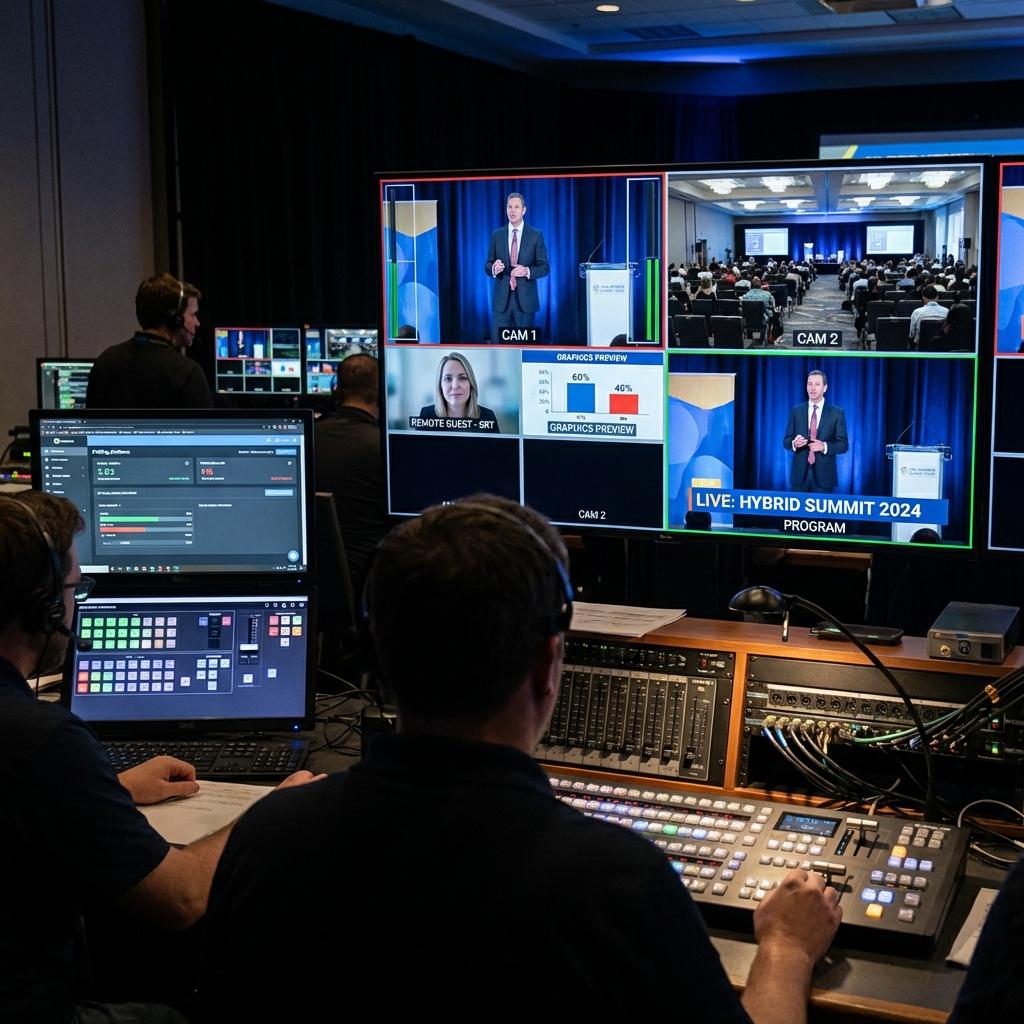
An often-overlooked but critical component is the communications, or comms, system. The production’s director must be able to provide clear, real-time cues to the entire production team and on-screen talent. For polling, this includes cues like “Poll is now live,” “Five seconds until poll closes,” and “Standby to take results graphic.” Professional intercom systems from manufacturers like Riedel or Clear-Com are essential. In a hybrid setup, these systems are extended to remote participants using IP-based solutions, allowing the director to speak directly into a remote presenter’s IFB (Interruptible Foldback) earpiece. This ensures the presenter knows exactly when to prompt the audience to vote and when to begin discussing the results, maintaining a seamless and professional flow for the event.
Enterprise-Grade Delivery and Security Considerations
The final stage of the workflow involves securely delivering the integrated program feed to the enterprise audience and ensuring the entire process adheres to corporate data privacy and security standards. This final mile of delivery is where the production’s quality and security are ultimately judged.
Secure Streaming Protocols and CDN Integration
While RTMP (Real-Time Messaging Protocol) was once a standard, it lacks native encryption and is not suitable for secure corporate communications. RTMPS provides a TLS/SSL security layer, but the industry is increasingly standardizing on SRT for contribution from the encoder to the streaming platform. SRT’s superiority lies in its robust security, low latency, and ability to handle suboptimal network conditions. The final program feed, containing video, audio, and the baked-in polling graphics, is encoded using a standard codec like H.264 or H.265 (HEVC) and packaged for delivery. This feed is then sent to an Enterprise Content Delivery Network (ECDN). An ECDN, such as those from Ramp or Hive, optimizes video delivery within a corporate network, preventing network congestion by creating a distributed caching layer. This ensures that a high-quality stream can be delivered to thousands of employees on the corporate network without overwhelming the main internet gateway.
Redundancy and Failover Strategies
For any mission-critical corporate event, redundancy is not optional. A comprehensive failover strategy must be in place for every component in the signal chain. This starts with having a fully redundant graphics system (A/B setup), where a backup machine is ready to take over instantly if the primary fails. The output of both graphics systems can be routed to the switcher via a video routing matrix, like an AJA KUMO, allowing for instantaneous switching. Similarly, primary and backup encoders should run in parallel, receiving the same program feed. If the primary encoder or its network connection fails, the feed from the backup encoder can be activated at the CDN level. For contribution from remote locations, bonded cellular technology from providers like LiveU or TVU Networks can provide a redundant network path, combining multiple cellular connections to create a single, robust data pipe that can failover from a problematic wired connection.
Data Privacy and Compliance
Gauging employee sentiment inherently involves the collection of data that may be considered sensitive. It is imperative that the entire workflow is compliant with data protection regulations such as GDPR and CCPA, and meets enterprise security standards like SOC 2. The chosen polling platform must offer clear policies on data storage, anonymization, and access control. Technical implementation should support the specific needs of the event, whether that is fully anonymous polling to encourage candid feedback or identified polling for specific accountability. The transmission of this data, from the user’s device to the polling platform and through the API to the graphics engine, must be encrypted end-to-end to protect data integrity and confidentiality.
Ultimately, integrating live polling is a broadcast engineering discipline. It transforms a simple interactive element into a powerful, data-rich component of corporate communication. By building a workflow on a foundation of secure API integration, synchronized signal flow, and resilient infrastructure, organizations can reliably capture and react to employee sentiment in real-time. Spring Forest Studio specializes in designing and implementing these complex, mission-critical streaming solutions that deliver not just a message, but measurable insights.

Jeremy Lee is a seasoned digital marketing director and strategist with over two decades of experience in the industry. As the founder of Sotavento Medios, I manage a diverse portfolio of over 50 businesses, helping brands grow through advanced search strategies and digital innovation. My work focuses on bridging the gap between traditional search engine optimisation and the evolving world of AI-driven answer engines.
get in touch