

The internal communication landscape for corporations in Singapore is undergoing a significant technological transformation. For years, High Definition (1080p) streaming was the accepted standard for town halls, annual general meetings, and internal broadcasts. It was sufficient. However, a confluence of factors, including the proliferation of large-format 4K displays in boardrooms, the increased complexity of data shared in presentations, and the strategic necessity of future-proofing digital assets, is driving a decisive shift towards 4K (3840×2160) production and distribution. This move is not about aesthetic enhancement; it is a strategic upgrade to bolster communication clarity, improve remote participant engagement in hybrid event models, and ensure the long-term value of recorded content. For enterprise decision-makers, IT directors, and AV professionals, understanding the technical implications of this transition is critical for successful implementation.
The Tangible Impact of 4K Resolution in Enterprise Environments
Adopting a 4K internal broadcast standard delivers immediate and long-term advantages that extend far beyond simply having more pixels. The upgrade directly impacts information retention, asset versatility, and the quality of experience for an increasingly distributed workforce. It addresses the core B2B challenge of ensuring that critical information is conveyed with absolute precision, regardless of how or where it is viewed.
Enhancing Data Clarity and Presentation Integrity
Corporate presentations are no longer simple slide decks. They often involve complex financial spreadsheets, detailed architectural renderings, multi-window software demonstrations, and intricate process diagrams. When this content is captured and streamed in 1080p, fine details, small text, and critical data points can become compressed, aliased, or illegible, especially when viewed on large 4K displays. A 4K acquisition and delivery workflow maintains the integrity of this high-frequency information. With four times the resolution of 1080p, every number in a spreadsheet and every line in a CAD drawing is rendered with precision. This is not a luxury; it is a requirement for industries like finance, engineering, and medical technology, where misinterpretation of visual data can have significant consequences.
Future-Proofing Content Archives and VOD Assets
Every live internal broadcast is a valuable corporate asset. These recordings serve as a system of record, training materials, and onboarding resources for years to come. Capturing these events natively in 4K creates a high-quality master archive. This 4K source material, often recorded in professional codecs like Apple ProRes or Avid DNxHR at high bitrates, provides maximum flexibility for future use. A 4K master file can be easily downscaled to 1080p or 720p for distribution on legacy platforms or for viewers with limited bandwidth. The reverse is not true; upscaling a 1080p source to 4K results in a significant loss of quality and is not a viable professional solution. By standardizing on 4K acquisition, organizations ensure their video-on-demand (VOD) libraries are prepared for the display technologies of tomorrow.
Improving Hybrid Event Immersion for Remote Participants
In a hybrid event model, the experience of remote attendees is paramount. A 4K production workflow offers powerful tools to create a more engaging broadcast. One key technique is digital reframing, or creating virtual camera angles from a single 4K source. A wide shot captured by a single 4K camera can be cropped in post-production or even live with the right switching hardware to create multiple, distinct HD (1080p) shots. For example, a single wide shot of a three-person panel can be digitally manipulated to generate a tight shot of the current speaker, a two-shot of the other panelists, and the original wide view, all without adding physical cameras. This creates a more dynamic and visually interesting program feed for the virtual audience, keeping them more engaged than a static, single-angle shot ever could.
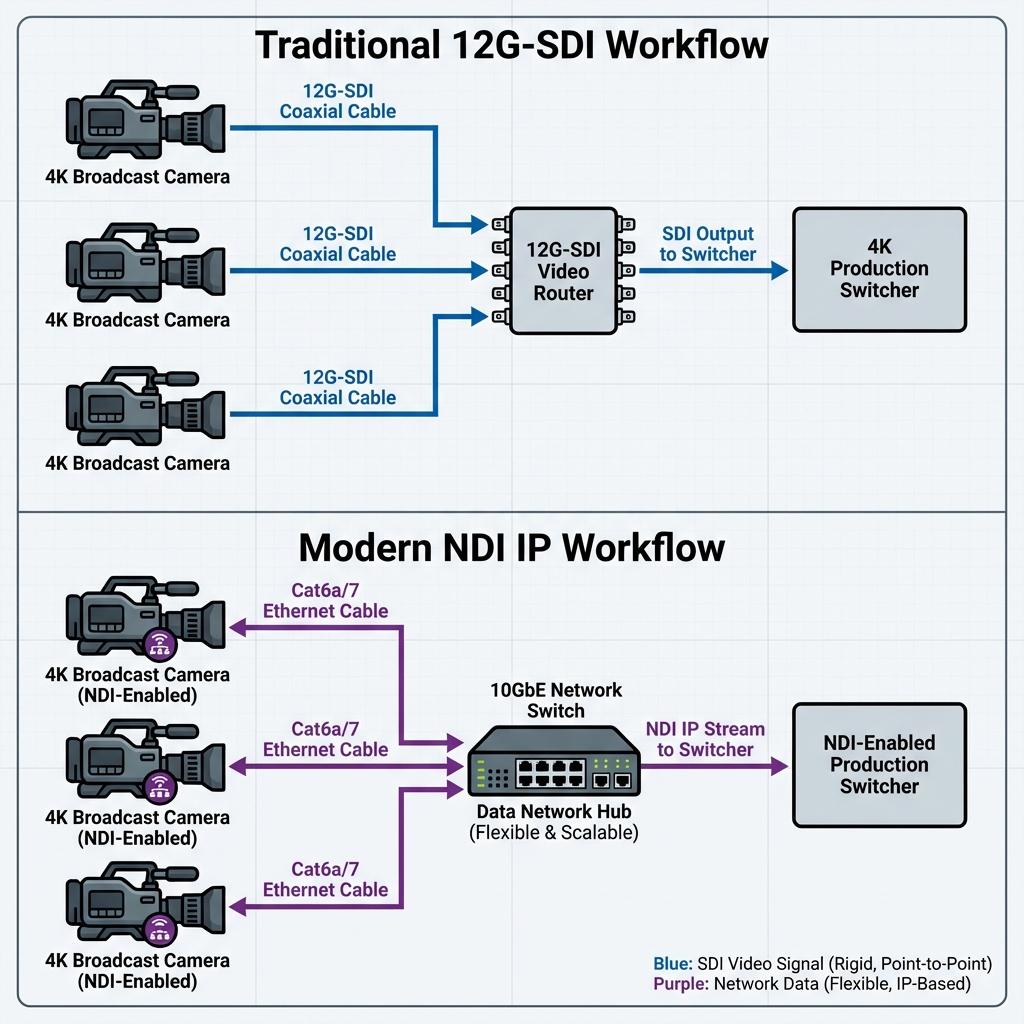
Upgrading the Production Infrastructure: The 12G-SDI vs. IP-Based Workflow Dilemma
Transitioning a production facility or event setup from HD to 4K is a significant undertaking that impacts the entire signal chain, from the camera sensor to the final encoder. The primary challenge lies in managing the immense data throughput of a 4K video signal. A 4K60p signal requires approximately 12 Gigabits per second (Gbps) of bandwidth, a fourfold increase over the 3 Gbps required for 1080p60. This necessitates a fundamental re-evaluation of signal routing and infrastructure, leading to a critical decision point: continue with a baseband Serial Digital Interface (SDI) workflow or migrate to a more flexible Video-over-IP solution.
The Traditional Pathway: Upgrading to 12G-SDI
For facilities already invested in SDI infrastructure, the most direct upgrade path is to 12G-SDI. This standard, defined by the Society of Motion Picture and Television Engineers (SMPTE) as ST 2082, allows for the transmission of a 4K60p signal over a single coaxial cable. This is a major improvement over the earlier Quad-Link SDI method, which required four separate 3G-SDI cables to carry one 4K signal, creating a cumbersome and error-prone cabling environment. A full 12G-SDI upgrade requires ensuring that every component in the signal path is compliant. This includes cameras with 12G-SDI outputs, video routers, patch panels, distribution amplifiers, and production switchers like the Blackmagic Design ATEM Constellation or Ross Video Carbonite Ultra. While reliable and well-understood by broadcast engineers, a 12G-SDI infrastructure is rigid; physical recabling is required for any changes in signal flow.
The Flexible Future: Embracing NDI for 4K Video-over-IP
An increasingly powerful alternative to baseband video is a networked approach using protocols like Network Device Interface (NDI). NDI allows for the transmission of high-quality, low-latency video, audio, and metadata over standard Ethernet networks. For 4K, this means connecting cameras, switchers, and other devices to a central network switch, typically operating at 10GbE or higher. There are two main variants: full-bandwidth NDI, which provides a visually lossless signal at a higher bitrate (approx. 250-400 Mbps for 4K), and NDI|HX, a more compressed version that requires less bandwidth but introduces slightly more latency. The primary advantage of an NDI workflow is its immense flexibility. Any source can be routed to any destination on the network through software, eliminating the need for physical patching. This approach, however, requires close collaboration with IT departments to ensure the network is properly configured with sufficient bandwidth, Quality of Service (QoS) to prioritize video traffic, and potentially Virtual LANs (VLANs) to isolate the production network from general corporate data traffic.
Encoding and Transport: Delivering Reliable 4K Broadcasts
Once a 4K program feed is produced, it must be compressed (encoded) and transported to the distribution platform for delivery to viewers. This stage is critical for ensuring a high-quality, stable viewing experience while managing network bandwidth, a key concern in any corporate environment. The jump to 4K necessitates adopting more efficient codecs and more robust transport protocols than those used for HD streaming.
The HEVC (H.265) Imperative for Bandwidth Efficiency
The Advanced Video Coding (AVC) or H.264 codec, while a workhorse for HD streaming, is not efficient enough for widespread 4K delivery. The bitrate required to maintain quality with H.264 is often too high for corporate networks or remote viewers. This is where High Efficiency Video Coding (HEVC), or H.265, becomes essential. H.265 is a compression standard designed to be roughly twice as efficient as H.264, meaning it can deliver comparable video quality at about half the bitrate. For an internal 4K30p broadcast, a stream encoded with H.265 might require a bitrate of 15-25 Mbps to look pristine, whereas an H.264 encode would need 30-50 Mbps or more. The trade-off is that H.265 encoding requires significantly more processing power, necessitating professional hardware encoders like those from Haivision, AJA, or Kiloview for reliable, low-latency performance in a live event context.
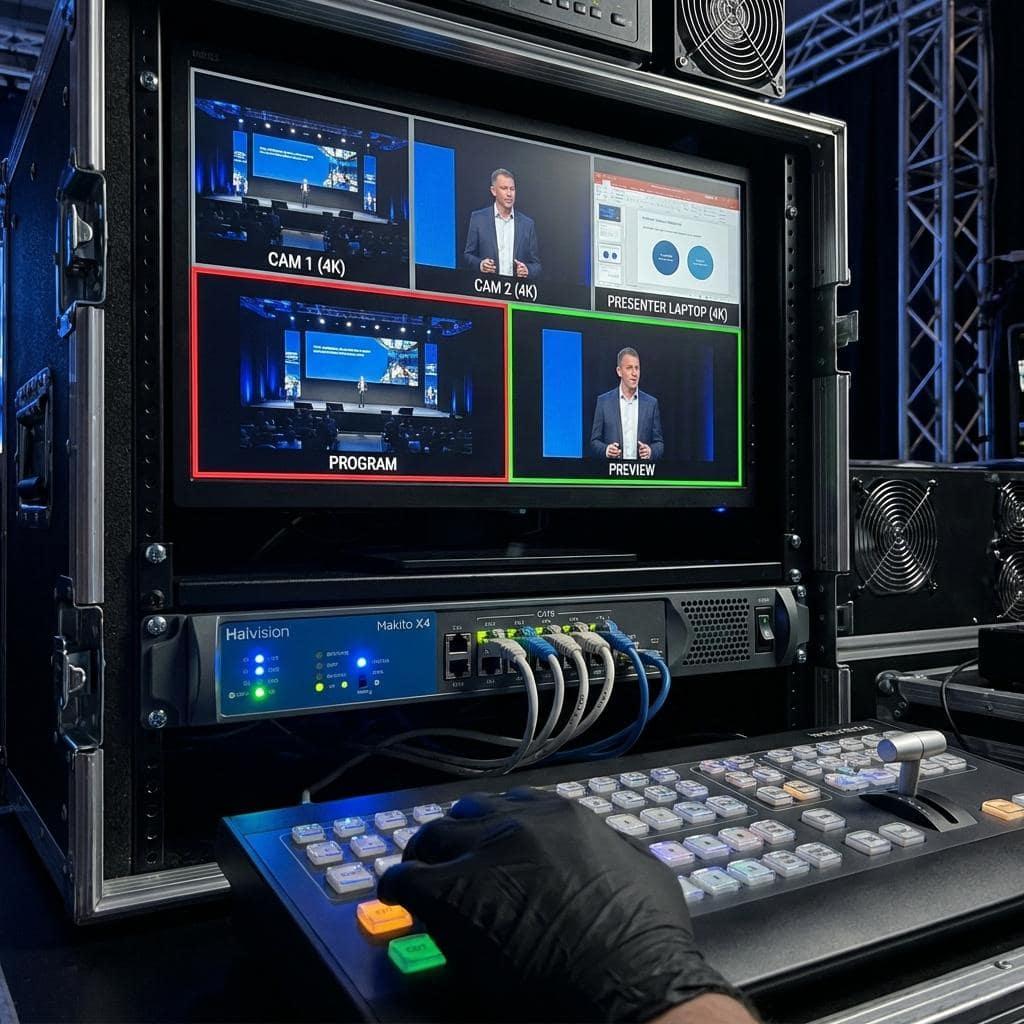
SRT vs. RTMP: Choosing the Right Transport Protocol
The transport protocol is responsible for moving the encoded video stream from the production site to the media server or CDN. For years, the Real-Time Messaging Protocol (RTMP) was the de facto standard. However, RTMP is a TCP-based protocol that can struggle with network instability; packet loss can cause buffering and stream failure. For mission-critical enterprise broadcasts, a more resilient solution is required. Secure Reliable Transport (SRT) is an open-source protocol specifically designed for high-performance video streaming over unpredictable networks. SRT operates over UDP and features a sophisticated ARQ (Automatic Repeat reQuest) error-correction mechanism to recover lost packets before they affect the video. It also provides AES-128/256 bit encryption for security and can deliver lower latency than RTMP. For sending a high-bitrate 4K feed from a Singapore event venue to a cloud platform or a different corporate office, SRT provides the reliability and security that enterprises demand.
Actionable Implementation Strategies for Singaporean Enterprises
Transitioning to a 4K internal broadcast workflow is a strategic process that requires careful planning and coordination between production teams, AV departments, and IT infrastructure managers. A successful rollout focuses on phased implementation, rigorous network preparation, and choosing the right distribution architecture to meet specific corporate needs.
Phased Upgrades and Hybrid HD/4K Workflows
A complete, simultaneous overhaul of all production equipment is often not practical or financially viable. A more prudent approach is a phased upgrade. The process can begin by upgrading the core of the production chain: the primary cameras, the production switcher, and the main encoder. This creates a 4K “core” that can produce a native 4K program feed. Existing HD sources, such as laptops for presentations or older HD cameras, can still be integrated into the workflow using high-quality hardware scalers and converters. This allows the organization to realize the primary benefits of a 4K output for key visual elements while leveraging its existing inventory of HD equipment, providing a clear and manageable path forward.
Network Infrastructure Audit and QoS Policies
Before deploying any IP-based video solutions like NDI or streaming high-bitrate SRT feeds, a thorough audit of the corporate network is non-negotiable. This audit, conducted by the IT department, must verify that the network switches have the necessary backplane capacity (typically 10GbE for 4K workflows) and that cabling is certified for high-speed data transfer. Following the audit, Quality of Service (QoS) policies must be implemented. QoS instructs network hardware to prioritize specific types of data packets. For example, a QoS policy can be configured to give SRT and NDI video packets the highest priority, ensuring they are not delayed by less critical traffic like email or file transfers. This proactive network management is the bedrock of a reliable IP-based broadcast system.
On-Premise vs. Cloud Distribution Architectures
The final step is distributing the 4K stream to employees. For organizations with highly sensitive content and robust internal networks, an on-premise Enterprise Content Delivery Network (eCDN) solution from vendors like Ramp, Hive, or Kollective is often the preferred choice. The 4K SRT feed is sent to an on-premise server, which then uses peer-to-peer or multicast technology to distribute the stream efficiently across the local area network, minimizing strain on the corporate internet connection. Conversely, for companies with a globally distributed workforce, a cloud-based enterprise video platform like Vimeo Enterprise, Brightcove, or Kaltura is more suitable. The 4K feed is sent to the cloud platform, which then performs just-in-time transcoding to create an adaptive bitrate ladder. This allows viewers worldwide to receive the best possible quality their individual connection can support, from 4K all the way down to standard definition.
Ultimately, the migration to 4K for internal corporate broadcasts in Singapore is an investment in clearer communication and more valuable digital assets. It reflects a commitment to providing all employees, whether in the boardroom or connecting remotely, with an uncompromised view of the information that drives the business forward. Navigating the technical complexities of this upgrade requires a partner with deep expertise in broadcast engineering and enterprise network architecture. At Spring Forest Studio, our technical team specializes in designing and implementing robust 4K production and streaming solutions tailored to the unique security and infrastructure demands of the corporate environment.

Jeremy Lee is a seasoned digital marketing director and strategist with over two decades of experience in the industry. As the founder of Sotavento Medios, I manage a diverse portfolio of over 50 businesses, helping brands grow through advanced search strategies and digital innovation. My work focuses on bridging the gap between traditional search engine optimisation and the evolving world of AI-driven answer engines.
get in touch