
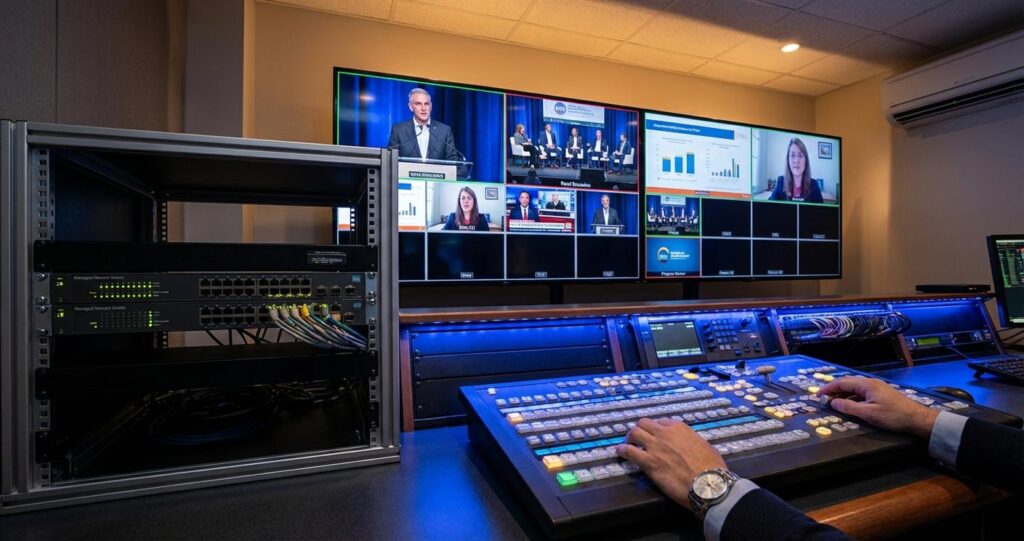
Enterprise live streaming is no longer a novelty; it is a mission-critical component of corporate communications, from CEO town halls to global sales kick-offs and hybrid B2B events. However, the assumption that a standard corporate office network, designed for email, file sharing, and web browsing, can support the rigorous demands of professional, multi-camera live production is a significant technical oversight. The real-time, high-bitrate, and low-latency nature of professional video workflows exposes the inherent limitations of general-purpose IT infrastructure. Packet loss, jitter, and insufficient bandwidth, which might be minor inconveniences for data transfer, are catastrophic for a live video stream, resulting in dropped frames, audio desync, and complete signal failure. This is why a comprehensive technical network audit is not just a preliminary step but a foundational requirement for any successful enterprise streaming initiative. It involves moving beyond a simple internet speed test and conducting a deep, methodical analysis of the network’s physical layer, logical configuration, and security posture to ensure it can function as a reliable broadcast backbone. This assessment, performed by professionals with expertise in both broadcast engineering and network architecture, is the difference between a seamless production and a high-stakes technical disaster.
Foundational Network Infrastructure Analysis
The first stage of any network audit is a granular assessment of the physical and logical hardware that forms the transport layer for your video signals. This is the bedrock upon which your entire streaming workflow is built, and any deficiencies at this level will inevitably compromise every subsequent part of the production chain. We must scrutinize the cabling, switching fabric, and routing policies to ensure they meet the specific, non-negotiable demands of real-time video and audio transport.
Physical Layer Integrity and Cabling Standards
The physical cabling is the circulatory system of your production network. While Wi-Fi has its place, it is fundamentally unsuitable for primary production signals like camera feeds or encoder outputs due to its susceptibility to interference and packet loss. A thorough audit begins with verifying the integrity and specification of the structured cabling. For modern production workflows utilizing Network Device Interface (NDI) or other IP-based video protocols, Category 6a (Cat6a) or Category 7 (Cat7) cabling is the minimum standard, providing the 10 Gbps throughput necessary for multiple uncompressed or lightly compressed high-definition video streams. We inspect termination points, patch panels, and cable pathways for physical damage, improper termination, or excessive bending radii that can degrade signal integrity. For high-camera-count 4K/UHD productions or for linking production suites across a corporate campus, a fiber optic backbone (typically single-mode OS2) is often essential for its high bandwidth and immunity to electromagnetic interference (EMI).
Switching and Routing Hardware Capabilities
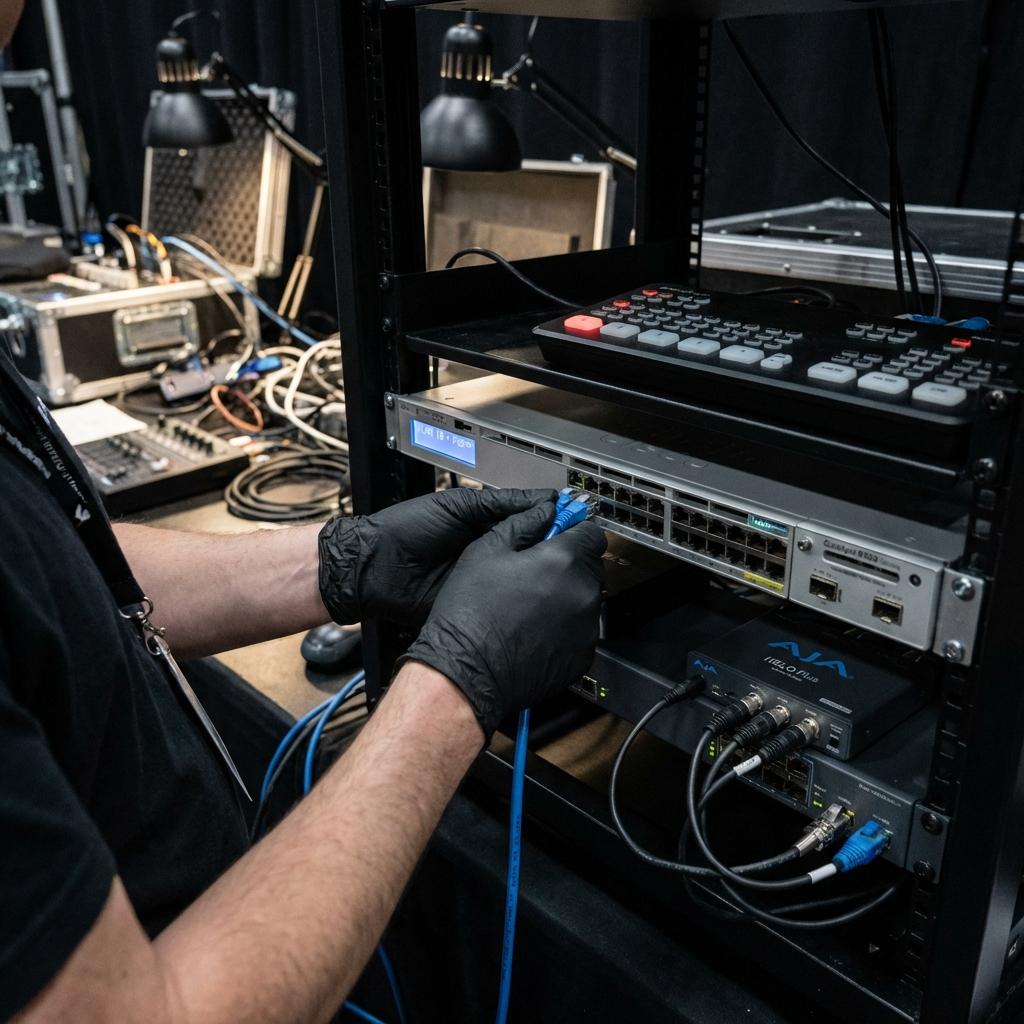
Not all network switches are created equal. Consumer-grade or unmanaged switches are entirely inappropriate for professional streaming. The audit must confirm the presence of managed switches with a sufficient non-blocking backplane capacity to handle the aggregate load of all video, audio, and control data streams without bottlenecks. Key features we analyze include Power over Ethernet (PoE) capabilities, specifically PoE+ (802.3at) or PoE++ (802.3bt), which are essential for powering cameras, encoders, and converters directly over the network cable, simplifying setup and reducing points of failure. Furthermore, the switch’s support for IGMP (Internet Group Management Protocol) Snooping is critical for NDI workflows to prevent multicast video traffic from flooding the entire network. The core router and firewall are also examined for processing power and their ability to handle sustained, high-throughput UDP (User Datagram Protocol) traffic, which is common for protocols like Secure Reliable Transport (SRT), without engaging stateful packet inspection processes that can introduce unacceptable latency.
Bandwidth and Throughput Validation for Production Workflows
With the physical and hardware foundation verified, the next critical phase of the audit is to quantify the network’s capacity and performance under realistic production loads. This involves moving from theoretical specifications to empirical testing. We calculate the precise bandwidth requirements for every signal in the proposed workflow and then use specialized tools to stress-test the network, ensuring it can deliver the required throughput consistently and with minimal packet loss. This is where we identify the true performance ceiling of the infrastructure.
Calculating Aggregate Bandwidth Requirements
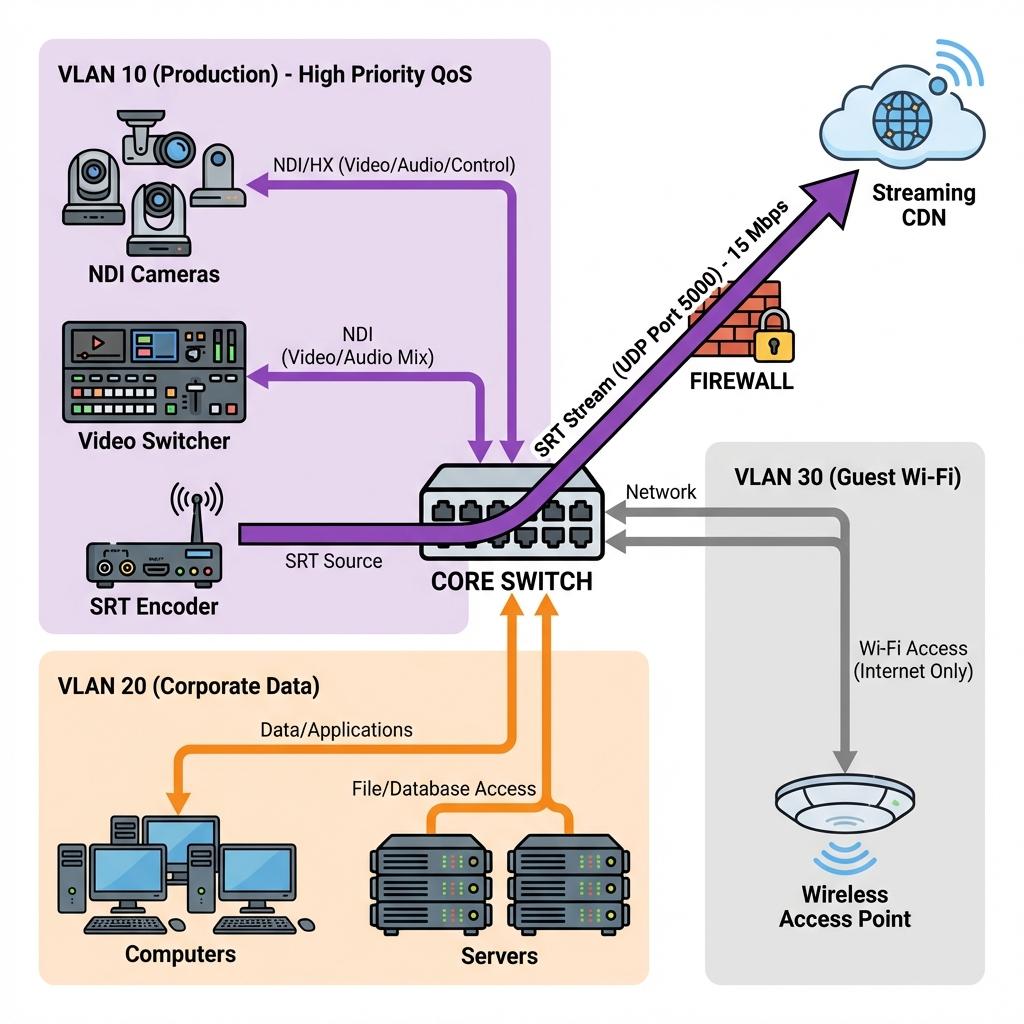
A successful stream requires a detailed accounting of every data stream. This is a simple but critical calculation. For example, a single 1080p60 Full NDI video stream requires approximately 125 Megabits per second (Mbps). A four-camera production using this protocol would therefore consume 500 Mbps of dedicated internal network bandwidth before even considering audio, control data, or the final encoded output stream. The final program feed, encoded using the H.264 or H.265 (HEVC) codec for contribution to a cloud platform via SRT or RTMPS (Real-Time Messaging Protocol Secure), will have its own bandwidth requirement. A high-quality 1080p60 stream is typically encoded at 6-8 Mbps, while a 4K stream may require 15-25 Mbps. The audit must account for the aggregate of all these streams: multiple camera inputs, multiviewer outputs, and the final encoded program feed. We must also factor in a significant overhead, typically 25-30%, to handle network traffic fluctuations and ensure performance is never compromised.
Testing Network Throughput and Packet Loss
Theoretical calculations must be validated with real-world testing. We utilize network performance tools like iPerf3 to measure the maximum achievable bandwidth between critical endpoints, for instance, between the video switcher and the hardware encoder, or between the contribution encoder and the firewall’s egress point. This testing reveals the true, sustainable throughput, not just the connection’s rated speed. Beyond pure throughput, we conduct packet loss and jitter tests. For streaming protocols like SRT, which are built on UDP, even a small amount of packet loss (as little as 1-2%) can degrade video quality if not properly compensated for by the protocol’s error correction. We analyze these test results to determine if the network’s performance is stable enough for the unforgiving nature of live video transport. An internet connection’s advertised “1 Gbps” speed is meaningless if it cannot sustain the required 10 Mbps for the SRT stream without significant packet loss during peak corporate network usage hours.
Quality of Service (QoS) and Network Segmentation
A shared corporate network is a hostile environment for live video. Standard data traffic, like file transfers or software updates, can create congestion that delays or drops time-sensitive video packets. To mitigate this, we must architect a network environment that isolates and prioritizes production traffic. This is achieved through the strategic implementation of Virtual Local Area Networks (VLANs) and the configuration of Quality of Service (QoS) policies on managed network hardware.
Implementing VLANs for Production Traffic
A VLAN is a standard method of creating logically isolated networks on the same physical hardware. During a network audit, we strongly recommend creating a dedicated VLAN for all production equipment: cameras, microphones, switchers, encoders, and control surfaces. This segmentation serves two critical purposes. First, it contains broadcast-intensive traffic like NDI multicast streams within the production VLAN, preventing it from congesting the general corporate network. Second, it creates a security boundary, protecting sensitive production equipment from being directly accessible on the main corporate LAN. The audit involves assessing the existing switch and router configurations to ensure they can support 802.1Q VLAN tagging and configuring the necessary switch ports as trunk or access ports for the newly designated production VLAN.
Configuring QoS for Real-Time Protocols
Within the production VLAN, and especially at the point where traffic egresses to the internet, QoS policies are essential. QoS instructs network hardware to prioritize certain types of traffic over others. For live streaming, we configure QoS policies to give the highest priority to traffic based on protocol and port. For example, we would create rules that mark SRT traffic (on its designated UDP port) and RTMPS traffic (TCP port 443) for expedited handling. This ensures that even if another department starts a large cloud backup, the network’s router will always process the packets for the live stream first. We typically use Differentiated Services Code Point (DSCP) values to mark packets, such as assigning `EF` (Expedited Forwarding) to our real-time video streams, a standard practice in enterprise voice and video deployments. This guarantees that your live stream’s packets get preferential treatment from the office to the internet.
Firewall, Security, and Protocol-Specific Port Configuration
The final pillar of the network audit addresses the intersection of production requirements and corporate IT security policy. Corporate firewalls are designed to be restrictive, and without proper configuration, they will block the specialized protocols required for professional streaming. A successful audit involves collaborating with the IT department to create precise, secure rules that enable the production workflow without creating unnecessary vulnerabilities.
Navigating Corporate Firewalls for Streaming
A key part of the audit is identifying and documenting all necessary inbound and outbound network ports for the entire video workflow. For example, RTMP typically uses TCP port 1935, while RTMPS uses TCP port 443. SRT is more complex; it requires a designated UDP port for bi-directional communication, and its “listener” and “caller” modes have different firewall implications. We work with IT security teams to translate these production requirements into specific, and most importantly, restrictive firewall access control lists (ACLs). This means opening a specific UDP port for SRT traffic, but only for traffic going to or coming from the specific IP address of the cloud streaming platform. This approach satisfies security requirements while enabling the technical workflow, avoiding the insecure practice of placing production equipment in a broad Demilitarized Zone (DMZ).
Secure Remote Contribution with SRT
The Secure Reliable Transport (SRT) protocol has become an industry standard for sending high-quality, low-latency video over unpredictable networks like the public internet. Its ability to handle packet loss makes it far superior to RTMP for contribution feeds. An audit for an SRT workflow involves not only opening the correct UDP port on the firewall but also ensuring that the network’s upstream connection has sufficient, stable bandwidth. We also advise on the optimal latency and recovery settings within the encoder’s SRT configuration. Setting the correct latency buffer (for example, 120-200 milliseconds) gives the protocol enough time to recover lost packets, providing a resilient stream even over a congested internet connection. The audit confirms that the network infrastructure can pass this traffic cleanly, enabling secure, broadcast-quality remote contributions for hybrid events.
Ultimately, assessing your office network is not an IT problem; it is a production problem. The network is as integral to your event’s success as your cameras and audio mixer. A thorough technical audit by a team that understands the unique physics of live video transport is the only way to guarantee a stable and professional broadcast. It proactively identifies and resolves the bottlenecks, security conflicts, and configuration errors that can derail a high-value corporate event, transforming a standard office network into a reliable production-grade infrastructure.

Jeremy Lee is a seasoned digital marketing director and strategist with over two decades of experience in the industry. As the founder of Sotavento Medios, I manage a diverse portfolio of over 50 businesses, helping brands grow through advanced search strategies and digital innovation. My work focuses on bridging the gap between traditional search engine optimisation and the evolving world of AI-driven answer engines.
get in touch