
The Imperative for Secure, Broadcast-Grade Internal Streaming
The contemporary corporate strategy retreat has evolved beyond the physical boardroom. For global enterprises, integrating key remote team members into high-stakes internal discussions is no longer a luxury; it is a strategic necessity. However, the sensitive nature of these events, which often involve proprietary financial data, intellectual property, and forward-looking strategy, introduces significant security and reliability challenges. Simply utilizing consumer-grade video conferencing or public streaming platforms is an unacceptable risk. Executing a successful and secure stream for an internal retreat requires a broadcast engineering mindset, focusing on robust production infrastructure, encrypted transport protocols, and verifiable access control. This is not a task for IT generalists; it is a specialized discipline within B2B live production.
This technical brief provides a detailed framework for production managers, AV professionals, and IT directors tasked with this mission-critical objective. We will dissect the requisite components of a secure streaming workflow, from on-premises signal acquisition and routing to encrypted contribution over the public internet and secure distribution within the corporate ecosystem. The focus is on implementing enterprise-grade solutions that guarantee confidentiality, maintain high Quality of Service (QoS), and deliver a seamless viewing experience for all participants, regardless of their location. We will explore the technical specifications of signal flow, the strategic advantages of specific protocols like Secure Reliable Transport (SRT), and the critical importance of hardware-based redundancy to ensure flawless execution when the content is invaluable and failure is not an option.
Architecting the On-Premises Production Core
The foundation of any secure stream is a robust, isolated, and professionally managed on-premises production environment. This is where all audio and video sources are ingested, mixed, and prepared for encoding and transmission. Relying on ad-hoc or under-specified equipment introduces unacceptable points of failure and compromises the quality of the final output.
Professional Signal Acquisition and Routing
Signal acquisition begins with professional cameras and microphones. For strategy retreats, remotely operated PTZ (Pan-Tilt-Zoom) cameras with 1-inch sensors and high-quality glass are often ideal, offering discretion and flexible shot composition without requiring multiple on-site camera operators. These cameras should output a baseband digital signal, preferably via 3G-SDI (Serial Digital Interface) or 12G-SDI for 4K/UHD workflows, to ensure signal integrity over long cable runs to the production switcher. SDI is a professional standard designed for reliability, unlike HDMI which is prone to degradation and lacks secure locking connectors. For local IP-based workflows, NDI (Network Device Interface) provides a high-quality, low-latency alternative for transporting video, audio, and metadata over a managed Gigabit Ethernet network. All production-related IP traffic, whether for NDI transport or PTZ control via VISCA over IP, must be segmented onto a dedicated VLAN, completely isolated from corporate or guest network traffic to guarantee performance and prevent unauthorized access.
Audio is equally critical. A combination of tabletop gooseneck microphones for presenters and strategically placed ceiling or boundary microphones can capture clear, intelligible audio. These sources should be fed into a digital audio mixing console, ideally one that supports Dante (Digital Audio Network Through Ethernet), allowing for flexible routing over the same managed IP network. A critical audio configuration for hybrid events is the creation of a “mix-minus” feed. This is a custom audio mix sent back to any remote participants that includes all program audio EXCEPT for their own microphone, preventing the distracting echo and feedback that plagues amateur productions.
The Production Switcher and Encoding Engine
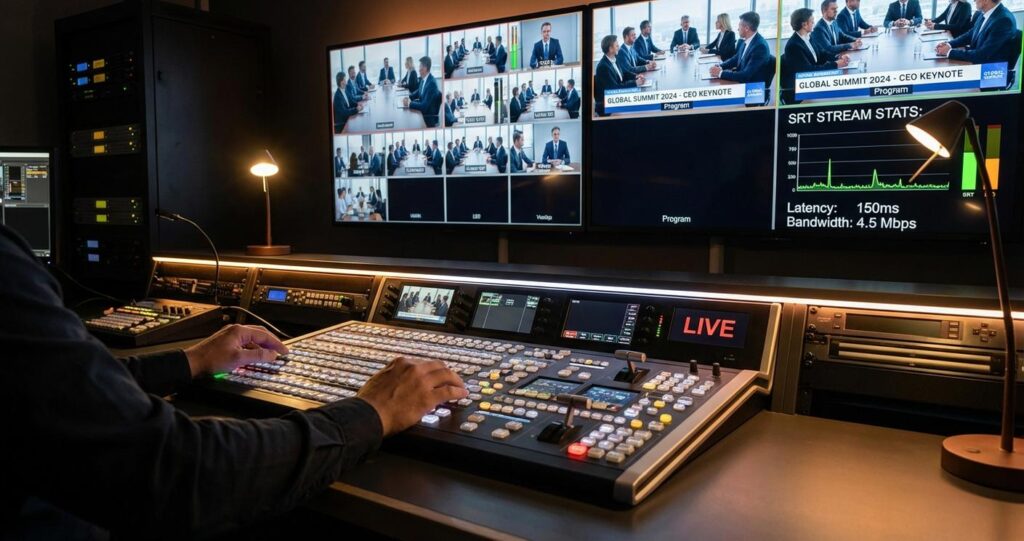
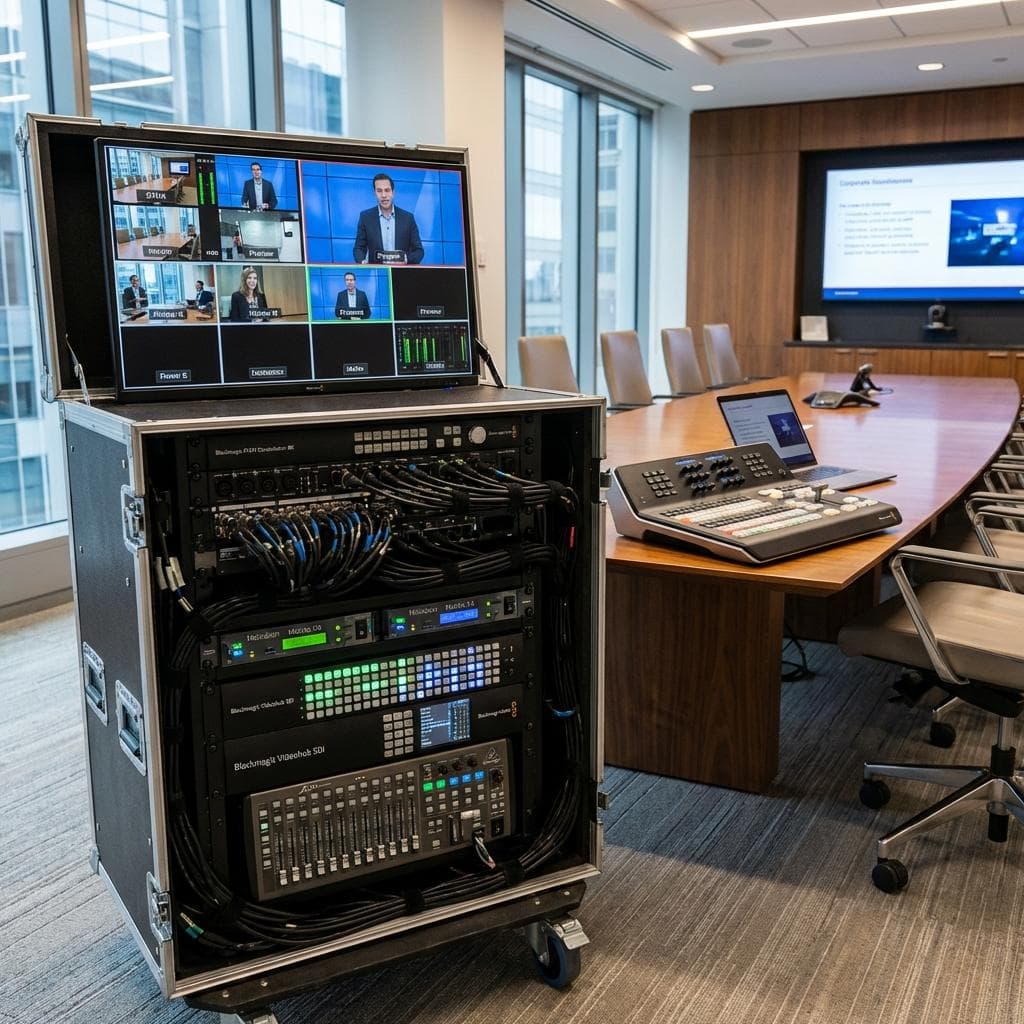
The core of the on-site setup is the production switcher. For mission-critical corporate events, hardware-based switchers from manufacturers like Ross Video, For-A, or Blackmagic Design are strongly recommended over software-based solutions running on general-purpose computers. Hardware switchers offer dedicated processing and significantly lower latency, reducing the risk of software crashes or OS-level interruptions. The switcher is responsible for creating the main program feed, integrating graphics such as speaker titles and presentations, and providing multiview monitoring for the technical director. A key professional feature to demand is ISO (isolated) recording capability, which records the output of each individual camera to a separate file. This is invaluable for post-event editing or for creating detailed archival records of the proceedings.
The final program feed (video and embedded audio) is routed via SDI to a dedicated hardware encoder. This is another area where professional-grade equipment is non-negotiable. A hardware encoder is a purpose-built appliance designed for stable, continuous operation. It should support modern codecs like H.264 (AVC) and H.265 (HEVC), with the latter offering superior compression efficiency for conserving bandwidth. The encoder must also natively support secure transport protocols, which is the lynchpin of the entire security architecture.
Securing the Stream: Transport Protocols and Network Hardening
Once the signal leaves the on-premises encoder, it enters the most vulnerable part of its journey: the public internet. This is where protocol selection and network configuration become the primary defense against interception and disruption. Relying on legacy or consumer-grade protocols is an immediate disqualifier for any sensitive internal communication.
SRT as the Enterprise Standard for Contribution
For professional B2B streaming, RTMP (Real-Time Messaging Protocol) is a legacy protocol. While its encrypted variant, RTMPS, provides a TLS/SSL wrapper, RTMP itself is based on TCP (Transmission Control Protocol), which is not optimized for live video over unstable networks. It suffers from head-of-line blocking and can result in buffering or complete signal loss with even minor packet loss.
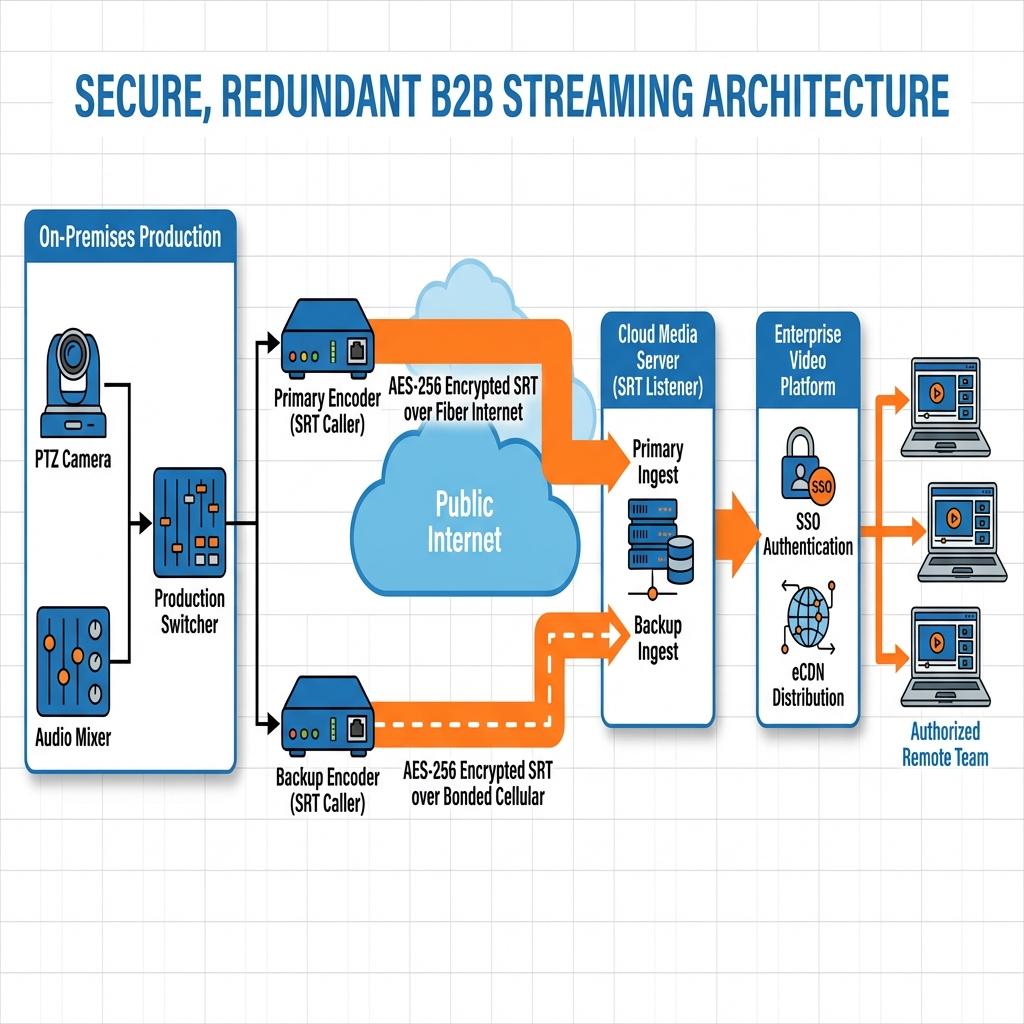
The modern, secure standard for video contribution is SRT (Secure Reliable Transport). SRT is an open-source protocol that provides the reliability of TCP-based transmission over UDP (User Datagram Protocol), which is better suited for real-time media. SRT’s core advantages are threefold: first, its sophisticated ARQ (Automatic Repeat reQuest) mechanism intelligently retransmits only lost packets, gracefully handling network jitter and packet loss without causing stream failure. Second, it provides mandatory end-to-end AES-128 or AES-256 bit encryption, ensuring the stream content is completely opaque to any unauthorized party during transit. Third, it allows for precise latency tuning, enabling operators to balance between interactivity and stream stability based on network conditions. An SRT workflow typically involves the on-site hardware encoder configured as a “caller,” initiating a secure, encrypted connection to a cloud-based media server or SRT decoder acting as a “listener.”
Hardening the Network Perimeter
The streaming encoder requires a dedicated, uncontended, hardwired internet connection with sufficient upload bandwidth. For a high-quality 1080p60 stream using H.264 at 8 Mbps, a minimum sustained upload speed of 20 Mbps is recommended to accommodate overhead and provide a buffer. Network security policy is critical. The production VLAN must be configured with strict firewall rules. All unnecessary ports should be closed. Only the specific UDP port range required for the SRT transmission should be opened for outbound traffic, and it should be restricted to the specific IP address of the cloud ingest server. This prevents the encoder from being exposed to the public internet and mitigates the risk of denial-of-service attacks. On-site network hardware, including switches and routers, should be enterprise-grade with firmware kept up-to-date to patch any security vulnerabilities.
Distribution and Access Control for the Remote Audience
Safely transporting the stream to the cloud is only half the battle. The final stage involves distributing that stream exclusively to authorized remote team members while preventing any form of leakage or unauthorized access. This requires an enterprise-grade video platform, not a public-facing service.
Leveraging Enterprise CDN and Secure Video Platforms
An Enterprise Content Delivery Network (eCDN) is a crucial component for large organizations. When dozens or hundreds of employees in the same office building attempt to watch a high-bitrate live stream, they can saturate the building’s primary internet connection. An eCDN solution, such as those from Kollective or Ramp, intelligently caches the video stream within the corporate LAN, serving it to multiple local viewers from a single initial download. This preserves enterprise-wide internet bandwidth for other business-critical applications.
The stream itself should be hosted on a secure enterprise video platform like Brightcove, Kaltura, or Panopto. These platforms are designed for corporate use and offer essential security features that are absent from public sites. The most important feature is Single Sign-On (SSO) integration with the company’s existing identity provider (e.g., Azure Active Directory, Okta). This ensures that only authenticated employees can access the viewing portal. Further security layers include domain restriction, which prevents the video player from being embedded on unauthorized websites, and IP address whitelisting or geofencing to restrict access to specific locations.
Integrating Remote Participants and Ensuring Interactivity
A modern strategy retreat is often interactive, requiring the ability to bring remote participants into the main discussion. This must be managed within the secure production workflow. A common method is to use a platform like Microsoft Teams or Zoom on a dedicated computer, taking a clean video output (via an NDI screen capture utility or a dedicated hardware I/O device) and feeding it into an input on the main production switcher. The aforementioned mix-minus audio feed is sent back to this computer to provide clean return audio. This technique seamlessly integrates the remote presenter into the main program feed, which is then encoded and sent out via the secure SRT stream. This architecture ensures the remote participant is part of the high-quality, professionally produced program, rather than simply having all viewers watch a low-quality conference call grid.
Building in Redundancy for Zero-Failure Events
For events of this importance, a single point of failure anywhere in the chain can be catastrophic. A professional broadcast workflow always incorporates redundancy at every critical juncture, from power and encoding to network connectivity and server ingest.
Path, Encoder, and Power Redundancy
A robust implementation utilizes a fully redundant signal path. This starts with a 1+1 encoder configuration: a primary and a secondary hardware encoder, each receiving the same program feed from the switcher. Each encoder should be connected to a separate internet connection from a different provider if possible (e.g., primary on fiber, backup on a bonded cellular solution like Teradek Bond or LiveU). This is known as path diversity. Both encoders send an independent SRT stream to the cloud platform. The primary stream is designated as active, but if it fails for any reason, the platform can automatically and instantly switch to the backup stream with no interruption for the viewer.
Platform-Level Failover and Infrastructure Resilience
The receiving cloud media server should also be configured for redundancy, with primary and backup ingest points, ideally in different data centers or availability zones. This protects against platform-level outages. On-premises, all critical equipment in the production chain, including cameras, switches, routers, the audio mixer, and both encoders, must be connected to an Uninterruptible Power Supply (UPS). This provides battery backup to ride out any short-term power fluctuations or outages, which are common in hotel or event venue environments.
In conclusion, the secure streaming of an internal strategy retreat is a complex, multi-layered technical operation that demands precision, expertise, and an unwavering focus on security and reliability. By architecting a professional on-premises production core, leveraging the encrypted transport capabilities of SRT, hardening the network perimeter, and utilizing an enterprise-grade distribution platform with full redundancy, organizations can confidently connect their global teams for their most important conversations. This is the standard of excellence that defines professional B2B event production.

Jeremy Lee is a seasoned digital marketing director and strategist with over two decades of experience in the industry. As the founder of Sotavento Medios, I manage a diverse portfolio of over 50 businesses, helping brands grow through advanced search strategies and digital innovation. My work focuses on bridging the gap between traditional search engine optimisation and the evolving world of AI-driven answer engines.
get in touch