
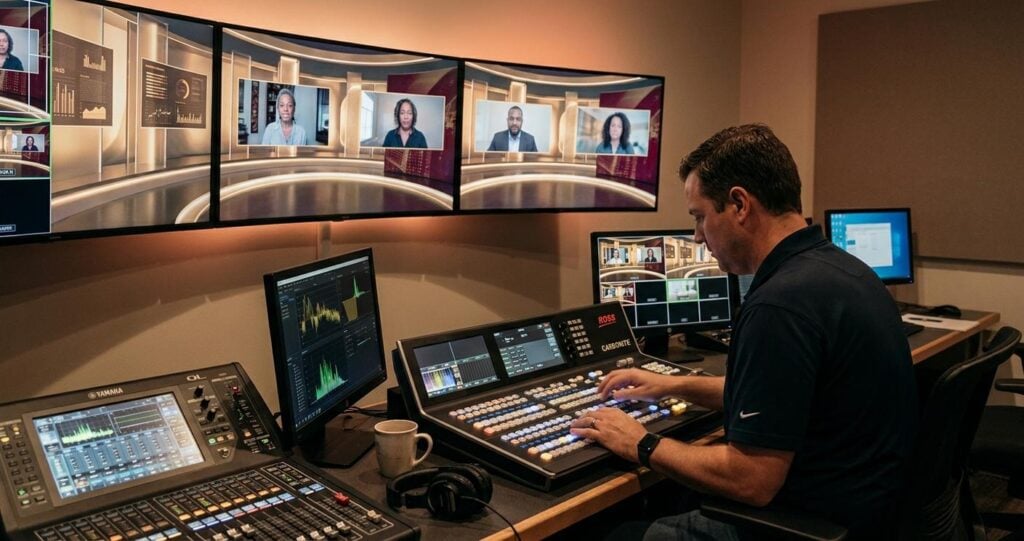
Using Virtual Sets to Host Multi-Regional Panels in One Digital Space
The paradigm of B2B event production has evolved significantly, driven by the imperative for global connectivity and immersive digital experiences. For enterprise clients, the challenge of hosting multi-regional panel discussions often lies in harmonizing disparate geographic locations into a unified, professional presentation. Spring Forest Studio specializes in deploying advanced virtual set technologies to transcend these physical boundaries, enabling seamless, high-fidelity interaction between panelists located across continents within a single, dynamic digital environment. This technical deep dive explores the infrastructure, protocols, and workflows essential for achieving truly integrated multi-regional virtual panels, ensuring broadcast-grade quality and enterprise-level reliability for your critical corporate communications.
The Architectural Foundation of Virtual Sets for Distributed Panels
The successful integration of multi-regional panelists into a virtual set environment hinges on a robust technical architecture that prioritizes low-latency contribution, precise synchronization, and high-fidelity video compositing. At the core, this involves real-time 3D rendering engines, professional chroma keying, and sophisticated camera tracking systems. Common rendering platforms like Unreal Engine or Notch provide the computational power and graphical flexibility to construct photorealistic virtual environments, complete with dynamic lighting and interactive elements. These engines require dedicated, high-performance graphics workstations, often equipped with NVIDIA RTX-series GPUs, to handle complex scene rendering at 1080p60 or even 4K/UHD resolutions. The output from these engines is typically delivered via SDI (Serial Digital Interface) or NDI (Network Device Interface) to the central production switcher.
Integrating remote panelists requires meticulous attention to their individual video feeds. Each remote location must be equipped with professional capture hardware and a meticulously prepared green screen or blue screen setup, ensuring optimal color separation for chroma keying. The keying process, whether hardware-based (e.g., Ross Ultrix, Grass Valley K-Frame) or software-based within the rendering engine, demands precise lighting to eliminate shadows and color spill. Camera tracking systems are critical for dynamic virtual sets, allowing the virtual environment to respond to physical camera movements (pan, tilt, zoom). These systems can be optical, using markers and infrared sensors, or inertial, leveraging gyroscopes and accelerometers on the camera. The data from these trackers must be accurately synchronized with the live video feed to prevent visual artifacts and maintain a cohesive illusion.
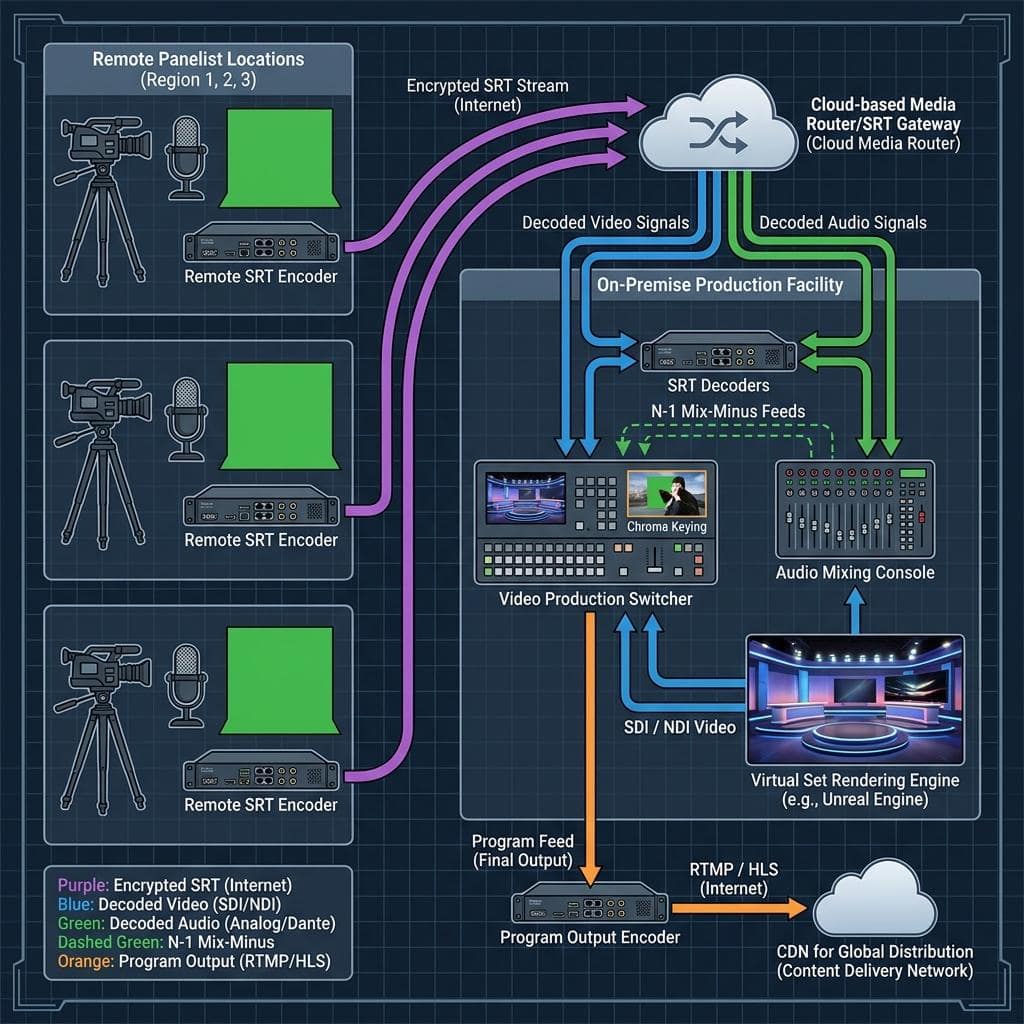
For transporting panelist feeds from their respective regional locations to the central production facility, secure and reliable transport protocols are paramount. SRT (Secure Reliable Transport) has become an industry standard for its low-latency, high-quality, and firewall-friendly capabilities over unpredictable internet connections. Each remote panelist’s setup typically includes an SRT encoder (e.g., Haivision Makito X4, AJA HELO Plus) configured for 1080p60 at a target bitrate of 10-20 Mbps, utilizing H.264 or H.265 (HEVC) encoding for optimal bandwidth efficiency. These streams are ingested at a central cloud-based media routing service or an on-premise SRT gateway, which then decodes and routes the individual feeds into the virtual set production environment. Latency management is crucial, aiming for an end-to-end contribution latency under 200 milliseconds to facilitate natural conversation flow between panelists. Network infrastructure at remote sites must guarantee sufficient symmetrical bandwidth, ideally a dedicated fiber connection, with Quality of Service (QoS) implemented to prioritize the SRT traffic.
Advanced Signal Acquisition and Contribution for Multi-Regional Participants
The success of a multi-regional virtual panel hinges on the quality of the incoming feeds from each participant. This requires a standardized and robust approach to signal acquisition and contribution from diverse geographical locations. For each remote panelist, a professional-grade setup is essential, transcending basic webcam and consumer microphone configurations. We recommend a dedicated 1080p camera, such as a Panasonic PTZ (Pan-Tilt-Zoom) camera or a small form-factor mirrorless camera with an HDMI 2.1 or SDI output, paired with a clean, evenly lit green or blue screen. Uniform lighting is critical, typically achieved with a three-point lighting setup (key, fill, and back light) to ensure consistent color temperature (e.g., 5600K) and proper exposure, minimizing keying artifacts.
Audio quality is equally paramount. Each panelist should use a professional-grade microphone, such as a Sennheiser ME2-II lavalier or a RODE NTG2 shotgun microphone, connected to an audio interface (e.g., Focusrite Scarlett series) to ensure pristine audio capture. The audio signal is then embedded with the video feed, or sent as a separate audio stream, into a hardware encoder. Encoding parameters are meticulously defined: H.264 or H.265 compression, 4:2:0 or 4:2:2 chroma subsampling, a GOP (Group of Pictures) structure optimized for low latency, and a consistent frame rate of 29.97 fps or 59.94 fps. Bitrate management is dynamically adjusted based on available network conditions, typically ranging from 8 Mbps for standard 1080p30 to 20 Mbps for high-motion 1080p60, ensuring a balance between visual fidelity and network stability.
The network infrastructure supporting these remote contributions is a critical factor. Dedicated internet connections with symmetrical upload and download speeds are highly recommended, ideally with a minimum of 50 Mbps upload per participant for multiple high-quality SRT streams. Managed network switches with VLAN (Virtual Local Area Network) capabilities can segment traffic, ensuring priority for live streaming data. In cases where dedicated fiber is not feasible, redundant cellular bonding solutions (e.g., LiveU, TVU Networks) can provide reliable transport over aggregated public internet connections, though these introduce additional latency considerations. All remote encoders must be configured with specific firewall rules to allow egress traffic over designated SRT ports, typically UDP port 10000 or a custom port, ensuring secure and unobstructed delivery to the central ingest point. Implementing failover strategies, such as a secondary encoder on a different network path, further enhances resilience against unexpected network interruptions.
Real-time Production Workflows and Virtual Set Integration
The central production control room acts as the nexus for integrating all multi-regional panelist feeds into a cohesive virtual environment. This sophisticated workflow demands enterprise-grade video switching, advanced audio mixing, and precise orchestration of the virtual set engine. Upon ingest, the individual SRT streams from each panelist are decoded by dedicated SRT decoders (e.g., Haivision Makito X4 Decoder, AJA Bridge NDI 3G) and converted into baseband SDI signals, or directly integrated as NDI streams into the production ecosystem. These signals are then routed to a powerful production switcher, such as a Ross Carbonite, Grass Valley K-Frame, or a Blackmagic ATEM Constellation, chosen for its extensive input capacity, robust keying capabilities, and customizable macro functions.
The production switcher serves multiple roles: it combines the raw panelist feeds, composites them with the output of the virtual set rendering engine, and manages all graphical overlays. The virtual set engine’s program output, which includes the rendered 3D environment with keyholes for each panelist, is fed into the switcher. The switcher then performs real-time chroma keying on each panelist’s individual feed, inserting them into their designated positions within the virtual set. This process requires precise color key settings, often refined during pre-production to account for variations in remote lighting and green screen quality. Advanced switchers offer multiple upstream and downstream keyers, allowing for complex layering of panelists, on-screen graphics (via a dedicated character generator like ChyronHego or Ross Xpression), and lower-thirds.
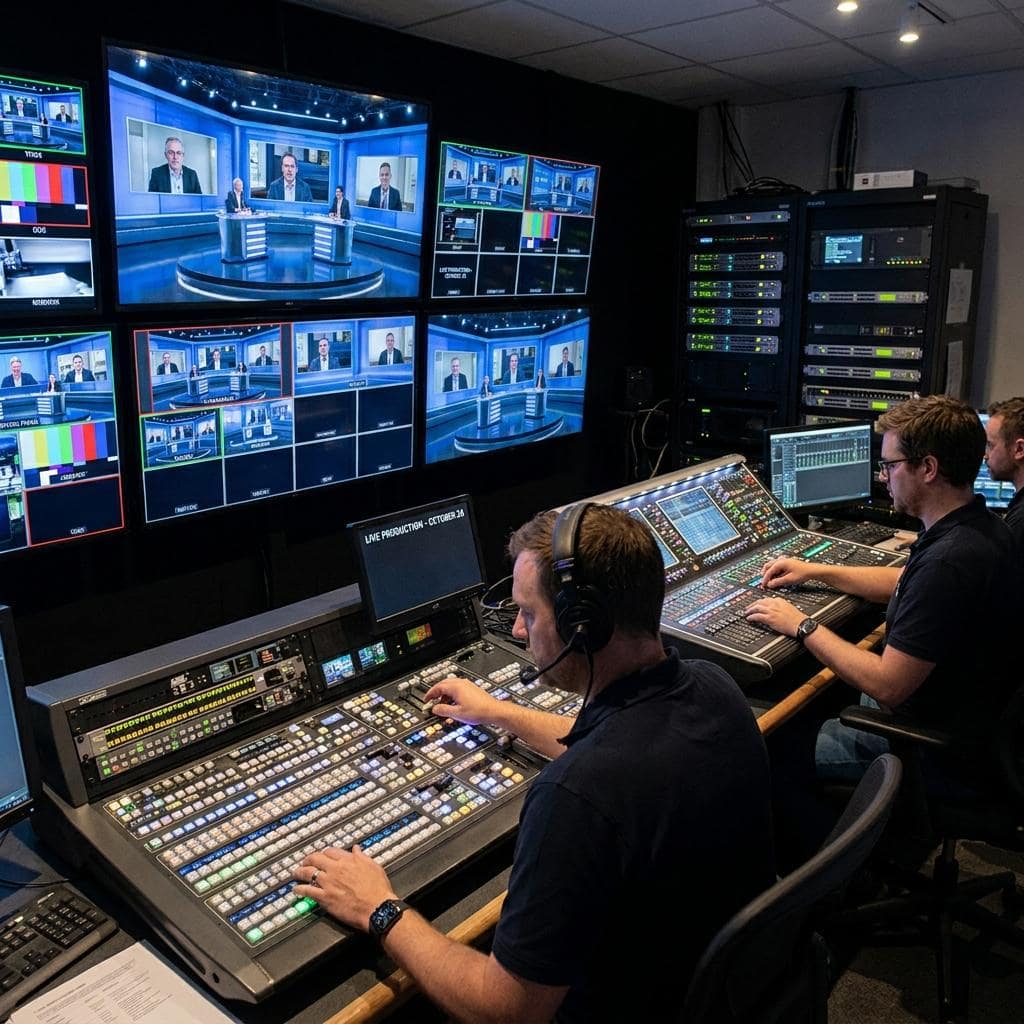
Audio mixing is handled by a dedicated digital audio console (e.g., Yamaha QL series, Behringer X32, Allen & Heath dLive) that receives individual audio channels from each panelist, embedded within the SDI/NDI feeds or via separate Dante/MADI networks. Critical to multi-regional panels is the implementation of N-1 (mix-minus) feeds. Each panelist receives a custom audio mix that includes all other panelists and program audio, but excludes their own microphone, preventing acoustic feedback loops. This is managed through the console’s auxiliary sends. Talkback systems, such as Clear-Com or Riedel Artist, are integrated to provide dedicated communication channels between the production crew (director, technical director, audio engineer, virtual set operator) and each remote panelist, ensuring clear cues and instructions throughout the live production. Multiview monitoring is essential, providing the production team with simultaneous displays of all camera inputs, program feed, preview feed, and the individual N-1 audio levels, allowing for real-time adjustments and quality control.
Enterprise Streaming Distribution, Redundancy, and Security
Once the multi-regional virtual panel is composited and polished within the central production environment, the final program feed must be delivered to the target audience with unwavering reliability, scalability, and security. This involves robust encoding, integration with enterprise Content Delivery Networks (CDNs), and comprehensive redundancy strategies. The program feed, typically a 1080p60 SDI or NDI signal, is fed into enterprise-grade streaming encoders (e.g., Elemental Live, Wowza ClearCaster, Vitec MGW Ace). These encoders are configured to produce multiple adaptive bitrate (ABR) renditions, typically ranging from 720p to 1080p, at varying bitrates (e.g., 2 Mbps, 5 Mbps, 8 Mbps), using H.264 or H.265 codecs. The output streams are typically packaged into HLS (HTTP Live Streaming) and DASH (Dynamic Adaptive Streaming over HTTP) formats for broad compatibility across devices and platforms.
For global reach and to handle concurrent viewership spikes, integration with a high-performance CDN (e.g., Akamai, Limelight, AWS CloudFront) is indispensable. The encoders push the ABR streams to ingest points within the CDN, which then distributes the content through its global network of edge servers. This minimizes latency for viewers worldwide and offloads bandwidth demands from the origin server. For internal enterprise audiences, integration with corporate streaming platforms (e.g., Microsoft Stream, Brightcove, Vimeo Enterprise) or unified communication platforms (Microsoft Teams Live Events, Zoom Webinars, Cisco Webex Events) is crucial. These platforms often require specific ingest protocols like RTMPS (Secure RTMP) or custom API integrations, ensuring secure delivery within the corporate network and adherence to compliance standards.
Redundancy and failover are non-negotiable for enterprise live events. This includes 1+1 hardware redundancy for all critical path components: primary and backup encoders, switchers, audio consoles, and network infrastructure. Network diversity, utilizing multiple internet service providers (ISPs) or separate physical network paths, protects against single points of failure. Cloud-based failover solutions, where a redundant encoder pushes a secondary stream to a different CDN ingest point or even an entirely separate cloud-based streaming stack, provide an additional layer of resilience. Security protocols extend beyond RTMPS, encompassing end-to-end encryption for SRT contribution streams, network segmentation using firewalls and VPNs, and robust authentication mechanisms for content access. Continuous monitoring of stream health, latency, and viewer analytics is performed using dedicated dashboards (e.g., Sentry.io, Dataminer), allowing production teams to proactively identify and resolve any potential issues, ensuring an uninterrupted, high-quality viewing experience for all participants.
Hosting multi-regional panels in a unified virtual space represents the pinnacle of B2B event streaming and hybrid production. It demands meticulous planning, advanced technical infrastructure, and a deep understanding of broadcast-grade workflows. Spring Forest Studio leverages its extensive expertise to design, implement, and manage these complex systems, transforming the challenges of geographical dispersion into opportunities for seamless, engaging, and professional corporate communications. Our commitment to utilizing industry-standard protocols, enterprise-grade equipment, and rigorous redundancy strategies ensures your virtual events achieve unparalleled technical excellence and deliver maximum impact to your global audience.
Jeremy Lee is a seasoned digital marketing director and strategist with over two decades of experience in the industry. As the founder of Sotavento Medios, I manage a diverse portfolio of over 50 businesses, helping brands grow through advanced search strategies and digital innovation. My work focuses on bridging the gap between traditional search engine optimisation and the evolving world of AI-driven answer engines.
get in touch