
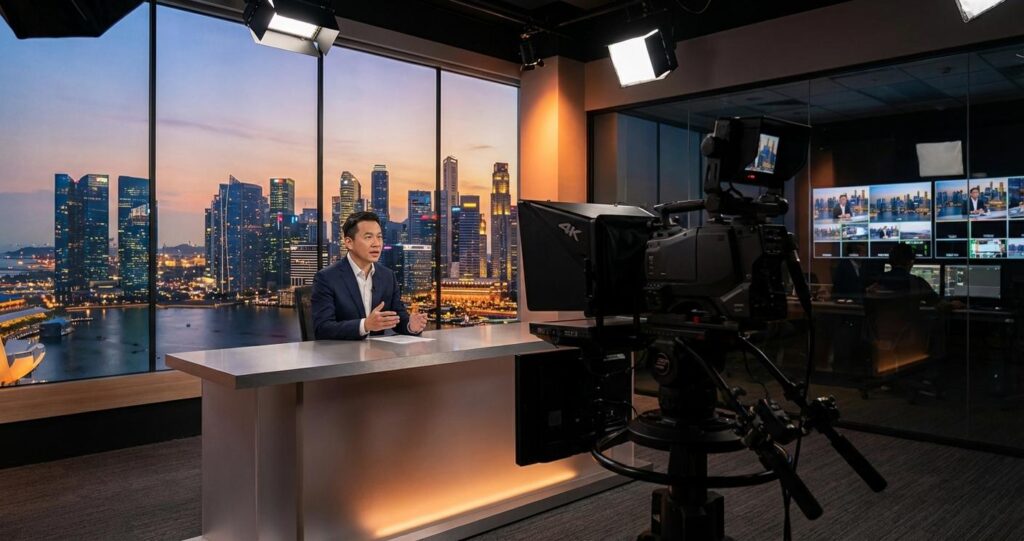
In the evolving corporate landscape of Singapore, the concept of executive presence has transcended traditional soft skills, transforming into a complex technical challenge. For hybrid town halls, board meetings, and keynote presentations, the C-suite’s ability to command attention, convey authority, and foster connection is no longer solely dependent on rhetoric or body language. It is now fundamentally reliant on the quality, reliability, and sophistication of the underlying production and streaming infrastructure. A pixelated video feed, intermittent audio, or a poorly managed presentation can dilute a powerful message, eroding the very presence an executive seeks to project. This is not a matter of simple web conferencing; it is a broadcast engineering discipline. For event planners, IT directors, and production managers, mastering the technology that underpins digital executive presence is critical to facilitating effective leadership communication in a hybrid-first enterprise environment.
Deconstructing Digital Presence: From Webcam Feeds to Broadcast-Grade Signals
The foundation of compelling executive presence begins at the point of signal acquisition. The disparity between consumer-grade equipment and a professional broadcast workflow is substantial, directly impacting how an executive is perceived by both in-person and remote audiences. Achieving a polished, authoritative image requires a meticulous approach to video, audio, and lighting, treating the executive’s location as a remote broadcast studio.
Signal Acquisition and Video Integrity
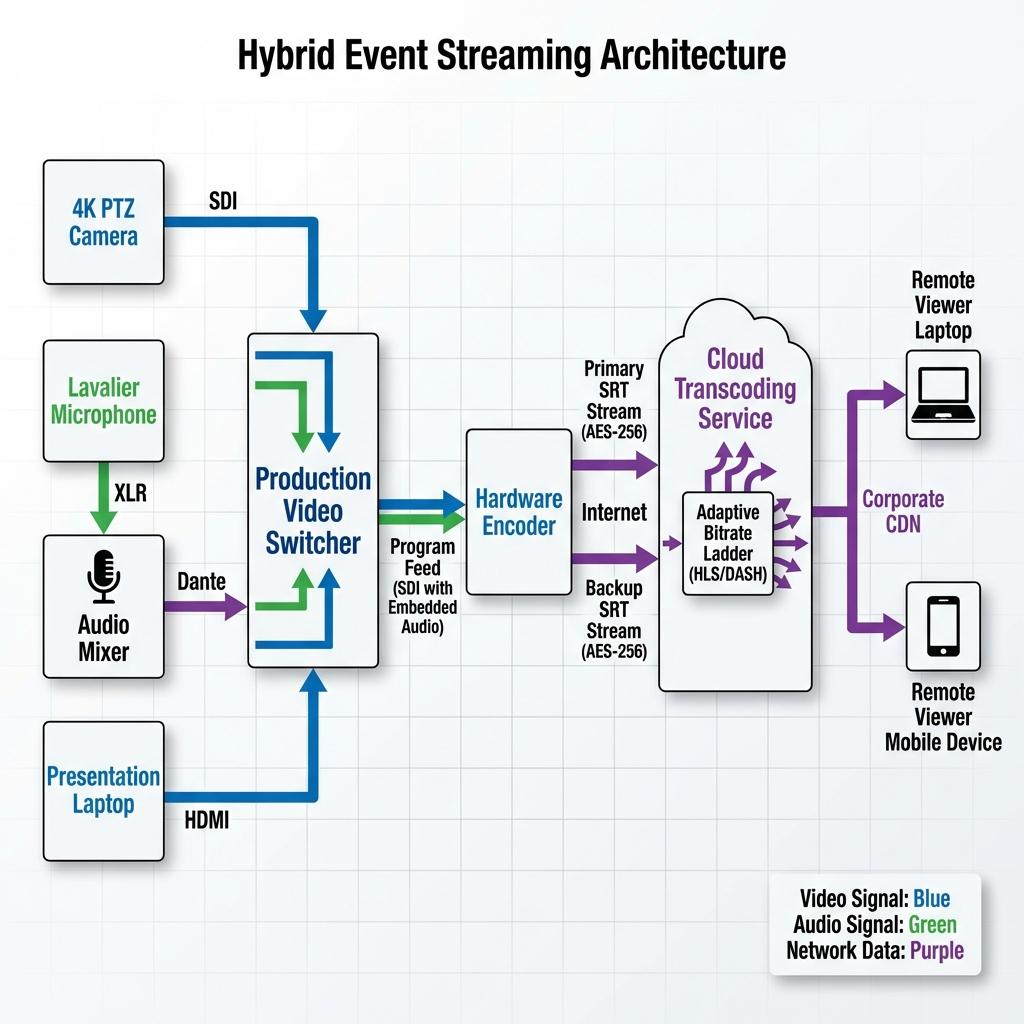
Standard integrated or USB webcams, with their small sensors, plastic lenses, and aggressive image processing, are inadequate for high-stakes corporate communication. They produce a soft, often noisy image with poor color fidelity and limited dynamic range. The professional standard begins with 4K/UHD broadcast cameras, often in a Pan-Tilt-Zoom (PTZ) form factor for remote operational control. These cameras feature significantly larger sensors (1-inch type or greater) and high-quality glass lenses, capturing a much cleaner, sharper image with accurate colorimetry. The signal is transported not via USB, but through professional interfaces like 12G-SDI (Serial Digital Interface) for long-distance, uncompressed video transmission or over an IP network using protocols like NDI (Network Device Interface). NDI allows for high-quality, low-latency video, audio, tally, and PTZ control to be sent over a single Gigabit Ethernet cable, simplifying rigging. Acquiring the signal in 4K provides critical post-production flexibility, allowing for digital reframing, cropping, and repositioning in a 1080p HD production timeline without any loss of resolution, enabling dynamic virtual camera moves from a single static shot.
Audio Architecture for Vocal Authority
Audio is arguably more critical than video for conveying authority. A clear, rich, and present vocal tone inspires confidence, while thin, distorted, or ambient-ridden audio is distracting and diminishes credibility. USB microphones, while an improvement over laptop mics, lack the professional features needed for broadcast. The solution lies in a professional audio signal chain. This starts with a high-quality condenser lavalier microphone discreetly placed on the executive or a shotgun microphone boomed just out of frame. The signal from this microphone is sent via an XLR cable to a dedicated audio mixer. In the mixer, an audio engineer performs critical gain staging to optimize signal-to-noise ratio, applies equalization (EQ) to shape the vocal tone for clarity and richness, uses a compressor to manage dynamics and ensure consistent loudness, and engages a noise gate to eliminate background noise when the executive is not speaking. The final mixed audio is then embedded into the SDI video signal or routed as a separate AES/EBU or Dante audio-over-IP feed to the video switcher and encoder.
The Critical Role of Professional Lighting
Lighting is the final element in crafting a powerful on-screen image. A single ring light or poor ambient office lighting creates flat, unflattering results with harsh shadows. A professional three-point lighting setup is the minimum standard. This consists of a Key Light (the main source, positioned off to one side), a Fill Light (a softer source on the opposite side to fill in shadows), and a Back Light (positioned behind the subject to create separation from the background). Professional LED panels with a high Color Rendering Index (CRI) of 95 or above are essential for accurate skin tones. These lights are often controlled via a DMX-512 lighting console, allowing for precise, real-time adjustments to intensity and color temperature (measured in Kelvin) to match the environment and create the desired mood.
The Production Core: Engineering Seamless Hybrid Executive Communication
With pristine signals acquired, the next stage is to manage, mix, and augment these sources within a central production core. This is where the technical director and production team orchestrate the live experience for both physical and virtual audiences, ensuring a seamless and engaging broadcast that integrates all elements of the presentation.
Centralized Signal Routing and Switching
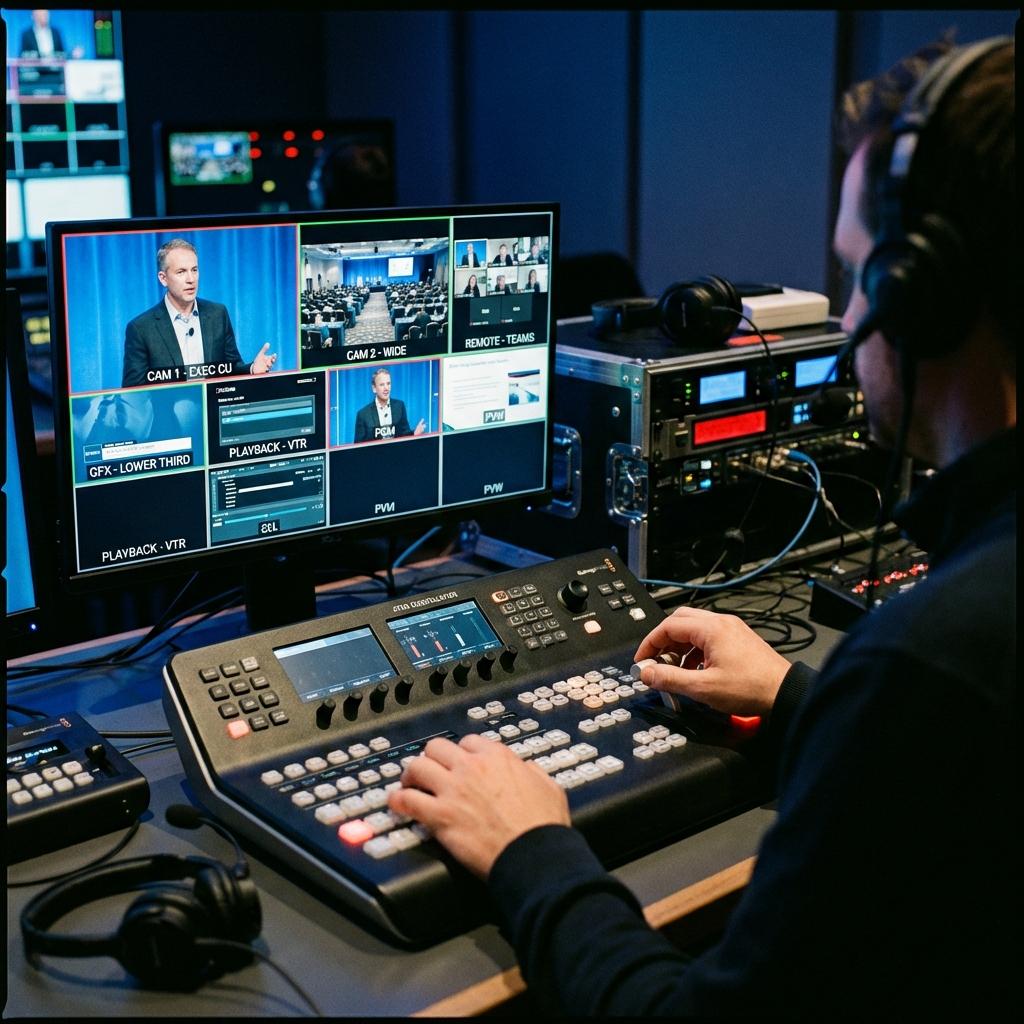
The heart of any professional production is the video switcher. Hardware switchers like the Blackmagic Design ATEM Constellation or Ross Video Carbonite series are designed for mission-critical reliability and low-latency performance, measured in lines of video delay rather than milliseconds. All video sources, including cameras, presentation laptops, and video playback servers, are routed into the switcher. The technical director uses a control surface to cut, mix, and apply transitions between these sources in real-time. A critical component of this workflow is the multiviewer output from the switcher. This displays all sources, along with Program (the live output) and Preview (the next source to be taken live), on a single monitor. This setup provides the production team with complete situational awareness. The signal routing can be baseband, using an SDI router for physical point-to-point connections, or increasingly, IP-based using NDI or SMPTE ST 2110 standards, which offer immense flexibility for routing signals across a standard network infrastructure.
Integrating Presentation and Remote Participant Feeds
A hybrid event requires flawlessly integrating remote participants and presentation content. Simply screen-sharing a Microsoft Teams or Zoom call into the broadcast is unacceptable due to low resolution, fluctuating quality, and distracting UI elements. The professional method involves bringing remote participants into the production switcher as discrete video sources. This can be achieved using tools like NDI Screen Capture, which turns a computer’s display into a high-quality NDI source on the network, or dedicated hardware like the NewTek TalkShow or Kiloview NDI converters. For audio, a mix-minus setup is crucial. This is an audio configuration where the audio mixer sends a custom output back to the remote participants that includes all program audio except for their own microphone feed, completely eliminating the echo and feedback that plagues typical web conferences.
Real-time Graphics and Data Visualization
To reinforce the executive’s message and maintain brand consistency, a real-time graphics system is employed. This is not simply adding text in post-production; it’s a live process. The switcher’s downstream keyer (DSK) is used to overlay graphics, such as the executive’s name and title (a lower third), on top of the main program video. More advanced character generators (CG) like Ross XPression can be used to display animated graphics, data visualizations, and full-screen slides with a higher degree of polish and control. These graphics are prepared in advance and triggered on cue by a graphics operator during the live event, ensuring a professional, broadcast-quality aesthetic that elevates the perceived value of the communication.
Network and Encoding Infrastructure for Flawless Global Delivery
The final, critical stage is the delivery of the produced feed to the remote audience. This involves encoding the video signal and transporting it over public and private networks with a focus on reliability, security, and quality of service (QoS). The choice of protocol, encoding parameters, and network strategy directly determines the stability and quality of the viewing experience.
Protocol Deep Dive: SRT for Enterprise Security and Reliability
While RTMP (Real-Time Messaging Protocol) has long been a standard, it is a TCP-based protocol that struggles with network packet loss and fluctuating bandwidth, leading to buffering and dropped frames. For mission-critical enterprise streaming, SRT (Secure Reliable Transport) is the superior open-source protocol. SRT is a UDP-based protocol that incorporates advanced error-correction mechanisms to gracefully handle packet loss, jitter, and bandwidth fluctuations common on the public internet. It establishes a stable connection with much lower latency than RTMP and includes AES-128/256 bit encryption, making it a secure choice for sensitive corporate content. A typical workflow involves sending a primary and a backup SRT stream from the on-site hardware encoder to the cloud ingest point for seamless failover.
Encoding Parameters and Bitrate Strategy
The program feed from the video switcher is sent to a dedicated hardware or software encoder. The encoder’s job is to compress the video using a codec like H.264 (AVC) or the more efficient H.265 (HEVC). For live streaming, a Constant Bitrate (CBR) encoding strategy is essential. CBR ensures the data stream remains at a predictable size, which is vital for stable transport over the internet and compatibility with content delivery networks (CDNs). A robust bitrate ladder is configured to provide adaptive bitrate (ABR) streaming for viewers. For example, a high-quality 1080p60 stream might be encoded at 6-8 Mbps, with lower-resolution versions created simultaneously: 720p at 3-5 Mbps, 480p at 1.5 Mbps, and so on. This allows the viewer’s player to automatically select the best quality stream their connection can support without interruption.
On-Premise vs. Cloud Transcoding and Redundancy
An enterprise can choose between on-premise hardware encoders, like a Haivision Makito X4, which offer maximum control and low latency, or cloud-based transcoding services like AWS Elemental MediaLive. A common hybrid approach is to use an on-premise encoder to send a high-quality SRT contribution stream to the cloud. The cloud service then transcodes this single stream into the multiple adaptive bitrate renditions for delivery. Redundancy is paramount. A 1+1 or N+1 configuration with redundant encoders, network switches, and power supplies is standard practice. For ultimate transmission reliability, bonded networking solutions can be used. These devices from manufacturers like LiveU or Teradek bond multiple internet connections (e.g., two fiber lines, 5G, LTE) into a single, highly resilient data pipe for the contribution stream, guaranteeing delivery even in the event of a single network failure.
Ultimately, establishing powerful executive presence in the hybrid Singaporean workplace is an exercise in technical excellence. It requires a strategic investment in broadcast-grade technology and a deep understanding of production workflows, network architecture, and streaming protocols. By moving beyond prosumer tools and embracing a professional broadcast methodology, organizations can ensure their leadership’s voice is not just heard, but felt, with clarity, authority, and impact, regardless of geographical boundaries. Partnering with a technical production specialist like Spring Forest Studio provides the expertise necessary to design, implement, and execute these sophisticated solutions flawlessly.

Jeremy Lee is a seasoned digital marketing director and strategist with over two decades of experience in the industry. As the founder of Sotavento Medios, I manage a diverse portfolio of over 50 businesses, helping brands grow through advanced search strategies and digital innovation. My work focuses on bridging the gap between traditional search engine optimisation and the evolving world of AI-driven answer engines.
get in touch