
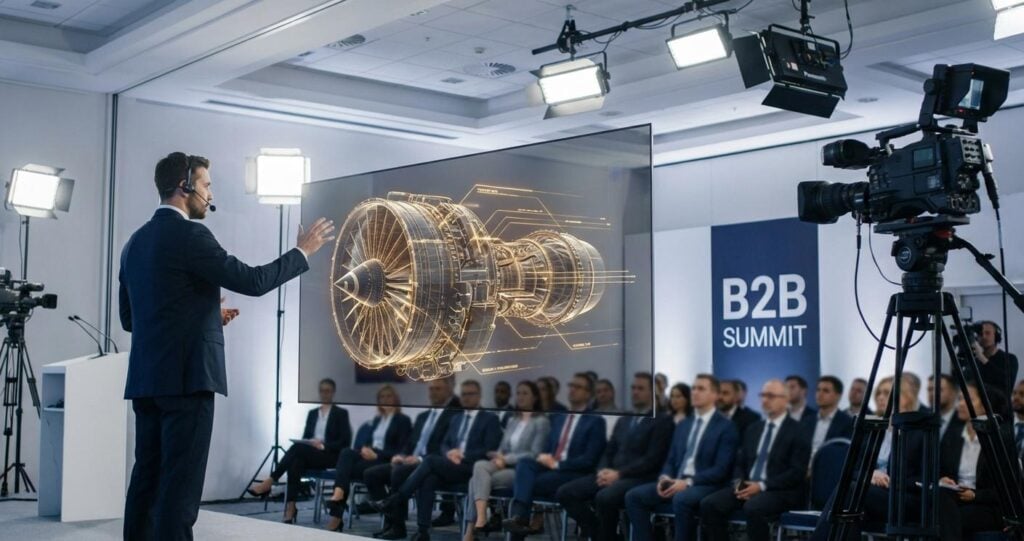
Augmented Reality for B2B Event Streaming: Visualizing Complex Engineering Solutions Live
In the demanding landscape of B2B event streaming and hybrid production, the ability to convey intricate technical data and complex engineering concepts with absolute clarity and precision is paramount. Traditional presentation methods, while foundational, often struggle to capture the full scope and dynamic nature of advanced industrial designs, manufacturing processes, or intricate system architectures. This is where Augmented Reality (AR) emerges as a transformative technology, offering unparalleled potential to bring engineering solutions to life on screen, enhancing comprehension and engagement for a discerning B2B audience. For Spring Forest Studio, integrating AR into enterprise-grade live event streams represents a significant leap forward in delivering immersive, highly informative, and technically robust production experiences for corporate event planners, AV professionals, and IT directors seeking to push the boundaries of technical communication.
The application of AR in a B2B streaming context extends far beyond consumer-grade filters or simple graphic overlays. It involves the real-time superimposition of meticulously rendered 3D models, data visualizations, and interactive schematics onto live video feeds of presenters, physical prototypes, or operational machinery. This allows for dynamic, interactive demonstrations of complex engineering principles, assembly sequences, or stress analyses in a way that static diagrams or pre-rendered animations cannot achieve. The technical challenges inherent in this integration are substantial, requiring a deep understanding of live production workflows, high-bandwidth network infrastructure, real-time rendering engines, and precise synchronization protocols to ensure a seamless, low-latency, and visually compelling output.
The Technical Foundation: AR Integration in Live Production Workflows
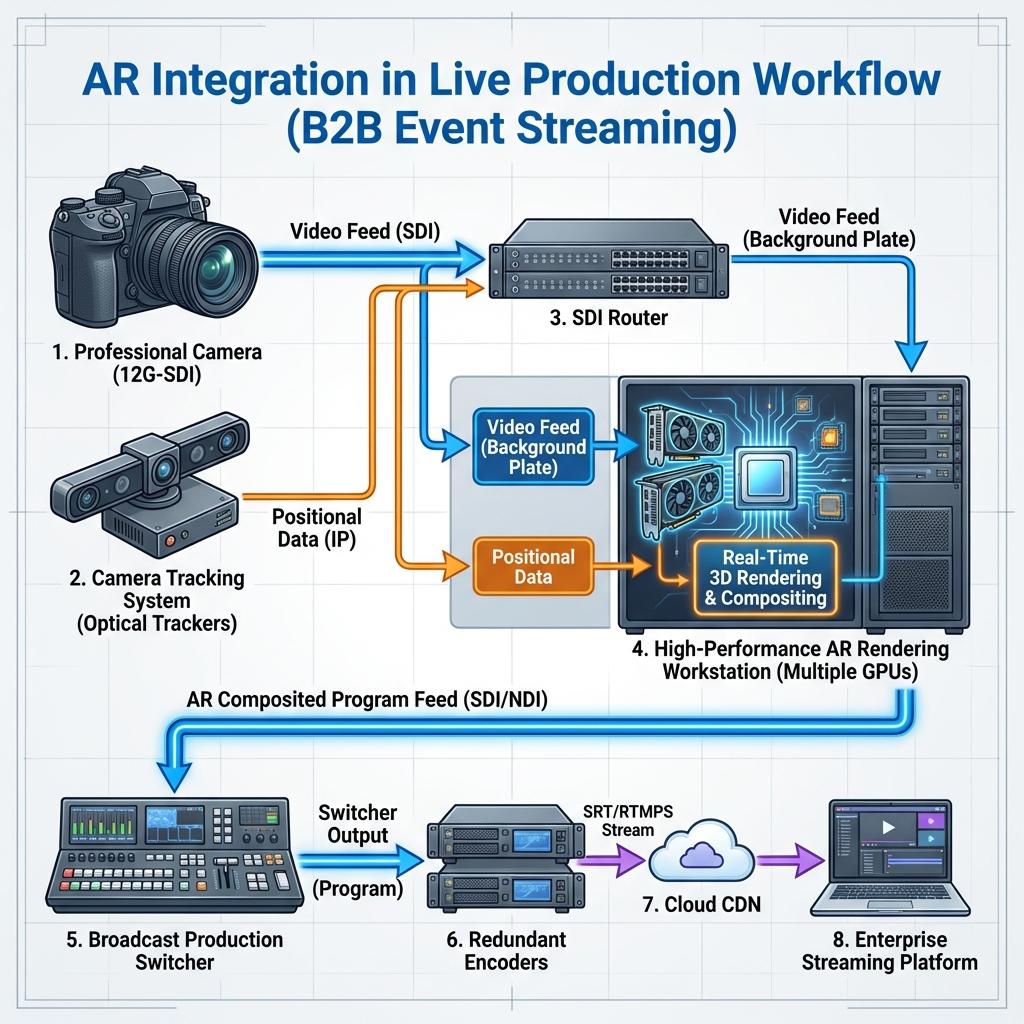
Implementing AR for B2B event streaming necessitates a robust and meticulously planned technical infrastructure. At its core, the workflow involves capturing live video, processing it through an AR rendering engine, and then compositing the augmented elements back into the program feed for encoding and distribution. This is a complex multi-stage process where each component must operate with broadcast-grade reliability and precision.
Camera Tracking and Positional Data: The fundamental requirement for convincing AR overlays is precise camera tracking. Professional AR systems for live production employ either optical tracking, inertial measurement units (IMUs), or a hybrid approach to determine the exact position, orientation, and lens parameters of the live camera in real-time. Optical tracking often utilizes specialized markers placed within the physical set or natural feature tracking algorithms, feeding highly accurate positional data (X, Y, Z coordinates, pan, tilt, roll) and lens distortion values into the AR rendering engine. This data, typically transmitted over low-latency IP networks, is crucial for rendering 3D models that appear anchored seamlessly within the real-world scene, maintaining perspective and scale as the camera moves. Latency in this data transfer must be minimized, ideally below 1-2 frames, to avoid any noticeable drift or jitter in the AR graphics.
Real-Time AR Rendering Engines: Industry-standard game engines like Unreal Engine or Unity, specifically optimized for real-time graphics rendering, form the backbone of AR integration. These engines receive the live video feed as a background plate and, based on the camera tracking data, render the 3D engineering models with accurate lighting, shadows, and reflections that match the physical environment. High-performance Graphics Processing Units (GPUs) are indispensable here, capable of rendering complex CAD models, simulated fluid dynamics, or structural stress visualizations at frame rates of 50p or 60p, corresponding to broadcast standards. The rendering engine must also handle alpha channel keying, allowing for seamless blending of the AR elements with the live video. Outputs from these engines are typically high-bandwidth, uncompressed video signals, often 1080p60 or 4K/UHD, delivered via SDI (Serial Digital Interface) or NDI (Network Device Interface) to the production switcher.
Video Acquisition and Signal Flow: For broadcast-quality AR integration, video sources must be professional-grade. This typically involves 3G-SDI or 12G-SDI cameras, ensuring uncompressed or minimally compressed signal integrity. The video signal flow often looks like this: Camera -> SDI Router -> AR Rendering Workstation (input for background plate) -> AR Rendering Workstation (output of composited AR graphics) -> Production Switcher. Alternatively, for NDI-centric workflows, cameras capable of native NDI|HX output can stream directly to the AR workstation and then back to an NDI-compatible switcher, simplifying cabling and increasing network flexibility. Meticulous signal timing and genlock across all devices are critical to prevent tearing or artifacting in the final composited image. SMPTE ST 2059-2, Precision Time Protocol (PTP), plays a vital role in synchronizing diverse IP-based and traditional SDI components within a hybrid production environment, ensuring consistent frame alignment.
Advanced AR Applications for Engineering Visualizations
The true power of AR in B2B event streaming lies in its capacity to transform abstract engineering data into tangible, interactive experiences. Beyond simply displaying 3D models, AR can be leveraged for dynamic simulations and collaborative design reviews.
Dynamic Data Visualization and Simulation: Imagine a live stream where a structural engineer is discussing the load-bearing capabilities of a new bridge design. With AR, a real-time stress analysis heatmap can be overlaid directly onto a miniature physical model of the bridge on stage, dynamically changing as the presenter explains different load scenarios. Similarly, a chemical engineer could demonstrate fluid flow dynamics within a reactor, with AR visualizing the liquid’s movement and pressure points inside a transparent model. This requires sophisticated integration between the AR rendering engine and real-time simulation software, often leveraging APIs for data exchange. Latency between simulation updates and AR visualization must be minimal, often demanding dedicated GPU resources for both simulation processing and rendering.
Interactive Product Demonstrations and Disassembly/Assembly Guides: AR provides an unparalleled platform for interactive product showcases. A presenter can walk around a new piece of industrial machinery, and through AR, the internal components can be revealed, allowing the audience to “see through” the exterior. Furthermore, complex assembly or disassembly procedures can be visually guided in real-time, with AR arrows, labels, and ghosted parts illustrating each step. This is particularly valuable for training sessions or technical sales pitches where explaining intricate mechanisms is crucial. The AR system can be programmed to respond to presenter gestures or voice commands, triggering different animated sequences or data overlays, transforming a monologue into a dynamic, interactive presentation.
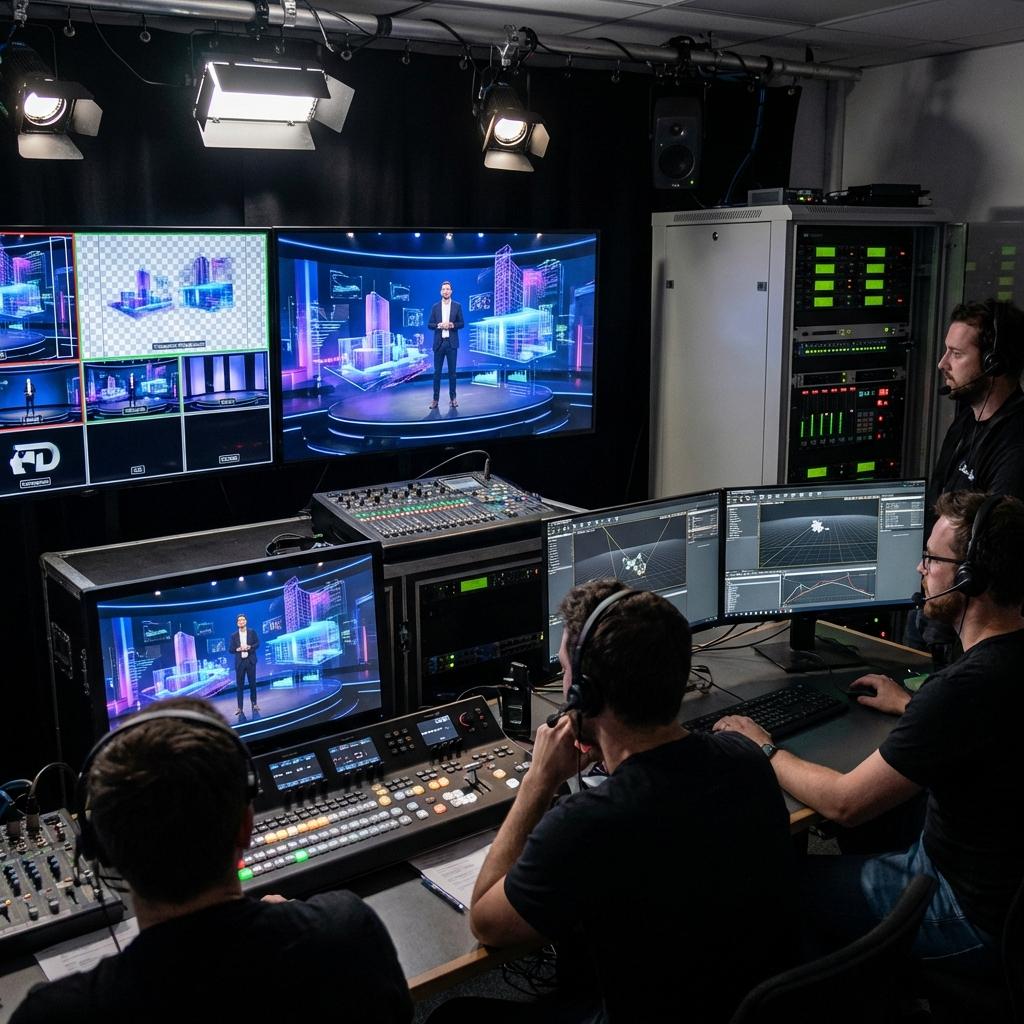
Collaborative Engineering Reviews in Hybrid Formats: For hybrid events, AR can bridge the gap between physical and virtual attendees in collaborative engineering reviews. On-site participants might view AR overlays through a monitor or specialized glasses, while virtual participants see the same AR-enhanced content streamed to their devices. Integration with enterprise collaboration platforms like Microsoft Teams or Zoom can allow remote engineers to annotate AR models in real-time, with their input visually appearing on the live stream for all participants, fostering truly interactive discussion and problem-solving regardless of physical location. This necessitates robust network infrastructure, including high-speed dedicated internet access, QoS (Quality of Service) prioritization for AR data and video streams, and potentially edge computing resources for localized AR rendering to reduce latency for remote participants.
Network Infrastructure and Streaming Protocols for AR-Enhanced Events
The integration of AR into B2B event streaming places significant demands on network infrastructure and necessitates careful selection of streaming protocols. The high-fidelity visuals and low-latency requirements of AR content cannot tolerate network bottlenecks or instability.
High-Bandwidth Network Requirements: Uncompressed or lightly compressed AR-enhanced video signals, especially in 4K/UHD resolutions at 50p or 60p frame rates, require substantial network bandwidth within the production environment. A single 4K60p uncompressed video stream can consume upwards of 12 Gbps, while lightly compressed NDI streams (e.g., NDI High Bandwidth) can range from 100 Mbps to 250 Mbps depending on resolution and frame rate. A robust 10 Gigabit Ethernet (10GbE) or even 25GbE network backbone is often required for intra-production signal routing, connecting cameras, AR workstations, switchers, and encoders. For hybrid events involving multiple remote participants interacting with AR, dedicated fiber optic internet connections with guaranteed symmetric bandwidth (e.g., 1 Gbps up/down or higher) are essential.
Streaming Protocols for AR Delivery: For the final program feed containing AR elements, several enterprise-grade streaming protocols are suitable, each with its own characteristics:
- SRT (Secure Reliable Transport): Ideal for transmitting high-quality, low-latency video over unpredictable networks, including the public internet. SRT’s error recovery mechanisms and flexible latency settings make it excellent for transmitting AR-enhanced program feeds from the venue to cloud encoders or content delivery networks (CDNs). It maintains video fidelity even with some packet loss.
- RTMP/RTMPS (Real-Time Messaging Protocol/Secure): Still widely used for its broad compatibility with CDNs and streaming platforms. While generally higher latency than SRT, it is a reliable choice for delivering the final program feed to a wide audience. RTMPS adds critical encryption for secure B2B content.
- NDI (Network Device Interface): Predominantly used within the local production network for transporting video, audio, and metadata (including AR camera tracking data) between devices. NDI|HX, a lower-bandwidth variant, is suitable for camera sources and monitoring, while NDI High Bandwidth is preferred for uncompromised quality between rendering engines and switchers.
Encoding standards such as H.264 (AVC) and increasingly H.265 (HEVC) are crucial for compressing these high-resolution, AR-rich streams efficiently for distribution, balancing visual quality with manageable bitrates. For maximum quality and future-proofing, 10-bit 4:2:2 chroma subsampling is preferred over 8-bit 4:2:0, especially when critical color accuracy for engineering visualizations is paramount.
Scalability, Redundancy, and Failover for Enterprise AR Streaming
Enterprise-grade B2B streaming, particularly with AR integration, demands meticulous planning for scalability, redundancy, and failover to ensure uninterrupted service and maintain audience trust.
Scalability Considerations: Scaling an AR-enhanced production involves not only increasing video processing power but also ensuring the AR rendering infrastructure can handle the complexity and quantity of augmented elements. For large-scale events with multiple AR-enhanced segments or interactive zones, distributed rendering architectures, potentially leveraging cloud-based GPU instances, may be necessary. Cloud resources offer burst capacity, allowing dynamic scaling of rendering power based on real-time demand, ensuring smooth performance even for computationally intensive AR scenarios. This also extends to CDN capacity, which must be provisioned to handle peak concurrent viewer loads for high-bitrate, AR-rich content, potentially across multiple geographical points of presence (PoPs).
Redundancy and Failover Strategies: In any professional broadcast environment, redundancy is non-negotiable. For AR streaming, this means redundant camera tracking systems, duplicate AR rendering workstations operating in parallel (hot-standby configurations), and mirrored network paths. Signal routers and production switchers should also be redundant, with automatic failover capabilities. For internet egress, dual-path connectivity from different internet service providers (ISPs) with automatic link failover is critical. Encoding systems should operate in a redundant fashion, often with primary and secondary encoders feeding independent SRT or RTMP streams to the CDN. Content Delivery Networks (CDNs) themselves provide inherent redundancy through their distributed architecture, but careful selection of a robust CDN with a proven track record for live event delivery is paramount. Implementing ISO (International Organization for Standardization) recording of both clean and program feeds is also essential, providing backup copies for post-production or disaster recovery.
Conclusion: The Future of Engineering Communication in B2B Events
The integration of Augmented Reality into B2B event streaming is more than a novelty; it is a strategic imperative for organizations aiming to communicate complex engineering solutions with unprecedented clarity and impact. Spring Forest Studio stands at the forefront of this evolution, offering the technical expertise and robust infrastructure required to implement these advanced production workflows. From precise camera tracking and high-performance AR rendering to resilient network architectures utilizing SRT and NDI, and comprehensive redundancy strategies, our team ensures that your intricate designs and innovative processes are not just shown, but truly brought to life for a global enterprise audience. By leveraging AR, B2B events can transcend traditional presentations, offering immersive, interactive, and deeply informative experiences that drive understanding, foster collaboration, and ultimately, accelerate innovation within the engineering and industrial sectors. The future of technical communication is augmented, and the stage is set for a new era of B2B engagement.

Jeremy Lee is a seasoned digital marketing director and strategist with over two decades of experience in the industry. As the founder of Sotavento Medios, I manage a diverse portfolio of over 50 businesses, helping brands grow through advanced search strategies and digital innovation. My work focuses on bridging the gap between traditional search engine optimisation and the evolving world of AI-driven answer engines.
get in touch