
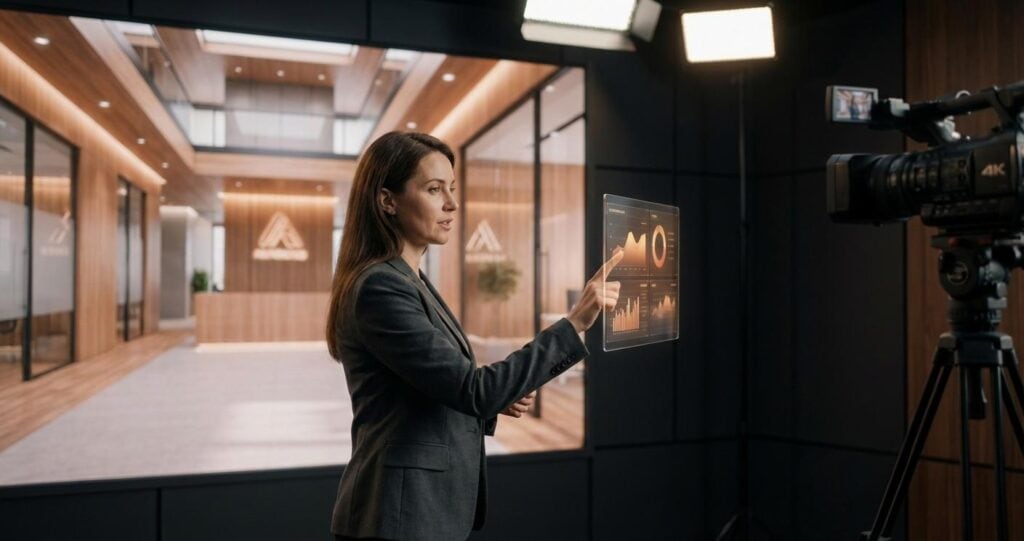
The Psychological Advantage of High-Fidelity Virtual Backgrounds
In the evolving landscape of B2B event streaming and hybrid production, the technical fidelity of virtual environments has transitioned from a mere aesthetic choice to a critical component impacting audience engagement, brand perception, and the overall psychological impact of a corporate message. Spring Forest Studio understands that in high-stakes enterprise communications, a pixelated, poorly keyed, or inconsistently lit virtual background is not merely a visual flaw; it is a profound technical deficit that erodes trust, diminishes perceived professionalism, and distracts from core content. This article delves into the advanced technical considerations and psychological benefits of deploying high-fidelity virtual backgrounds, offering a deep analysis for corporate event planners, AV professionals, and IT directors seeking to elevate their hybrid and virtual event strategies beyond conventional expectations.
The human brain is intrinsically wired to detect anomalies. Subconscious processing identifies visual inconsistencies, even minute aberrations in chroma keying, lighting mismatches, or resolution disparities between foreground and background elements. These technical imperfections generate cognitive dissonance, subconsciously signaling a lack of professionalism or technical prowess. Conversely, a seamlessly integrated, high-fidelity virtual background allows the audience to suspend disbelief, focusing entirely on the presenter and content. This fosters a more immersive, trustworthy, and impactful viewing experience, directly translating into enhanced attendee retention, deeper message resonance, and a fortified brand image in the competitive B2B arena.
The Technical Foundations of Visual Immersion in Virtual Environments
Achieving true high-fidelity virtual backgrounds demands a meticulous approach to every stage of the production pipeline, extending far beyond basic chroma keying. It commences with pristine input acquisition. Professional broadcast-grade cameras equipped with large sensors, high dynamic range (HDR) capabilities, and superior low-light performance are paramount. Lenses with minimal chromatic aberration and high optical sharpness ensure that the foreground subject is captured with absolute clarity, providing optimal data for the keying process. Critically, the camera’s output signal must preserve maximum color information, necessitating 4:4:4 or at minimum 4:2:2 chroma subsampling over SDI (Serial Digital Interface) or HDMI 2.1 connections, typically at resolutions of 1080p, 4K/UHD, or even 8K for future-proofing immersive displays. This rich color data is fundamental for sophisticated keying algorithms to differentiate nuanced shades of green or blue with precision, especially around complex elements like hair, translucent materials, or reflective surfaces.
Lighting is a non-negotiable technical pillar. The foreground subject and the chroma key screen must be lit independently and uniformly. For the green screen, an even light field is crucial to avoid “hot spots” or shadows that create varying shades of green, making keying significantly more challenging. Soft, diffuse lighting for the presenter minimizes harsh shadows and facilitates a natural blend with the virtual environment. Furthermore, the virtual background itself must be rendered with an appropriate virtual lighting scheme that matches the real-world lighting on the presenter. This involves understanding color temperature, light direction, and intensity. Advanced compositing engines, often running on powerful GPU-accelerated workstations, can apply virtual spill suppression, de-spill, and color correction to seamlessly integrate the keyed foreground into the synthetic background, creating a unified visual plane that fools the eye. Some setups leverage real-time rendering platforms like Unreal Engine or Vizrt for dynamic, interactive 3D virtual sets, which demand low-latency, high-bandwidth communication between the rendering engine and the video switcher.
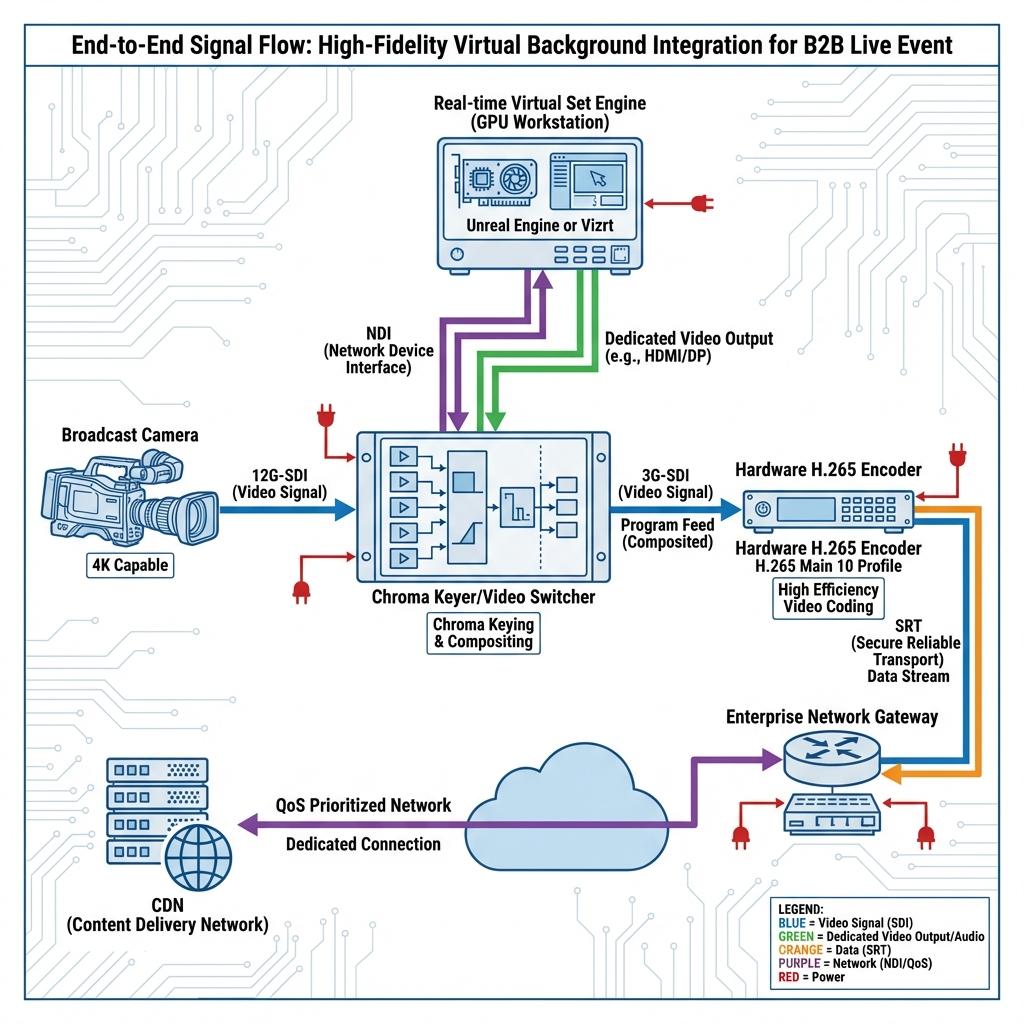
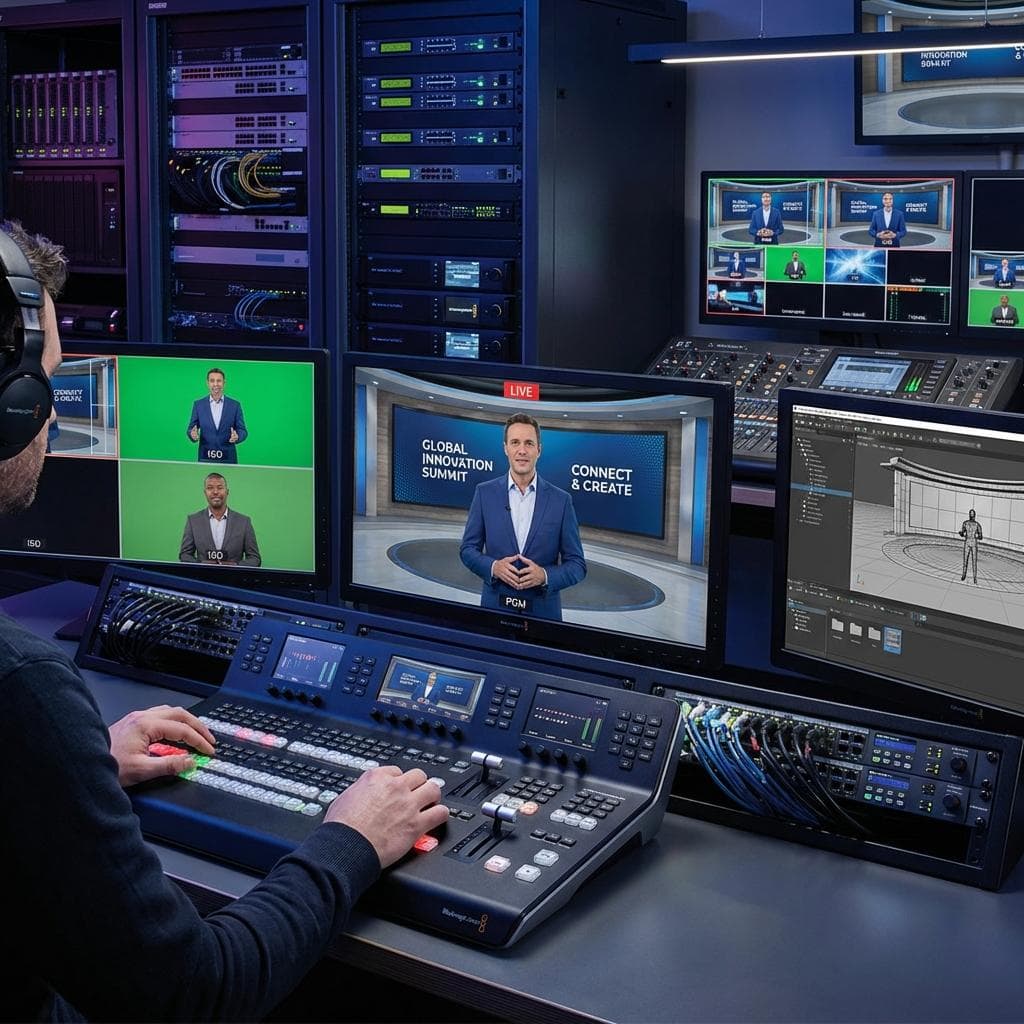
The processing power required for real-time, high-fidelity compositing is substantial. Dedicated hardware keyers, often found in professional video switchers such as those from Ross Video, Grass Valley, or Blackmagic Design, offer superior performance compared to software-only solutions. These systems handle multiple layers of video, graphics, and effects with minimal latency. They often employ advanced 10-bit or 12-bit processing for color accuracy and precision. Integration with professional audio mixing consoles, talkback systems, and multiview monitoring solutions ensures that the entire production team can precisely control and observe the composited program feed (PGM) in real-time. The output of this compositing stage is a high-quality program feed, typically 3G-SDI or 12G-SDI, ready for encoding and distribution.
Encoding, Transmission, and Decoding for Pristine Virtual Backgrounds in B2B Streaming
Once the high-fidelity virtual background is composited, maintaining its visual integrity throughout the streaming pipeline becomes the next critical technical challenge. The choice of encoding codec and bitrate management strategy directly impacts the final viewer experience. H.264 (AVC) and H.265 (HEVC) remain the industry standards. For virtual backgrounds, particularly those with intricate details or dynamic elements, utilizing higher profiles such as H.264 High Profile or H.265 Main 10 Profile is essential to maximize compression efficiency while preserving visual quality. Bitrate allocation must be generous. While a static talking head might suffice at 3-5 Mbps, a dynamic presentation with complex virtual backgrounds and motion graphics demands bitrates upwards of 8-15 Mbps or even higher for 1080p content, and significantly more for 4K/UHD streams, to mitigate compression artifacts, macroblocking, and especially the “mosquito noise” often visible around keyed edges and fine text.
Bitrate management is key. Constant Bitrate (CBR) can offer predictable network loads but may sacrifice quality during visually complex scenes. Variable Bitrate (VBR) can optimize quality by allocating more bits to demanding segments, but its variability can challenge network stability. Capped VBR, a hybrid approach, provides a balance. For B2B events, the emphasis is on quality over absolute minimum bandwidth. Therefore, professional-grade hardware encoders, often equipped with multiple encoding engines and advanced rate control algorithms, are preferred over software encoders. These units ensure consistent, high-quality output crucial for maintaining the psychological advantage derived from a pristine virtual environment.
The transmission protocol plays a pivotal role in delivering this quality to the audience. For ultra-low latency, high-quality contribution and distribution, the Secure Reliable Transport (SRT) protocol has become an industry standard. SRT, developed by Haivision, offers FEC (Forward Error Correction) and ARQ (Automatic Repeat Request) mechanisms, ensuring robust delivery over unpredictable internet connections while maintaining low latency. NDI (Network Device Interface) provides a high-quality, low-latency IP video standard for intra-network transport, ideal for moving program feeds between production components within a local area network (LAN) before egress to the wider internet. For broad ingest compatibility with CDNs (Content Delivery Networks) and established platforms, RTMP (Real-Time Messaging Protocol) and its secure variant RTMPS remain prevalent, though with inherently higher latency. Enterprise streaming infrastructure requires a robust network backend, often involving dedicated gigabit or 10-gigabit Ethernet connectivity, VLAN (Virtual Local Area Network) segmentation for QoS (Quality of Service) prioritization of video traffic, and redundant internet service providers (ISPs) to prevent service interruptions, all contributing to the unbroken delivery of high-fidelity content.
Real-World Implementation: Integrating High-Fidelity Virtual Backgrounds into Hybrid Event Workflows
Integrating high-fidelity virtual backgrounds into a complex hybrid event workflow requires a meticulous understanding of signal flow, system architecture, and interoperability. In a typical corporate hybrid event, the program feed (PGM) from the main production switcher, which now includes the seamlessly composited presenter against the virtual background, needs to be distributed to various endpoints. For physical attendees in a venue, this PGM feed might be sent via SDI to large LED video walls or projectors. Simultaneously, for remote virtual attendees, the PGM is encoded and streamed to a content delivery network (CDN) for global distribution. This involves careful scaling and resolution management to ensure optimal viewing experiences across diverse devices and network conditions without compromising the source quality of the virtual background.
Consider a multi-presenter panel discussion. Each presenter might be in a different physical location, requiring individual chroma key setups. Their discrete camera feeds are then sent to a central production hub – either on-premise or a cloud-based virtual control room. Here, each feed undergoes individual keying and compositing with the shared high-fidelity virtual background. A professional video switcher then orchestrates the various presenter feeds, graphics, and pre-recorded content, ensuring smooth transitions and consistent visual branding. Advanced production scenarios might utilize augmented reality (AR) elements within the virtual background, dynamically displaying data visualizations, 3D product models, or interactive polls, all rendered in real-time and seamlessly integrated into the PGM. This level of technical sophistication not only enhances the psychological impact but also provides an unparalleled platform for dynamic content delivery.
For hybrid events leveraging platforms like Microsoft Teams, Zoom, or Webex, the high-fidelity PGM output from the dedicated broadcast production system can be ingested as a virtual camera or direct NDI input. This means remote participants within the collaboration platform view a professionally produced, visually stunning stream rather than standard webcam feeds. This approach ensures that even in interactive Q&A sessions, the production quality remains consistently high, reinforcing the brand’s commitment to excellence. Redundancy and failover strategies are integral for enterprise-grade events. This includes redundant power supplies for all critical equipment, duplicated signal paths (e.g., primary and secondary SDI routers), diverse network connections, and sometimes, entirely parallel production systems that can take over instantaneously in case of a primary system failure. Cloud-based rendering solutions can also provide additional resilience and scalability, allowing for burst capacity during peak viewership or for distributed production teams.
Quality of Service (QoS) configurations across the network infrastructure are essential. Prioritizing video and audio packets over other network traffic prevents jitter, packet loss, and latency spikes that can degrade the perceived quality of the virtual background and disrupt the psychological flow of the event. Enterprise-grade managed switches, firewalls, and network monitoring tools provide the visibility and control necessary to maintain these QoS standards. The ultimate goal is to deliver a virtual experience so technically robust and visually compelling that the audience forgets they are viewing a composite, fostering a sense of presence and professionalism that is indistinguishable from a physical, impeccably produced event. This technical mastery translates directly into a powerful psychological advantage, reinforcing the message and the brand’s authority.
Actionable Technical Recommendations for Enterprise Clients
To harness the psychological advantages of high-fidelity virtual backgrounds, enterprise clients should consider the following technical recommendations:
- Invest in Broadcast-Grade Camera Systems: Prioritize cameras with 4:2:2 or 4:4:4 output, superior low-light performance, and high dynamic range to ensure optimal source material for keying.
- Optimize Lighting Rigging: Implement professional, uniform lighting for both the chroma key screen and the presenter. Utilize light meters to ensure even illumination across the green screen (typically within 1/4 to 1/2 stop variance).
- Deploy Dedicated Hardware Keyers: Utilize professional video switchers with integrated hardware keyers or standalone keying appliances for real-time, high-quality compositing and minimal latency.
- Ensure Adequate Bitrate Allocation: Plan for substantially higher bitrates (e.g., 10-20 Mbps for 1080p, 30-50 Mbps for 4K) for the final program stream, especially when dynamic virtual backgrounds are used, to prevent compression artifacts.
- Leverage Robust Transmission Protocols: Implement SRT for secure, low-latency, and resilient contribution and distribution over public internet, and NDI for high-quality intra-network signal routing.
- Fortify Network Infrastructure: Ensure dedicated gigabit Ethernet infrastructure, implement VLANs with QoS for video traffic prioritization, and establish redundant internet connectivity.
- Consider Real-time 3D Graphics Engines: For truly immersive and dynamic virtual sets, explore integration with platforms like Unreal Engine or Vizrt, which can render complex 3D environments in real-time.
- Engage Professional Production Expertise: Partner with a technical production team possessing deep expertise in broadcast standards (SMPTE, ISO), advanced compositing techniques, and enterprise streaming infrastructure to design, implement, and manage these complex workflows.
- Implement Comprehensive Monitoring: Utilize waveform monitors, vectorscopes, and multiview displays to continuously monitor video levels, color accuracy, and signal integrity throughout the entire production chain.
- Establish Redundancy and Failover Protocols: Design redundant signal paths, equipment, and network connections to guarantee uninterrupted service, a critical aspect of enterprise-grade event delivery.
By meticulously addressing these technical facets, corporate clients can transcend the limitations of basic virtual backgrounds, transforming their B2B event streaming into a psychologically engaging, visually compelling, and unequivocally professional experience that reinforces their brand authority and delivers their message with maximum impact.

Jeremy Lee is a seasoned digital marketing director and strategist with over two decades of experience in the industry. As the founder of Sotavento Medios, I manage a diverse portfolio of over 50 businesses, helping brands grow through advanced search strategies and digital innovation. My work focuses on bridging the gap between traditional search engine optimisation and the evolving world of AI-driven answer engines.
get in touch