
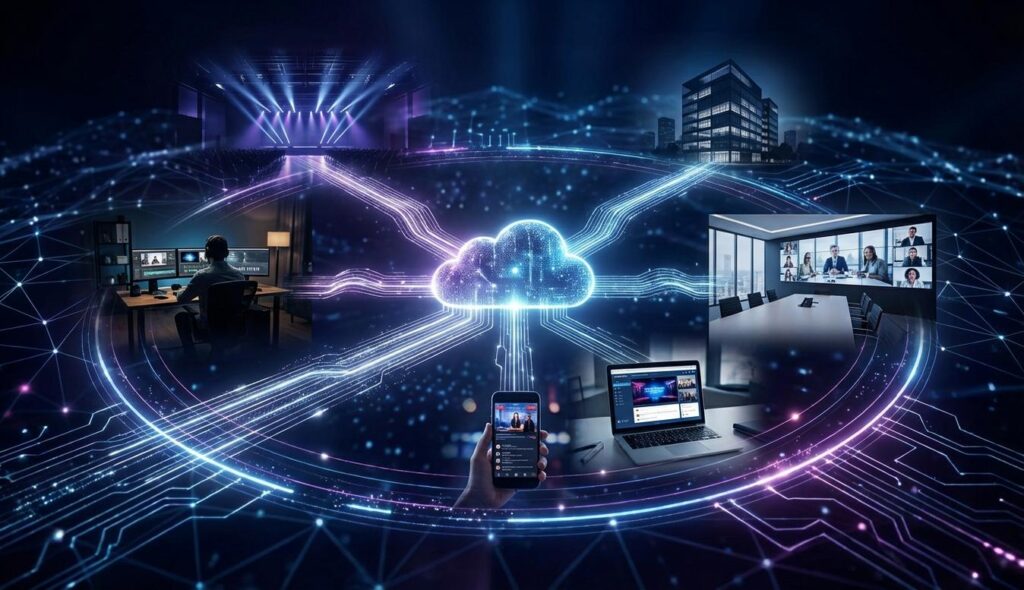
Deconstructing the Monolith: From On-Premise Iron to Cloud-Native Architecture
For decades, professional B2B event production has been defined by its physical infrastructure. The foundation was built on racks of dedicated hardware, intricate Serial Digital Interface (SDI) routing, and significant capital expenditure on equipment with limited flexibility. This monolithic, on-premise model, while reliable, presents substantial barriers to scalability, geographic reach, and operational agility required for modern hybrid events. The blueprint for 2026 and beyond necessitates a fundamental shift from this hardware-centric paradigm to a disaggregated, software-defined Unified Production Cloud.
The Limitations of Traditional SDI-Based Infrastructure
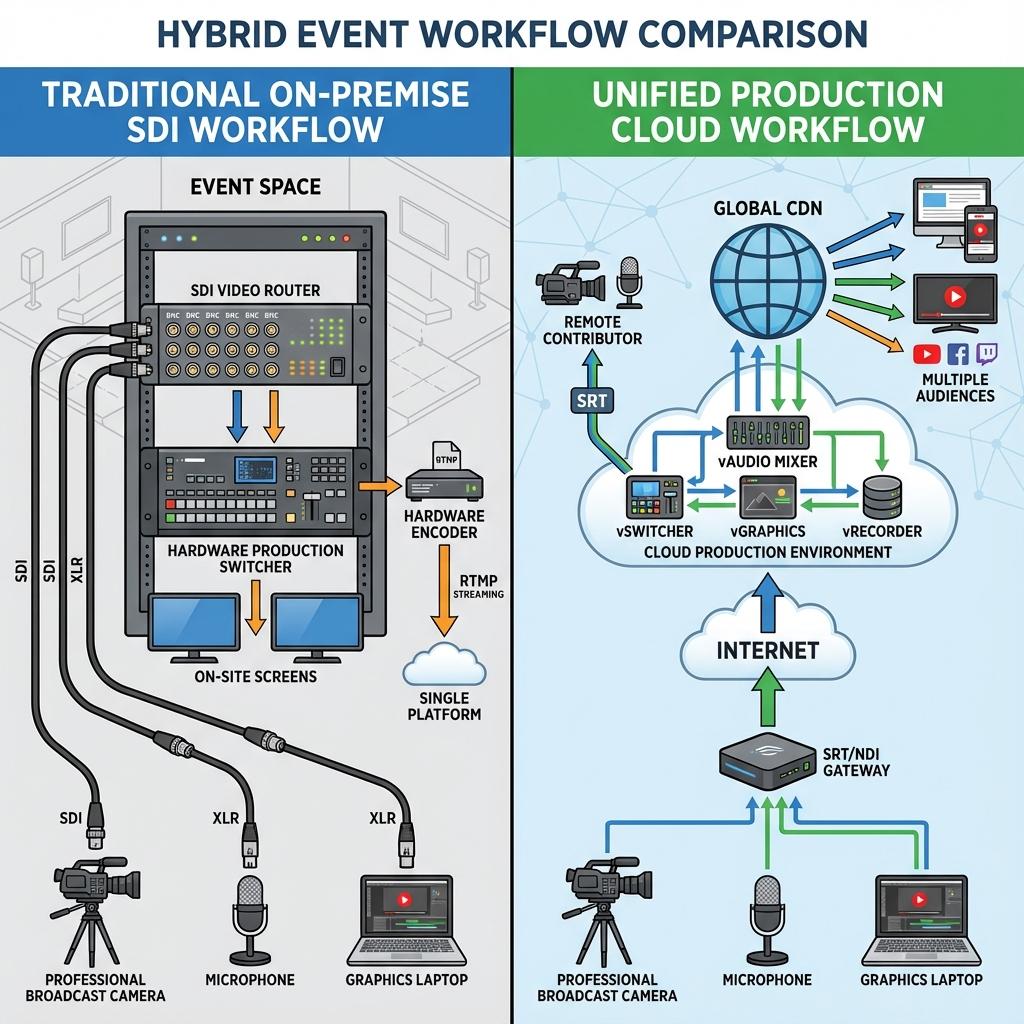
The traditional broadcast workflow is a testament to precision engineering, but it is inherently rigid. A typical setup involves baseband video signals running over SDI cabling from cameras to a central production switcher. Audio is often embedded or routed separately through AES/EBU or MADI protocols to a dedicated audio console. Graphics, replays, and recording are handled by distinct hardware units, all interconnected via a master video router. This architecture demands meticulous physical setup, extensive cabling, and significant on-site engineering presence. Expanding a production from six to ten cameras is not a simple software change; it requires additional hardware inputs, more router capacity, and potentially a larger switcher chassis. Furthermore, integrating remote contributors into an SDI environment is cumbersome, often relying on expensive satellite links or complex IP gateways that introduce latency and points of failure.
Embracing a Disaggregated, Microservices-Based Model
The Unified Production Cloud dismantles this monolithic structure. Instead of a single, all-in-one production switcher, the core functions of event production are broken down into discrete, containerized microservices running on elastic cloud computing infrastructure. Video switching, audio mixing, graphics generation, encoding, and recording become independent software processes that can be spun up, scaled, and interconnected as needed. This cloud-native approach allows production capacity to be treated as an operational expense (OpEx) rather than a capital expense (CapEx). An event requiring 20 ISO recording channels and 4K/UHD resolution can provision the necessary cloud resources for the event’s duration and then scale them down, a feat impossible with fixed on-premise hardware. This model provides unparalleled resilience; if a graphics engine microservice fails, it can be instantly restarted or rerouted without affecting the core video switching or audio mixing services.
The Role of COTS Hardware and Virtualized Production Environments
This transition is powered by the increasing capability of Commercial Off-The-Shelf (COTS) hardware, particularly at the point of acquisition. High-quality PTZ cameras, professional camcorders, and audio interfaces can now output directly to IP using protocols like NDI or SRT. This eliminates the need for SDI-to-IP conversion at the edge. The heavy lifting of production is then handled within a virtualized environment in the cloud. A production director, graphics operator, and audio engineer can be located anywhere in the world, accessing the same cloud-based production environment through a web browser or lightweight client application. They can view real-time multiviewer outputs, operate a virtual control surface, and communicate via integrated talkback systems, all with latencies low enough for live, frame-accurate production. This liberates enterprise events from the physical constraints of a single control room, enabling a global talent pool and drastically reducing travel and logistics costs.
The Protocol Fabric: Weaving Together On-Site and Remote Contribution
The backbone of any Unified Production Cloud is the protocol fabric that transports high-quality audio and video signals from their source to the cloud and ultimately to the audience. This requires a sophisticated understanding of various transport protocols, each suited for specific segments of the production workflow. The reliance on the public internet necessitates robust protocols that can handle network imperfections like packet loss, jitter, and fluctuating bandwidth, which standard protocols were not designed to manage.
Beyond RTMP: The Ascendancy of Secure Reliable Transport (SRT)
For years, Real-Time Messaging Protocol (RTMP) was the de facto standard for contribution encoding. However, its reliance on TCP (Transmission Control Protocol) makes it poorly suited for unstable networks, as packet loss can cause significant buffering and stream failure. Enter Secure Reliable Transport (SRT), an open-source protocol that has become the new industry standard for professional contribution over the public internet. SRT operates over UDP (User Datagram Protocol) but incorporates an intelligent packet recovery mechanism based on ARQ (Automatic Repeat reQuest). If a packet is lost in transit, only that specific packet is re-transmitted, avoiding the head-of-line blocking that plagues TCP. This allows for stable, high-quality, low-latency video transport even over networks with 10-15% packet loss. Furthermore, SRT includes mandatory AES-128/256 bit encryption, making it a secure choice for sensitive corporate content. A typical 1080p60 contribution feed over SRT can be reliably delivered at 8-10 Mbps with a glass-to-glass latency of under 500ms.
NDI and NDI|HX for High-Quality, Low-Latency Local Networks
While SRT excels over wide area networks (WAN), Network Device Interface (NDI) has become the dominant protocol for video-over-IP on a local area network (LAN). Within the event venue, NDI allows cameras, graphics systems, and other sources to be connected to the network via a standard Ethernet cable, where they are automatically discoverable by any other NDI-enabled device on the same subnet. Full-bandwidth NDI provides visually lossless quality with sub-frame latency, making it ideal for the demanding environment of a live production. A single 1080p60 NDI stream requires approximately 125 Mbps of bandwidth. For environments with more limited network capacity, such as Wi-Fi or 1GbE networks with many sources, the NDI|HX variant offers a more compressed, long-GOP version of the protocol, with NDI|HX3 providing excellent quality at bitrates as low as 10-20 Mbps, albeit with slightly higher latency. The on-site NDI streams are then fed into a local encoder for transport to the Unified Production Cloud via SRT.
Integrating Enterprise UC Platforms: The Hybrid Event Bridge
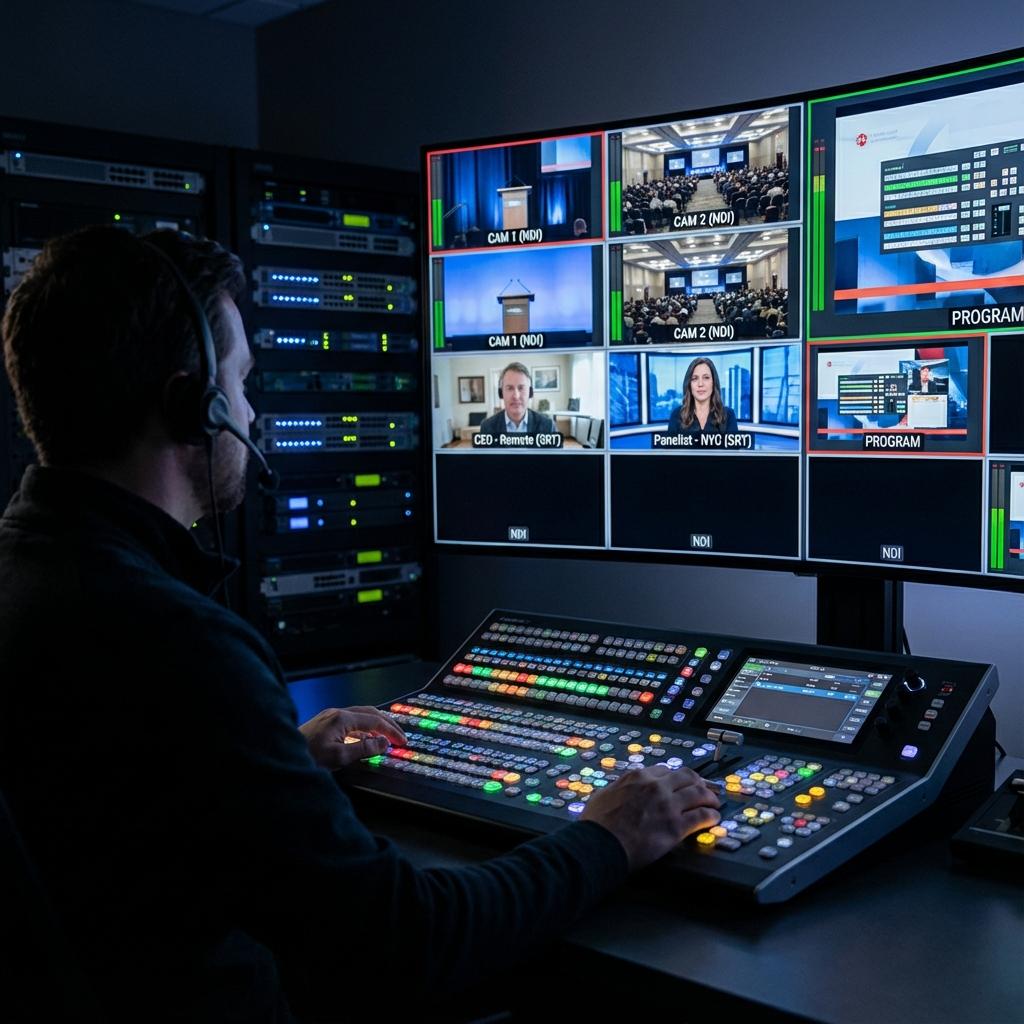
A critical component of the 2026 enterprise event is the seamless integration of Unified Communications (UC) platforms like Microsoft Teams, Zoom, and Webex. These platforms are the primary interface for remote presenters and panelists. The technical challenge is to extract high-quality, isolated video and audio feeds (ISO feeds) from these platforms and integrate them into the main production. Modern solutions offer direct NDI outputs from platforms like Teams, allowing a local machine to expose each participant’s video as a distinct NDI source on the network. For platforms without native NDI support, screen-capture with virtual audio cable routing is a common technique. A crucial element is creating a proper mix-minus audio feed for each remote contributor. This is an audio mix containing the full program audio minus that specific contributor’s own voice, preventing them from hearing a delayed echo of themselves. In a cloud production environment, this mix-minus can be generated virtually for each remote source, ensuring a clean and professional experience for all participants.
Orchestrating the Unified Cloud: Management, Monitoring, and Redundancy
A collection of cloud-based tools is not a unified platform. True power is unlocked through a centralized orchestration layer that provides holistic control, deep monitoring, and robust redundancy. For enterprise-level events where failure is not an option, the architecture must be designed from the ground up for resilience and high availability, leveraging the inherent strengths of cloud infrastructure.
Centralized Control Planes and API-Driven Workflows
A Unified Production Cloud is managed through a single web-based control plane. From this interface, a production manager can provision resources, configure SRT encoder settings, route sources to a cloud-based switcher, build graphics templates, and set distribution points. This centralized control eliminates the need to log into a dozen different systems. More importantly, these platforms are increasingly API-driven. This allows for powerful automation and integration. For example, an event registration system could use an API call to automatically generate a personalized graphic title for each speaker, or a master scheduling system could automatically start and stop encoders at pre-defined times. This level of automation reduces the chance of human error and frees up the production team to focus on creative execution.
Real-Time QoS Monitoring and Telemetry
You cannot manage what you cannot measure. Professional cloud production platforms provide extensive real-time telemetry for every leg of the signal path. For SRT contribution streams, engineers can monitor critical Quality of Service (QoS) statistics, including latency, round-trip time (RTT), packet loss, and available bandwidth. Alarms can be configured to trigger if any metric exceeds a pre-defined threshold, allowing engineers to proactively identify and address network issues before they impact the broadcast. This deep visibility extends through the entire cloud pipeline, from ingest to final distribution, providing a comprehensive view of the entire production’s health from a single dashboard.
Architecting for Failure: Geo-Redundancy and Hitless Failover
The final piece of the puzzle is building an architecture that can withstand failure. A core principle is redundancy at every level. This starts with sending dual, redundant SRT streams from the event venue, often over diverse network paths (e.g., one over dedicated fiber, one over 5G cellular). These streams are ingested by cloud encoders running in different geographic availability zones (e.g., AWS us-east-1 and us-west-2). If one entire cloud region experiences an outage, the production can continue uninterrupted from the secondary region. For distribution, this same principle applies. The final program feed is sent to redundant origin servers, and a Content Delivery Network (CDN) with hitless failover capabilities ensures that if a viewer’s primary stream is interrupted, their player will automatically switch to the secondary source without any buffering or noticeable disruption. This multi-layered approach to redundancy provides the 99.999% uptime reliability that enterprise clients demand.
The 2026 Blueprint: Implementation and Strategic Considerations
Transitioning to a Unified Production Cloud is a strategic evolution, not an overnight replacement of existing workflows. For enterprise AV and IT teams, this shift requires careful planning around network infrastructure, security, and a phased adoption that bridges legacy systems with cloud-native capabilities. By focusing on these core pillars, organizations can build a resilient, scalable, and future-proof production ecosystem.
Phased Adoption: Bridging Legacy and Cloud Workflows
A pragmatic approach to implementation is a phased migration. An organization can begin by leveraging the cloud for contribution and distribution while keeping the core production switching on-premise. For example, remote presenters can be brought in via SRT to the local switcher, and the final program output can be encoded with SRT and sent to the cloud for global distribution and recording. The next phase could involve moving specific functions, like graphics or replay, to the cloud, accessed by an on-site operator. The final phase is the full migration to a completely cloud-based control room, where only camera and audio acquisition remain on-site. This gradual process allows technical teams to build familiarity with cloud workflows, test network performance, and demonstrate value at each stage without the risk of a wholesale cutover.
Network Infrastructure: The Unsung Hero
The performance of a Unified Production Cloud is entirely dependent on the underlying network infrastructure. This cannot be an afterthought. At the event venue, this means securing dedicated, symmetric, and uncontended internet bandwidth. A minimum of 100/100 Mbps dedicated fiber is a realistic starting point for a multi-camera production with several SRT feeds. Network firewalls must be properly configured to allow SRT traffic (typically on a specific UDP port) and Quality of Service (QoS) policies should be implemented to prioritize video packets over general data traffic. Latency to the cloud provider’s nearest ingest point is also a critical factor; a stable, low-latency connection is paramount for effective remote production control.
Security and Compliance: Zero-Trust Architecture for Production
Moving production workflows to the cloud introduces new security considerations. A Zero-Trust security model should be applied, where no device or user is trusted by default. All transport streams must be encrypted end-to-end using protocols like SRT with AES-256 encryption or RTMPS. Access to the cloud control plane should be protected with multi-factor authentication (MFA) and role-based access control (RBAC), ensuring that an operator only has access to the tools they require. All production assets, such as recordings and graphics, must be encrypted at rest within the cloud storage environment. Furthermore, the chosen cloud platform must comply with relevant data privacy regulations, such as GDPR and CCPA, to protect the data of both the client and the event attendees. Security is not a feature; it is a prerequisite for enterprise-grade cloud production.
Jeremy Lee is a seasoned digital marketing director and strategist with over two decades of experience in the industry. As the founder of Sotavento Medios, I manage a diverse portfolio of over 50 businesses, helping brands grow through advanced search strategies and digital innovation. My work focuses on bridging the gap between traditional search engine optimisation and the evolving world of AI-driven answer engines.
get in touch