
The paradigm of corporate events has fundamentally shifted. Simple webcasting is no longer sufficient for engaging a discerning and geographically dispersed enterprise audience. Today, the benchmark for success is the next-generation hybrid event, a sophisticated fusion of in-person experience and broadcast-quality virtual participation. Executing this model requires a deep understanding of production engineering, network architecture, and streaming protocols far beyond basic IT knowledge. This technical briefing deconstructs the essential anatomy of a modern hybrid event, providing enterprise leaders and their technical teams with a clear framework for architecting and deploying a robust, scalable, and resilient solution. We will explore the critical signal chains, contribution protocols, and cloud infrastructure that differentiate a professional broadcast from a standard video call, ensuring a seamless and impactful experience for every attendee, regardless of their location.
Core Production Infrastructure: The On-Premise Signal Chain
The foundation of any high-quality hybrid event is the on-premise production workflow. This is where physical actions are translated into pristine digital signals, forming the bedrock of the entire virtual experience. Signal integrity, flexibility, and redundancy are paramount at this stage, as any degradation here will be amplified by the time it reaches the remote audience.
Acquisition and Ingest: Capturing Pristine Signals
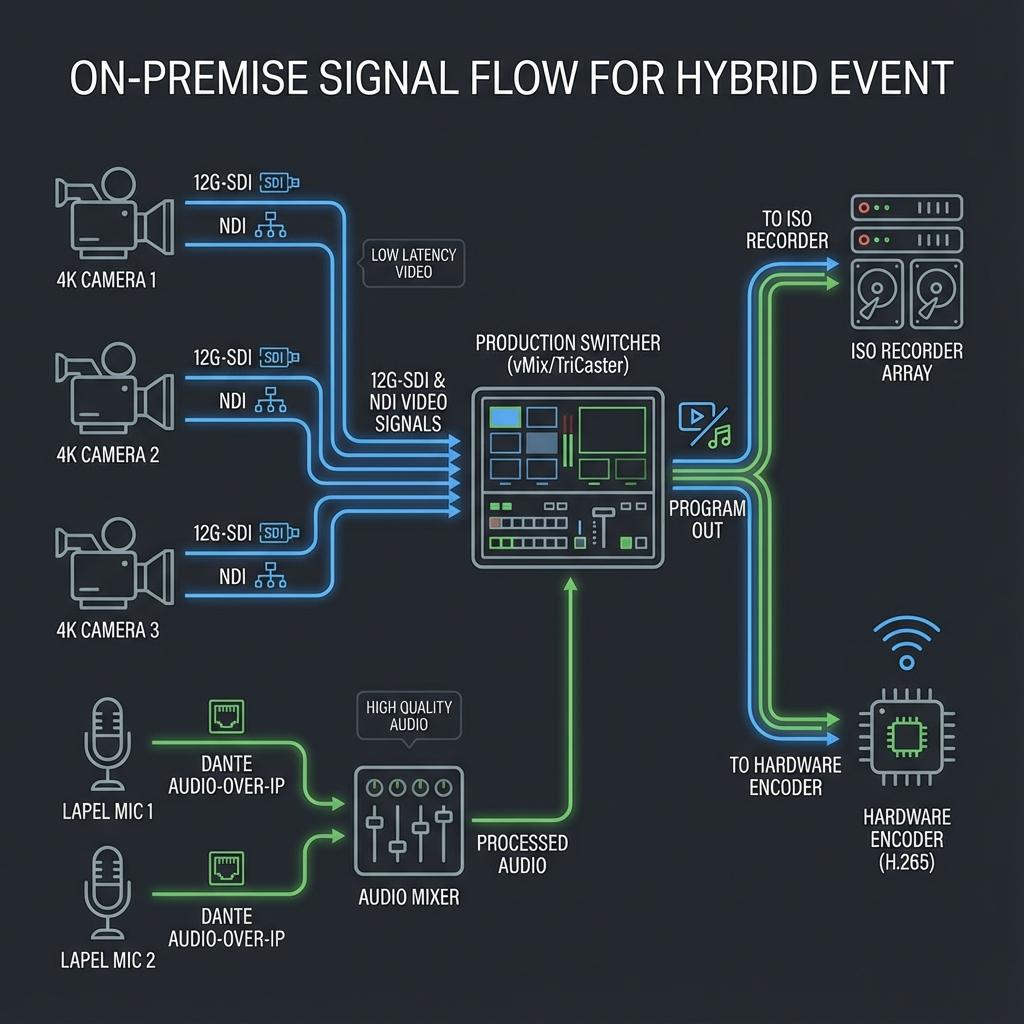
The signal chain begins with acquisition. For enterprise events, this means utilizing professional broadcast cameras, not webcams. 4K/UHD cameras, whether PTZ (Pan-Tilt-Zoom) models for dynamic coverage or studio configurations for primary speakers, offer the resolution required for crisp delivery and future-proofing content for on-demand use. The transport of these signals from camera to control is a critical decision point. For decades, Serial Digital Interface (SDI) has been the standard, with 12G-SDI offering the bandwidth for uncompressed 4K video over a single coaxial cable. It is a proven, reliable, and point-to-point solution. However, IP-based workflows using Network Device Interface (NDI) are rapidly gaining dominance. NDI allows for the transport of high-quality, low-latency video, audio, and metadata over standard Gigabit Ethernet networks. This dramatically simplifies cabling and increases routing flexibility. Full-bandwidth NDI offers quality comparable to SDI, while NDI|HX variants use more compression to operate over lower-bandwidth networks, including Wi-Fi, offering flexibility for more challenging environments. Audio acquisition follows a similar path. Professional microphones feed into a dedicated audio console, where a skilled engineer creates a mix for the in-room PA system and a separate, clean mix for the broadcast feed. Audio-over-IP protocols like Dante are essential here, allowing audio signals to be seamlessly integrated into the network and embedded within NDI or SDI video streams for perfect synchronization.
Video Switching, Processing, and ISO Recording
Once ingested, video and audio signals converge at the production switcher, the heart of the live production. Hardware switchers, such as those from Ross Video or Blackmagic Design, provide dedicated tactile control surfaces for mission-critical reliability. Software-based solutions like vMix or TriCaster offer immense flexibility and are powerful tools for integrating graphics and remote callers. The core function is to switch between camera angles, presentation sources, and pre-recorded video content to create a dynamic program feed. This feed is enhanced with graphics overlays, such as lower thirds and corporate branding, managed by systems like Singular.live for cloud-based graphics or dedicated local hardware. A crucial best practice for enterprise events is Isolated (ISO) Recording. This involves recording each individual camera feed and audio source separately, in addition to the main program output. This provides maximum flexibility for post-production, allowing for re-editing, fixing errors, or creating derivative content without being locked into the live switching decisions.
The Digital Bridge: Encoding and Contribution Protocols
The program feed created in the venue is a high-bitrate, mezzanine-quality signal. It is not suitable for direct delivery to a global audience. The next critical stage is encoding this feed and contributing it reliably to the cloud or a distribution hub. This process, known as contribution, is where many events falter without the right technology.
The Critical Shift from RTMP to SRT
For years, Real-Time Messaging Protocol (RTMP) was the de facto standard for sending video to platforms. However, RTMP is a TCP-based protocol that is susceptible to packet loss and can introduce significant latency. While its secure variant, RTMPS, adds a layer of encryption, the underlying transport mechanism remains dated. The modern broadcast standard for contribution is Secure Reliable Transport (SRT). SRT is an open-source protocol that operates over UDP, providing low-latency video transport while intelligently handling packet loss through an advanced ARQ (Automatic Repeat reQuest) mechanism. It also includes AES-128/256 bit encryption, making it secure by design. In a professional hybrid event workflow, a hardware or software encoder in the venue sends a high-quality SRT stream over a standard internet connection to a cloud-based media server or directly to the chosen event platform. This ensures the highest possible quality and reliability for the source signal before it is prepared for mass distribution.
Encoding Parameters and Codec Selection
The encoder’s role is to compress the video signal for efficient transport. The two primary codecs in use are H.264 (Advanced Video Coding, or AVC) and H.265 (High Efficiency Video Coding, or HEVC). H.265 is approximately 50% more efficient than H.264, meaning it can deliver the same quality at half the bitrate, which is a significant advantage for 4K/UHD streaming. For the contribution feed, a Constant Bitrate (CBR) is typically employed to ensure a stable and predictable data flow, which is crucial for network planning and stability. For example, a 4K contribution feed might be sent via SRT using H.265 at a CBR of 20-30 Mbps. This mezzanine file is then transcoded in the cloud to create an Adaptive Bitrate (ABR) ladder. ABR streaming is the process of creating multiple versions of the stream at different resolutions and bitrates (e.g., 1080p at 5 Mbps, 720p at 2.5 Mbps, 480p at 1 Mbps). The viewer’s video player then automatically selects the best possible rendition based on their current network conditions, ensuring a smooth playback experience without buffering.
Cloud and Network Architecture: Ensuring Scalability and Delivery
With a pristine signal contributed to the cloud, the focus shifts to a scalable and resilient architecture for processing and delivering the stream to a global audience. This is where enterprise-grade cloud services and specialized network strategies become indispensable.
Cloud-Native Transcoding and Distribution
Leveraging cloud platforms like AWS Elemental MediaLive, Microsoft Azure Media Services, or Google Cloud Transcoder API provides the power and scalability needed for enterprise events. These services ingest the high-quality SRT contribution feed and perform the transcoding to create the ABR ladder in real-time. The primary advantage of the cloud is elasticity. Whether there are one hundred remote viewers or one hundred thousand, the cloud infrastructure can scale instantly to meet demand. Furthermore, deploying these transcoding workflows across multiple availability zones (AZs) creates a robust, redundant system that can withstand a regional service outage without disrupting the event.
Enterprise CDN and eCDN Strategy
Once transcoded, the various stream renditions are passed to a Content Delivery Network (CDN). A CDN, such as Amazon CloudFront or Akamai, is a globally distributed network of servers that caches the video content closer to the end-users. When a viewer in London requests the stream, it is delivered from a server in Europe, not from the origin server in North America, dramatically reducing latency and improving playback performance. For internal audiences, an Enterprise CDN (eCDN) is often required. If thousands of employees within a single corporate network attempt to watch a high-bitrate stream simultaneously, it can overwhelm the corporate internet connection. An eCDN solution from providers like Kollective or Ramp mitigates this by deploying intelligent caching nodes or peer-to-peer technology within the corporate network, ensuring that a single external stream can be efficiently distributed to many internal viewers without crippling network performance.
Integrating the Interactive Experience: The Hybrid Engagement Layer
A next-generation hybrid event is not a passive viewing experience. It requires a technical framework that seamlessly integrates remote participants into the event, fostering genuine interaction between the two audiences. This involves managing complex bidirectional media flows.
Bidirectional Feeds and Remote Presenter Management
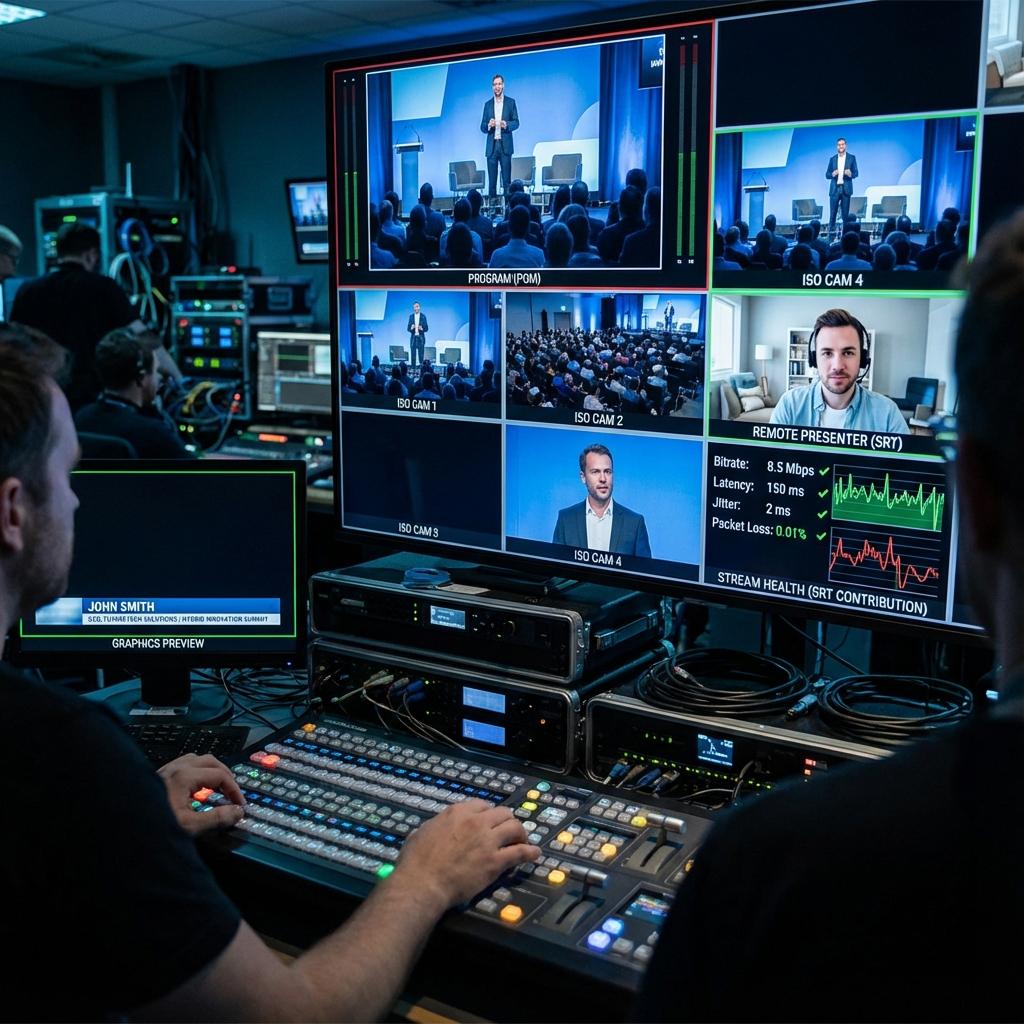
Bringing remote presenters into the main program requires a reliable, low-latency return path. While platforms like Zoom or Microsoft Teams can be used, a more professional workflow involves using SRT or WebRTC to bring the remote presenter’s feed directly into the production switcher. This allows for full broadcast control over their video and audio. Equally important is providing the remote presenter with a low-latency return feed of the program output so they can see what the audience sees. An Interruptible Foldback (IFB) system is also critical, providing a dedicated audio channel for the director to communicate privately with presenters, both on-site and remote, without being heard by the audience.
Platform Integration and Data Synchronization
The final layer is the event platform itself. This is the web portal where remote attendees watch the stream and interact. The broadcast-quality video feed is embedded into this platform, but it must work in concert with engagement tools. Services like Slido or MeetingPulse, which provide Q&A, live polling, and chat, must be synchronized for both audiences. Questions from the virtual audience can be displayed on screens in the physical venue, and polls can be voted on by everyone simultaneously. This requires careful API integration and a technical team capable of managing the flow of data between the production environment, the streaming platform, and these third-party engagement tools, creating a single, unified event experience for all participants. By architecting these systems in concert, an organization can transcend simple streaming and deliver a truly interactive and valuable hybrid event.

Jeremy Lee is a seasoned digital marketing director and strategist with over two decades of experience in the industry. As the founder of Sotavento Medios, I manage a diverse portfolio of over 50 businesses, helping brands grow through advanced search strategies and digital innovation. My work focuses on bridging the gap between traditional search engine optimisation and the evolving world of AI-driven answer engines.
get in touch