
The Unified Production Workflow: Engineering Flawless Enterprise Hybrid Events
In the enterprise sector, the standard for event production is no longer just a flawless in-person experience or a stable remote stream. It is the seamless integration of both. The challenge for corporate event planners, IT directors, and production managers lies in creating a single, cohesive experience for two distinct audiences simultaneously. This requires a departure from disjointed, ad-hoc solutions and an embrace of a Unified Production Workflow. This technical framework treats the physical and virtual venues as two endpoints of the same broadcast, ensuring signal integrity, low latency, and consistent branding from acquisition to delivery. It involves a sophisticated orchestration of signal flow, protocol conversion, and distribution architecture that guarantees every attendee, regardless of location, receives a high-quality, engaging, and perfectly synchronized event experience.
Foundational Infrastructure: Signal Acquisition and Ingest
The foundation of any successful hybrid event is the uncompromised quality of its source signals. The Unified Production Workflow begins with a robust strategy for acquiring video and audio from both on-premise and remote locations, ingesting them into a central production hub with meticulous attention to format, timing, and reliability. This stage is about more than just pointing cameras; it’s about building a resilient signal acquisition network.
On-Premise Signal Acquisition: From Baseband to IP
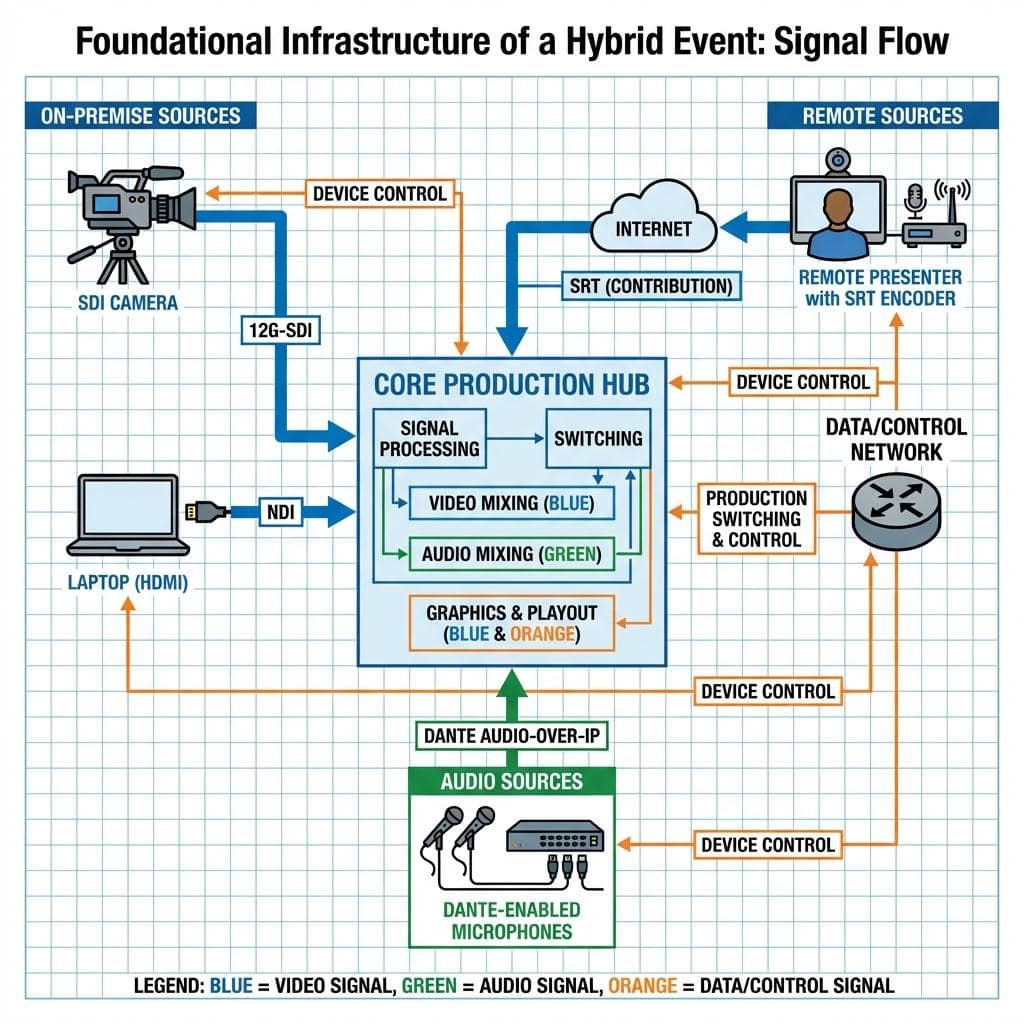
For the physical event space, professional broadcast standards remain paramount. Primary cameras, whether they are studio configurations or robotic pan-tilt-zoom (PTZ) units, should leverage Serial Digital Interface (SDI) connections, specifically 12G-SDI for 4K UHD (Ultra High Definition) at 59.94 frames per second. This ensures a pristine, uncompressed signal path from the camera sensor to the video switcher. However, the industry’s migration towards IP-based workflows introduces powerful flexibility. Implementing a Network Device Interface (NDI) infrastructure allows for high-quality, low-latency video to be transported over a standard 10GbE local area network. This simplifies cabling for breakout rooms, secondary cameras, and presentation sources, allowing them to be ingested as IP sources directly by the production switcher. Proper network configuration, including IGMP snooping and Quality of Service (QoS) prioritization, is critical to prevent packet loss and maintain signal stability in an NDI environment.
Remote Contribution Ingest: SRT as the Enterprise Standard
Integrating remote presenters is where many hybrid productions falter. While platforms like Zoom or Microsoft Teams are user-friendly, they are not production-grade transport streams. The professional solution is to establish a direct, secure contribution link using the Secure Reliable Transport (SRT) protocol. SRT provides low-latency, high-quality video transport over unpredictable public internet connections, offering error correction and AES-256 encryption. A typical workflow involves providing the remote presenter with a small hardware or software encoder that sends an SRT feed to a dedicated decoder or SRT gateway at the production venue. This bypasses the variable quality of consumer conferencing platforms, delivering a reliable, broadcast-quality signal that can be treated as just another source in the video switcher. For panel discussions requiring real-time interaction, platforms like vMix Call or WebRTC-based solutions can be integrated, but SRT remains the superior choice for keynote presentations where quality and stability are non-negotiable.
Cohesive Audio Architecture: Dante and Mix-Minus
Audio is arguably more critical than video. A unified audio workflow utilizes protocols like Dante to transport hundreds of channels of uncompressed, multi-channel audio over a standard IP network. This allows microphones, mixers, and intercom systems to be interconnected with incredible flexibility. For hybrid events, the most critical audio configuration is the mix-minus. Each remote contributor must receive a unique audio feed (a “minus” mix) that contains the full program audio minus their own microphone. This prevents the distracting echo and feedback that occurs when a remote presenter hears their own voice returning on a delay. This requires a digital audio console capable of generating multiple auxiliary sends, which are then routed back to the remote contributors, often embedded within their SRT return feed.
The Core Production Hub: Switching, Encoding, and Control
With all video and audio sources successfully ingested, the core production hub becomes the nexus of the event. This is where the narrative is shaped, graphics are integrated, and the final program feed is assembled and prepared for distribution. In a unified workflow, this hub is designed for maximum control, flexibility, and redundancy, capable of managing the complex signal routing required for a hybrid event.
Hybrid Video Switching and Signal Routing
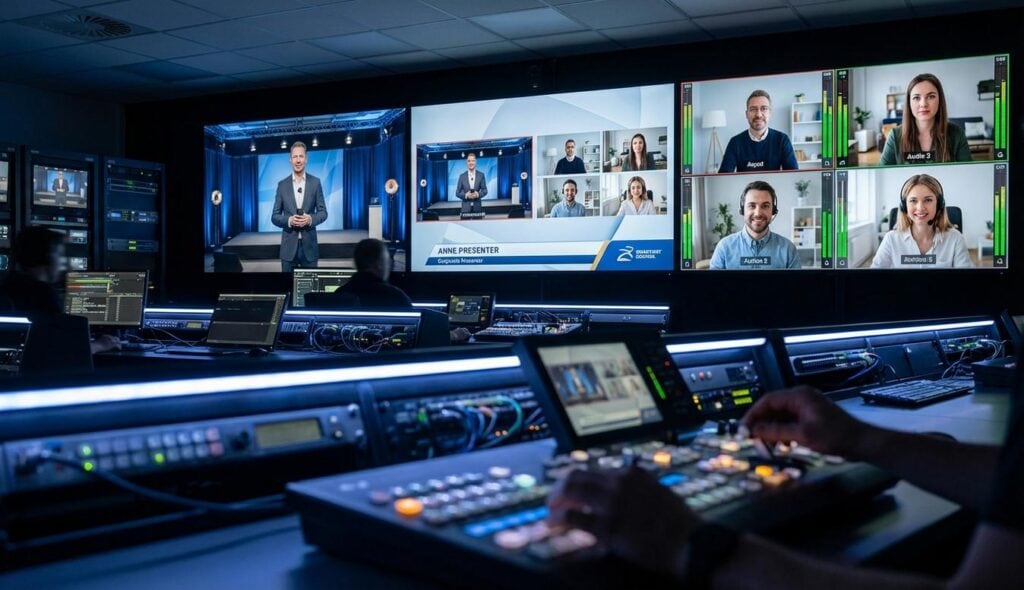
The heart of the production hub is the video switcher. An enterprise-grade switcher, such as a Ross Carbonite Ultra or Blackmagic Design ATEM Constellation, is essential for its ability to handle a diverse array of inputs simultaneously: SDI for on-premise cameras, NDI for networked sources, and SRT via dedicated hardware decoders for remote contributors. The program director utilizes a multiview monitor to see all available sources, preview, and the final program output. The output of the switcher is then distributed via a routing matrix. This allows the main program feed to be sent to on-site IMAG (Image Magnification) screens, stage monitors, recording decks, and the encoding pipeline simultaneously. ISO (isolated) recording of each camera and remote feed is a best practice, providing maximum flexibility for post-event editing and VOD assets.

Encoding and Transcoding for Dual Audiences
The encoding stage is where the program feed is prepared for digital distribution. A crucial distinction must be made between the mezzanine file and the distribution streams. The primary program output should be recorded at a high bitrate, often using a mezzanine codec like Apple ProRes or Avid DNxHD, for archival purposes. For the live virtual audience, this high-quality feed is sent to a dedicated encoder. This encoder, which can be a hardware appliance like an Elemental Live or a cloud-based service, performs transcoding. It converts the single high-bitrate stream into multiple adaptive bitrate (ABR) streams. ABR streaming creates several versions of the feed at different resolutions and bitrates (e.g., 1080p at 6 Mbps, 720p at 3 Mbps, 480p at 1.5 Mbps). The video player on the attendee’s device then intelligently selects the best possible stream based on their available bandwidth, ensuring a smooth playback experience without buffering.
Unified Control and Communication Systems
An often-overlooked aspect of a unified workflow is the integration of control and communication systems. The technical director, graphics operator, and audio engineer need to be in constant, clear communication. A digital matrix intercom system (e.g., Riedel or Clear-Com) is standard for on-premise crew. This system must be extended to key remote personnel. Using Dante or SRT, dedicated audio channels can be established for talkback and IFB (Interruptible Foldback) for remote presenters, allowing the director to cue them discreetly. Furthermore, control systems like Bitfocus Companion running on a Stream Deck can consolidate complex actions, such as rolling a video clip, changing a graphic, and switching a camera angle, into a single button press. This level of automation reduces the chance of operator error during a live production.
Distribution and Delivery: Reaching Every Attendee Flawlessly
The final stage of the workflow is delivering the encoded video streams to the global audience with security, scalability, and minimal latency. The distribution strategy must account for the unique network environments of both internal employees connecting from corporate offices and external attendees connecting from public networks.
Enterprise Content Delivery Networks (eCDNs)
When a large portion of the virtual audience is located within the corporate WAN (Wide Area Network), streaming directly from an external source can overwhelm the company’s internet connection. An Enterprise Content Delivery Network (eCDN) solves this problem. Platforms from providers like Hive, Ramp, or Kollective integrate with the corporate network. The eCDN agent intelligently pulls a single video stream from the public CDN and then distributes it peer-to-peer within the local network. This prevents thousands of individual employees from pulling the same stream from the internet, thus preserving critical business bandwidth while delivering a high-quality, stable stream internally. For external viewers, a traditional public CDN (like Akamai, Cloudflare, or AWS CloudFront) is used to cache the streams at edge servers around the world, ensuring low-latency delivery to any device, anywhere.
Latency and Synchronization Management
Glass-to-glass latency, the total time from the camera lens to the viewer’s screen, is a critical metric. For interactive hybrid events, this should be kept as low as possible. While traditional RTMP (Real-Time Messaging Protocol) workflows often have latencies of 15-30 seconds, modern workflows using SRT for contribution and WebRTC (Web Real-Time Communication) or Low-Latency HLS for distribution can achieve latencies under 5 seconds. Managing synchronization is also key. On-premise, all SDI sources should be synchronized using a master genlock signal from a sync pulse generator (SPG). For remote sources, minor audio sync drift can be corrected using audio delay processors in the mixer or video switcher to ensure perfect lip-sync in the final program output.
Redundancy and Failover Strategy
For any mission-critical enterprise event, failure is not an option. A robust redundancy plan is the final pillar of the Unified Production Workflow. This starts with bonded networking, using devices that combine multiple internet connections (e.g., two fiber lines, LTE, and satellite) to create a single, highly reliable connection for stream contribution. The encoding and delivery infrastructure should have 1+1 redundancy. This means a primary and a backup encoder running in parallel. If the primary encoder fails, the stream can be seamlessly switched to the backup. Similarly, using a multi-CDN strategy ensures that if one CDN provider experiences an outage, traffic can be instantly rerouted to a secondary provider, ensuring the event remains online for all attendees. This comprehensive approach to failover provides the peace of mind required for high-stakes corporate broadcasts.

Jeremy Lee is a seasoned digital marketing director and strategist with over two decades of experience in the industry. As the founder of Sotavento Medios, I manage a diverse portfolio of over 50 businesses, helping brands grow through advanced search strategies and digital innovation. My work focuses on bridging the gap between traditional search engine optimisation and the evolving world of AI-driven answer engines.
get in touch