
Beyond the Webcam: A Technical Framework for Transitioning to Broadcast-Grade Town Halls
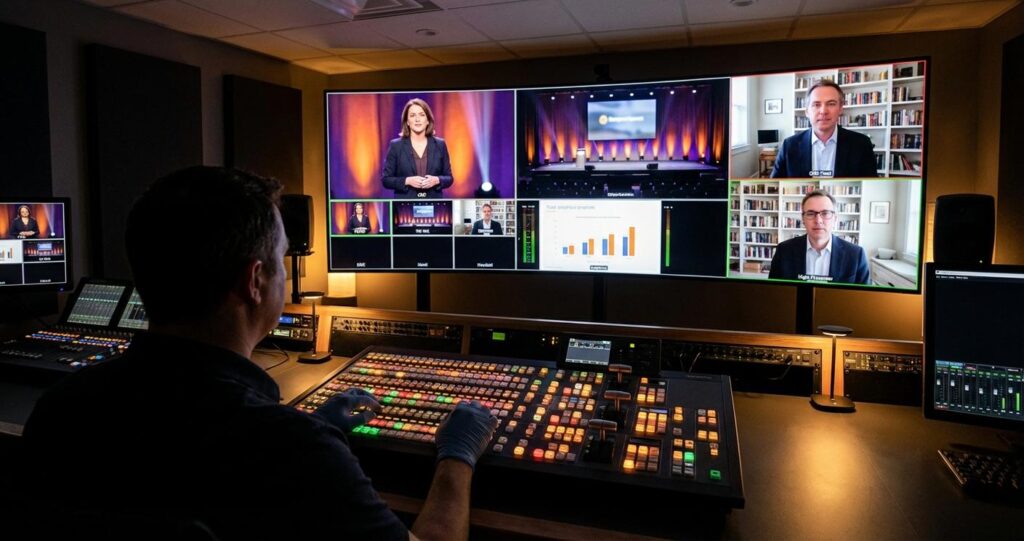
In the enterprise ecosystem, communication tools like Zoom, Microsoft Teams, and Webex have become ubiquitous for daily operations. They serve a functional purpose for meetings and basic webinars. However, for high-stakes, high-visibility events such as all-hands meetings, investor relations calls, and CEO town halls, the inherent limitations of these videoconferencing platforms present significant risks to brand reputation and message delivery. Relying on a platform designed for collaborative meetings to execute a one-to-many broadcast is a technical compromise that sacrifices quality, reliability, and control. This article provides a detailed technical framework for enterprise IT directors, AV professionals, and production managers on transitioning from the constraints of simple web-conferencing to a robust, broadcast-grade production workflow. We will examine the core infrastructure, signal flow, and protocols required to elevate corporate communication to a professional standard that mirrors broadcast television.
Foundational Architecture: Videoconferencing vs. Broadcast Production
The fundamental difference between a Zoom-based event and a broadcast production lies in the architecture. Videoconferencing platforms are built on a many-to-many, best-effort delivery model, prioritizing low-latency interaction over absolute signal integrity. Broadcast production is a one-to-many model, built on a foundation of absolute control over every element of the signal chain, from photon to pixel.
Signal Acquisition and Integrity
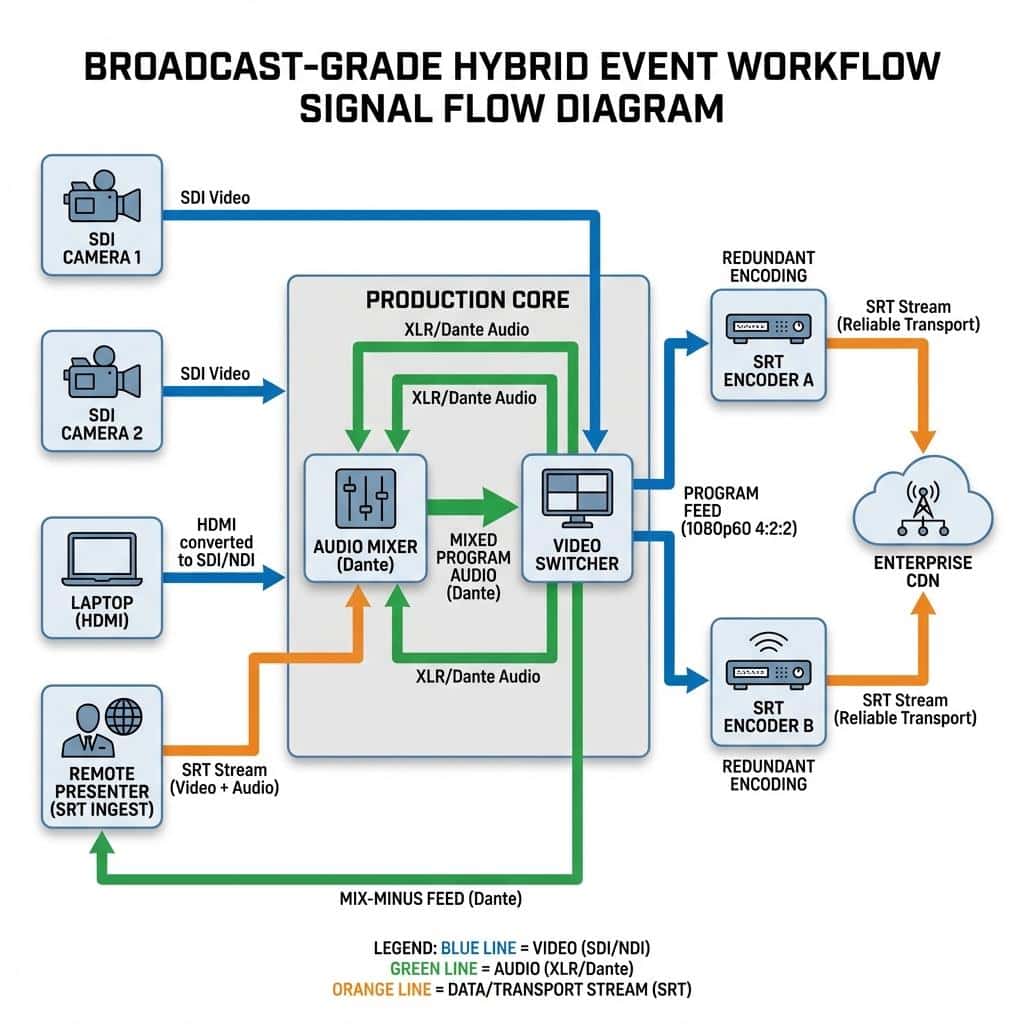
A professional production begins with high-quality signal acquisition. Standard town halls often rely on integrated webcams or USB-connected cameras, which deliver a heavily compressed video signal (often using MJPEG or YUY2) over a shared, non-deterministic bus. This results in variable frame rates, poor color depth, and susceptibility to system resource conflicts. A broadcast workflow utilizes dedicated video connections and professional cameras. The industry standard has long been SDI (Serial Digital Interface), a coaxial-based connection capable of carrying uncompressed, full-resolution video over long distances, typically 3G-SDI for 1080p60 or 12G-SDI for 4K/UHD. Increasingly, IP-based workflows using protocols like NDI (Network Device Interface) allow for high-quality, low-latency video transport over a standard Gigabit Ethernet network. These sources provide a pristine, full-raster signal (e.g., 1920×1080 at 59.94 frames per second) with superior color information (4:2:2 chroma subsampling) directly into the production system, forming the bedrock of a high-quality output.
Professional Audio Chains
Audio is arguably more critical than video for message retention. Videoconferencing platforms use aggressive audio compression and automatic gain control (AGC) that can crush dynamic range and introduce artifacts. A broadcast audio workflow is meticulously managed. It starts with professional microphones connected via balanced XLR cables, which eliminate noise over long cable runs. These signals are fed into a dedicated audio mixing console. Here, an audio engineer has per-channel control over equalization (EQ), compression, and gain staging. The output is a carefully crafted mix delivered at a professional line level (typically +4 dBu). For complex setups, audio-over-IP (AoIP) protocols like Dante allow for routing hundreds of audio channels over a network infrastructure, providing immense flexibility and scalability far beyond the capabilities of any USB microphone or conferencing software audio engine.
Designing the Broadcast-Grade Production Workflow
With pristine source signals, the next step is to process and compose them into a final program. This is handled by a dedicated production hub, which replaces the limited layout options of a platform like Zoom with a suite of powerful broadcast tools.
The Core: Video Switchers and Production Control
The heart of any live production is the video switcher, also known as a vision mixer. This can be a hardware device (like a Blackmagic Design ATEM Constellation or Ross Video Carbonite) or a software solution (like vMix or NewTek TriCaster). A switcher allows a technical director to cut, dissolve, and wipe between multiple video sources in real-time. It operates on a Program/Preview bus architecture. The “Program” output is what the audience sees, while the “Preview” bus is used to cue up the next shot, ensuring seamless transitions. Switchers include powerful features like M/E (Mix/Effects) buses, which are essentially switchers-within-a-switcher, used to create complex compositions. They also feature DVEs (Digital Video Effects) for creating picture-in-picture boxes and hardware keyers (chroma, luma, and pattern) for layering graphics over video, such as lower-third titles identifying a speaker.
Graphics, Playout, and ISO Recording
Professional events demand sophisticated graphics and video playback that are integrated seamlessly into the program. This is managed by a Character Generator (CG) or graphics playout system. These systems render animated titles, full-screen graphics, and transition animations in real-time. This is a significant step up from the basic “screen share” functionality of a conferencing platform, which often results in poor frame rates and resolution for video content. Furthermore, a professional workflow includes ISO (isolated) recording. This means recording each individual camera feed separately, in addition to the final program output. This provides immense flexibility in post-production for creating highlight reels, fixing errors, or re-editing the content for on-demand viewing without being locked into the live-switched program.
Encoding and Transmission: RTMP vs. SRT
Once the final program is produced, it must be encoded and transmitted to the viewing platform. The most common protocol has been RTMP (Real-Time Messaging Protocol). However, RTMP is a TCP-based protocol, which can struggle with network congestion, leading to dropped frames and buffering. For high-reliability enterprise streaming, the industry has moved towards SRT (Secure Reliable Transport). SRT is a UDP-based protocol that incorporates an ARQ (Automatic Repeat Request) mechanism to intelligently retransmit lost packets, providing the reliability of TCP with the low latency of UDP. It is resilient to packet loss and jitter, making it vastly superior for streaming over unpredictable public internet connections. Encoding is performed by a dedicated hardware or software encoder, converting the baseband SDI or NDI program feed into a compressed H.264 or H.265 (HEVC) stream at a specific bitrate (e.g., 8 Mbps for a high-quality 1080p60 feed).
Bridging the Hybrid Gap: Professional Integration of Remote Presenters
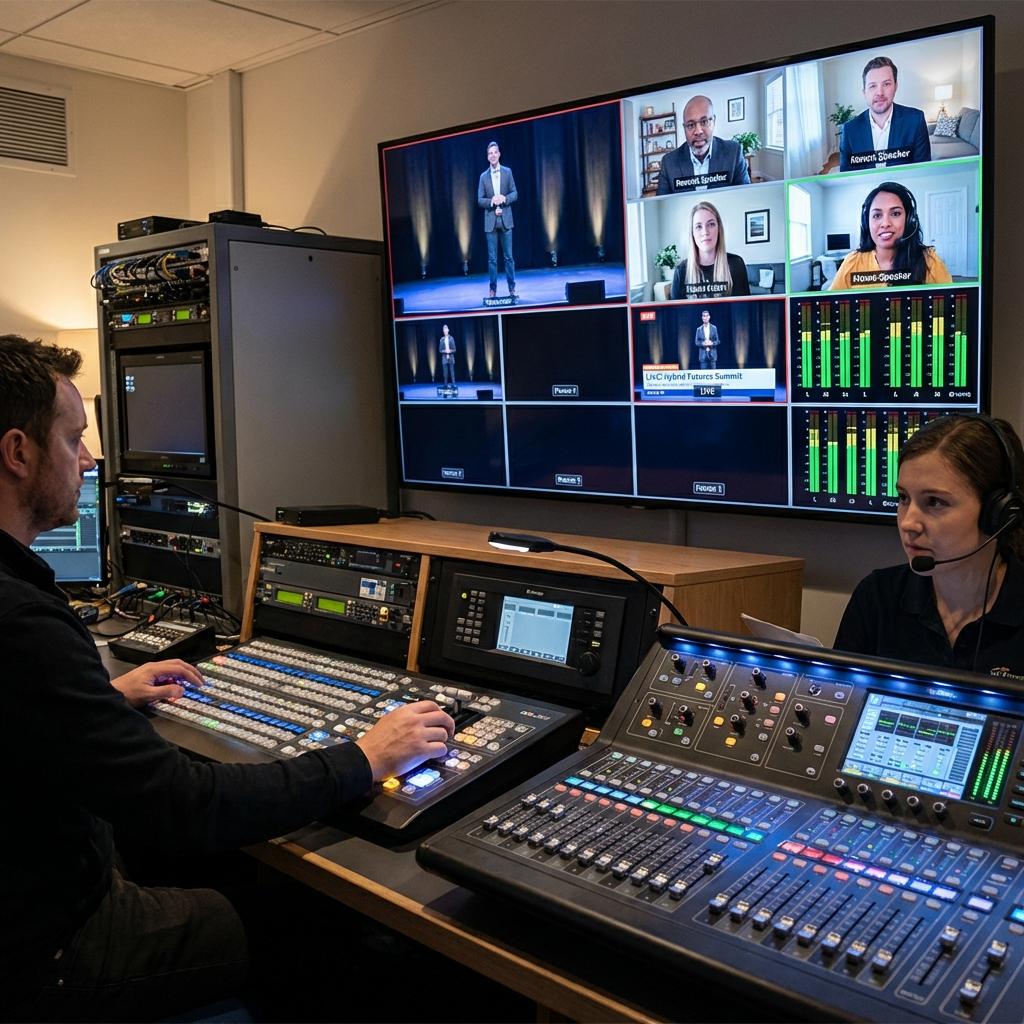
A common requirement for modern town halls is the inclusion of remote presenters. While it may be tempting to simply have them join a Zoom call and screen-capture it, this reintroduces all the quality and reliability issues we aim to solve. A broadcast workflow integrates remote presenters as high-quality sources.
High-Quality Remote Contribution
Several professional methods exist for bringing in remote contributors. Platforms like vMix Call or LiveU allow a remote presenter to send a high-bitrate stream from their location using a simple web browser or dedicated app. For the highest quality, a small hardware encoder can be shipped to the presenter, allowing them to send a full SRT stream directly into the production switcher. It is also possible to leverage platforms like Zoom or Teams by using their “ISO” or individual output features (where available), which provide cleaner, isolated feeds of each participant that can be brought into the switcher as distinct sources, rather than capturing a single compressed gallery view.
Mix-Minus: The Key to Clean Remote Audio
The single most critical audio concept for any production with remote participants is the mix-minus. A remote presenter needs to hear all the other audio from the event (other speakers, video playback) but must NOT hear their own voice coming back to them, as this creates a distracting echo and can cause feedback. A mix-minus is a custom audio mix created on the audio console. It contains the main program audio *minus* the audio of the specific remote presenter it is being sent to. Each remote participant receives their own unique mix-minus feed. This complex audio routing is impossible to achieve correctly within a standard conferencing application but is a routine function of a professional broadcast audio setup, ensuring clean, echo-free communication.
Enterprise Infrastructure: Scalability, Redundancy, and Security
The final piece of the puzzle is the delivery infrastructure, which must be robust enough to handle a large corporate audience securely and reliably.
Content Delivery Networks (CDNs) for Scalability
An encoder cannot serve thousands of viewers directly. The SRT or RTMP stream from the production site is sent to a single ingest point on an enterprise-grade Content Delivery Network (CDN) like Akamai, AWS CloudFront, or Vimeo Enterprise. The CDN then replicates the stream across hundreds or thousands of servers globally. When a viewer presses play, they are automatically connected to the geographically closest server, ensuring a stable, low-latency viewing experience. Enterprise CDNs also provide critical security features like token-based authentication to ensure only authorized employees can view the stream, and DVR functionality for live rewind.
Implementing A/B Redundancy and Failover
For a mission-critical town hall, there is no room for failure. A fully redundant workflow is the professional standard. This involves a complete “A” and “B” signal chain. Two separate encoders (1+1 redundancy) are fed the same program output and stream to separate primary and backup ingest points on the CDN. If the primary encoder or its internet connection fails, the CDN can be manually or automatically switched to the backup stream with minimal interruption. This strategy extends to internet connectivity, where bonded networking solutions combine multiple internet sources (e.g., fiber, cable, 5G) into a single, resilient connection for the encoders.
Network Planning and QoS
Professional streaming requires dedicated, uncontended bandwidth. A single 1080p60 SRT stream at 8 Mbps should be allocated at least 16-20 Mbps of sustained upstream bandwidth to account for protocol overhead and network fluctuations. On a corporate network, it is critical to implement Quality of Service (QoS) policies that prioritize the streaming traffic from the encoders, ensuring that other office network activity does not interfere with the stream’s stability. Firewall rules must also be configured to allow outbound traffic for the specific ports used by SRT (which are user-configurable) or RTMP (port 1935).
Conclusion: From Compromise to Control
Transitioning from a videoconferencing platform to a broadcast-grade workflow is a strategic investment in communication quality, control, and reliability. It moves the execution of a corporate town hall from a position of technical compromise to one of complete command over the message and brand. By implementing professional signal acquisition, a dedicated production hub, robust transmission protocols like SRT, and enterprise-level delivery infrastructure, organizations can ensure their most important internal and external communications are delivered with the clarity, professionalism, and impact they deserve. This is not merely an upgrade in video quality; it is a fundamental shift in production philosophy that aligns the technical execution with the strategic importance of the event.
Jeremy Lee is a seasoned digital marketing director and strategist with over two decades of experience in the industry. As the founder of Sotavento Medios, I manage a diverse portfolio of over 50 businesses, helping brands grow through advanced search strategies and digital innovation. My work focuses on bridging the gap between traditional search engine optimisation and the evolving world of AI-driven answer engines.
get in touch