
The Architectural Blueprint for Flawless Enterprise Streaming to 5,000+ Concurrents
Successfully delivering a high-quality, secure video stream of a corporate all-hands meeting or keynote presentation to over 5,000 concurrent viewers is not a simple task. Standard consumer platforms lack the requisite security and control, while enterprise collaboration tools like Teams or Zoom are not architected for high-production, one-to-many broadcast scenarios at this scale. Executing this level of event requires a broadcast engineering mindset applied to a corporate IT environment. The primary challenge is twofold: managing immense network load without crippling internal infrastructure and ensuring the content remains strictly confidential. This requires a meticulously planned architecture that integrates on-premise production hardware, resilient contribution protocols, cloud-based media services, and an intelligent content delivery strategy within the corporate network. At Spring Forest Studio, our technical teams design and implement these systems, ensuring that the CEO’s message reaches every employee with broadcast-grade quality and reliability.
Deconstructing the Primary Bottleneck: Enterprise Network Saturation
The most immediate and catastrophic failure point for any large-scale internal stream is the corporate network itself. A standard unicast video stream, where every single viewer pulls a unique stream from the source server, is unsustainable. A 4 Mbps stream delivered to 5,000 employees via unicast would generate 20,000 Mbps, or 20 Gbps, of traffic, overwhelming the main corporate internet egress point and potentially disrupting all other business-critical operations. The solution lies in intelligent delivery topologies designed for the enterprise Local Area Network (LAN) and Wide Area Network (WAN).
Unicast vs. Enterprise-Grade Delivery: eCDN and P2P
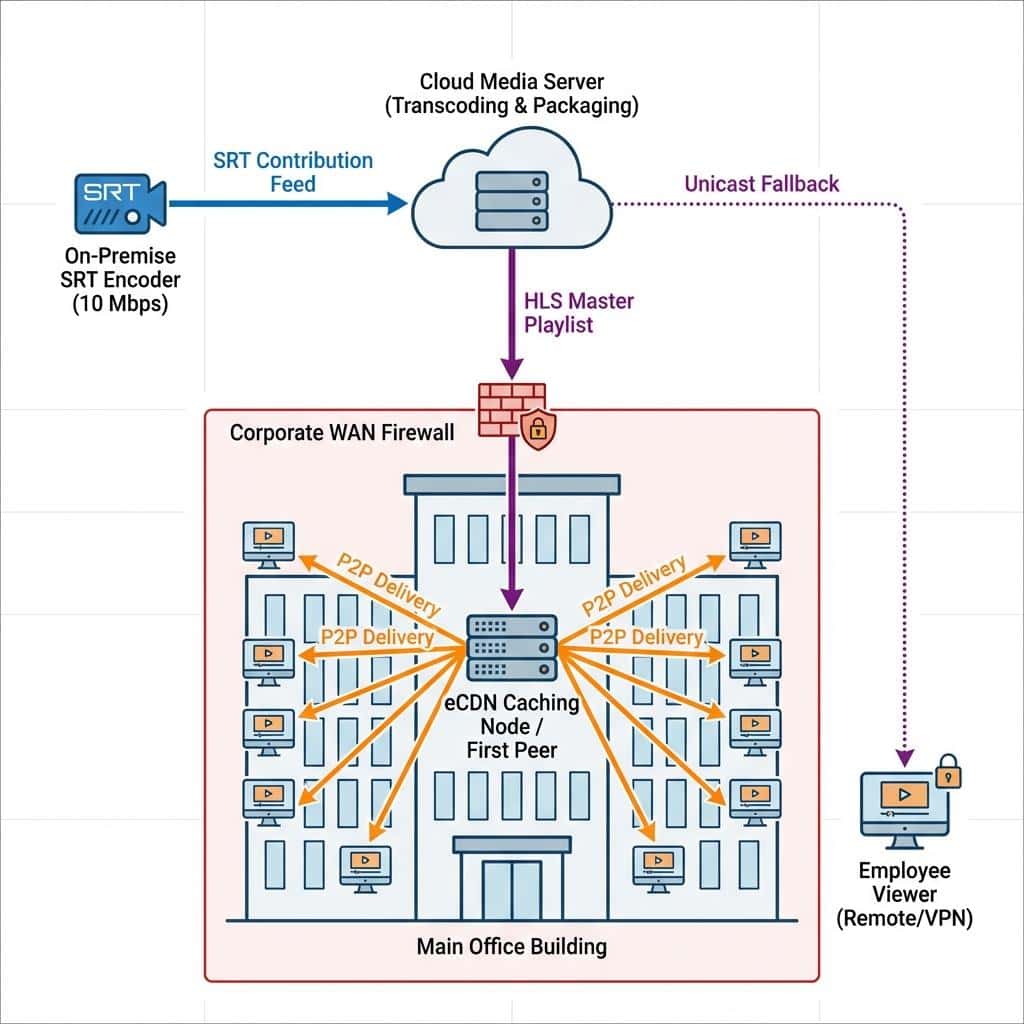
To prevent network collapse, we must move away from a unicast model. The leading solution is an Enterprise Content Delivery Network (eCDN). An eCDN is a specialized delivery platform that deploys either software agents on employee devices or physical caching nodes within the corporate network. Instead of 5,000 viewers pulling the stream from the public internet, a single master stream enters the network. The eCDN then efficiently distributes it internally. The two predominant eCDN architectures are peer-to-peer (P2P) and caching. In a P2P model, viewers who have already downloaded segments of the video share them with other nearby viewers on the same network segment. This creates a mesh network that dramatically reduces external bandwidth consumption. Caching models use on-premise servers at major office locations to store the video segments locally, serving them to employees at LAN speed. The selection of a P2P or caching eCDN vendor depends entirely on the client’s IT infrastructure, security policies, and office distribution.
Navigating the Corporate Firewall: Security and Protocol Traversal
A robust eCDN is only effective if the video stream can reliably enter the corporate network and reach the endpoints. This involves close collaboration with the client’s IT security team. Video delivery must typically be configured to use standard web ports like 443 (HTTPS) to traverse firewalls and proxies without requiring complex rule changes. Modern eCDN solutions are designed for this, encapsulating video data within standard TLS encrypted sessions. This ensures compatibility with existing security infrastructure while maintaining the integrity and confidentiality of the stream. Secure delivery also requires a clear understanding of the network topology, including any split-tunneling VPN configurations for remote workers, to ensure the eCDN logic correctly identifies which viewers can participate in P2P sharing and which must be served from the cloud.
The Contribution Workflow: A Resilient Path from Production to Cloud
Before the stream can be distributed, a pristine, high-quality audio and video signal must be captured and transported from the event venue to the cloud media processing services. This contribution link is a mission-critical component where redundancy and signal integrity are paramount. A failure at this stage means a complete loss of picture for all 5,000 viewers, regardless of how robust the downstream delivery infrastructure is.
Signal Chain and Encoding Best Practices
The production signal typically originates from professional cameras outputting Serial Digital Interface (SDI) signals, often in 1080p59.94 or 2160p29.97 format. These feeds are routed into a production switcher for live mixing. The final program feed is then sent to a dedicated contribution encoder. For enterprise-grade reliability, we exclusively use the Secure Reliable Transport (SRT) protocol for contribution. Unlike the older Real-Time Messaging Protocol (RTMP), SRT provides superior packet loss recovery, jitter smoothing, and AES-256 bit encryption, making it ideal for transport over unpredictable public internet connections. The encoder is configured to create an adaptive bitrate (ABR) ladder, but for the contribution feed, we send a single, high-bitrate mezzanine stream, typically a 10-15 Mbps H.264 or a more efficient 6-8 Mbps H.265 (HEVC) stream, to the cloud for transcoding.
Building Redundancy at the Source
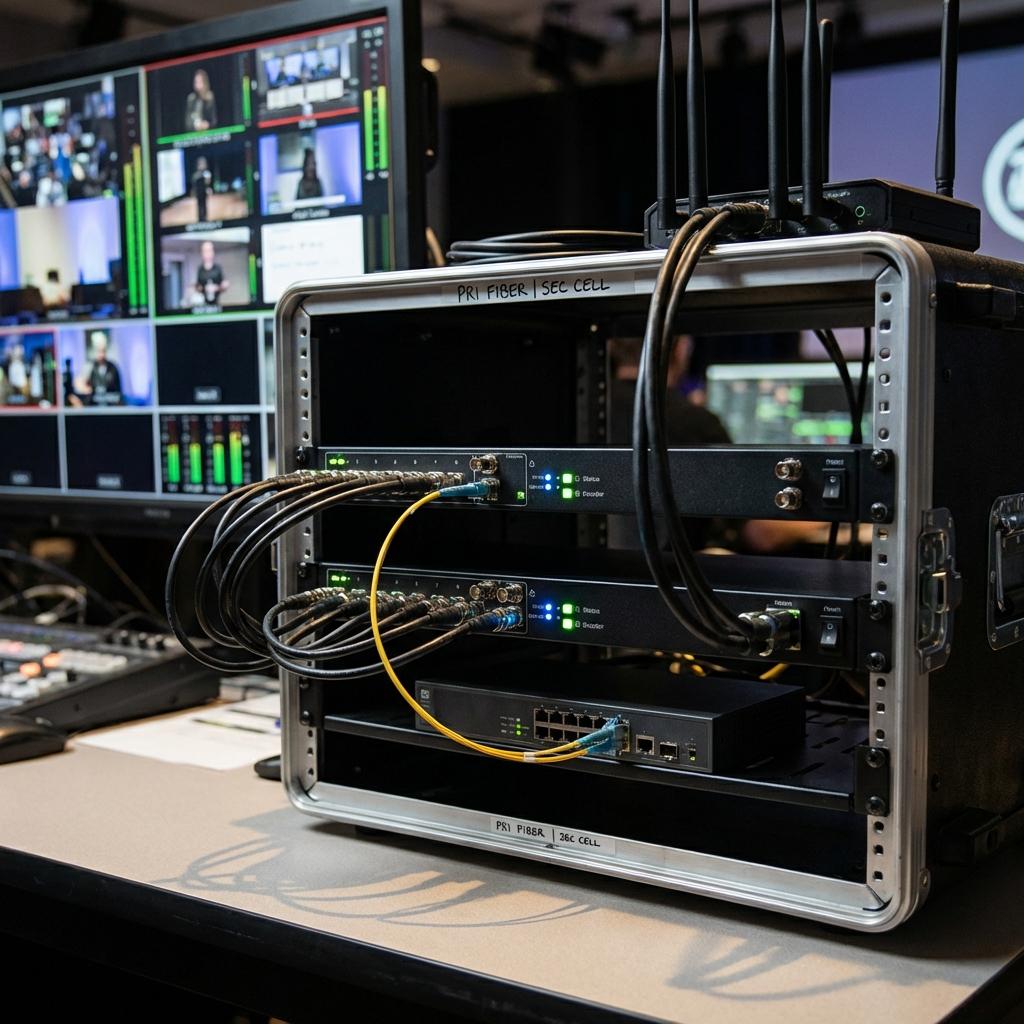
For an event of this magnitude, a single point of failure is unacceptable. We implement redundancy at every critical step of the contribution path. This starts with using two separate hardware encoders, fed from the same program output of the switcher. Each encoder is connected to a physically separate network path. The primary path might be the venue’s dedicated fiber internet, while the secondary path is a bonded cellular solution combining multiple 4G/5G carriers or a secondary satellite link. These two independent SRT streams are sent to separate ingest points on the cloud media server. This A/B path redundancy ensures that a complete failure of one encoder or one entire network circuit will not interrupt the program feed, allowing for seamless failover in the cloud.
Cloud Architecture: Transcoding, Security, and Global Scaling
Once the secure contribution feed arrives in the cloud, it enters a sophisticated media services workflow responsible for processing, securing, and preparing it for mass distribution. This is where the single high-quality mezzanine stream is transformed into multiple renditions suitable for a diverse audience on varied devices and network conditions.
Just-in-Time Transcoding and ABR Packaging
The cloud media server, often a service like AWS Elemental MediaLive or a dedicated streaming platform, immediately begins a process of just-in-time transcoding. The incoming 10 Mbps SRT feed is converted into a multi-bitrate H.264 stack. A typical ABR ladder would include profiles such as 1080p at 5 Mbps, 720p at 3 Mbps, 540p at 1.5 Mbps, and 360p at 800 kbps. These separate renditions are then packaged into a modern adaptive bitrate streaming format, most commonly HTTP Live Streaming (HLS). The HLS manifest file, which acts as a playlist of the available bitrates, is what the viewer’s video player uses to dynamically switch between quality levels based on real-time network performance, minimizing buffering and optimizing the viewing experience.
Implementing Enterprise-Grade Access Control and Security
Security is non-negotiable for internal corporate communications. The stream must be protected from unauthorized access at the distribution layer. This is achieved through multiple layers. First, the HLS media segments are encrypted using AES-128. Second, access to the decryption key is controlled via a tokenization system. To grant access, the video player must be embedded on a corporate intranet page that is behind the company’s Single Sign-On (SSO) system, like Azure Active Directory or Okta. When an authenticated employee loads the page, a unique, short-lived token is generated and passed to the player. The player then presents this token to the key server to receive the decryption key. This SSO integration ensures that only verified employees can view the stream, and features like domain restriction and IP whitelisting provide further layers of protection.
The Final Mile: Monitoring Viewer Experience and Ensuring Quality
The final stage of the architecture focuses on the viewer’s device and the crucial process of monitoring the entire ecosystem in real time. Proactive monitoring allows the production team to identify and resolve issues before they impact a significant portion of the audience.
Player Integration and Real-Time Analytics
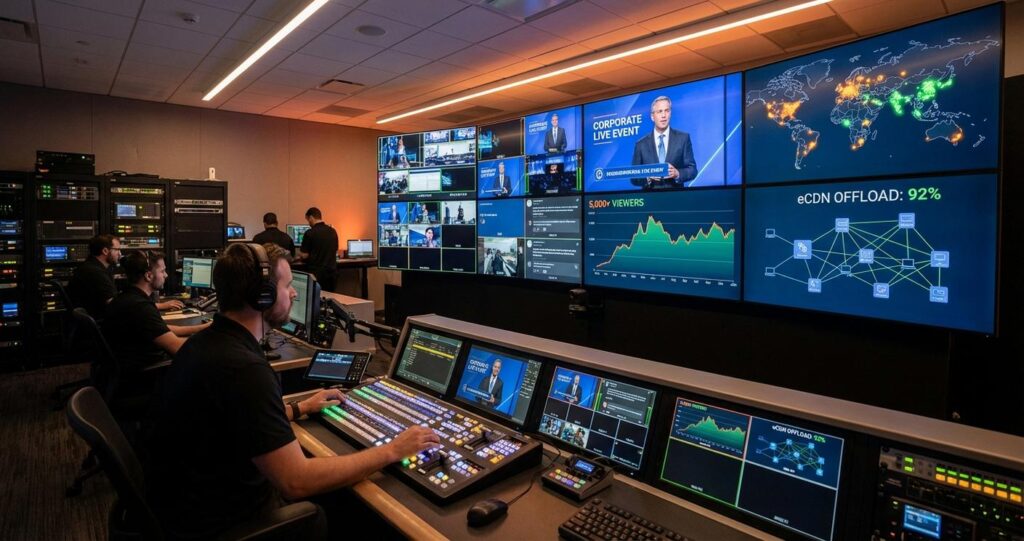
The video player itself is a critical component. A professional-grade HTML5 player is configured to work with the chosen eCDN provider and the SSO security framework. As viewers begin to watch, a real-time analytics dashboard provides a comprehensive overview of the stream’s health. Key metrics we monitor include concurrent viewership, rebuffering ratio, playback failures, and, most importantly, the eCDN offload percentage. A high offload percentage (typically 90% or more) confirms that the internal delivery network is functioning correctly and preventing WAN saturation. We can drill down into this data geographically or by network segment to pinpoint any local performance issues.
White-Glove Support and Redundancy Testing
For a Tier 1 event with thousands of executives and employees, automated systems must be backed by expert human oversight. Our technical team actively monitors the entire signal chain, from the on-site production switcher to the cloud transcoding output and the eCDN analytics. We establish dedicated communication channels with the client’s IT and event teams to provide white-glove support and address any viewer-reported issues instantly. Prior to the event, we conduct rigorous load testing and failover drills, simulating a primary encoder failure or network outage to ensure the redundant systems perform exactly as designed. This combination of robust architecture, proactive monitoring, and expert management is the blueprint for delivering a flawless, secure streaming experience to a global internal audience of any scale.

Jeremy Lee is a seasoned digital marketing director and strategist with over two decades of experience in the industry. As the founder of Sotavento Medios, I manage a diverse portfolio of over 50 businesses, helping brands grow through advanced search strategies and digital innovation. My work focuses on bridging the gap between traditional search engine optimisation and the evolving world of AI-driven answer engines.
get in touch