
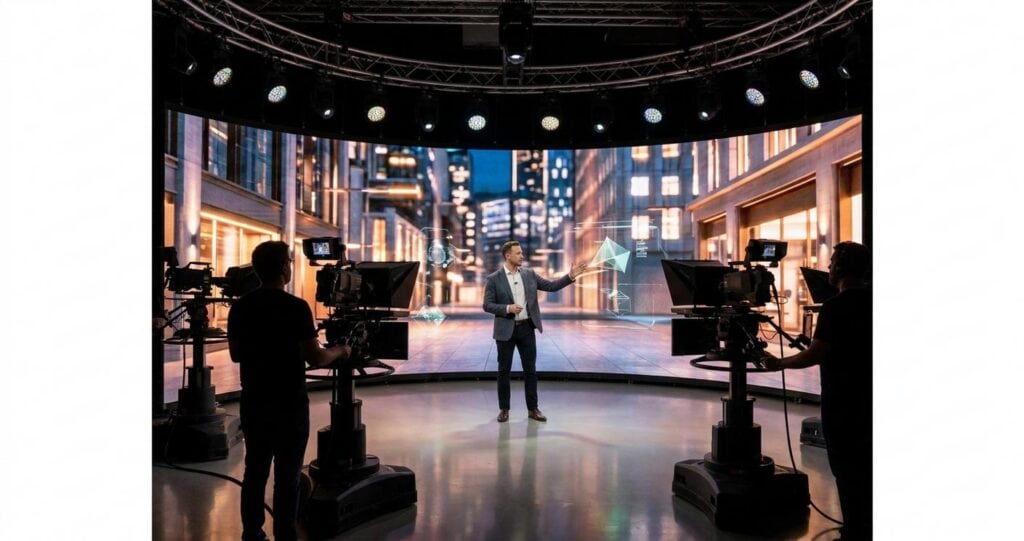
In the evolving landscape of B2B event production, the line between physical and virtual continues to blur. As corporate events, product launches, and global conferences increasingly adopt hybrid and fully virtual formats, the demand for immersive and visually captivating experiences escalates. At the core of creating truly compelling 3D virtual environments for live streamed events lies the sophisticated engineering of dynamic lighting. This is not merely an aesthetic consideration; it is a critical technical discipline that dictates realism, engagement, and ultimately, the perceived professionalism and brand value conveyed to a global, enterprise-level audience. Spring Forest Studio understands that for AV professionals, production managers, and IT directors, mastering the technical intricacies of dynamic lighting within these virtual spaces is paramount to delivering high-fidelity, enterprise-grade streaming solutions that overcome traditional production limitations and elevate the virtual event experience.
The Interplay of Real-Time Rendering and Virtual Production for Enterprise Events
The foundation of any impactful 3D virtual environment for B2B streaming is robust real-time rendering. Unlike pre-rendered animations, live event virtual production requires immediate computational power to generate scenes that respond dynamically to camera movements, presenter interactions, and, crucially, lighting changes. This real-time capability is essential for synchronous hybrid events where virtual elements must seamlessly integrate with live camera feeds and physical stage components, all while maintaining ultra-low latency for an engaging audience experience.
Real-Time Engine Architectures and Their Role in Virtual Sets
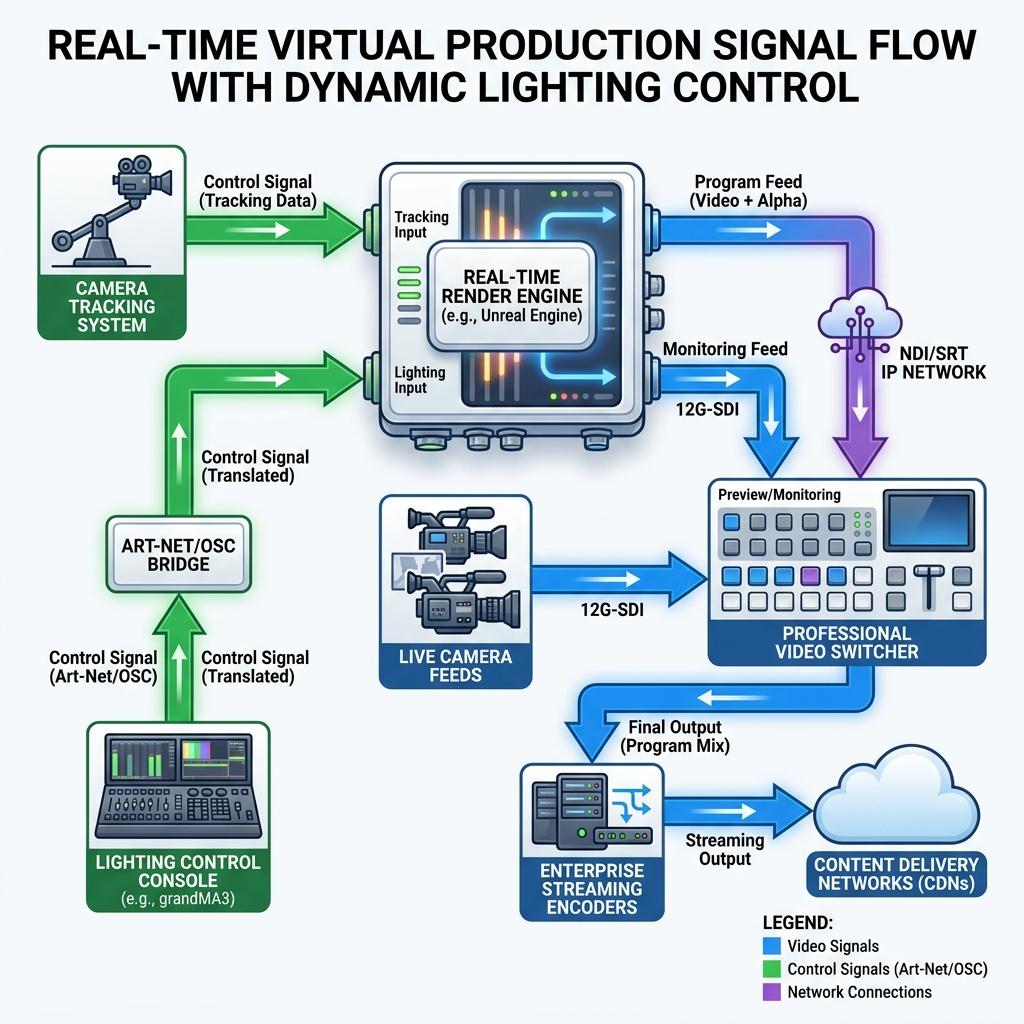
The backbone of modern virtual production workflows for enterprise events rests on advanced real-time rendering engines such as Unreal Engine and Unity. These platforms leverage highly optimized graphics processing unit (GPU) architectures, typically high-performance professional-grade GPUs like NVIDIA Quadro or AMD Radeon Pro series, to execute complex calculations for lighting, reflections, refractions, and material shaders at frame rates suitable for broadcast (29.97p, 50p, 59.94p). A single render node might be equipped with multiple GPUs, often an NVIDIA A6000 or similar, to handle the immense computational load of rendering high-resolution (e.g., 4K/UHD) virtual environments with complex lighting models. These engines provide a development environment where virtual sets are constructed, assets are imported, and lighting scenarios are programmed. The output is a live video stream, often with an embedded alpha channel for keying, ready for integration into a broadcast switcher.
Integrating Physical and Virtual Spaces: Extended Reality (XR) Frameworks
Extended Reality (XR) encompasses Augmented Reality (AR), Virtual Reality (VR), and Mixed Reality (MR), and its application in B2B virtual production is transforming how presenters interact with content. For corporate events, AR overlays virtual graphics onto a physical stage, MR allows presenters to interact with virtual objects as if they were physically present, and VR creates fully immersive 3D environments. Key integration methodologies include precise chroma keying techniques, utilizing broadcast-grade keyers like Ultimatte or Carbonite Chroma Key, which require meticulous lighting of the physical green or blue screen. An increasingly prevalent method involves large LED volumes, where virtual environments are displayed on high-resolution LED walls, creating a seamless background and practical lighting source for the physical stage. This approach eliminates many of the complexities of chroma key lighting. Central to both methods are advanced camera tracking systems (e.g., Mo-Sys StarTracker, Stype Follower, or systems employing the FreeD protocol), which provide real-time positional and rotational data of the physical camera to the render engine. This data allows the virtual environment to be rendered from the exact perspective of the physical camera, ensuring perfect parallax and a believable integration of physical and virtual elements, crucial for maintaining visual integrity in the final program feed streamed to enterprise audiences.
The Engineering of Dynamic Lighting within Virtual Stages
Dynamic lighting in 3D virtual environments is far more than just illumination; it is a sophisticated system that simulates the physics of light to create depth, mood, and visual realism. For B2B streaming, this translates into professional-grade visuals that elevate a corporate message above standard webcam presentations.
Advanced Lighting Models and Their Implementation in Real-Time
The pursuit of photorealism in virtual production relies heavily on advanced lighting models. Physically Based Rendering (PBR) is the industry standard, ensuring that virtual materials react to light in a way that mimics real-world physics. PBR workflows accurately represent properties like metallicness, roughness, and albedo, allowing for consistent visual fidelity regardless of the lighting conditions within the virtual scene. Complementing PBR is Global Illumination (GI), which simulates how light bounces and reflects off surfaces, illuminating areas not directly hit by a light source. Real-time GI solutions, often leveraging ray tracing techniques (e.g., NVIDIA RTX-accelerated ray tracing in Unreal Engine), calculate complex light interactions instantly. While computationally intensive, these techniques produce incredibly realistic soft shadows, color bleeding, and ambient occlusion, which are vital for a believable and professional appearance, especially when delivering high-resolution video (e.g., 1080p60 or 4K30) via enterprise streaming platforms.
Dynamic Light Sources, Shadows, and Volumetric Effects
Virtual environments employ a variety of light sources, mirroring their physical counterparts: directional lights simulate sunlight, point lights emulate bulbs, spot lights focus illumination, and area lights provide soft, diffused light. Each virtual light can have configurable parameters such as intensity (lumens or lux equivalent), color temperature (Kelvin), color (RGB), and falloff characteristics. Real-time shadow generation, utilizing techniques like shadow maps or ray-traced shadows, adds critical depth and realism. Performance is a key consideration; highly detailed ray-traced shadows are resource-intensive, often requiring careful optimization. Volumetric lighting effects, such as fog, haze, or god rays, further enhance the visual depth and atmosphere. These effects simulate light scattering through particles in the air, adding another layer of realism and artistic control. While some lighting elements can be pre-computed or ‘baked’ into the scene for performance optimization, fully dynamic lighting, where every light source can be adjusted in real-time, offers unparalleled flexibility for live events, enabling instant adjustments to match changes in content or presenter mood.
Data Flow and Control: DMX, Art-Net, and OSC Integration
The synchronization of physical and virtual lighting is a complex but crucial aspect of hybrid event production. Traditional stage lighting is controlled via DMX512-A, a robust digital communication network protocol. For virtual environments, this control extends into the 3D space. Art-Net, an Ethernet-based protocol that transports DMX data over a network, allows for the control of thousands of DMX universes from a single console, making it ideal for large-scale virtual sets. Virtual lighting fixtures within the real-time engine can be mapped to Art-Net channels, enabling a physical lighting console (e.g., grandMA3, Hog 4) to control both physical stage lights and their virtual counterparts simultaneously. This allows a single lighting director to manage a cohesive lighting design across the entire production, ensuring consistent ambiance and energy. Open Sound Control (OSC) provides an alternative, more flexible protocol for sending and receiving commands to and from the render engine, allowing for real-time manipulation of lighting parameters, camera positions, and other scene elements from various control surfaces or software applications. The integration of these protocols ensures that dynamic lighting adjustments, whether pre-programmed cues or live improvisations, are executed with precision and synchronized across all aspects of the hybrid production.
Seamless Integration and Distribution of High-Fidelity Virtual Productions
The technological prowess invested in creating stunning 3D virtual environments with dynamic lighting culminates in their seamless integration into the live streaming workflow and reliable distribution to the target audience. This requires meticulous planning of signal flow, selection of enterprise-grade protocols, and robust network infrastructure.
Video Signal Flow from Render Engine to Encoder
The high-fidelity video output from the real-time render engine is a critical input into the overall production workflow. For professional B2B events, two primary pathways are utilized for transporting this video to the master switcher or encoder: IP-based video transport and traditional baseband SDI. IP-based protocols like NDI (Network Device Interface) and SRT (Secure Reliable Transport) offer flexible, low-latency transmission of high-resolution video (e.g., 4K at 60 frames per second) over standard Ethernet networks. NDI, particularly NDI|HX for lower bandwidth scenarios or full NDI for uncompressed quality, enables multiple video streams to be sent and received across a local area network, simplifying cabling and increasing flexibility. SRT provides secure, reliable, and low-latency transport over unpredictable public internet connections, ideal for remote render farms or cloud-based virtual production pipelines. For facilities requiring uncompressed, broadcast-grade signals, 12G-SDI infrastructure is employed to carry 4K/UHD signals from the render engine output cards to a professional video switcher. In scenarios involving chroma keying, the render engine often outputs a separate alpha channel feed, which is then composited with the live camera feed in a dedicated hardware keyer or a powerful production switcher to create the final integrated program feed.
Enterprise-Grade Encoding and Streaming Protocols for Virtual Environments
Once the composited program feed, incorporating the dynamically lit virtual environment, is ready, it must be encoded for distribution. H.264 (AVC – Advanced Video Coding) remains a widely supported and efficient codec for streaming, suitable for 1080p content. However, for 4K/UHD virtual environments, H.265 (HEVC – High Efficiency Video Coding) offers superior compression efficiency, delivering comparable visual quality at significantly lower bitrates, crucial for minimizing bandwidth consumption without sacrificing detail. Bitrate management strategies are paramount: Constant Bitrate (CBR) provides predictable bandwidth usage, Variable Bitrate (VBR) optimizes quality by allocating more bits to complex scenes, and Adaptive Bitrate (ABR) encoding creates multiple renditions at different resolutions and bitrates, allowing the client player to dynamically switch based on network conditions. For contribution and distribution, RTMP (Real-Time Messaging Protocol) and its secure variant RTMPS are still prevalent for delivery to Content Delivery Networks (CDNs) and social platforms. However, for mission-critical B2B applications requiring enhanced reliability and security over unmanaged networks, SRT is increasingly preferred for transport from the encoder to the CDN or directly to specific enterprise platforms. For high-end broadcast integration, SMPTE ST 2110 facilitates the transport of uncompressed video, audio, and ancillary data over IP networks within a facility, ensuring maximum fidelity for the most demanding virtual production environments.
Network Infrastructure and Latency Optimization for Synchronized Hybrid Events
A robust and meticulously engineered network infrastructure is non-negotiable for professional virtual production and streaming. Dedicated gigabit or 10-gigabit Ethernet networks are essential to handle the high-bandwidth requirements of uncompressed or lightly compressed video streams from render engines and cameras. Network segmentation, utilizing VLANs, helps isolate virtual production traffic from general corporate network traffic, preventing congestion and ensuring predictable performance. Quality of Service (QoS) configurations, such as DiffServ Code Point (DSCP) tagging, are implemented to prioritize real-time video, audio, and control data packets, minimizing jitter and packet loss. Latency optimization is a continuous effort; every millisecond counts in hybrid events where live presenters interact with virtual elements. Strategies include utilizing dedicated hardware encoders, optimizing network routing, and minimizing processing stages. Precision Time Protocol (PTP – IEEE 1588) is critical for achieving frame-accurate synchronization across all devices in a complex hybrid setup, ensuring that virtual elements, physical cameras, audio, and lighting cues are perfectly aligned, eliminating visual or auditory discrepancies that would detract from the professional experience.
Strategic Deployment and Scalability of Dynamic Virtual Lighting in B2B Streaming
Implementing dynamic lighting in 3D virtual environments for B2B streaming requires not only advanced technical know-how but also strategic planning for workflow orchestration, scalability, and robust redundancy to meet enterprise-grade demands.
Workflow Orchestration and Control Room Integration
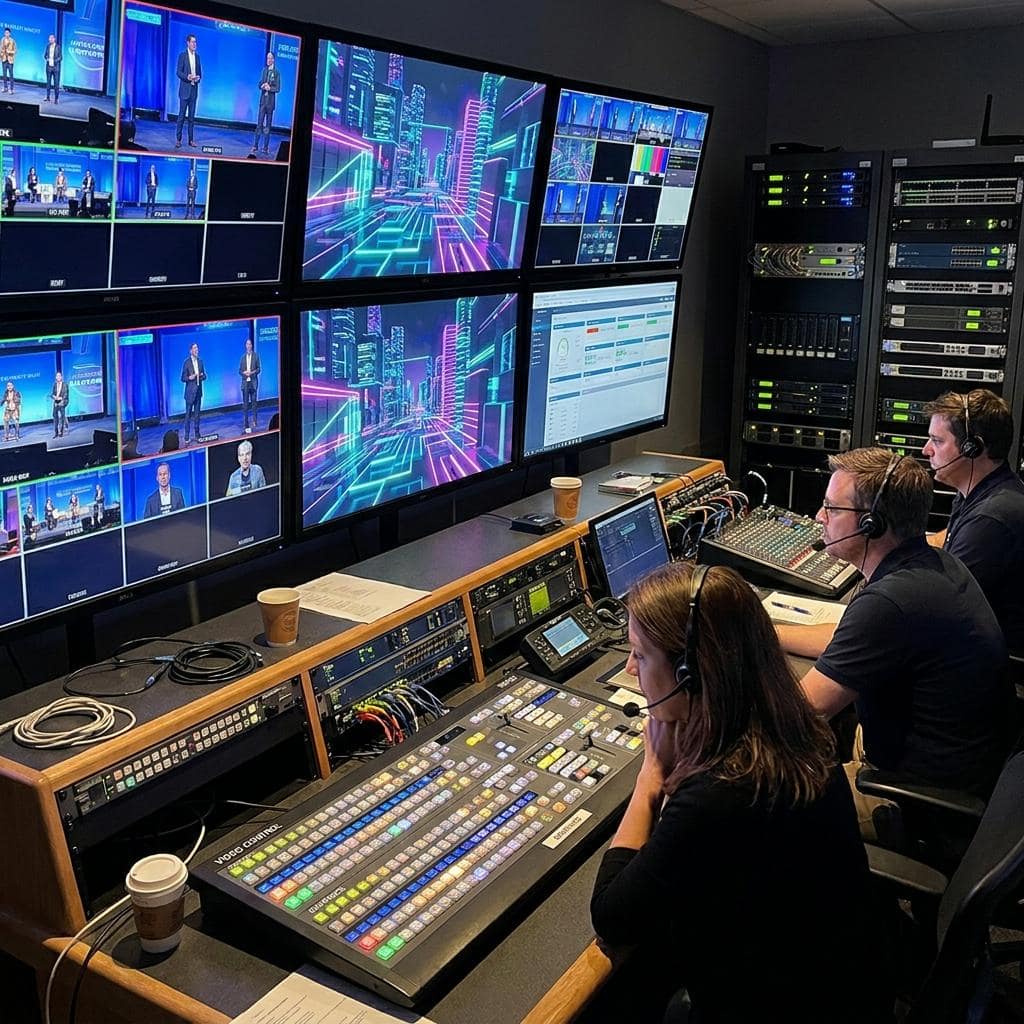
The successful execution of a virtual production heavily relies on expert workflow orchestration within a dedicated control room. Professional video switchers, such as those from Ross (e.g., Carbonite series) or Blackmagic Design (e.g., ATEM Constellation), serve as the central hub for blending live camera feeds, graphics, and the high-resolution output from the real-time render engine. These switchers handle complex compositing, keying, and layering, ensuring a seamless transition between various visual elements. Multiview monitoring systems are indispensable, providing comprehensive visual oversight of all incoming camera feeds, program outputs, preview feeds, and the virtual environment’s rendered perspective. This allows the production team, including technical directors, video engineers, and virtual production operators, to meticulously monitor quality control, color consistency, and synchronization in real-time. The coordination of lighting cues, camera movements, and virtual content changes is managed by a highly skilled technical team, often using unified control surfaces that integrate physical and virtual parameters, ensuring a cohesive and polished final program.
Scalability, Redundancy, and Failover Architectures
Enterprise events demand uncompromising reliability and scalability. For larger virtual productions, render farms comprising multiple GPU-accelerated workstations or cloud-based rendering services can be deployed to distribute the computational load, ensuring consistent frame rates even with highly complex virtual environments and dynamic lighting. Redundancy is built into every layer of the infrastructure: primary and secondary render nodes, redundant network paths (e.g., via link aggregation or diverse fiber routes), and redundant hardware components (e.g., power supplies, capture cards). For mission-critical corporate events, a comprehensive failover strategy is essential. This includes redundant internet circuits with automatic failover, parallel streaming encoders feeding different CDNs, and hot-swappable hardware components. A well-defined disaster recovery plan, covering both hardware failures and software glitches within the virtual production pipeline, is crucial to guarantee uninterrupted service delivery and uphold the integrity of the corporate event.
Ensuring Quality of Service (QoS) and Visual Fidelity
Maintaining a consistently high Quality of Service (QoS) and visual fidelity throughout the entire virtual production and streaming pipeline is paramount. This involves continuous monitoring using specialized tools that track network performance (bandwidth, latency, jitter, packet loss), CPU and GPU utilization on render nodes, and the health of streaming encoders and CDNs. Color management and calibration workflows are critical to ensure visual consistency between physical cameras, LED volumes, and the virtual environment. This involves precise calibration of monitors and projectors to industry standards (e.g., Rec. 709 for HD, Rec. 2020 for UHD) and meticulous color grading to match the aesthetic across all sources. End-to-end testing of the entire virtual production and streaming pipeline – from virtual light programming to final audience delivery – is performed rigorously. This includes testing various lighting scenarios, camera movements, network conditions, and failover procedures to identify and mitigate any potential issues before the live event, guaranteeing a flawless, professional presentation.
The strategic application of dynamic lighting in 3D virtual environments is fundamentally reshaping the capabilities of B2B event streaming and hybrid production. It moves beyond mere visual enhancement to become an integral component of a technically sophisticated, immersive, and engaging experience. For corporate event planners, AV professionals, and IT directors seeking to push the boundaries of virtual engagement, understanding and implementing these advanced lighting methodologies and robust infrastructure solutions is not an option, but a necessity. Spring Forest Studio stands ready as your expert technical partner, providing the deep engineering knowledge and practical implementation experience required to transform your enterprise events into visually stunning, flawlessly executed virtual and hybrid spectacles.

Jeremy Lee is a seasoned digital marketing director and strategist with over two decades of experience in the industry. As the founder of Sotavento Medios, I manage a diverse portfolio of over 50 businesses, helping brands grow through advanced search strategies and digital innovation. My work focuses on bridging the gap between traditional search engine optimisation and the evolving world of AI-driven answer engines.
get in touch