
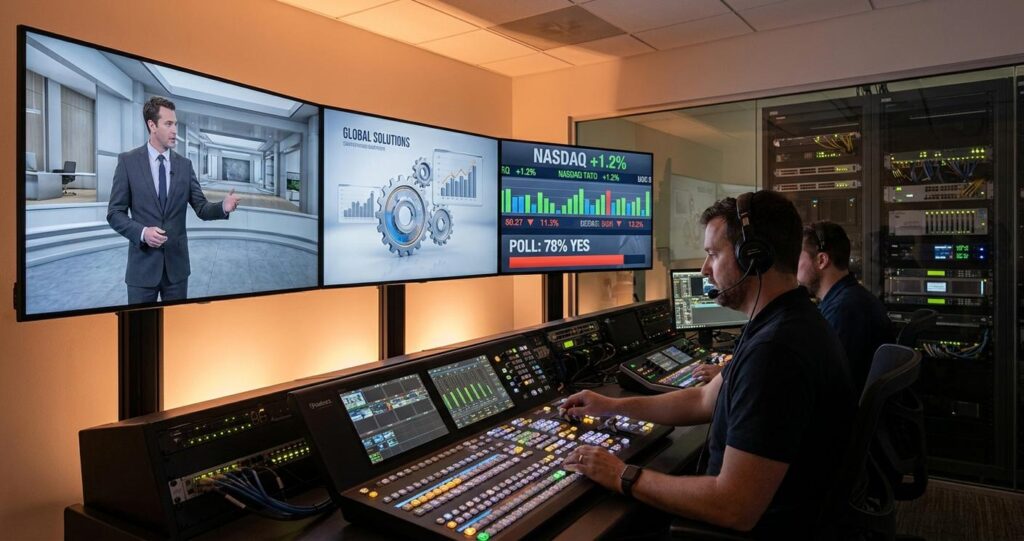
The landscape of B2B event streaming and hybrid production has undergone a profound transformation, driven by the imperative to deliver engaging, high-fidelity experiences to global audiences. Central to this evolution is the sophisticated orchestration of visual and auditory elements within virtual studio environments. A critical technical challenge, and indeed a strategic differentiator, lies in the meticulous management and seamless integration of pre-rendered and real-time assets. This dichotomy directly impacts latency, bandwidth utilization, processing overhead, and ultimately, the perceived professionalism and interactivity of an enterprise event. Understanding the technical nuances of each asset type, their respective integration workflows, and the underlying infrastructure required is paramount for corporate event planners, AV professionals, and IT directors aiming to deliver broadcast-grade virtual and hybrid productions.
Understanding Asset Archetypes in Virtual Production
Effective virtual studio management begins with a clear technical distinction between pre-rendered and real-time assets. Each serves distinct purposes and imposes unique demands on the production infrastructure.
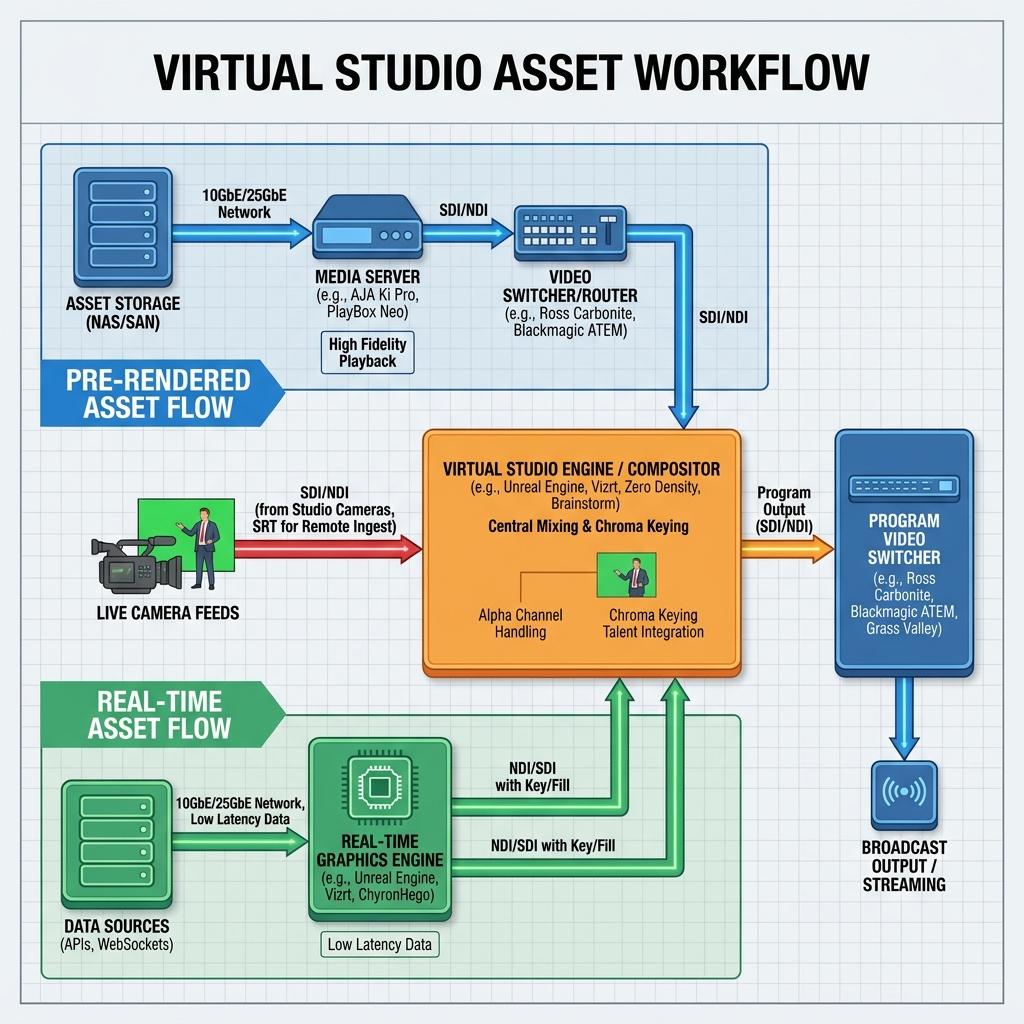
Pre-Rendered Assets: Precision and Predictability in Playback
Pre-rendered assets are media elements that have been fully processed and finalized prior to the live production. These typically include:
- Opening and closing sequences: High-production-value animated introductions and outros.
- Sponsorship bumpers: Short, branded video clips.
- Interstitial video clips: Pre-recorded presentations, testimonials, or corporate messages.
- Animated lower thirds and full-screen graphics: Static or pre-animated graphical overlays for speaker names, titles, or event information.
Technically, these assets are characterized by their fixed resolution, commonly 1920x1080p for HD or 3840x2160p for 4K/UHD content, encoded using industry-standard codecs such as H.264 (MPEG-4 AVC) or H.265 (HEVC) for distribution, or higher-quality intermediate codecs like Apple ProRes or Avid DNxHR for internal production workflows. Crucially, many pre-rendered graphics require an alpha channel to allow for transparent overlays, ensuring they blend seamlessly with live video feeds. This alpha channel information is typically embedded within the video file itself (e.g., ProRes 4444) or delivered as a separate key/fill signal over SDI.
The primary advantage of pre-rendered assets lies in their predictability and high fidelity. Complex animations, detailed visual effects, and precise timing can be perfected in post-production, reducing the real-time processing load on the virtual studio engine during the live event. However, they lack dynamic interactivity and cannot respond to live data or audience input. Integration often involves dedicated media servers, such as PlayBox Neo or AJA Ki Pro Rack, or professional video playback systems. The signal flow typically involves retrieving the stored asset, routing it through the media server, and then ingesting it into a central video switcher via SDI or NDI (Network Device Interface) for mixing into the program feed.
Real-Time Assets: Dynamic Interactivity and Adaptability
Real-time assets, conversely, are generated, updated, or manipulated dynamically during the live event. These are essential for interactive and data-rich B2B productions:
- Live data visualizations: Stock tickers, polling results, social media feeds, live metrics.
- Interactive audience Q&A graphics: Displaying questions submitted by attendees in real time.
- Dynamic lower thirds and scoreboards: Updating speaker information or event scores instantly.
- Real-time 3D graphics and virtual sets: Environments rendered on-the-fly, often integrating live talent via chroma keying.
- Augmented reality (AR) elements: Graphics overlaid onto the physical stage or virtual set that interact with live cameras.
The technical requirements for real-time assets are significantly more demanding. They necessitate powerful computational resources, primarily high-performance GPUs, to render complex graphics and animations on the fly. Data integration is critical, often relying on APIs (Application Programming Interfaces) or WebSockets to pull live information from external databases, CRMs, or audience engagement platforms. Low-latency input is paramount, typically achieved through protocols like NDI, or uncompressed SDI for high-end systems, to ensure synchronization with live camera feeds. Character generators (e.g., Ross Xpression, ChyronHego) and advanced real-time 3D render engines (e.g., Unreal Engine, Vizrt Viz Artist/Engine, Zero Density Reality Engine, Notch) are the workhorses for generating these assets.
While offering unparalleled audience engagement and adaptability, real-time assets introduce complexity. Their reliance on generative engines and dynamic data streams requires robust network infrastructure with stringent latency controls. The signal flow involves the data source or user input feeding into a real-time graphics engine, which then outputs the rendered graphics, often with embedded alpha, to the virtual studio engine or directly to the video switcher for composition.
Infrastructure and Protocols for Optimized Asset Management
The seamless interplay between pre-rendered and real-time assets hinges on a robust, purpose-built streaming infrastructure. Enterprise-grade B2B event streaming demands meticulous attention to network architecture, video-over-IP protocols, and encoding standards.
Network Architecture for Hybrid and Virtual Studios
A fundamental requirement for professional virtual and hybrid productions is a meticulously designed network infrastructure. Production networks must be segregated from general enterprise traffic to ensure dedicated bandwidth and minimal latency. A 10 Gigabit Ethernet (10GbE) backbone is often the minimum for reliable NDI workflows, supporting multiple uncompressed or lightly compressed video streams. For larger, more complex setups, 25GbE or even 100GbE may be necessary, particularly with SMPTE ST 2110 deployments. Quality of Service (QoS) configurations are essential to prioritize media packets, preventing jitter and dropped frames. Dedicated VLANs (Virtual Local Area Networks) further segment traffic, ensuring that real-time video, audio-over-IP (e.g., Dante, AES67), and control data have guaranteed resources. For hybrid events incorporating remote talent or cloud-based virtual studio elements, WAN (Wide Area Network) connectivity demands secure and reliable transport protocols.
Video Over IP Protocols: NDI, SRT, and SMPTE ST 2110
- NDI (Network Device Interface): NewTek’s NDI has become a dominant force in IP-based video production, offering high-efficiency, low-latency, and cost-effective distribution of video, audio, and metadata over standard Ethernet networks. It is ideally suited for routing both pre-rendered assets from media servers and real-time graphics outputs from character generators within the virtual studio environment. NDI|HX provides a bandwidth-efficient option for scenarios with constrained network resources, though with slightly higher latency than full NDI.
- SRT (Secure Reliable Transport): Developed by Haivision, SRT is an open-source video transport protocol designed for robust, low-latency video contribution over unpredictable public internet connections. It employs advanced error correction (ARQ – Automatic Repeat reQuest) and encryption, making it indispensable for bringing remote talent, pre-rendered assets from distributed production teams, or cloud-based real-time graphics into a central virtual studio. Its ability to manage packet loss and fluctuating bandwidth ensures reliable delivery of critical content.
- SMPTE ST 2110: This suite of standards from the Society of Motion Picture and Television Engineers (SMPTE) specifies the transport of uncompressed or minimally compressed professional media (video, audio, and ancillary data) over IP networks. Predominantly used in high-end broadcast facilities and large-scale productions, ST 2110 offers pristine quality, ultra-low latency, and granular control over each media stream. While requiring significant network infrastructure investment, it provides the most robust foundation for the highest-tier virtual studio integrations.
Encoding and Decoding Standards
The choice of encoding and decoding standards significantly impacts asset quality, file sizes, bandwidth requirements, and latency. For final distribution to a global audience, H.264 (MPEG-4 Part 10 Advanced Video Coding) remains the prevalent standard, offering a strong balance between compression efficiency and broad compatibility. H.265 (HEVC – High Efficiency Video Coding) provides even greater compression efficiency, delivering similar quality at roughly half the bitrate of H.264, crucial for 4K/UHD streaming, though it requires more processing power for encoding and decoding. Within the production pipeline, intermediate codecs like Apple ProRes and Avid DNxHR are often used for pre-rendered assets to preserve visual quality during editing and playback, minimizing generation loss before final H.264/H.265 encoding for delivery. Proper handling of alpha channels for graphics, whether through embedded key/fill data in NDI streams or dedicated SDI key/fill signals, is vital for seamless overlays.
Production Workflows and Integration Strategies
The successful amalgamation of pre-rendered and real-time assets relies on sophisticated production workflows and seamless integration between disparate systems. This requires a deep understanding of video switching, virtual studio engines, and data integration.
Virtual Studio Engines and Video Switchers
At the heart of any professional virtual studio lies a powerful video switcher, such as a Ross Carbonite, Grass Valley Kahuna, or Blackmagic ATEM Constellation. This central hub is responsible for taking multiple input sources – live camera feeds, pre-rendered video clips, and outputs from real-time graphics engines – and compositing them into a cohesive program feed. Advanced virtual studio software (e.g., Vizrt Viz Artist/Engine, Unreal Engine with nDisplay, Zero Density Reality Engine) integrates directly with these switchers, often receiving live camera feeds and outputting a composited virtual scene with embedded talent. Chroma keying, the process of isolating a subject (e.g., a presenter) against a single-color background (green or blue screen) and placing them into a virtual environment, is a critical technical function. Achieving convincing chroma keying demands precise lighting, high-quality camera sensors, and robust keying algorithms to manage spill suppression, edge definition, and shadow detail, ensuring the live talent appears naturally integrated into the real-time virtual set.
Data Integration for Real-Time Graphics
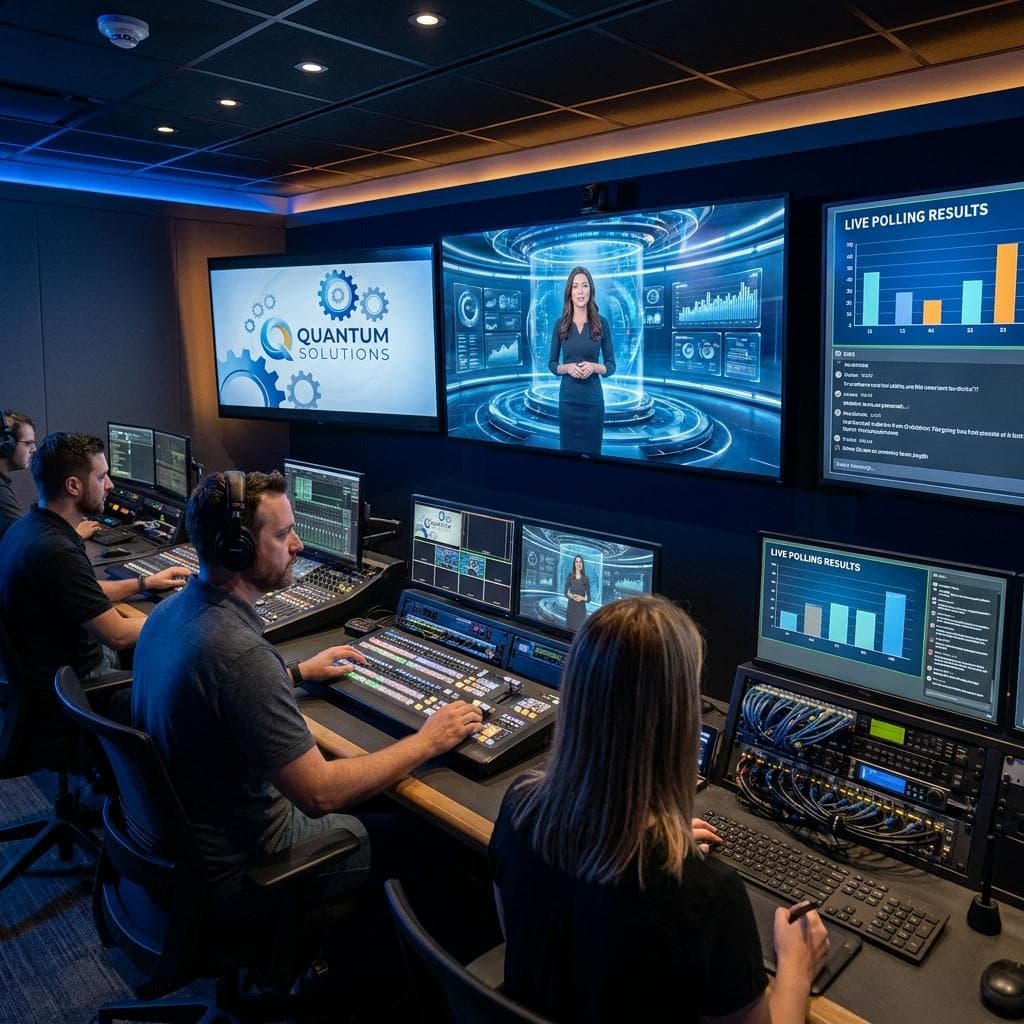
The power of real-time assets in B2B events is amplified through robust data integration. Modern graphics engines connect via APIs and WebSockets to external data sources. This enables dynamic content generation, allowing elements like lower thirds to automatically update with speaker names from a schedule database, or product information slides to reflect real-time inventory levels. For interactive audience engagement, live polling results or Q&A questions can be pulled from event platforms and instantly rendered onto screen graphics. This level of dynamic integration requires careful planning of data schemas, API authentication, and robust error handling to prevent display glitches during a live event. The latency between data update and on-screen display must be meticulously managed, often targeting sub-50ms for highly interactive elements, to maintain a fluid and responsive experience.
Audio Asset Management in Virtual Environments
Audio is equally critical. Pre-rendered video assets typically have embedded audio, which must be routed and mixed appropriately. Live audio inputs from presenters, panel discussions, and audience microphones are managed through professional digital audio mixers (e.g., Yamaha Rivage PM series, Behringer X32, Allen & Heath dLive). Audio-over-IP protocols like Dante or AES67 facilitate flexible routing and minimize cabling complexity. A significant technical challenge in virtual production is maintaining audio-video synchronization, especially when dealing with variable latency introduced by complex real-time graphic rendering or remote contributions via SRT. Precision audio delays and frame synchronizers may be necessary to ensure perfect lip-sync. Talkback systems are also essential, providing critical communication channels between the production crew, directors, and presenters in both physical and virtual locations.
Scalability, Redundancy, and Quality of Service for Enterprise Streaming
For enterprise-grade B2B event streaming, merely integrating assets is insufficient; the solution must also be scalable, resilient, and deliver uncompromising quality.
Ensuring Scalability for Enterprise Events
Scalability considerations are paramount for corporate events that may grow from hundreds to tens of thousands of simultaneous viewers, or require multiple parallel tracks. The decision between cloud-based virtual studio services and on-premise dedicated hardware often hinges on this. Cloud solutions offer elastic scalability, allowing resources to be provisioned dynamically to handle peak loads for rendering real-time graphics or delivering streams to a global audience via CDNs (Content Delivery Networks). On-premise solutions provide more direct control and often lower latency for local production workflows but require upfront investment and careful capacity planning. Bandwidth provisioning must account for simultaneous asset ingest, internal studio processing (often multiple gigabits per second for NDI or ST 2110), and high-bitrate egress to streaming platforms. Furthermore, multi-program output capabilities allow for bespoke content delivery, such as different language tracks, regionalized advertisements, or specific content feeds for various audience segments, all leveraging the same core asset management system.
Redundancy and Failover Strategies
The reliability of a B2B event streaming platform is non-negotiable. Redundancy planning must encompass every critical component. This includes N+1 or 1:1 redundancy for media servers, real-time graphics engines, video switchers, and encoders. Dual network paths, often with diverse routing, and redundant power supplies are standard. Automatic failover mechanisms for streaming encoders, pushing parallel streams to multiple CDNs or origin servers, ensure continuous service even if one pathway fails. Backup asset storage, often replicated across geographically diverse data centers, and rapid deployment protocols are crucial for quick recovery in the event of a primary system failure. Comprehensive monitoring of all system components, including CPU/GPU utilization, network throughput, and storage health, is essential for proactive issue identification.
Quality of Service (QoS) and Latency Optimization
Maintaining a consistently high Quality of Service (QoS) is fundamental for a professional B2B experience. This involves meticulous configuration of network equipment to prioritize real-time video and audio packets over less time-sensitive data. End-to-end latency optimization is particularly critical for interactive real-time assets. Any perceptible delay between audience input and on-screen response can degrade engagement. This requires careful management of every stage, from camera capture to encoding, transmission, decoding, and display. Monitoring tools, including network analyzers, video scopes, audio meters, and multiviewers displaying all program and preview feeds, provide real-time insights into system performance. While Adaptive Bitrate (ABR) streaming is a standard for distribution, its application within the virtual studio workflow must be carefully considered to avoid introducing unacceptable latency to real-time elements. Precision timing protocols like PTP (Precision Time Protocol) or NTP (Network Time Protocol) ensure all components are synchronized to within microseconds, preventing drift and ensuring perfect alignment of disparate media streams.
In conclusion, the sophisticated management of pre-rendered and real-time assets is not merely a technical detail; it is a strategic imperative for any enterprise seeking to deliver truly impactful virtual and hybrid events. The meticulous planning of infrastructure, the judicious selection of protocols, and the expert orchestration of intricate workflows are essential to achieving broadcast-grade quality, seamless interactivity, and unwavering reliability. For corporate event planners, AV professionals, and IT directors, mastering this complex interplay is key to unlocking the full potential of virtual studios and delivering unparalleled B2B streaming experiences. Navigating these technical challenges requires deep expertise and a partner with a proven track record in enterprise-grade production.

Jeremy Lee is a seasoned digital marketing director and strategist with over two decades of experience in the industry. As the founder of Sotavento Medios, I manage a diverse portfolio of over 50 businesses, helping brands grow through advanced search strategies and digital innovation. My work focuses on bridging the gap between traditional search engine optimisation and the evolving world of AI-driven answer engines.
get in touch