

Secure AI in Cloud Production: The 2026 Enterprise Blueprint
The convergence of artificial intelligence and cloud-based production is no longer a theoretical exercise for enterprise event technology. It is the emerging operational standard. For corporate event planners, AV professionals, and IT directors, the monolithic, on-premise production control room is proving increasingly inefficient for the demands of scalable, secure, and data-rich hybrid events. While cloud infrastructure offers unprecedented flexibility, it introduces significant security and integration challenges that must be systematically addressed. By 2026, a resilient enterprise B2B event strategy will be defined by its adoption of a secure, AI-driven cloud production blueprint. This framework is not about replacing human expertise but augmenting it, creating workflows that are more secure, efficient, and capable of delivering measurable business intelligence from live video assets. The foundational pillars of this blueprint are a Zero Trust security architecture, AI-powered workflow automation for quality control and metadata enrichment, and seamless integration with existing enterprise collaboration platforms.
Foundational Security: A Zero Trust Architecture for Live Production
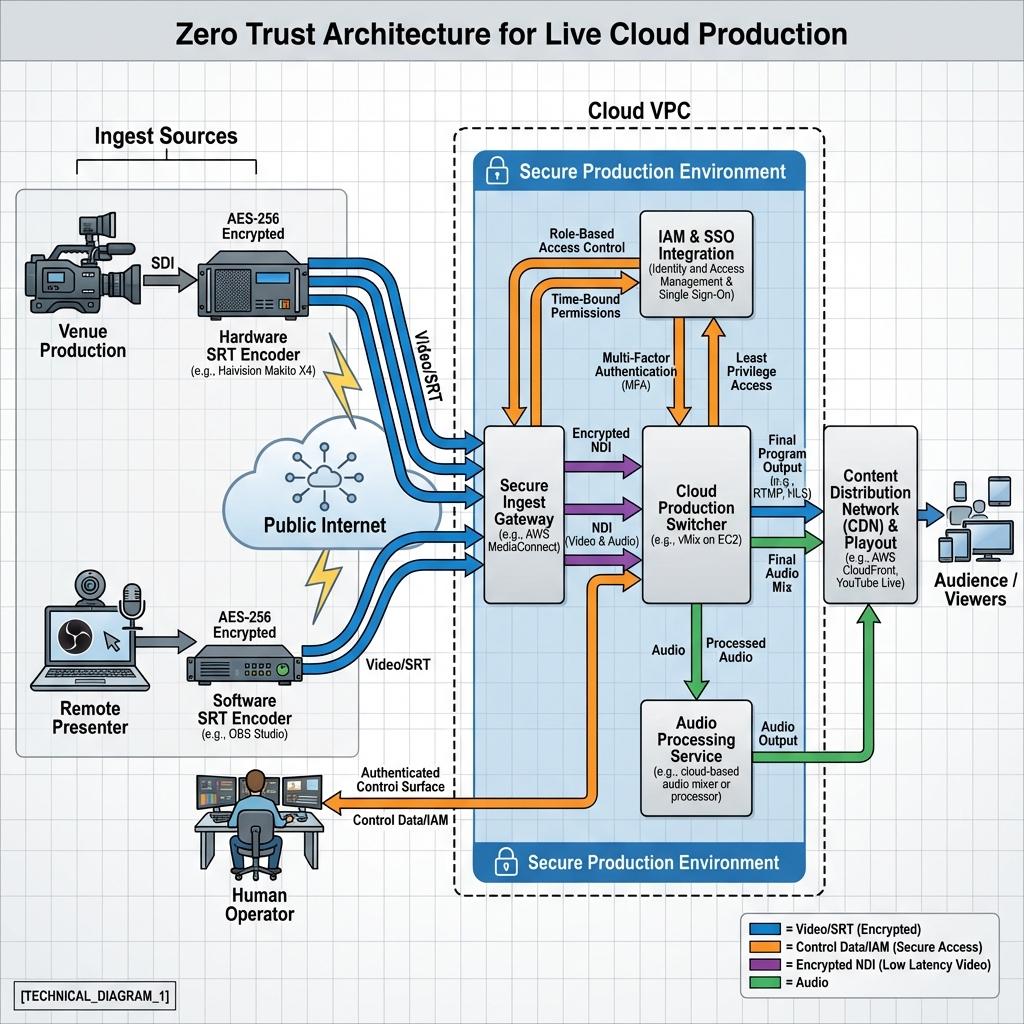
In a distributed cloud production environment, the traditional network perimeter is obsolete. A Zero Trust security model, which assumes no user or device is inherently trustworthy, is the mandatory starting point. Every access request, from camera contribution feeds to operator control surfaces, must be authenticated, authorized, and encrypted before access is granted. This approach is critical for protecting high-value corporate communications and intellectual property being transported and processed in the cloud.
Beyond RTMPS: The Role of SRT and Encrypted NDI
Relying solely on RTMP (Real-Time Messaging Protocol) or even its secure variant, RTMPS, is insufficient for modern enterprise security requirements. The 2026 blueprint mandates the use of more robust transport protocols. Secure Reliable Transport (SRT) is a cornerstone technology in this model. SRT provides end-to-end AES-256 encryption, robust packet loss recovery, and stable connectivity over unpredictable public networks, making it ideal for contributing high-bitrate video from a venue to a cloud ingest point. For internal signal routing within a virtual private cloud (VPC) or across a secure WAN, encrypted NDI (Network Device Interface) offers a high-quality, low-latency solution. Implementing these protocols requires specific network configurations, including firewall rules that only permit traffic on designated SRT and NDI ports from pre-authorized IP addresses. Network segmentation is also crucial, isolating production traffic from other corporate network activity to prevent lateral movement in the event of a breach.
Identity and Access Management (IAM) for Production Crews
Securing the transport layer is only half the battle. Access to the cloud production resources themselves, such as virtualized switchers, encoders, and media storage buckets, must be rigorously controlled. Generic, shared passwords must be eliminated. A robust Identity and Access Management (IAM) framework using Role-Based Access Control (RBAC) is essential. For example, a video engineer may be granted permissions to configure encoder settings and monitor stream health, while a graphics operator only has access to the character generator (CG) and asset management system. These permissions should be time-bound, automatically expiring after the event concludes. Integrating the production IAM system with enterprise Single Sign-On (SSO) platforms like Azure Active Directory or Okta streamlines user management and ensures that access policies align with corporate IT governance.
Securing Contribution Endpoints
The most vulnerable part of the chain is often the initial signal acquisition point. Securing camera feeds and audio sources originating from a physical venue or a remote presenter’s location is paramount. This involves deploying professional hardware encoders, such as those from Haivision or Teradek, that have native SRT support and built-in encryption capabilities. For critical events, bonded cellular networking solutions provide both signal redundancy and an additional layer of connection diversity. At the cloud entry point, these feeds should terminate at a secure gateway, like AWS MediaConnect or a Zixi Broadcaster, which authenticates the incoming stream before passing it into the internal production VPC. This gateway acts as a secure demarcation point between the public internet and the private cloud production environment.
AI-Driven Workflows: Automation, Efficiency, and Real-Time Analytics
With a secure foundation in place, the next layer of the blueprint leverages AI to automate complex tasks, enhance quality control, and extract valuable data from video content. This moves the production workflow from a purely operational function to a source of business intelligence. AI’s role is not to replace the Technical Director or producer but to serve as an infinitely vigilant co-pilot, handling repetitive tasks and flagging anomalies that require human intervention.
Intelligent Ingest and Automated Metadata Tagging
During a live event, AI models can analyze incoming SRT or NDI feeds in real time. This process, known as intelligent ingest, can automatically generate a wealth of metadata. For instance, an AI service like AWS Rekognition or Azure Video Indexer can perform real-time speaker identification, transcribing their speech and tagging the video with their name and title. It can also detect on-screen text, logos, and topics of discussion. This metadata is invaluable. Instead of an eight-hour monolithic video file, the result is a fully searchable archive where a communications manager can instantly find every instance a specific product was mentioned or every segment featuring the CEO. This transforms a live stream from a transient communication into a permanent, searchable knowledge asset.
AI-Assisted Quality Control and Anomaly Detection
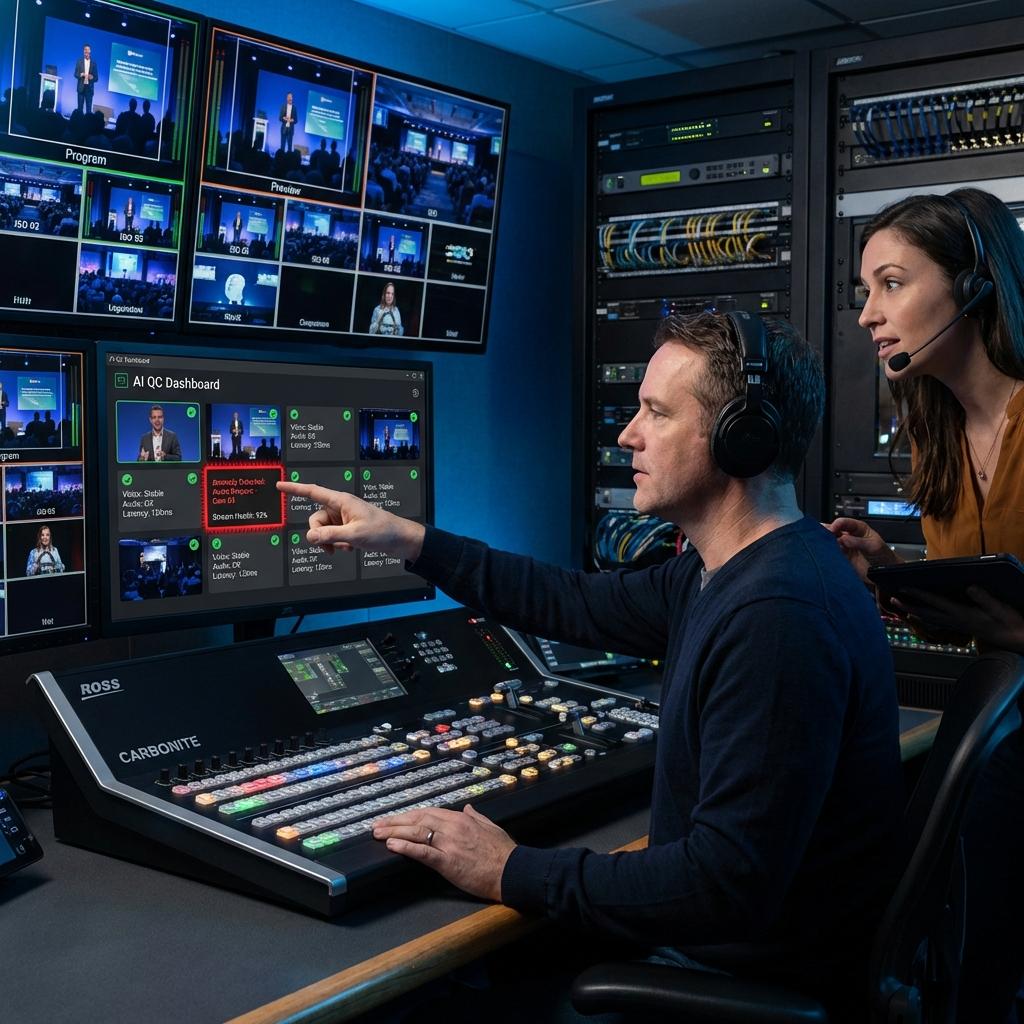
Human operators monitoring multiple multiviewer screens are susceptible to fatigue and distraction. AI-powered Quality Control (QC) systems can monitor dozens of streams simultaneously for technical errors with greater precision. These systems are trained to detect issues like video freeze frames, macroblocking artifacts from packet loss, audio dropouts, out-of-sync audio and video, and color space errors. Upon detecting an anomaly, the system can instantly alert the lead engineer via a dashboard or messaging system, providing the specific timestamp and error type. Advanced implementations can even trigger automated failover procedures, such as switching to a backup encoder or a redundant signal path, reducing the mean time to recovery (MTTR) from minutes to seconds and protecting the viewing experience.
Dynamic Content Personalization and Accessibility
AI enables a level of content customization that is impractical to achieve manually in a live environment. It can generate highly accurate, real-time closed captions that far exceed the quality of basic automated speech recognition, and even translate those captions into multiple languages simultaneously for a global audience. Furthermore, by analyzing the real-time transcript and metadata, AI can identify key moments, applause points, or product mentions. This data can be used to automatically generate highlight reels for social media distribution or create personalized VOD (Video on Demand) summaries for different attendee segments. An engineer might receive a summary focused on technical deep dives, while an executive receives one centered on keynote presentations and business strategy discussions.
The 2026 Hybrid Infrastructure: Integrating Cloud and Enterprise Platforms
The final component of the blueprint is a flexible and scalable infrastructure that seamlessly connects cloud-native production tools with the enterprise collaboration platforms that have become central to corporate communications. This hybrid model ensures that both in-person and remote participants have a high-quality, cohesive experience.
Architecting a Scalable Cloud Production Environment
A modern cloud production environment is built from modular, API-driven services. This includes cloud-based live production switchers like Grass Valley AMPP or Vizrt Vectar, which replicate the functionality of a physical switcher in a virtualized environment. These are complemented by scalable encoding ladders for creating adaptive bitrate (ABR) packages and cloud-native Media Asset Management (MAM) systems. When designing this infrastructure, geographic region selection is critical. Placing compute and processing resources in a cloud region geographically close to the physical venue minimizes contribution latency. For data sovereignty and compliance, some enterprises may require that all processing and storage occur within a specific country’s cloud region. The choice between Infrastructure as a Service (IaaS) and Platform as a Service (PaaS) solutions depends on the level of control and in-house expertise available. PaaS solutions offer faster deployment, while IaaS provides greater customization at the cost of increased management overhead.
Seamless Integration with Teams, Zoom, and Webex
A primary challenge in hybrid events is managing remote presenters. Simply screen-capturing a Zoom call results in poor video quality and audio sync issues. A professional workflow involves pulling high-quality feeds directly from these platforms into the main cloud production switcher. This can be achieved using technologies like NDI Bridge or by having the remote presenter send their feed via SRT from a dedicated software or hardware encoder. Equally important is providing a custom return feed. Remote presenters should see the main program output, not a standard gallery view, with a mix-minus audio feed that contains all program audio except their own voice. This allows them to interact naturally with the event as if they were on stage.
Redundancy and Failover Strategies in a Distributed Model
In the cloud, redundancy is logical rather than physical. A robust failover strategy is non-negotiable for enterprise events. This starts with a 1+1 or N+M redundancy model for all critical components like encoders and production switchers, where a duplicate instance is running in parallel, ready to take over instantly. For maximum resilience, a geo-redundant architecture is the gold standard. This involves replicating the entire production stack in a separate geographic cloud region (e.g., a primary in us-east-1 and a secondary in us-west-2). In the event of a full region-wide service disruption, traffic can be rerouted to the secondary region via automated DNS failover, ensuring continuity for the audience-facing distribution endpoint.
Your Blueprint for Action: Adopting Secure AI Cloud Production
Transitioning to a secure, AI-driven cloud production model is a strategic imperative for any enterprise serious about the future of its event and communication programs. This evolution requires a deliberate and phased approach. The first step is to audit your current streaming workflows, identifying security gaps and protocol deficiencies. From there, piloting a small-scale cloud production for an internal town hall or training session can provide invaluable hands-on experience in a low-risk environment. Concurrently, your IT and production teams must collaborate to develop an IAM policy specifically for production roles. Ultimately, successfully navigating this complex technological landscape requires specialized expertise. Partnering with a B2B streaming and production specialist like Spring Forest Studio can provide the technical guidance and implementation support necessary to build a bespoke blueprint that aligns with your organization’s security posture and strategic goals. This investment is not merely in technology; it is in creating more secure, intelligent, and impactful B2B event experiences.

Jeremy Lee is a seasoned digital marketing director and strategist with over two decades of experience in the industry. As the founder of Sotavento Medios, I manage a diverse portfolio of over 50 businesses, helping brands grow through advanced search strategies and digital innovation. My work focuses on bridging the gap between traditional search engine optimisation and the evolving world of AI-driven answer engines.
get in touch