
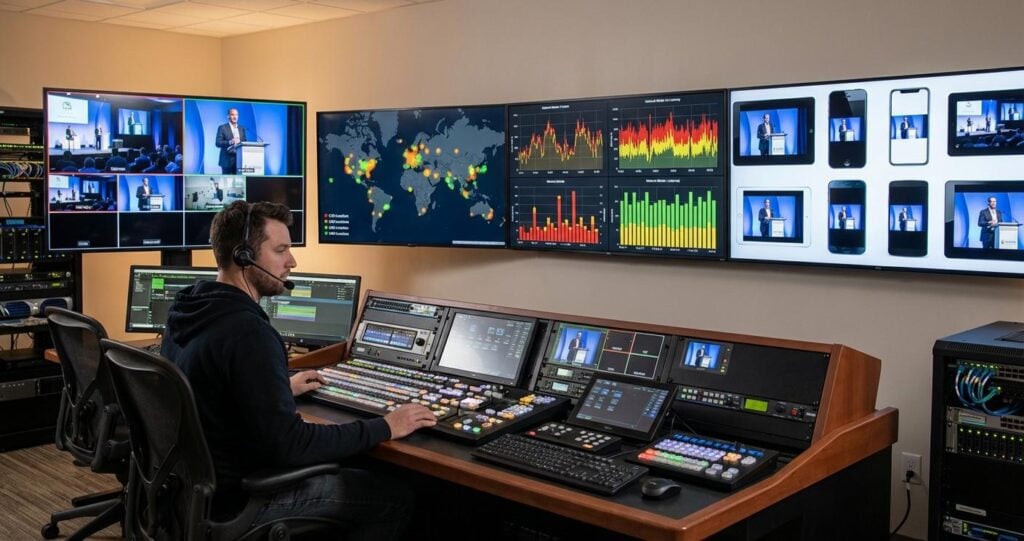
The Enterprise Challenge: Flawless Streaming to Geographically Dispersed Hybrid Audiences
The paradigm of corporate events has fundamentally shifted. The single-venue model has been augmented by a more complex, hybrid structure involving a central broadcast location and multiple regional hubs. These hubs, populated by key stakeholders, partners, and employees, participate actively, requiring a high-quality audio-visual experience. Simultaneously, a global audience of mobile viewers tunes in from disparate locations, often over unpredictable wireless networks. For the enterprise, the objective is non-negotiable: deliver a seamless, high-Quality of Experience (QoE) to every participant, regardless of their location or device. This is not a simple webcast; it is a mission-critical exercise in broadcast engineering and network architecture. Ensuring that a mobile viewer in a satellite office has the same flawless experience as an executive in the main auditorium requires a robust, multi-layered technical strategy that begins at the point of acquisition and extends to the last mile of delivery.
Successfully executing such a stream hinges on a deep understanding of contribution protocols, cloud transcoding infrastructure, Content Delivery Network (CDN) topology, and local network optimization. A failure at any point in this complex signal chain, from incorrect encoder settings to inadequate bandwidth at a regional hub, can result in buffering, low resolution, and a compromised message. This article provides a technical blueprint for production managers, AV professionals, and IT directors tasked with architecting and delivering high-stakes B2B hybrid events, with a specific focus on mastering the mobile viewing experience within regional hubs.
Foundational Architecture: Contribution Encoding and Protocol Selection
The integrity of the entire streaming workflow is determined by the quality and stability of the initial contribution feed from the primary event location. This is the master signal from which all other renditions are derived. Compromising here guarantees a poor experience for all downstream viewers. The process involves two critical components: the encoding specifications and the transport protocol used to send the signal to the cloud.
Multi-Bitrate Source Encoding for Downstream Flexibility
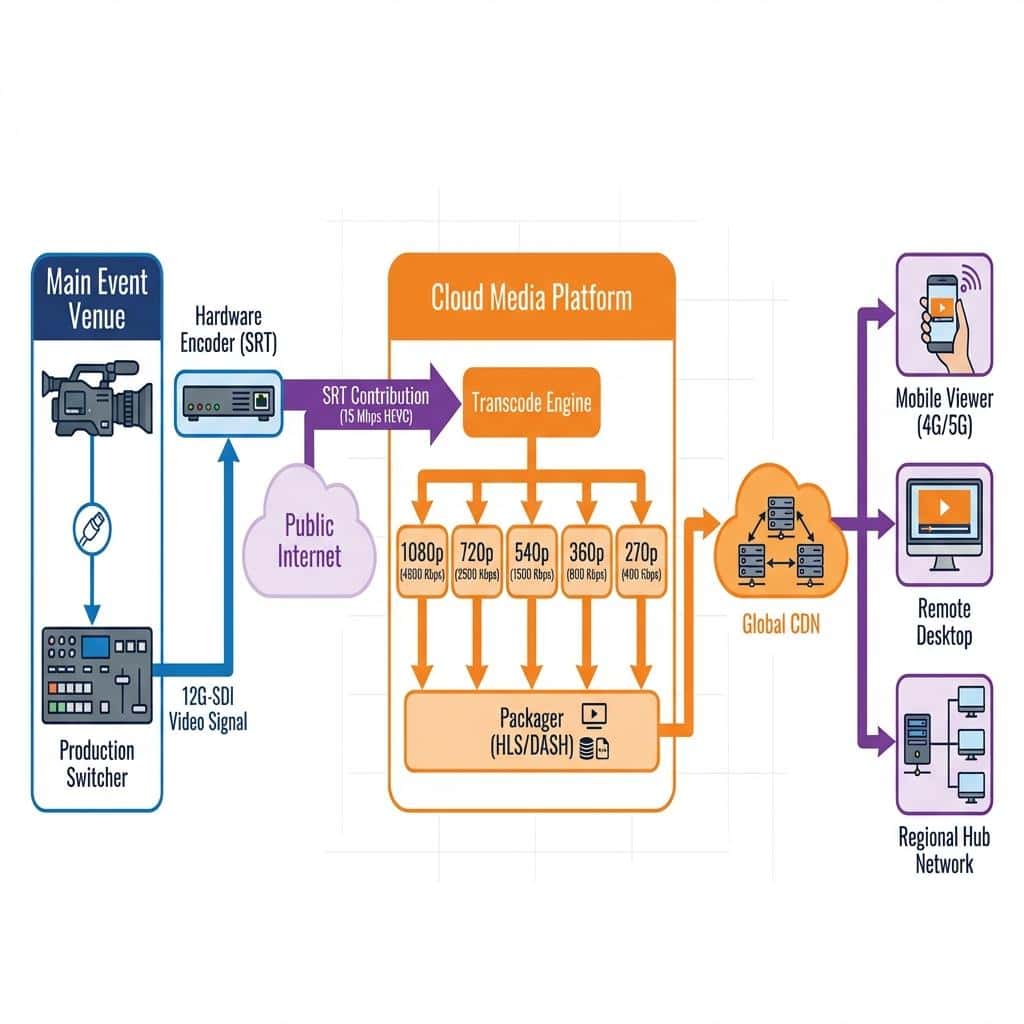
While the final delivery to end-users will be an Adaptive Bitrate (ABR) ladder, the contribution feed itself must be of the highest possible quality. We recommend a single, high-bitrate mezzanine feed. A typical specification for a 1080p60 source would be a 10-15 Mbps stream encoded using the H.264 (AVC) codec or, for greater efficiency, an 8-12 Mbps stream using H.265 (HEVC). HEVC is particularly advantageous as it offers superior compression, reducing bandwidth requirements for the contribution leg of the journey without sacrificing visual fidelity. The encoder, whether a hardware appliance like a Haivision Makito X4 or a software solution like OBS Studio running on dedicated hardware, should be configured for a strict Constant Bitrate (CBR) to ensure predictable bandwidth usage and stability for the cloud ingest point. Key Frame Interval, or Group of Pictures (GOP) size, should be set to 2 seconds to align with standard ABR segmenting practices for HLS and DASH delivery.
SRT as the Enterprise Standard for Contribution
The choice of transport protocol for sending the encoded stream from the venue to the cloud is one of the most critical decisions in the entire workflow. While Real-Time Messaging Protocol (RTMP) has long been a standard, its reliance on TCP (Transmission Control Protocol) makes it highly susceptible to packet loss and fluctuating latency, which are common on public internet connections. A single dropped packet can cause the entire video frame to stall until the packet is retransmitted, leading to stuttering and buffering. For enterprise applications, Secure Reliable Transport (SRT) is the superior protocol. SRT, an open-source protocol, operates over UDP (User Datagram Protocol) but includes its own sophisticated packet loss recovery mechanism based on ARQ (Automatic Repeat reQuest). It can recover from significant packet loss with minimal added latency, making it ideal for transport over unmanaged networks. Configuring SRT involves setting a latency buffer (e.g., 120-500ms) that gives the protocol time to retransmit lost packets before the video is affected. This ensures a stable, broadcast-quality signal arrives at the cloud ingest point, even over a standard business fiber connection.
Cloud Infrastructure: Transcoding, Packaging, and CDN Strategy
Once the pristine SRT contribution feed reaches the cloud, it enters the processing and distribution phase. This is where the single high-quality mezzanine stream is transformed into a multi-bitrate ladder suitable for delivery to a diverse range of devices and network conditions. A robust cloud media service, such as AWS Elemental MediaLive or a dedicated platform like Wowza Streaming Cloud, is essential for this process.
Crafting the Adaptive Bitrate (ABR) Ladder
The core of the cloud operation is transcoding. The high-bitrate SRT input is decoded and then re-encoded into multiple, simultaneous streams at varying resolutions and bitrates. This collection of streams is the ABR ladder. A well-designed ladder for a hybrid event targeting both desktop and mobile viewers must include several rungs. A typical 1080p ladder might look like this:
- 1920×1080, 5,000 kbps video + 128 kbps audio
- 1280×720, 2,800 kbps video + 128 kbps audio
- 960×540, 1,500 kbps video + 96 kbps audio
- 640×360, 800 kbps video + 96 kbps audio
- 480×270, 500 kbps video + 64 kbps audio
The video player on the viewer’s device then intelligently requests segments from the most appropriate rung based on its current network bandwidth and processing power. This dynamic switching is what allows for a seamless experience; a viewer on a weak Wi-Fi signal will automatically receive the 360p stream instead of buffering the 1080p stream.
Packaging and Global CDN Delivery
After transcoding, the ABR streams are packaged into a modern HTTP-based streaming format. The two dominant standards are HLS (HTTP Live Streaming) and MPEG-DASH (Dynamic Adaptive Streaming over HTTP). Both work by breaking the video into small chunks (typically 2-6 seconds in duration) and creating a manifest file that lists the available ABR rungs. The packaged content is then pushed to a global Content Delivery Network. The CDN is a distributed network of servers where copies of these video chunks are cached at Points of Presence (PoPs) around the world. When a mobile viewer in a regional hub requests the stream, the request is routed to the nearest PoP. This geographic proximity drastically reduces latency and improves playback stability, forming the backbone of a global delivery strategy.
The Regional Hub: Local Network Optimization and eCDN Implementation
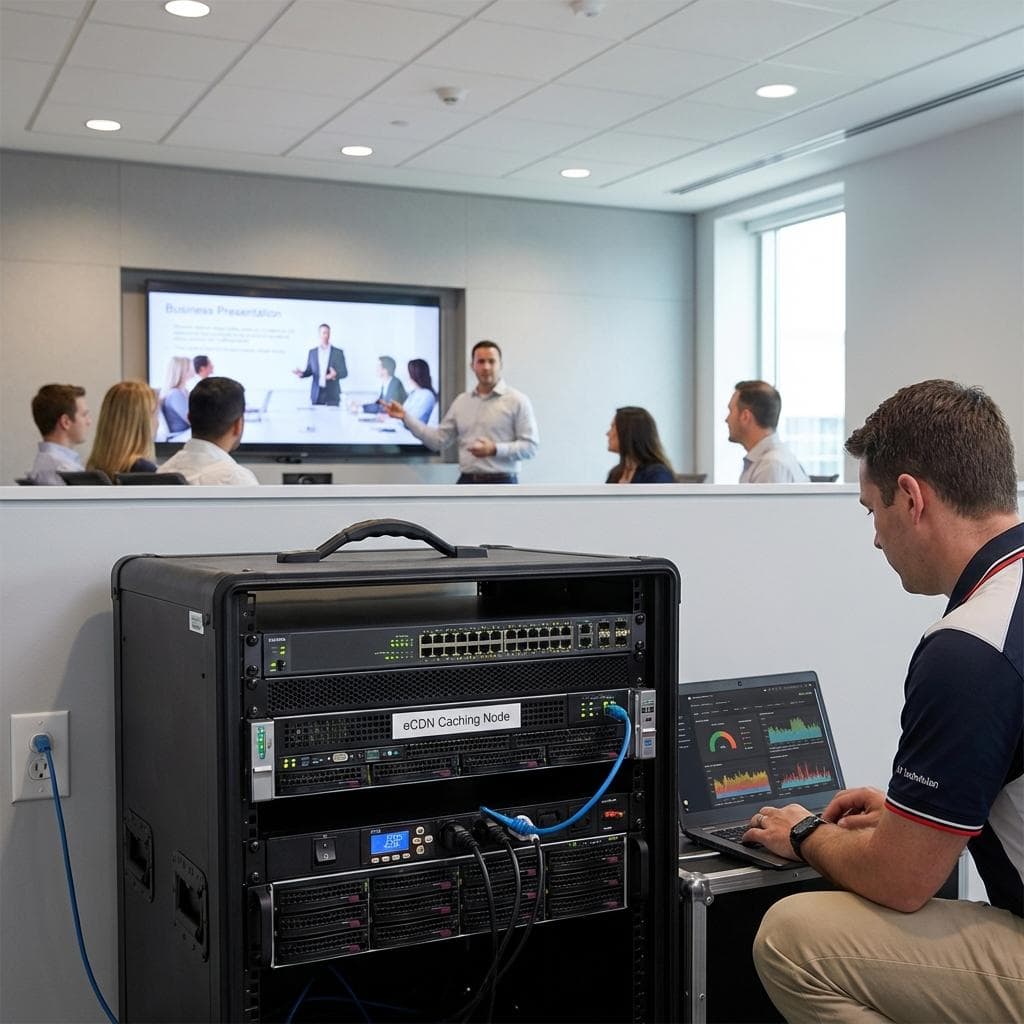
The most unique challenge arises within the regional hubs themselves. A conference room with 50 executives all attempting to view the live stream on their mobile devices during a breakout session can instantly saturate the venue’s internet connection. If each of those 50 devices pulls a separate 2.8 Mbps stream from the public CDN, it would consume 140 Mbps of bandwidth, likely overwhelming the local network and causing a poor experience for everyone. The solution is to implement a local caching and distribution strategy, often referred to as an Enterprise CDN (eCDN).
Deploying an On-Premise Caching Node
An eCDN solution involves deploying a small server or appliance on the local network of the regional hub. This eCDN node connects to the public CDN and pulls only a single copy of each ABR rendition. It then acts as a local origin server for all viewers within that hub. When the 50 executives start their streams, their players request video segments from the local eCDN node over the Local Area Network (LAN) instead of the public internet. The LAN can handle this traffic with ease, and the venue’s internet connection only has to support one set of streams from the CDN. This architecture dramatically reduces external bandwidth consumption and isolates the viewing experience from public internet congestion. Solutions from providers like Ramp or Hive Streaming are designed for this specific enterprise use case.
Coordinating with Venue IT for QoS and Network Stability
Deploying an eCDN node requires close collaboration with the venue’s IT department. The port where the node is connected must have sufficient capacity, and any firewalls must be configured to allow traffic to the public CDN. Furthermore, implementing Quality of Service (QoS) policies on the network’s switches and routers is a broadcast best practice. QoS allows for the prioritization of video traffic over less time-sensitive data like emails or file downloads. By tagging the streaming packets (e.g., using DSCP markings), the network hardware can ensure that video segments are delivered with minimal latency and jitter, even when the network is busy. This level of network management is essential for guaranteeing a professional and reliable experience inside the hub.
Redundancy, Failover, and Monitoring for Mission-Critical Events
For any B2B event, failure is not an option. A comprehensive redundancy and monitoring plan must be in place to mitigate potential issues at every stage of the signal flow. This transforms a standard stream into a broadcast-grade production.
Implementing Full Path Redundancy
True redundancy involves creating a complete, parallel signal path from source to destination. This starts at the venue with two separate encoders, each fed by the production switcher’s program output. These encoders should use different internet connections for contribution; a common configuration is to use the primary house fiber line for the main feed and a bonded cellular unit (e.g., LiveU, TVU Networks) as the backup path. Both SRT streams are sent to separate ingest points in the cloud. The cloud media service should be configured for automatic input switching. If it detects a failure on the primary SRT feed, it will instantly and seamlessly switch to the backup feed with no interruption to the viewer. This redundancy should extend to the CDN, ensuring that if one PoP goes offline, traffic is immediately rerouted to the next closest server.
Real-Time Analytics and QoE Monitoring
It is impossible to manage what you cannot measure. Real-time monitoring across the entire workflow is critical. This includes monitoring the health of the on-premise encoders (CPU load, temperature), the stability of the SRT contribution stream (latency, packet loss, bandwidth), the performance of the cloud transcoding pipeline, and CDN delivery metrics (cache hit ratio, error rates). Most importantly, client-side analytics must be deployed. A video player integrated with a service like Mux or Datazoom can provide real-time QoE data from every single viewer, including buffering ratios, startup times, and the specific ABR rendition they are watching. This granular data allows the production team to proactively identify issues, such as a regional hub experiencing high buffering, and troubleshoot them before they become widespread problems.
Conclusion: An Engineering Approach to Enterprise Streaming
Ensuring a seamless mobile viewing experience in regional hubs is a complex engineering task that demands a broadcast-level approach. It requires moving beyond simple RTMP webcasting and embracing a professional toolkit of protocols, architectures, and strategies. By building a foundation on a reliable contribution protocol like SRT, leveraging the power of cloud transcoding and a global CDN, implementing intelligent local network optimization with eCDN solutions, and wrapping the entire system in a robust redundancy and monitoring plan, organizations can confidently deliver flawless hybrid events. This technical rigor is the hallmark of a professional production and the core of Spring Forest Studio’s commitment to providing reliable, scalable, and high-impact streaming solutions for our enterprise clients.

Jeremy Lee is a seasoned digital marketing director and strategist with over two decades of experience in the industry. As the founder of Sotavento Medios, I manage a diverse portfolio of over 50 businesses, helping brands grow through advanced search strategies and digital innovation. My work focuses on bridging the gap between traditional search engine optimisation and the evolving world of AI-driven answer engines.
get in touch