
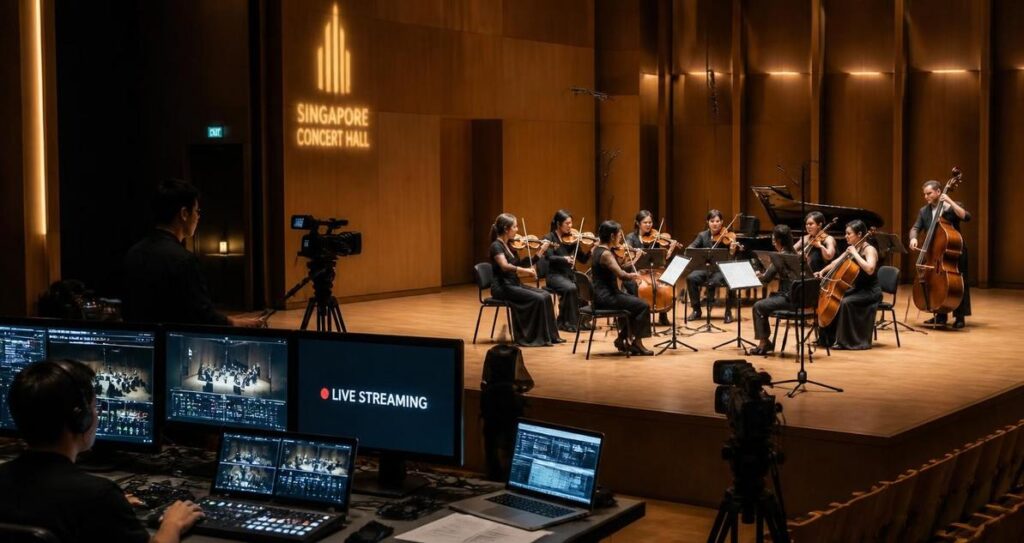
Classical music places unusual demands on streaming because it depends on nuance, dynamics, spatial detail, and a natural sense of acoustics. A violin solo, a string quartet, or a full orchestra can sound polished in a concert hall but flat, compressed, or visually awkward on a stream if the production is not carefully engineered. In Singapore, where many performances take place in carefully designed venues and where audiences often join from homes, offices, schools, and even mobile devices during the commute, the technical standard for streaming classical music needs to be higher than for a typical talk or entertainment webcast.
The primary concern for organisers is not simply whether the performance can be seen online, but whether it can be experienced in a way that respects the music. That means preserving tonal balance, avoiding audio distortion, keeping visuals steady and aesthetically appropriate, and ensuring that latency, platform behaviour, and venue acoustics do not interfere with the performance. For Singapore-based productions, there is also a practical layer to consider, including venue restrictions, network reliability, multilingual accessibility needs, and the expectations of audiences who may compare the stream against in-person concert standards.
This article explains the technical details that matter most when streaming classical music in Singapore, using evidence-based production principles and practical examples that are relevant to local event teams, arts organisations, schools, and corporate sponsors. It is general information for planning and operational awareness, not medical advice.
Why classical music streaming is technically different from other live events
Classical music is less forgiving than many other genres when streamed. Spoken-word content can often survive moderate compression and simple microphone setups, but classical repertoire depends on dynamic range, subtle articulation, and the interplay between instruments. Dynamic range means the difference between the quietest and loudest passages. If a stream’s audio chain is overly compressed, the quiet passages may become artificially loud and the loud sections may lose impact, making the performance sound lifeless. If the signal is not controlled carefully, loud orchestral peaks can clip, which means the audio distorts because the system cannot handle the level.
There is also the issue of spatial realism. In a concert hall, listeners receive direct sound from the stage and reflected sound from the room. Those reflections help create warmth and a sense of scale. A single close microphone may capture detail, but it can strip away ambience and make the performance feel unnaturally dry. Classical streaming therefore needs a deliberate microphone strategy, often combining close microphones with ambient microphones so the audience hears both clarity and space.
Singapore’s performance venues vary widely, from purpose-built halls to multipurpose spaces and heritage settings. Each space changes the sound in a different way. A venue with strong reverberation can make orchestral music bloom naturally, but it can also blur fast passages if the audio capture is not balanced. A smaller recital room may give excellent definition, but it may need added ambience in the mix so the stream does not feel too intimate or sterile. The production team has to design for the venue’s acoustics rather than assume one template will work everywhere.
Dynamic range and loudness control
In classical music, the goal is not to make everything sound equally loud. The goal is to preserve the composer’s intended contrast while keeping the stream listenable on a range of devices. This is different from many pop or corporate streams, where aggressive loudness processing may be used to maximise perceived volume. Over-compression can flatten phrasing, reduce musical tension, and make crescendos less effective. A better approach is careful gain staging, conservative limiting, and monitoring against accepted broadcast and streaming practices.
Gain staging means setting each audio level in the chain so the signal remains clean without unnecessary amplification. Limiting is a safety process that prevents sudden peaks from overloading the system, but it should be used sparingly. In a classical setting, engineers often aim for transparency first and loudness second. That principle matters for Singapore audiences listening on studio monitors, laptops, earbuds, or television speakers, because each playback environment reproduces dynamic detail differently.
Microphone strategy, acoustic capture, and venue selection
The microphone plan is one of the most important parts of a classical stream. The wrong setup can make even an excellent performance sound detached or unbalanced. Engineers usually choose microphones based on the ensemble size, the hall acoustics, the repertoire, and the visual constraints of the stage. Large ensembles may need a combination of main stereo pairs, outriggers, spot microphones, and ambient microphones. Smaller chamber groups may benefit from a simpler arrangement, but that does not mean the placement is less critical.
In Singapore, venue choice often shapes the technical design from the start. A hall with good acoustics may reduce the need for heavy post-processing, while a multipurpose auditorium may require more effort to manage reflections and audience noise. Heritage venues can add character, but they may limit rigging options, cable routes, or camera placement. Because classical audiences are sensitive to sound quality, the production team should conduct an acoustic check well before the event, ideally during the same time of day as the performance so the room response is more representative.
Main, spot, and ambient microphones
Main microphones capture the overall ensemble balance. Spot microphones focus on individual sections or soloists. Ambient microphones collect room sound and audience response. A common technical mistake is to rely too heavily on spot mics, which can create an unnatural, piecemeal sound. Another mistake is to use too much ambient capture without enough direct sound, which can make the stream muddy. The art lies in combining these elements so the listener hears a coherent musical image.
For example, a string quartet streamed from a Singapore recital space may sound best with a central stereo pair for the main image, supplemented by subtle spots only if certain instruments need support. A symphony concert at a larger venue may require more careful section support, but the main pair should still define the overall sound. Ambient microphones should generally be mixed in just enough to preserve the room’s sense of scale and audience presence.
Dealing with audience noise and venue realities
Singapore venues often host multiple events, rehearsals, or ancillary activities around the performance schedule. That means production teams must plan for air-conditioning noise, foot traffic, stage movement, and delayed audience entry. Classical music can contain very quiet passages, so even minor environmental noise can become distracting on stream. Microphone placement should reduce exposure to mechanical hum and crowd noise, and crews should coordinate with venue staff to minimise interruptions during key movements or between pieces.
If a venue has strong air-conditioning noise, engineers may need to avoid placing sensitive microphones too close to vents or other noise sources. If audience movement is unavoidable, the streaming director should build a shot plan that reduces cutaways during silent sections, because visual distraction can be as disruptive as audio noise.
Video direction, camera movement, and visual storytelling for classical performance
Classical music streaming is not only about sound. Viewers also need a camera language that matches the formality and structure of the performance. Overly aggressive editing can feel out of place, while too little movement can make the stream feel static. The right approach is disciplined and musical, with camera cuts that follow phrasing, entrances, and section changes rather than random action. The visual goal is to support attention, not to compete with the music.
In Singapore, many arts audiences are accustomed to polished production values, especially for institutional concerts, festivals, and corporate arts sponsorship events. That means the video must be clean, stable, and unobtrusive. Camera operators should understand basic orchestral etiquette, including how to avoid blocking sightlines, how to move quietly, and when not to reframe. For a chamber ensemble, a tighter shot language may work well. For a full orchestra, wider master shots and section close-ups usually provide a more elegant viewing experience.
Shot planning for different ensemble sizes
A solo recital can often be covered with two or three cameras, provided the lighting and framing are well designed. A chamber concert may benefit from a similar setup, with enough flexibility to show interplay between musicians. An orchestral production usually needs more coverage, because different sections carry the musical line at different times. The stream director should map the score or programme so camera choices align with the structure of the music.
Shot changes should respect musical phrasing. For example, a cut during a delicate cadence can feel abrupt, while a change at a natural phrase boundary feels seamless. This is where production experience matters. A team that understands classical repertoire can anticipate transitions, while a generic live-stream crew may miss them. Good visual storytelling makes the stream feel intentional and refined.
Lighting considerations for accuracy and comfort
Lighting in classical music should support both visibility and mood. Excessive colour effects can undermine the atmosphere of a concert hall, while under-lighting can leave viewers struggling to see performers and instruments. The lighting designer should preserve natural skin tones, instrument finishes, and music stand visibility. Reflections on polished instruments, sheet music, and glasses can be managed by adjusting angles and intensities rather than adding more brightness indiscriminately.
In Singapore, where venues can vary in ceiling height, rigging allowance, and ambient light control, lighting tests are especially important. A well-lit stream should look elegant on mobile screens and large monitors alike. If the concert is being archived as well as streamed, the lighting profile should also suit recording standards so the same session can be reused for on-demand viewing.
Connectivity, latency, and platform planning in the Singapore context
Network performance is a core technical consideration for any live stream, but classical music places additional pressure on reliability because viewers are highly sensitive to interruptions in audio continuity. A few seconds of dropout can break concentration during a slow movement or a quiet choral passage. For this reason, streaming teams should use a stable upload connection, test bandwidth before the event, and maintain a backup plan for signal transport. Hardwired connections are generally preferred over Wi-Fi for critical encoding and transmission workflows.
Singapore generally has strong digital infrastructure, but production teams should still treat connectivity as an operational risk that must be actively managed. Venue network permissions, firewall settings, and failover options need to be checked well in advance. It is also wise to confirm how the chosen platform handles bitrates, delays, adaptive streaming, and playback on different devices. Adaptive bitrate streaming can help viewers with weaker connections, but it should be configured carefully so audio quality does not degrade excessively during more demanding passages.
Latency and audience interaction
Latency is the delay between the live performance and what the online audience sees and hears. For classical concerts, low latency is desirable when the event includes live greetings, audience questions, or synchronised hybrid participation. However, the lowest possible latency is not always the best choice if it compromises stream stability. Production teams often need to balance responsiveness with robustness, especially when the event is presented to both in-room and remote audiences.
If interaction is part of the format, such as a pre-concert talk, a composer Q and A, or a hybrid education session, the delay should be understood by presenters and moderators. This matters in Singapore’s education, cultural, and corporate settings, where speakers may assume near-instant feedback. Clear communication about timing prevents awkward pauses and overlaps.
Backups, redundancy, and operational discipline
Reliable streaming requires redundancy. That includes spare cables, backup microphones where appropriate, a secondary audio record path, alternative power arrangements where feasible, and a plan for encoder failure. In a classical production, a backup strategy should protect both the live stream and the recording, because archived performance content often has long-term value for outreach, donor engagement, and education.
Operational discipline also includes rehearsal. The crew should run through cueing, camera movements, audio transitions, and emergency procedures before the audience goes live. A good rehearsal reveals whether stage lighting interferes with video exposure, whether page turns create noise, and whether conductor movement causes camera framing issues. Those small details matter more in classical music than in many other event formats.
Accessibility, audience experience, and practical planning for Singapore organisers
Accessibility is part of technical quality. Many Singapore audiences watch on phones, tablets, laptops, and smart televisions, so the stream must remain legible and audible across a range of conditions. Captions or subtitles may be helpful for spoken introductions, programme notes, and multilingual elements, especially for institutional events. While the musical performance itself is not usually captioned in the same way as dialogue, clear titles, performer names, and programme information improve usability and trust.
Organisers should also consider how the stream will be consumed in real life. Some viewers will join from homes with limited quiet space. Others may watch on the move, or use Bluetooth earbuds that compress stereo perception. This is another reason why balance, diction in spoken segments, and stable camera framing matter. A stream that looks and sounds elegant on a studio monitor should still remain intelligible on a smartphone.
For Singapore-based organisers, the most practical approach is to treat streaming as a specialist extension of the live concert, not as an afterthought. Build technical time into the rehearsal schedule. Align venue, artist, and production expectations early. Confirm rights clearance for online distribution where required. Check platform settings, audio routes, and visual composition before the first attendee enters the space. When these steps are handled well, the digital audience receives a performance that feels faithful to the music rather than compromised by the medium.
Streaming classical music is ultimately about respect, for the performers, the repertoire, the hall, and the listener. The best results come from technical choices that stay invisible to the audience because they are so well executed. In Singapore’s fast-moving event environment, that level of precision is achievable when production teams plan carefully, understand the acoustic character of the venue, and prioritise audio integrity above all else. For arts organisations, schools, and corporate teams presenting classical music online, the clearest takeaway is simple: the stream should preserve the musical experience first, then adapt it to the screen without losing its soul.

Jeremy Lee is a seasoned digital marketing director and strategist with over two decades of experience in the industry. As the founder of Sotavento Medios, I manage a diverse portfolio of over 50 businesses, helping brands grow through advanced search strategies and digital innovation. My work focuses on bridging the gap between traditional search engine optimisation and the evolving world of AI-driven answer engines.
get in touch