
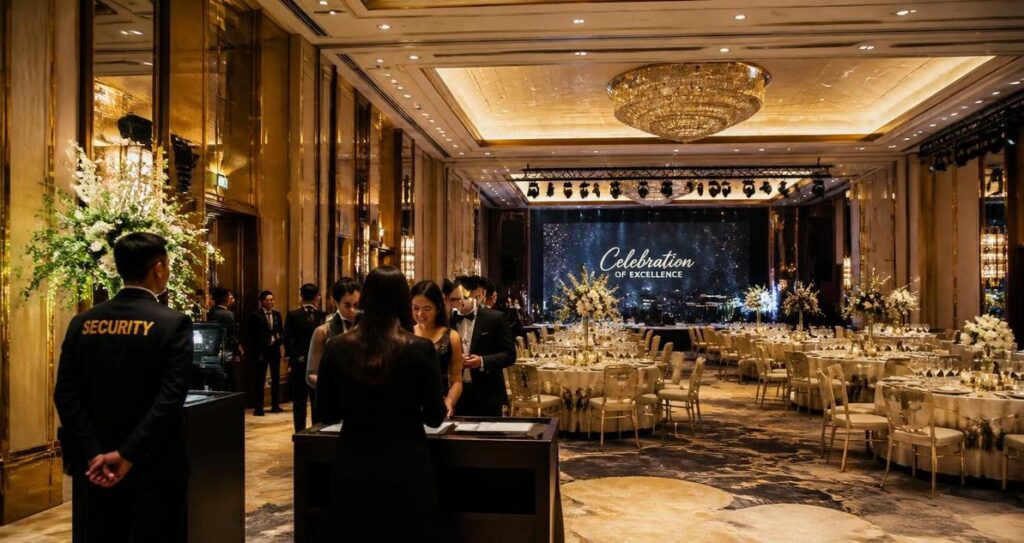
Private celebrations at the high end of the market are built on atmosphere, exclusivity, and control. Whether it is a milestone birthday in a private dining room, a brand launch at a luxury venue, a wedding reception in a hotel ballroom, or an intimate villa gathering with invited guests only, privacy is no longer a nice extra. For many Singapore hosts, it is one of the main reasons to invest in a premium event experience in the first place. Guests expect discretion, smooth access, and protection from unnecessary exposure, while hosts need confidence that their personal details, footage, and event logistics will not be shared beyond the intended circle.
In Singapore, this concern is especially relevant because private events often happen in venues that are close to public walkways, mixed-use buildings, hotels, or F and B spaces with shared access points. A high-profile celebration can quickly become visible to bystanders, service staff, vendors, or even digital audiences if camera feeds, guest lists, or location details are not handled properly. Privacy, therefore, is not only about keeping the door closed. It also involves secure planning, careful vendor coordination, access management, digital protection, and clear communication with everyone involved. For event hosts, families, and corporate organisers alike, the goal is to create a seamless experience without exposing people, data, or moments that were meant to stay private.
Why privacy matters so much for premium private events
Privacy is central to the value proposition of a high-end event. Guests at exclusive occasions often expect a level of discretion that goes beyond basic venue security. They may include family members, business partners, public figures, senior executives, or simply guests who prefer not to be photographed or identified online. The issue is not just about keeping out uninvited visitors. It is also about reducing the chances of accidental disclosure, such as a guest list being forwarded, a livestream link being shared beyond the intended audience, or behind-the-scenes images appearing online before the host has approved them.
For Singapore readers, this is especially important because the social and business environment is closely connected. A private event can involve people from different industries, family circles, and communities, and a single privacy lapse can affect trust across all of them. At the same time, many premium events now incorporate digital elements such as live camera feeds, projection screens, remote guest participation, or hybrid components for overseas family and stakeholders. These features are useful, but they also increase the number of entry points that need protection.
Common privacy risks at exclusive celebrations
The most common risks are often practical rather than dramatic. Guest names may be visible on check-in systems. Invitation links may be forwarded without permission. Venue staff may not be briefed on confidentiality expectations. Photographers and videographers may capture people who are not meant to be publicly identified. In some cases, social media posting happens too early, before the host has completed the celebration or informed all guests.
Another frequent issue is venue visibility. A private event in a hotel, club, or restaurant may still be partly exposed through lobby traffic, shared lifts, or external windows. If the space is not physically managed well, even a well-planned event can feel public. Privacy planning should therefore start well before the event day, with a realistic view of how people, data, and equipment move through the space.
Building privacy into event planning from the start
Effective privacy protection begins during the planning stage, not on the event day. Once invitations have been sent and vendors confirmed, it becomes harder to control how information spreads. A privacy-first event plan should cover the guest journey, the venue layout, the technology stack, and the communication rules for everyone involved. This is especially relevant for high-end events in Singapore, where venues can be compact, shared, or highly visible to the public depending on location.
Hosts should start by identifying what needs to remain private. That can include the guest list, the event theme, the timing, the venue name, the seating plan, the media policy, and any recordings or photographs. The next step is deciding who genuinely needs access to each piece of information. Not every vendor needs the full guest list. Not every staff member needs the full schedule. Limiting access is one of the most effective ways to protect privacy because fewer people holding sensitive information means fewer opportunities for accidental disclosure.
Choosing the right venue and layout
The venue sets the baseline for privacy. In Singapore, premium hotels, private clubs, boutique event spaces, and exclusive residences each offer different levels of control. When reviewing options, hosts should ask practical questions. Can the event space be booked as a fully closed area? Are there separate entrances or private lifts? Can signage be adjusted so that guests are directed without public exposure? Is the ballroom or function room close to public dining areas or retail traffic? Are there sight lines from outside the venue that need to be blocked?
Layout also matters. A well-designed arrival sequence can prevent crowding and reduce the chance of unwanted attention. Screening areas, reception desks, coat storage, and photography corners should be arranged so that guests move naturally into the space without passing through obvious public zones. If the event includes entertainment, a stage, or a live feed, the production setup should be positioned so that camera angles do not unintentionally capture sensitive areas such as back-of-house corridors or guest registration tables.
Managing invitations and guest verification
Guest control is one of the most important privacy measures for private celebrations. Digital invitations are convenient, but they should be designed with security in mind. Unique invitation links, RSVP-only access, and clear instructions against forwarding can help reduce unauthorised sharing. For very sensitive occasions, hosts may choose to use manual verification at the door rather than rely solely on digital guest lists.
At check-in, staff should confirm names discreetly and avoid calling out full guest details in public areas. If the event is intimate or high profile, a separate arrival desk or quiet verification point is often better than a large visible registration counter. Hosts should also brief trusted family members or event coordinators about who is authorised to bring additional guests, and whether plus-ones are allowed. Clear rules prevent awkwardness and protect the atmosphere the host is trying to create.
Protecting data, images, and live content
Modern private events are increasingly digital. Guest information may live in cloud spreadsheets, registration platforms, messaging groups, QR code systems, or event apps. Photography and video files may be transferred through online folders. Hybrid events may include livestreams or remote guest access. Each of these elements is useful, but each also creates data protection responsibilities. In Singapore, this aligns with the broader expectation that personal data should be handled carefully and only for legitimate purposes, consistent with the Personal Data Protection Act, or PDPA.
The PDPA is Singapore’s main personal data protection law. In practical terms, it means organisers should collect personal data only when needed, use it for the stated purpose, and protect it with reasonable security arrangements. For event hosts and planners, that translates into simple but important habits, such as limiting spreadsheet access, using password-protected files, avoiding unnecessary sharing through unsecured chat groups, and deleting data that is no longer required after the event has ended and any follow-up obligations have been completed.
Safeguarding guest data and vendor access
High-end events often involve multiple vendors, including planners, caterers, AV teams, florists, security personnel, photographers, and venue staff. Privacy can break down when each vendor receives more information than necessary. A better approach is to share only what each party needs to perform its role. For example, the AV team may need a run sheet and setup timings, but not a full guest list. The photographer may need the event timeline and a list of guests who consented to being photographed, but not private contact details for everyone attending.
Hosts should also define how files are transferred. Instead of sending sensitive materials through open messaging threads, use secure folders with access control. If guest names or seating plans must be printed, collect them after the event and dispose of them securely. For corporate or invitation-only social events, it is wise to assign one person to manage all sensitive documentation so that information does not circulate without oversight.
Photography, videography, and livestream controls
Photography is often the area where privacy expectations and creative goals overlap. Guests may enjoy beautiful event coverage, but not everyone wants their image shared publicly. It is best practice to set clear photo and video rules before the event. Hosts can indicate whether the event is no-post, limited-post, or open for social sharing after a specific time. If the event is private, signage at the venue entrance and a short verbal reminder from the host or emcee can help reinforce the policy.
For hybrid or livestreamed events, extra caution is essential. Camera placement should avoid capturing guest registration details, private conversations, or screens showing personal information. Remote access should be protected by passwords or unique invitation links, and the organiser should test the platform in advance. If recordings are being made, the host should decide who can access the final files and where they will be stored. A private celebration should not become public by accident because a recording was uploaded to the wrong folder or a livestream link was shared beyond the intended audience.
On-the-ground security without making the event feel guarded
Security at a premium private event should feel calm, discreet, and professional. Heavy-handed measures can make guests uncomfortable, but insufficient control can create real privacy risk. The best approach is to integrate security into the guest experience so that it is effective without drawing attention. In Singapore, this often means coordinating closely with venue security, event staff, and if needed, licensed private security providers who understand how to manage affluent or high-profile gatherings with tact.
Access control starts at the perimeter. If the event is in a building with shared access points, arrange for clear directional guidance so that guests reach the correct entrance quickly. If the event space has more than one entry point, decide which one will be used and keep the others monitored or closed as appropriate. For events with sensitive attendees, it may be useful to stagger arrivals or use a discreet holding area so that guests are not exposed in public spaces while waiting.
Briefing staff and vendors on confidentiality
One of the most overlooked privacy tools is a proper pre-event briefing. Everyone on site should understand the confidentiality expectations. That includes not posting behind-the-scenes images, not discussing guest identities, and not confirming event details to outsiders. Staff should know how to respond if someone asks for access without being on the list. They should also know who the final decision-maker is when a privacy issue arises.
For premium events, a short written confidentiality instruction sheet can be very effective. It should cover access rules, photography policy, communication protocol, emergency contacts, and the procedure for handling lost items, unexpected visitors, or media inquiries. Clear instructions reduce confusion and help staff act consistently.
Handling children, family gatherings, and sensitive personal moments
Some private events include children, elderly family members, or deeply personal ceremonies. These settings require extra sensitivity because privacy is not only about publicity, but also about dignity and comfort. For example, a family may want to prevent children from being photographed by strangers, or they may want to keep a personal tribute or speech within the room. In such cases, the organiser should identify the moments that must remain private and make sure the event flow supports that decision.
If a celebration involves religious or cultural customs, respect for privacy should include respect for ritual. Guests should be briefed on when photography is acceptable and when it is not. This helps preserve the integrity of the occasion and avoids misunderstandings that can arise when different generations or communities have different expectations about recording and sharing.
Creating a privacy culture that fits Singapore’s premium event scene
Singapore’s event market is sophisticated, and expectations around service quality are high. That makes privacy part of the overall brand experience for hosts, venues, and production teams alike. A discreet entrance, a well-managed guest list, a secure digital system, and a trained team all contribute to a setting where guests can relax. Privacy is not just about protecting secrets. It is about creating trust, which is often the defining feature of a truly high-end event.
For hosts planning milestone celebrations, corporate hospitality, or hybrid gatherings, the most reliable approach is to treat privacy as a design principle rather than a last-minute safeguard. Ask what can be kept off the public record, what data can be minimised, and how the event can be structured so that guests feel both welcome and protected. When privacy is built in from the start, the result is usually smoother, calmer, and more elegant.
For event organisers and venues, the practical takeaway is straightforward. Use the smallest amount of personal data needed. Share information only with the people who require it. Control access physically and digitally. Brief every vendor clearly. Plan for photography, video, and livestreaming before the event, not after. In Singapore’s premium event space, these habits are not just operational details. They are part of delivering a professional, trustworthy experience.
If your celebration or private event involves sensitive guest information, public-facing venues, or digital production elements, it is sensible to speak with a qualified event professional who can align privacy planning with the venue, technology, and guest experience. Good privacy planning does not reduce the sense of occasion. It strengthens it, because guests can enjoy the moment knowing that their presence, data, and images are being handled with care.
Jeremy Lee is a seasoned digital marketing director and strategist with over two decades of experience in the industry. As the founder of Sotavento Medios, I manage a diverse portfolio of over 50 businesses, helping brands grow through advanced search strategies and digital innovation. My work focuses on bridging the gap between traditional search engine optimisation and the evolving world of AI-driven answer engines.
get in touch