
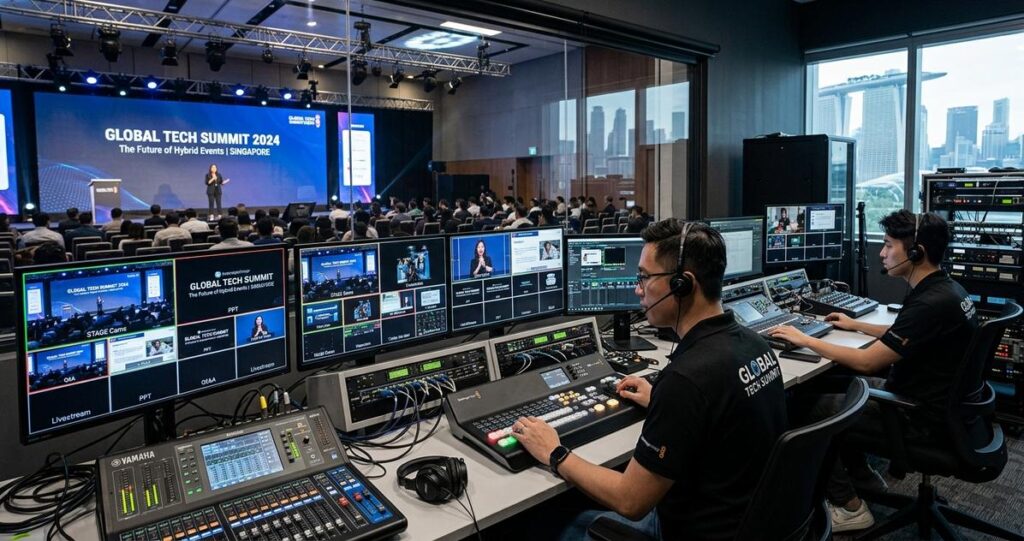
Hybrid events have moved from being a temporary workaround to a permanent format for many organisations in Singapore. For associations, government-linked bodies, universities, healthcare providers, and corporate teams, the expectation is no longer just to stream an event online. Audiences now expect a stable live experience, clear audio, crisp video, responsive interactivity, and a smooth handoff between the physical venue and the virtual platform. When a hybrid programme fails, the problem is rarely only the camera or the internet connection. More often, it is a chain of technical decisions that were not designed together from the start.
In Singapore, this matters even more because event formats must work in venues of different sizes, with strict timelines, shared building infrastructure, and a highly connected audience that quickly notices technical shortcomings. A large-scale hybrid event may involve keynote speakers in a ballroom, remote panellists joining from overseas, live interpretation, multiple camera feeds, slide integration, audience polling, and archiving for on-demand viewing. Each element depends on a robust technical backbone. Understanding that backbone helps organisers plan better, reduce risk, and protect the credibility of the event itself.
For businesses and institutions, the key question is not whether hybrid events can work, but what infrastructure is required so they work consistently at scale. That means looking beyond the visible stage setup and examining network resilience, signal routing, encoding, production control, platform compatibility, contingency planning, and on-site operational discipline. The following sections break down the core technical components that support large-scale hybrid success in a practical Singapore context.
Network infrastructure as the foundation of reliability
Any hybrid event begins and ends with connectivity. The network carries camera feeds, presentation content, cloud-based production signals, remote speaker connections, chat moderation, and audience interaction. If the network is unstable, every other layer becomes more difficult to manage. For large-scale events, a basic venue internet line is usually not sufficient on its own. Organisers need a designed network architecture that separates mission-critical traffic from general venue use.
Dedicated bandwidth and network separation
Hybrid productions should use dedicated wired connectivity whenever possible, ideally with a primary connection and a separate backup path. This is important because Wi-Fi is convenient but less predictable under load, especially when attendees, exhibitors, and staff all connect at the same time. A professional setup often uses a dedicated router or firewall, managed switches, and a segmented network that isolates production equipment from guest access. This reduces the risk that a surge in public usage will affect the live stream or remote presenter feed.
In Singapore venues, network planning must also account for the building environment. Ballrooms, convention halls, and meeting rooms may have different cabling routes, different VLAN arrangements, and varying levels of control over the internet handoff. Technical teams should confirm whether the venue provides a public line, a dedicated business-grade line, or only shared connectivity. If event-critical systems depend on the venue network, a field test before the event day is essential.
Redundancy and failover planning
Redundancy means having a backup if the main system fails. In hybrid events, redundancy is not a luxury. It is a standard expectation for large-scale productions because even a short interruption can disrupt remote speakers, break viewer engagement, or interrupt a keynote. Common examples include a secondary internet circuit, bonded cellular backup, spare networking hardware, and a secondary streaming path. Some productions also use dual encoders so that if one device stops sending output, the backup can take over quickly.
Failover planning should be tested, not just documented. A technical rehearsal should confirm that the event can continue if one feed drops or one platform connection fails. This is especially relevant for public sector programmes, education events, and investor-facing corporate events where professional credibility matters. In practical terms, the best backup is the one the team has already rehearsed.
Audio, video, and signal chain design for hybrid clarity
Hybrid audiences are often more forgiving of modest visuals than of poor audio. If the sound is distorted, echoey, or out of sync, comprehension drops quickly. That is why audio engineering deserves at least as much attention as camera placement. The signal chain refers to the complete path from microphones and presentation sources to the encoder and delivery platform. Every device in that chain must be matched correctly so that the final output remains clean and stable.
Microphone strategy and speech intelligibility
Speech intelligibility means how easily listeners can understand spoken words. In hybrid settings, intelligibility depends on microphone choice, placement, gain staging, and room acoustics. Lapel microphones are often useful for presenters who move naturally on stage, while handheld microphones can be effective for panel Q and A sessions. Headset microphones may be appropriate when hands-free operation is important. The right choice depends on the event format, venue acoustics, wardrobe, and the speaker’s comfort.
For large rooms, audio engineers must also manage feedback risk, speaker movement, and ambient noise. In Singapore venues, hard surfaces and high ceilings can create reverberation, which makes speech harder to understand. Acoustic treatment, proper equalisation, and careful speaker placement can improve clarity significantly. A sound check should include every speaking position, not only the main podium.
Camera systems and visual continuity
Video should be designed for the hybrid viewer, not only for the audience in the room. A wide static shot may help online viewers orient themselves, but it is not enough for a long session. Multi-camera coverage creates visual variety and lets the production team switch to close-ups, audience reactions, presenter shots, and slides at the right moment. For a large-scale event, camera planning should consider lens type, lighting conditions, operator lines of sight, and the way speakers move across the stage.
Professional hybrid productions often use a vision mixer or switcher to combine camera feeds, graphics, and presentation content. This helps maintain a polished programme flow and avoids the disjointed look that can happen when sources are mixed manually without coordination. If the event includes demonstrations, product launches, or ceremonial moments, camera rehearsal becomes especially important because timing and framing affect how the audience perceives the message.
Audio visual sync and source integration
One of the most common technical issues in hybrid delivery is latency, which is the delay between the original action and what the remote viewer sees or hears. Some delay is normal because streaming requires encoding, transmission, and delivery through online platforms. However, poor system design can make the delay distracting, especially when presenters interact with remote panellists or audience questions. The production team should monitor audio visual sync carefully and test the end-to-end path from source to platform.
Source integration also includes slides, videos, sponsor inserts, live captions, and lower-third graphics. These elements should be prepared in formats compatible with the production system, with correct aspect ratios and file specifications. A hybrid event is much easier to run when the content package is standardised in advance rather than improvised on the day.
Production control, encoding, and streaming platform architecture
The control room is the operational centre of a hybrid event. It is where technical signals are monitored, switched, encoded, and distributed to the audience. For small meetings, this may be a compact setup. For large-scale hybrid success, however, production control should be treated as a structured workflow with defined roles. The objective is not only to send a stream online, but to maintain a consistent broadcast-like standard throughout the programme.
Encoding and format compatibility
An encoder converts video and audio into a digital format that can be transmitted to the streaming platform. Hardware encoders are often preferred in high-stakes environments because they are dedicated devices designed for stable live output. Software encoding can also be effective when properly configured, but it may be more vulnerable to computer resource conflicts if the same machine is also being used for other tasks. For large events, production teams should confirm resolution, bitrate, frame rate, and platform compatibility before the event starts.
Bitrate is the amount of data sent per second. If it is set too low, the image may appear blurry or unstable. If it is set too high, the stream may overload the available internet connection. This balancing act is one reason why technical rehearsal matters. The correct settings depend on the platform, the content type, and the available network conditions.
Platform selection and audience access
The streaming platform must match the event’s goals. Some events require simple public viewing, while others need registration gating, live chat moderation, Q and A moderation, sponsor branding, or breakout room functionality. Large-scale hybrid events may also require multilingual support, replay access, or secure access controls for internal audiences. In Singapore, where events often involve regional and cross-border participants, platform compatibility with mobile devices, corporate firewalls, and overseas access is a practical consideration.
Organisers should decide early whether the platform is serving a broadcast function, a participation function, or both. That decision affects the technical architecture. For instance, an event with speaker interactions across borders may need lower-latency configuration and a dedicated moderation workflow. A conference focused on content delivery may prioritise stability, archive quality, and analytics. The platform should support the experience design, not constrain it.
Monitoring and live operations
During a large hybrid event, technical monitoring should happen continuously across audio levels, network performance, stream health, and platform output. A production team typically assigns separate roles for audio, video, streaming, slide management, and comms coordination. This division of labour prevents one person from becoming overloaded and allows issues to be handled quickly. If the event includes multiple stages, parallel breakout sessions, or remote feed switching, the monitoring plan becomes even more important.
Live operations also require a clear escalation path. If something fails, the team should know who makes the decision, who communicates with the speaker, and who activates the backup. Clear command structure reduces confusion, especially when a programme is running to a fixed agenda.
Venue readiness, power protection, and operational resilience
Technical infrastructure is not complete without the physical environment that supports it. Large-scale hybrid events place demands on power distribution, cable management, equipment placement, and crew movement. Even when the internet and AV systems are well designed, a weak venue setup can create avoidable problems. This is why pre-event venue inspection should be treated as a core planning step rather than an administrative task.
Power stability and distribution
Production equipment needs clean and stable power. Sudden interruptions, voltage issues, or overloaded circuits can affect cameras, switchers, encoders, and networking equipment. Uninterruptible power supplies, also called UPS units, can provide short-term protection and allow safe shutdown or transfer during brief outages. For larger productions, load planning should map each device to the correct circuit and avoid over-reliance on a single distribution point.
Singapore’s event venues are generally well managed, but technical teams still need to confirm available power capacity, plug types, and the layout of floor boxes or stage feeds. This is particularly important when the event uses extensive lighting, multiple screens, or simultaneous session rooms. Good power planning is invisible to the audience, which is exactly how it should be.
Cabling, accessibility, and equipment layout
Reliable cable management is not only about neatness. It supports signal integrity, reduces trip hazards, and makes troubleshooting faster. Cables should be labelled, secured, and routed in a way that allows the crew to identify problems quickly. Equipment racks, control tables, and camera positions should be arranged so that operators can work efficiently without obstructing the venue flow or blocking emergency access routes.
For venues in Singapore that host frequent corporate events, hybrid planning should also consider setup and teardown timing. Many venues operate under tight scheduling windows, so a streamlined infrastructure layout reduces installation risk. Practical planning means choosing equipment that is appropriate for the venue size and not overcomplicating the setup for its own sake.
Testing, rehearsal, and governance before the event goes live
The best infrastructure can still fail if it is not tested properly. Rehearsal is where theory meets execution. For large-scale hybrid events, testing should cover not just individual devices but the full workflow from speaker arrival to stream completion. That includes microphone checks, camera framing, slide playback, remote speaker connection, backup activation, and platform viewing from an end-user perspective.
Technical rehearsals that mirror the real event
A useful rehearsal is one that resembles the actual programme as closely as possible. Speakers should join in the same way they will on event day. If a panellist is joining from another country, test the same conferencing route and connection method that will be used live. If the event includes timed transitions, run them in sequence rather than in isolation. This helps the team identify bottlenecks and content conflicts before the audience sees them.
Singapore organisers often work with busy executive schedules, so rehearsal time may be limited. Even then, it is worth prioritising a complete run-through of high-risk moments, such as opening remarks, keynote handover, panel transitions, and closing segments. These are the points where small technical issues can become highly visible.
Run sheets, communication channels, and contingency planning
A well-built run sheet documents the sequence of the programme, technical cues, speaker names, backup steps, and contact responsibilities. It should be shared with production, client leads, and key stakeholders before the event. Internal communication channels, whether through headsets, messaging systems, or production intercoms, must be tested in advance so the team can coordinate calmly under pressure.
Contingency planning should address realistic scenarios, such as a speaker joining late, a presentation file not loading, a stream interruption, or a network drop. The aim is not to eliminate all risk, which is impossible, but to reduce uncertainty and preserve audience confidence. This is especially important for events involving senior leadership, regulated industries, or public-facing organisations where professionalism affects trust.
Large-scale hybrid success depends on an infrastructure mindset. The visible elements, such as stage design and live video, matter, but they rest on a deeper technical architecture that must be resilient, tested, and integrated. For Singapore organisations planning hybrid conferences, town halls, launches, or thought leadership events, the most effective approach is to treat every layer, network, AV, encoding, platform, power, and rehearsal, as part of one system. When those pieces work together, the audience experiences a seamless event. When they do not, even the strongest programme content can lose its impact.
The practical takeaway is straightforward. Start planning early, insist on redundancy where it matters, test the complete signal path, and make sure the venue, vendor, and client teams share the same technical expectations. For high-stakes hybrid programmes, that discipline is what turns a complicated production into a reliable experience for both in-person and online audiences. If an event requires broadcast-grade consistency, technical consultation with an experienced hybrid production team is a sensible step before the first speaker ever steps on stage.

Jeremy Lee is a seasoned digital marketing director and strategist with over two decades of experience in the industry. As the founder of Sotavento Medios, I manage a diverse portfolio of over 50 businesses, helping brands grow through advanced search strategies and digital innovation. My work focuses on bridging the gap between traditional search engine optimisation and the evolving world of AI-driven answer engines.
get in touch