
Managing Shared Success: Collaborative Streaming for Joint Ventures
In the enterprise ecosystem, joint ventures, multi-brand product announcements, and cross-departmental town halls represent high-stakes communication events. The logistical complexity of these initiatives is mirrored in the technical execution of their live streaming component. A traditional, single-source production workflow is fundamentally inadequate for scenarios requiring seamless integration of multiple, geographically dispersed stakeholders. True collaborative streaming demands a broadcast-grade infrastructure built on robust protocols, centralized control, and comprehensive redundancy. This is not a task for prosumer tools or improvised solutions; it requires a deep understanding of signal contribution, production engineering, and secure distribution architecture. The challenge lies in unifying disparate technical teams, equipment, and network conditions into a single, cohesive, and reliable broadcast that protects the brand integrity of all participating entities. Successfully navigating this requires a shift in thinking from a simple web stream to a decentralized, multi-point professional production.
Architecting the Contribution Layer for Multi-Party Ventures
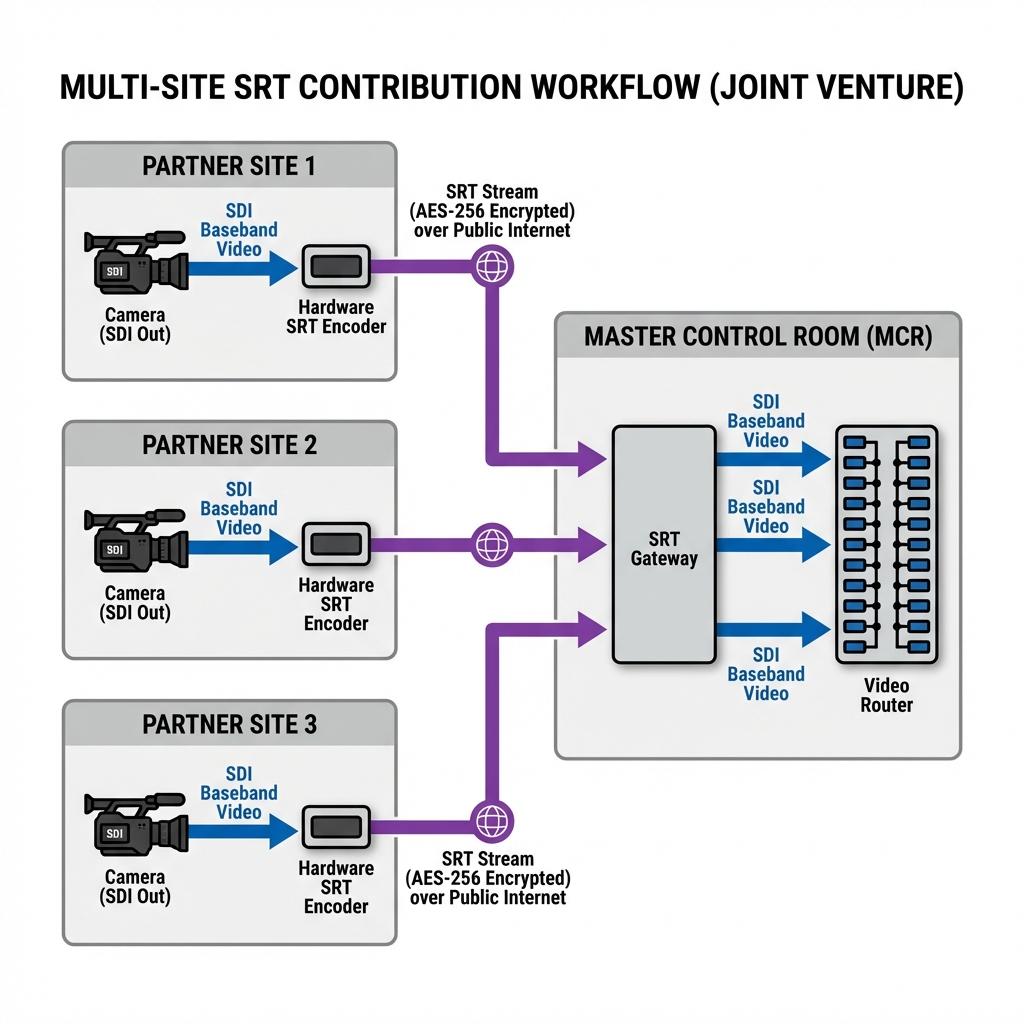
The foundation of any successful collaborative stream is the contribution layer, the process of transporting high-quality, low-latency audio and video feeds from each partner location to a central production facility. The integrity of these source signals dictates the maximum quality of the final broadcast. Relying on unstable protocols or inadequate hardware at this stage introduces unacceptable risk. Therefore, a meticulous approach to protocol selection and on-site encoding is non-negotiable for any serious B2B production.
Selecting the Right Contribution Protocol: SRT vs. NDI vs. RTMP
The choice of transport protocol is the single most important decision in the contribution workflow. While RTMP (Real-Time Messaging Protocol) was once a standard, its TCP-based nature and lack of modern codec support make it unsuitable for professional multi-site contribution due to its high overhead and poor performance over imperfect networks. The modern broadcast standards are SRT (Secure Reliable Transport) and NDI (Network Device Interface). SRT is an open-source protocol designed specifically for high-performance video transport over unpredictable networks like the public internet. It uses UDP for low-latency transmission but incorporates an intelligent ARQ (Automatic Repeat reQuest) mechanism to retransmit lost packets, providing the reliability of TCP without the associated latency penalty. With support for AES-128/256 bit encryption, it is the industry standard for secure, remote contribution. For a joint venture stream, this means each partner can send a secure, stable feed with a configurable latency buffer, typically between 80ms and 200ms, to compensate for network jitter. NDI, on the other hand, excels within managed, high-bandwidth LAN or WAN environments. Full NDI is a visually lossless, high-bitrate codec ideal for connecting studios or event spaces on a dedicated fiber network, offering near-zero latency. For contribution over bandwidth-constrained networks, NDI|HX and its subsequent versions use H.264 or H.265 compression, behaving more like a traditional streaming protocol but with the added benefits of network device discovery and control data transmission.
On-Site Encoding and Hardware Considerations
Each remote contribution site must be equipped with a professional hardware encoder. These devices are purpose-built for continuous, stable operation and offer superior performance to software-based solutions for mission-critical feeds. A typical requirement is a unit that accepts a baseband video input, such as 3G-SDI or HDMI 2.0, and encodes the signal into the chosen transport protocol. For SRT contribution, encoders from manufacturers like Haivision, AJA, or Kiloview are standard. Key specifications include support for H.265 (HEVC) encoding for superior compression efficiency over H.264 (AVC), redundant power supplies, and dual Gigabit Ethernet ports for network redundancy. For locations with unreliable terrestrial internet, bonded cellular technology from providers like LiveU or TVU Networks becomes essential. These systems aggregate bandwidth from multiple cellular modems (4G/5G), Wi-Fi, and Ethernet connections to create a single, highly resilient transmission path, ensuring a stable contribution feed from even the most challenging remote locations.
Centralized Production: Unifying Disparate Feeds into a Cohesive Broadcast
Once all contribution feeds are reliably flowing from partner locations, they must be received, managed, and integrated at a central Master Control Room (MCR), whether a physical facility or a cloud-based production environment. This hub is where individual streams are transformed into a polished, professionally produced program. This process involves sophisticated signal routing, switching, audio mixing, and communication systems to ensure perfect synchronization and broadcast quality control. The MCR serves as the single point of truth for the entire live event.
Signal Ingest and Routing Infrastructure
The first stop for incoming SRT or NDI feeds in the MCR is a decoder or gateway. An SRT gateway, such as Haivision’s SRT Gateway, can receive multiple streams and convert them back into baseband SDI for use in a traditional broadcast workflow or re-encapsulate them as NDI or SMPTE 2110 for an IP-based facility. Once in baseband, these signals are fed into a video router or matrix switcher, like a Ross Ultrix or Blackmagic Videohub. This allows any source to be routed to any destination, such as the production switcher, multiview monitors, or recording decks. A critical component in this stage is a master sync generator that provides a genlock signal to all equipment, ensuring every video source is frame-accurate and preventing glitches during switching.
The Production Switcher: The Heart of the Collaborative Stream
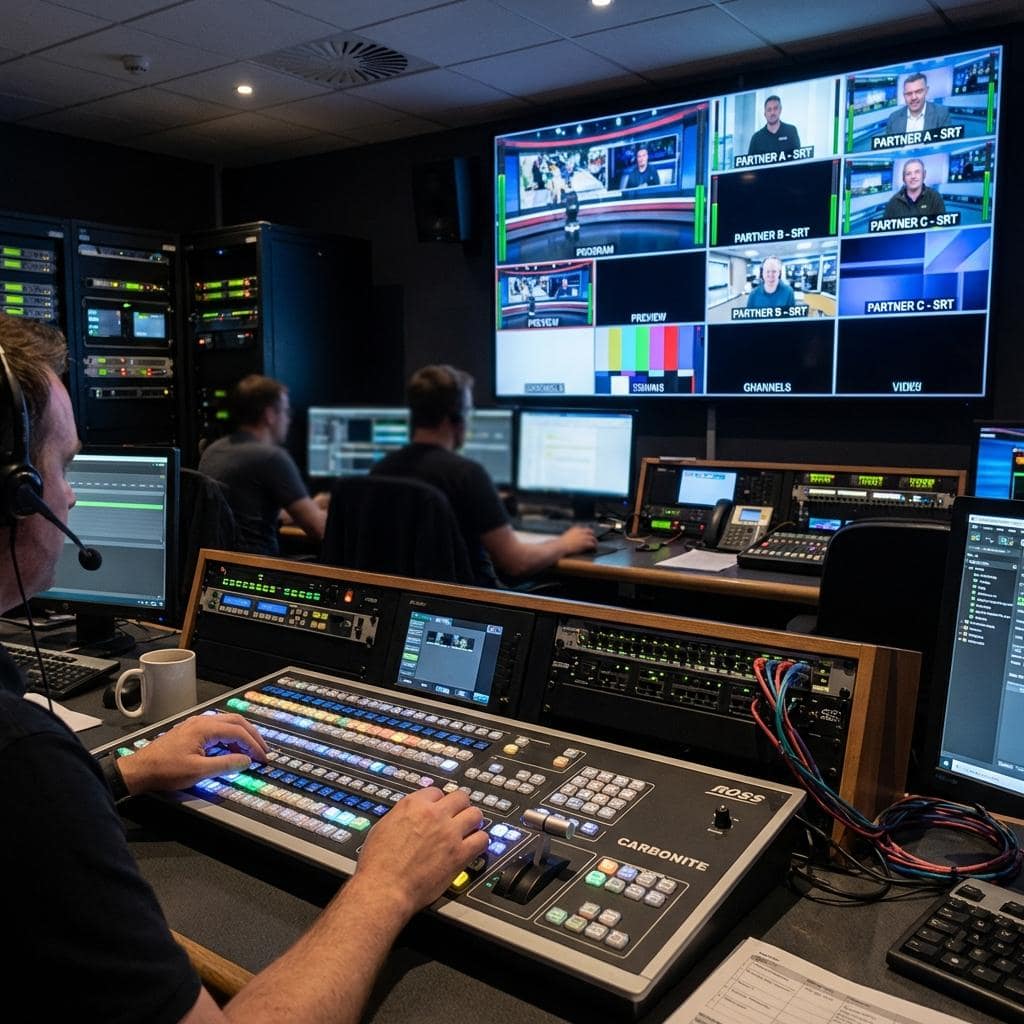
The production switcher, or vision mixer, is where the creative and technical aspects of the broadcast converge. For a joint venture, a switcher with multiple Mix/Effects (M/E) buses is essential. This allows a technical director to create complex compositions, such as a multi-box view showing speakers from different companies, while simultaneously preparing the next shot on a separate M/E bus. Advanced keyers are used to overlay partner-specific branding, logos, and lower-third graphics. Powerful composition engines like a SuperSource or DVE (Digital Video Effects) are leveraged to build polished, dynamic layouts that give equal and appropriate screen time to all stakeholders. The choice between a hardware switcher, like a Ross Carbonite, and a software-based system like vMix or Tricaster depends on the scale and complexity of the production, but both must be capable of handling the required number of inputs and delivering multiple program outputs if necessary.
Managing Audio Complexity and Intercoms
Audio is often more complex than video in a multi-site production. Each remote feed arrives with its own embedded audio, which must be de-embedded, mixed, and processed. A dedicated audio engineer operating a digital mixing console is a necessity. Using Audio-over-IP (AoIP) protocols like Dante or AES67 simplifies routing audio between the video infrastructure and the audio console. The engineer is responsible for ensuring consistent levels, applying EQ and dynamics processing, and creating the final program mix. Equally important is the communication infrastructure. A professional matrix intercom system, like those from Riedel or Clear-Com, is deployed to provide discrete communication channels between the MCR director and the camera operators, talent, and technical staff at each remote location. This includes providing Interruptible Foldback (IFB) feeds to on-air talent so the director can cue them in real-time without being heard by the audience.
Distribution, Security, and Analytics for Joint Audiences
With a final program feed produced, the focus shifts to delivering it reliably and securely to the combined audience of all venture partners. The distribution strategy must account for potentially disparate viewing platforms, strict access control requirements, and the need for unified analytics to measure the event’s success. This final-mile delivery is just as critical as the contribution and production stages, as it is the audience’s sole point of contact with the event.
Multi-Destination Streaming and Transcoding
The single, high-bitrate SDI program output from the MCR must be encoded for public consumption. This is typically done using a dedicated distribution encoder that creates an Adaptive Bitrate (ABR) ladder. This process generates multiple, simultaneous streams at different resolutions and bitrates (e.g., 1080p at 6 Mbps, 720p at 3 Mbps, 480p at 1.5 Mbps). ABR streaming allows the viewer’s video player to intelligently select the best quality stream their network connection can support, ensuring a smooth playback experience. This encoded ABR stream is then sent to an enterprise Content Delivery Network (CDN) or a specialized Online Video Platform (OVP) like Brightcove or Kaltura. From there, it can be distributed to multiple endpoints simultaneously. This could include an embedded player on a corporate website, a secure internal portal, or even re-streamed via RTMP to social platforms if required by the event’s marketing strategy.
Enterprise-Grade Security and Access Control
For internal town halls or sensitive product launches, security is paramount. The distribution platform must offer robust access control mechanisms. This goes far beyond a simple password. Common enterprise requirements include Single Sign-On (SSO) integration with corporate directories like Azure AD or Okta, ensuring only authenticated employees can view the stream. Token-based authentication provides time-limited, single-use access for secure viewing. Other security layers include geo-blocking to restrict viewing to specific countries and IP whitelisting to limit access to corporate office networks. The stream itself should be protected with AES encryption from the CDN to the viewer’s player to prevent unauthorized interception.
Redundancy and Failover: The Non-Negotiable for High-Stakes Events
For any high-stakes corporate event, especially one involving multiple C-level executives from partner companies, failure is not an option. A comprehensive redundancy plan must be built into every layer of the streaming architecture, from the initial contribution feed to the final distribution. The goal is to create a system with no single point of failure, capable of withstanding hardware malfunctions, network outages, or human error without interrupting the live broadcast.
The A/B Redundancy Model
The gold standard for production resilience is a fully redundant A/B signal path. This involves duplicating the entire primary signal chain. For each remote contributor, this means deploying two separate hardware encoders, fed by a distribution amplifier from the camera. Each encoder should use a different network path; for instance, Path A on dedicated fiber internet and Path B on a bonded cellular system. In the MCR, two separate SRT gateways receive these feeds, which are then routed to two independent production switchers (a primary and a backup). The program outputs from both switchers are sent to a failover switch that can instantly and cleanly cut to the backup program feed if the primary fails. This entire A/B philosophy extends to power, with all critical equipment connected to Uninterruptible Power Supplies (UPS) and, ideally, separate power circuits.
ISO Recording and Disaster Recovery
Beyond live redundancy, robust recording is a critical part of a disaster recovery plan. Every single incoming contribution feed should be recorded in isolation (ISO recording) before it even enters the production switcher. This ensures that if the MCR were to experience a catastrophic failure, the raw feeds from all participants are captured. These ISO recordings are invaluable for post-production, allowing for a polished on-demand version to be created. They also serve as a definitive backup; in a worst-case scenario where the live program feed is lost, the event can be re-assembled from the ISO recordings. This is accomplished using banks of hardware recorders like Blackmagic HyperDecks or dedicated recording servers that capture each SDI or NDI source as a separate, high-quality video file.
Ultimately, orchestrating a collaborative stream for a joint venture is a testament to meticulous engineering and strategic planning. It requires a deep technical partnership between all stakeholders, managed by a team with proven expertise in broadcast-grade production workflows. By architecting a robust infrastructure based on professional standards like SRT, centralizing production control, and building in layers of redundancy, organizations can ensure their shared message is delivered with the clarity, quality, and reliability their brands deserve. This is the foundation of shared success in the modern era of B2B communication.

Jeremy Lee is a seasoned digital marketing director and strategist with over two decades of experience in the industry. As the founder of Sotavento Medios, I manage a diverse portfolio of over 50 businesses, helping brands grow through advanced search strategies and digital innovation. My work focuses on bridging the gap between traditional search engine optimisation and the evolving world of AI-driven answer engines.
get in touch