
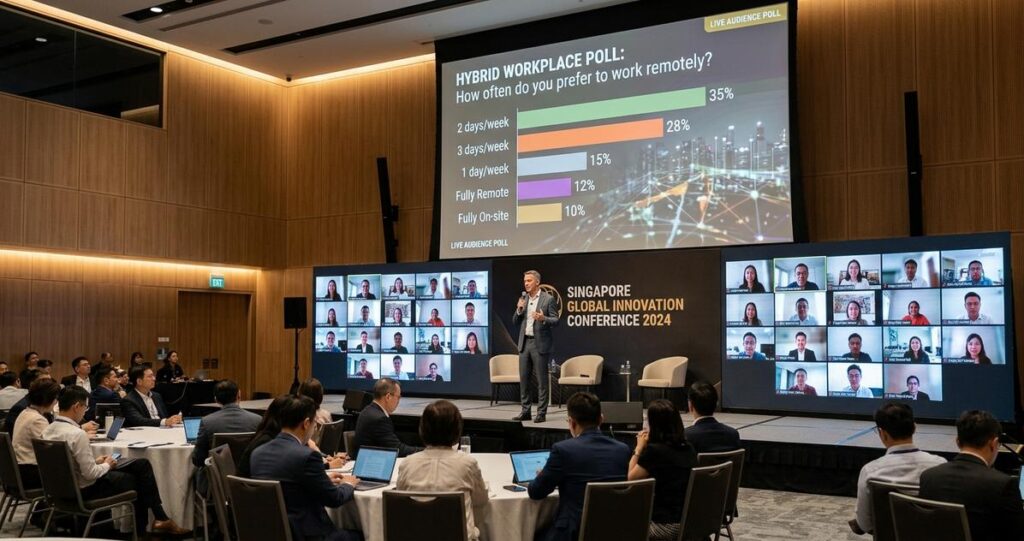
Hybrid events have become a practical reality for many organisations in Singapore, from corporate town halls and product launches to association conferences, continuing education sessions, and public forums. When some participants are in the room and others join remotely, the biggest challenge is often not the content itself, but the distance between people. A well-designed live polling strategy can narrow that gap quickly. It gives every attendee, whether seated in Marina Bay, working from home in Tampines, or joining from overseas, a simple way to respond in real time. That shared moment of participation can make an event feel immediate, inclusive, and responsive.
For Singapore audiences, this matters because expectations for digital convenience are high. People are used to scanning QR codes, using mobile-first interfaces, and moving between platforms efficiently. If a hybrid event asks them to sit passively through long presentations, the online audience often disengages first, followed by the in-room audience. Live polling offers a practical way to keep attention active, test understanding, gather opinions, and shape the session as it unfolds. Used properly, it is not just an engagement feature. It becomes part of the event design.
The key is to treat live polling as more than a novelty. The most effective hybrid events use it with clear purpose, thoughtful timing, and careful moderation. They also consider accessibility, language preferences, and technical reliability, all of which are especially relevant in Singapore’s multilingual and highly connected environment. When these elements are planned well, live polling can create instant connection without disrupting the professional tone of the event.
Why live polling works so well in hybrid events
Live polling works because it lowers the barrier to participation. Many people are comfortable answering a single question on a phone or laptop, even if they are less willing to speak aloud in front of colleagues or a large virtual audience. This is especially useful in hybrid settings, where remote participants can otherwise feel like observers rather than contributors. A live poll gives them a direct voice in the room.
It also helps event hosts read the audience in real time. If a poll shows that most attendees are unfamiliar with a topic, the facilitator can slow down and explain foundational concepts. If the audience already understands the basics, the session can move into more advanced discussion. This responsiveness is valuable for Singapore business events, where attendee groups are often mixed, with different levels of seniority, technical knowledge, and functional background.
In addition, live polling supports psychological engagement. When participants see that their answers appear instantly on screen, they understand that the event is interactive, not one-directional. This visible feedback loop encourages attention. For in-person audiences, it can also create a sense of shared momentum. For remote participants, it reduces the feeling of isolation that can happen when the main conversation seems to happen only in the room.
What live polling can achieve
- Instant participation, allowing attendees to respond without speaking publicly.
- Audience insight, helping facilitators gauge knowledge, sentiment, or preferences.
- Improved pacing, so presenters can adjust the flow of the session in real time.
- Greater inclusion, especially for remote participants who may otherwise stay silent.
- Better memory retention, because active participation supports attention.
These benefits are strongest when the poll supports the event objective. If the question feels random, novelty fades quickly. If it is tied to the topic, the audience sees a reason to respond.
Design polls that people actually want to answer
The quality of a live poll depends on the quality of the question. Good polling is specific, easy to understand, and relevant to what comes next. In hybrid events, the question should also be simple enough that both in-room and remote audiences can respond within seconds. Long, complicated questions reduce participation and create confusion.
For Singapore audiences, clarity is especially important because events may include participants from different language backgrounds and professional disciplines. Even when the event is conducted in English, plain language improves response rates. Avoid jargon unless the audience is highly specialised. If technical terms are necessary, define them briefly before asking the poll question.
It also helps to think about the role of each poll. Some polls are best used at the beginning of a session to warm up the audience. Others work during the presentation to test understanding. A third type works at the end to collect feedback or next-step preferences. When each poll has a role, the session feels structured rather than random.
Strong poll formats for hybrid sessions
- Multiple choice, useful for quick audience checks and preference questions.
- Ranked options, helpful when comparing priorities or opinions.
- Yes or no, effective for quick consensus checks.
- Word clouds, useful for gathering short, open-ended responses, though they work best with moderation.
- Scales, such as confidence or agreement ratings, useful for measuring sentiment without overcomplicating the task.
Questions should be written with a single goal in mind. For example, “Which challenge is most relevant to your team right now?” is clearer than “What are your thoughts on operational issues?” The first question guides a measurable response. The second invites broad interpretation that is harder to use.
When to place polls in the agenda
Opening polls can break the ice and reveal who is in the room. Mid-session polls can check comprehension or shift the pace if attention starts to drop. Closing polls can capture feedback, preferred follow-up topics, or practical takeaways. In a Singapore corporate setting, this sequence works well for leadership briefings, training workshops, and industry panels because it supports both productivity and interaction.
A useful rule is to avoid over-polling. If every few minutes includes another question, the audience may start ignoring them. A small number of purposeful polls usually performs better than a long sequence of repetitive prompts.
Make the technology invisible and reliable
Technical reliability is central to live polling. If participants cannot access the poll quickly, or if responses appear slowly, the sense of immediacy is lost. Hybrid events already depend on stable audio, video, and moderation. Polling should fit into that system smoothly, not add another point of failure.
For Singapore-based events, this usually means choosing platforms that load well on mobile devices, support common browsers, and work reliably on public and private networks. It also means testing the experience in the actual venue, because Wi-Fi conditions, screen visibility, and device compatibility can affect participation. A poll that works in an office meeting room may behave differently in a ballroom, auditorium, or conference hall.
Event teams should always run a full rehearsal. Check how the poll looks on the main screen, how quickly results refresh, whether the presenter can control question timing, and whether remote participants receive the same prompt at the same time as the in-room audience. Small delays can make the experience feel uneven.
Operational checks before the event
- Test on multiple devices, including phones, tablets, and laptops.
- Confirm QR code or link access, especially for attendees joining from different locations.
- Prepare backup questions in case a chosen poll does not receive enough responses.
- Align moderator and presenter timing so questions are launched at the right moment.
- Check screen readability for both the question and the live results.
Good technical preparation also means having a fallback plan. If the platform experiences a problem, the moderator should know whether to continue verbally, switch to a simpler question, or collect responses through a backup channel. That level of readiness protects the audience experience.
Use live results to shape the conversation, not just display data
The real value of live polling comes after the votes are in. If the audience responds and the result is never addressed, the poll feels decorative rather than meaningful. The facilitator should interpret the outcome immediately, acknowledge what it suggests, and use it to move the session forward. This is where hybrid events can feel truly connected, because attendees see that their input changes the direction of the discussion.
For example, if a poll shows that many participants are unsure about a policy change, the speaker can spend more time explaining the practical implications. If a poll shows clear interest in one topic over another, the moderator can prioritise that topic during the Q and A portion. In a Singapore business context, this responsive approach is especially useful for executive briefings, product demonstrations, and sector-specific forums where attendees value efficiency.
Live poll results can also help facilitators manage diverse audiences. A room may contain senior decision-makers, functional specialists, and junior staff, while the online audience may include clients, partners, or regional colleagues. Poll responses can reveal differences in perspective that are not obvious at the start. Instead of treating that variation as a problem, strong event design uses it to create a more balanced and relevant discussion.
How to discuss poll results well
- State the result clearly, without overexplaining or rushing past it.
- Connect the result to the agenda, so the audience sees why it matters.
- Invite comparison, especially if in-room and remote groups seem to differ.
- Use the result to ask a follow-up question when deeper discussion is useful.
- Keep the tone neutral, particularly when responses are mixed or unexpected.
This approach helps maintain credibility. The audience should feel that the poll is part of a serious exchange of information, not a gimmick inserted for entertainment.
Adapt live polling for Singapore’s multilingual, mobile-first environment
Singapore offers a strong environment for hybrid engagement, but local context still matters. Audiences may include people who are more comfortable with different levels of formal English, and some events serve participants who benefit from simpler sentence structures. Polling should be written with that diversity in mind. Where appropriate, short labels or supporting explanations can reduce misunderstanding without cluttering the screen.
Mobile-first behaviour is another practical reality. Many attendees will join a poll from their phone even when they are physically in the venue. This makes concise formatting essential. Long answer lists are difficult to navigate on a small screen. If the question can be answered with one tap, participation is usually smoother.
Accessibility should also be part of the planning process. Make sure the on-screen content is legible, the contrast is adequate, and the instructions are easy to follow. If the event includes people with visual, hearing, or cognitive access needs, avoid relying only on fast verbal instructions. A clear on-screen prompt helps everyone.
For larger public-facing events in Singapore, the polling approach should also respect privacy and professional norms. If questions touch on sensitive topics, such as workplace issues or opinion-based feedback, be transparent about whether answers are anonymous. People are more likely to participate honestly when they understand how their responses will be used.
Practical examples for Singapore events
- Corporate town hall, ask employees which topic they want addressed first, then use the result to set the order of discussion.
- Healthcare or professional training session, check baseline knowledge before moving into case-based teaching.
- Association conference, let attendees choose between policy, market trends, or operations as the next focus.
- Product launch, invite the audience to rank features by relevance to their work.
These examples show how polling can support practical event goals without requiring elaborate interaction design.
Build trust by keeping polling transparent and purposeful
Trust is central to any event experience, especially when live interaction is involved. Participants should know why a poll is being used, how long it will take, and what will happen with the results. If the event uses analytics or exports responses for follow-up, that should be consistent with the organiser’s stated data handling practices. In Singapore, where organisations are increasingly attentive to digital trust and responsible data use, transparency strengthens professionalism.
It is also wise to avoid polls that feel manipulative. Questions should not push attendees toward a predetermined response or present incomplete options that distort the discussion. Balanced polling respects the audience’s time and intelligence. That is particularly important in B2B settings, where attendees expect practical value.
When live polling is done well, the audience experiences the session as collaborative. They are not simply receiving information. They are helping shape the pace, emphasis, and direction of the event. That sense of contribution is what makes hybrid audiences feel connected instantly, even when they are not sharing the same physical space.
For organisers in Singapore, the best next step is simple. Choose one clear event objective, design one or two purposeful polls around that objective, test the technology thoroughly, and prepare the moderator to respond to the results with confidence. If the polls are easy to answer, relevant to the audience, and smoothly integrated into the programme, they can do more than increase engagement. They can turn a split-format event into a genuinely shared experience.

Jeremy Lee is a seasoned digital marketing director and strategist with over two decades of experience in the industry. As the founder of Sotavento Medios, I manage a diverse portfolio of over 50 businesses, helping brands grow through advanced search strategies and digital innovation. My work focuses on bridging the gap between traditional search engine optimisation and the evolving world of AI-driven answer engines.
get in touch