
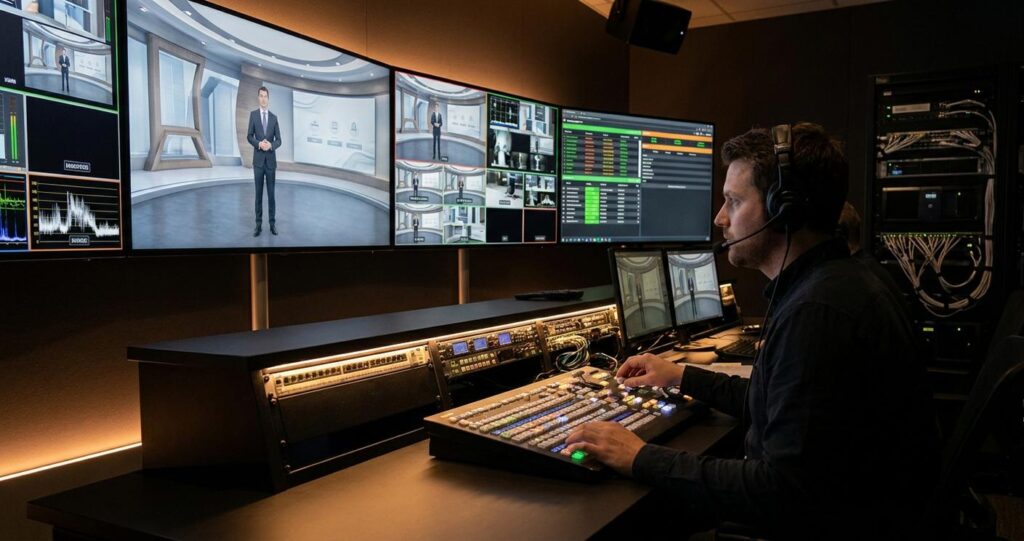
The global business landscape increasingly demands expansive reach coupled with stringent cost control. For corporate entities conducting product launches, financial reporting, or critical policy announcements, global press tours have traditionally been indispensable yet remarkably expensive. These multi-city endeavors, burdened by extensive travel logistics, substantial venue hire fees, and considerable personnel expenses, are ripe for technological disruption. Enter the era of virtual 3D studios, a sophisticated paradigm shift in B2B event streaming and hybrid production that offers an economically astute and technically superior alternative to conventional physical tours. Leveraging cutting-edge extended reality (XR) technologies, broadcast-grade production workflows, and resilient enterprise streaming infrastructure, organizations can now host immersive, interactive, and visually compelling press engagements that transcend geographical limitations. For astute corporate event planners, discerning AV professionals, production managers, IT directors, and enterprise decision-makers aged 30-55, comprehending the intricate technical architecture, advanced streaming protocols, and meticulous implementation methodologies of these virtual environments is not merely advantageous, but strategically imperative. Spring Forest Studio stands at the forefront of engineering and executing these complex B2B event streaming solutions, ensuring uncompromised broadcast-grade quality and seamless global delivery. This comprehensive article delves into the advanced technical analysis of utilizing 3D virtual studios for global press tours, focusing on the infrastructure, protocols, and production methodologies that yield unparalleled cost efficiency, enhanced audience engagement, and fortified brand presence.
The Technical Architecture of Virtual 3D Press Studios
The bedrock of a successful virtual 3D press tour is a meticulously engineered technical architecture that harmoniously integrates real-time graphics rendering, advanced video processing, and sophisticated audio-visual signal routing. This intricate system moves far beyond rudimentary video conferencing; it employs broadcast-standard workflows to generate photorealistic or highly stylized virtual environments where presenters are seamlessly integrated, irrespective of their physical location, creating an illusion of presence within a dynamic, custom-designed space.
Real-time 3D Rendering and XR Technologies for Broadcast
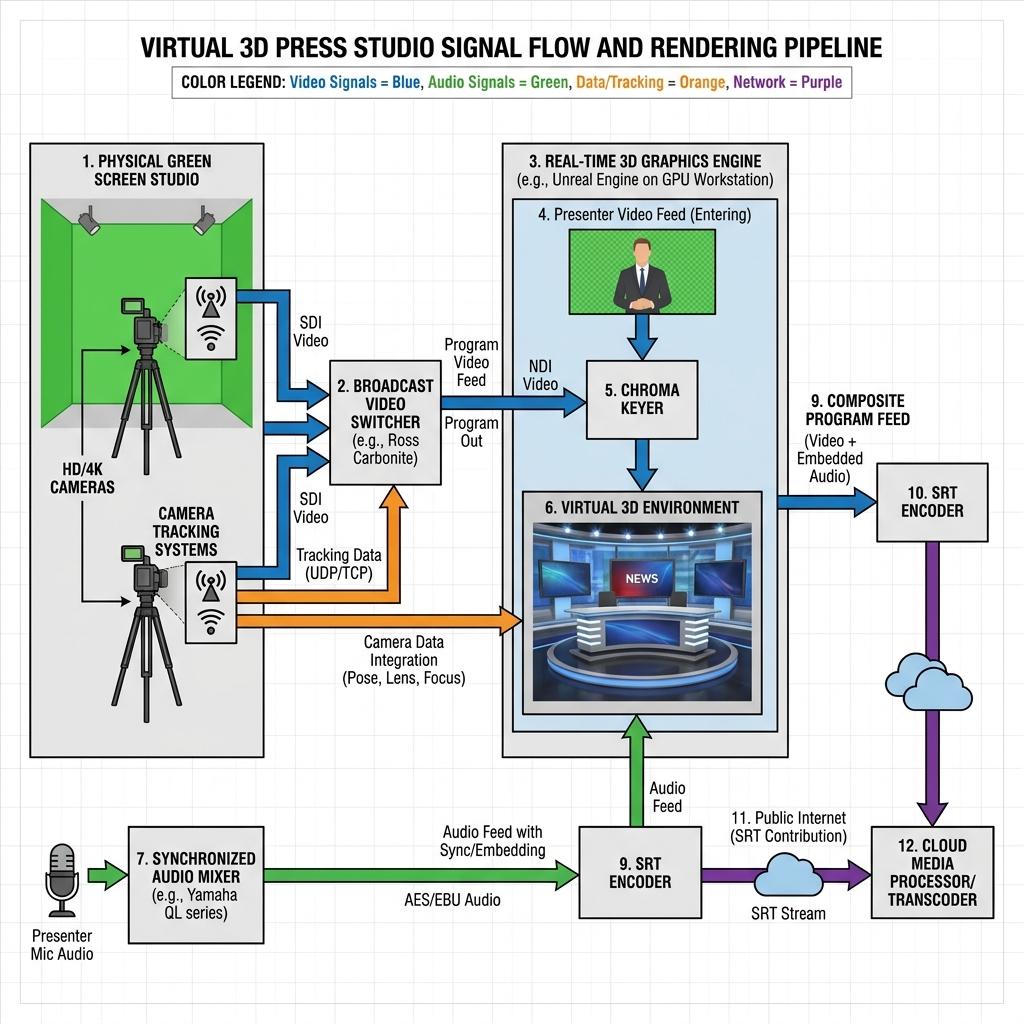
At the technological heart of a virtual 3D studio lies the real-time graphics engine, typically utilizing platforms such as Epic Games’ Unreal Engine or Unity, specifically optimized and adapted for high-fidelity broadcast applications. These robust engines are capable of rendering extraordinarily complex 3D environments, including intricately designed virtual sets, dynamic augmented reality (AR) overlays, and interactive data visualizations, all with sub-frame latency critical for live production. A key aspect of their functionality involves the seamless integration of external data sources and sophisticated control systems. This integration is often facilitated via industry-standard protocols such as Open Sound Control (OSC) for precise communication with external devices, or DMX (Digital Multiplex) for real-time synchronization of virtual and physical lighting elements. For presenters physically situated in a dedicated green screen cyclorama studio, the live video feed is ingested into the graphics engine. This raw video feed, often uncompressed 1080p (Progressive) or 4K/UHD (Ultra-High Definition) at common broadcast frame rates like 29.97p or 59.94p, is typically delivered over SDI (Serial Digital Interface) or increasingly, NDI (Network Device Interface) to a high-performance video processing unit. Advanced chroma keying algorithms, frequently hardware-accelerated to ensure superior performance and artifact suppression, meticulously isolate the presenter from the monochromatic green or blue background, facilitating their flawless placement and blending within the rendered 3D environment. Specialized hardware, including dedicated broadcast-grade video servers and multi-GPU-accelerated workstations, are absolutely indispensable for maintaining render fidelity, sustaining consistent frame rates, and preventing distracting visual artifacts, all paramount for delivering a smooth and professional viewer experience. The precision required for these processes demands hardware capable of processing millions of polygons and complex shaders in real-time, often necessitating professional-grade GPUs like NVIDIA Quadro or AMD Radeon Pro series, configured with ample VRAM and high-speed interconnects.
Multi-Camera Integration and Chroma Keying Workflows
Professional virtual press tours mandate the flexibility of multi-camera operations, mirroring the sophisticated setups found in traditional broadcast productions. This workflow necessitates the deployment of multiple high-definition (HD) or 4K cameras within the physical green screen studio, each strategically positioned to capture distinct perspectives of the presenter. These camera feeds are then meticulously routed through a broadcast-grade video switcher, such as a Ross Carbonite, Grass Valley K-Frame, or Blackmagic Design ATEM Constellation, enabling a production director to execute dynamic shot selection, seamless transitions, and composite layering in real-time. The program feed emanating from the switcher, alongside individual ISO (Isolated) recordings of each camera source for post-production flexibility, is then precisely fed into the real-time graphics engine. Each individual camera feed undergoes a rigorous process of precise chroma keying and meticulous color grading to guarantee perfect visual consistency and seamless integration into the virtual set. Modern keyers, whether hardware or software-based, offer advanced features such as intelligent spill suppression, precise edge blending, and garbage matting capabilities to achieve an utterly believable and natural composite. Furthermore, sophisticated camera tracking systems are absolutely vital for creating dynamic virtual sets. These systems, which can employ optical sensors, infrared markers, or mechanical encoders, transmit real-time positional and rotational data (pan, tilt, zoom, focus, and X, Y, Z coordinates) of each physical camera to the 3D graphics engine. This critical data allows the virtual camera within the 3D environment to precisely synchronize and mimic the movements of its physical counterpart. This perfect synchronization is crucial for maintaining accurate perspective, parallax, and depth, thereby creating a truly dynamic and immersive perspective for the audience and meticulously preventing any distracting discrepancies between the foreground presenter and the background virtual elements. Absolute synchronization across all input sources, encompassing video, audio, and tracking data, is rigorously achieved through a master blackburst or tri-level sync generator. These devices adhere to stringent SMPTE (Society of Motion Picture and Television Engineers) timing standards, specifically SMPTE 292M for HD-SDI or SMPTE 424M for 3G-SDI, to prevent timing drift and maintain frame-accurate alignment across the entire production pipeline, which is critical for a broadcast-quality output.
Synchronized Audio Production and Immersive Soundscapes
The audio production in a virtual 3D studio environment is unequivocally as critical as the video component, necessitating a multi-channel approach to deliver crystal-clear, intelligible speech and immersive, spatially accurate soundscapes. Presenter microphones, typically high-quality condenser lavaliers (e.g., DPA d:screet series) or professional boom microphones (e.g., Sennheiser MKH series), are routed through a professional digital audio mixer console (e.g., Yamaha QL series, Allen & Heath dLive, Behringer X32). This advanced mixing console enables precise gain staging, parametric equalization, dynamic compression, and sophisticated noise reduction techniques to optimize speech clarity. Critically, ambient sound effects and spatial audio elements meticulously designed for the virtual environment are expertly mixed with the presenter’s voice, creating a cohesive and believable auditory experience that complements the visual realism. Robust talkback systems are rigorously implemented to facilitate instantaneous and clear communication between the director, the entire technical crew, and the presenter, ensuring seamless production cues, immediate feedback, and rapid problem resolution during the live broadcast. The final program audio feed, which is often digitally embedded within the SDI or NDI video stream (e.g., using SMPTE 299M for SDI audio embedding), is meticulously monitored via loudness meters. These meters conform to international standards such as EBU R 128 (European Broadcasting Union) or ITU-R BS.1770 (International Telecommunication Union) to prevent digital clipping, manage dynamic range, and ensure consistent audio levels that are compliant for global audiences across various playback devices. For intricate hybrid events, separate and distinct audio feeds may be strategically routed for the live physical audience present at a hub location, the remote virtual audience, and dedicated feeds for multi-language simultaneous interpretation, all managed through a matrix routing system within the digital audio console.
Enterprise-Grade Streaming Protocols and Distribution Networks
The efficacy of global distribution for high-quality virtual press tour content is intrinsically linked to the astute selection of appropriate streaming protocols and the strategic leverage of resilient content delivery networks. This meticulously chosen technical stack is paramount for guaranteeing low latency, exceptional reliability, and formidable scalability to serve geographically diverse and numerous audiences.
Secure Reliable Transport (SRT) for Low-Latency Contribution
For the highly secure and eminently reliable transport of professional video and audio streams from the originating production studio to cloud-based processing platforms or global distribution points, the Secure Reliable Transport (SRT) protocol emerges as a critical, enabling technology. SRT, an open-source protocol collaboratively developed by Haivision and the SRT Alliance, offers profound technical advantages over older, less robust protocols such as RTMP (Real-Time Messaging Protocol), particularly in scenarios characterized by unpredictable or challenging network conditions. It employs a highly sophisticated error recovery mechanism that builds upon UDP (User Datagram Protocol), leveraging a meticulously designed retransmission system known as ARQ (Automatic Repeat Request). This effectively mitigates the detrimental effects of packet loss, network jitter, and bandwidth fluctuations without introducing substantial, undesirable latency. For a high-stakes global press tour, SRT enables encrypted, high-quality video contribution streams, typically encoded using efficient codecs like H.264 (AVC) or H.265 (HEVC) at bitrates ranging from 10 Mbps to 50 Mbps (or even higher for uncompromised quality, depending on resolution, chroma subsampling, and frame rate). These streams can traverse public internet links with end-to-end latencies often below 500 milliseconds, significantly outperforming the inherent latency of unoptimized TCP-based RTMP. SRT can operate robustly in three distinct modes: Caller (initiating connection), Listener (awaiting connection), and Rendezvous (peer-to-peer connection without firewall configuration), providing unparalleled flexibility for diverse network topologies and challenging firewall configurations. The successful implementation of SRT necessitates either dedicated hardware encoders/decoders (e.g., Haivision Makito X Series) or robust software-based solutions (e.g., OBS Studio with SRT support, or specialized media servers) capable of efficiently handling the protocol’s computational overhead and ensuring sustained performance.
Content Delivery Networks (CDNs) for Global Scale and Redundancy
To unequivocally guarantee that global audiences experience minimal buffering, consistent uptime, and optimal playback quality, a geographically distributed Content Delivery Network (CDN) is an indispensable component of the streaming architecture. Tier-1 CDNs, such as Akamai, Cloudflare, AWS CloudFront, or Limelight Networks, strategically cache video content at edge servers located worldwide, physically bringing the content closer to end-users. This architectural design drastically reduces network latency, minimizes network hops, and effectively distributes the load, thereby preventing congestion at a single origin server. For live streaming applications, the CDN ingest points receive the primary SRT stream (often after it has been transcoded into adaptive bitrate formats like HLS (HTTP Live Streaming) or MPEG-DASH) and then intelligently replicate it across their expansive global network. This adaptive bitrate streaming methodology allows client devices to dynamically switch between different quality renditions (e.g., 360p, 720p, 1080p) based on their currently available bandwidth and CPU capabilities, ensuring a smooth and uninterrupted viewing experience across highly variable network conditions. Critical CDN features for enterprise-grade streaming encompass robust DDoS (Distributed Denial of Service) protection, granular geo-blocking and IP whitelisting capabilities for restricted access, real-time analytics dashboards for comprehensive audience metrics, and extensive API integration for programmatic control, automated workflows, and sophisticated monitoring. Intrinsic redundancy is meticulously engineered into modern CDN architectures, with multiple Points of Presence (PoPs) ensuring automated failover mechanisms in the event of an outage or performance degradation in a specific regional node. Furthermore, many CDNs offer advanced features like stream encryption (e.g., TLS/SSL for HLS/DASH), token-based authentication, and digital rights management (DRM) integration to protect premium content.
Integration with Enterprise Video Platforms (EVP) for Secure Distribution
For B2B press tours, particularly those within large corporate ecosystems, seamless integration with existing Enterprise Video Platforms (EVPs) such as Microsoft Teams Live Events, Zoom Webinars, or Cisco Webex Events is frequently a non-negotiable requirement. This approach leverages established corporate infrastructure for secure, authenticated distribution and often provides enhanced native interactivity features. The broadcast-grade SRT stream, following its ingestion and processing by the CDN, can be further routed to these EVP platforms. This typically involves configuring specific RTMP or HLS ingest points that are provided by the respective EVP, which then assumes responsibility for the internal distribution to authenticated users within their controlled environment. This hybrid strategy skillfully combines the uncompromised broadcast-quality production capabilities of a professional virtual studio with the secure, controlled, and often single sign-on (SSO) enabled environment of an enterprise platform. It unlocks a suite of features including audience registration workflows, robust authentication mechanisms, advanced analytics tracking, and integrated Q&A functionalities, all within a familiar and trusted corporate ecosystem. Key technical considerations include meticulously ensuring format compatibility between the CDN output streams (e.g., HLS or RTMP) and the specific EVP ingest requirements, judiciously managing network bandwidth allocation for optimal performance within existing corporate network topologies, and configuring precise firewall rules (e.g., opening specific TCP/UDP ports like 1935 for RTMP, 443 for HTTPS) to enable seamless and secure data flow between external streaming services and internal enterprise networks.
Network Infrastructure and Bandwidth Optimization for Global Virtual Events
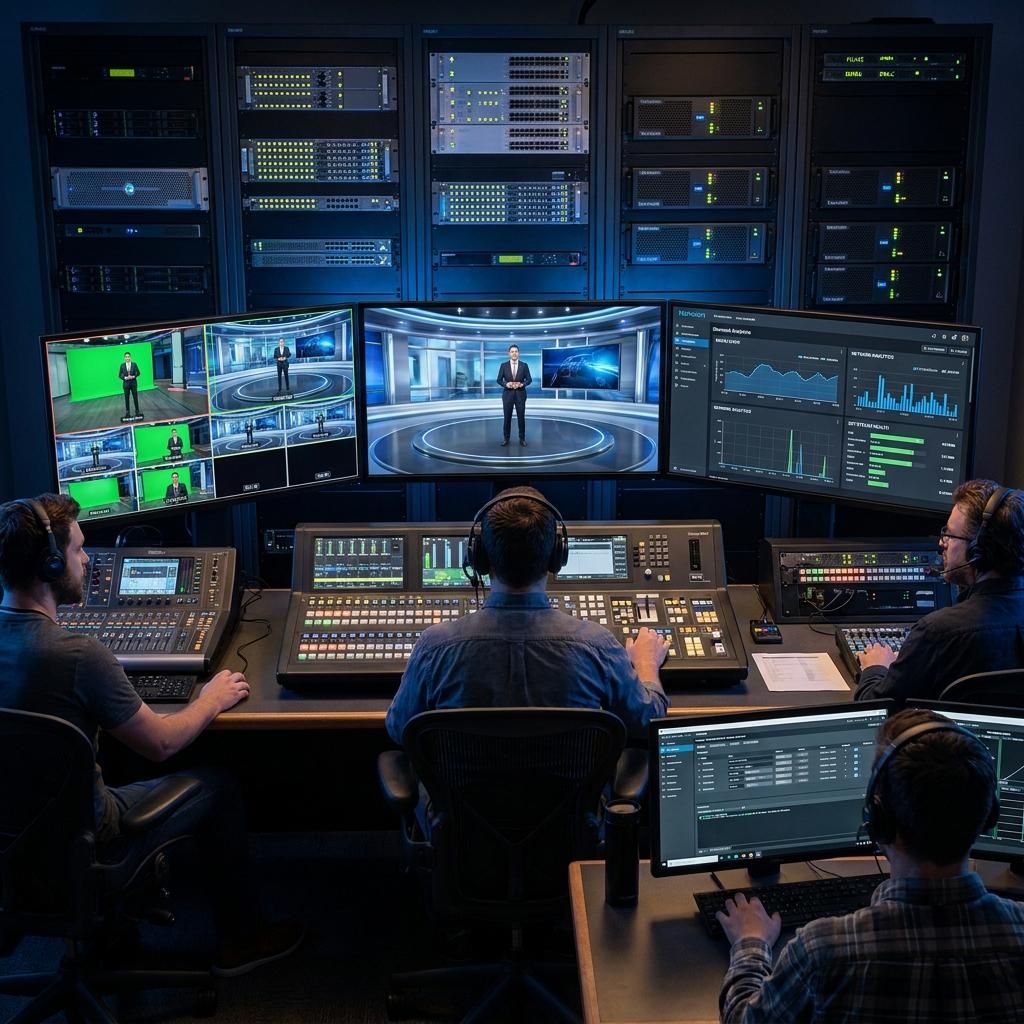
The unyielding performance of a global virtual press tour is fundamentally predicated upon a resilient and meticulously optimized network infrastructure, purpose-built to accommodate the demanding requirements of high-bandwidth, ultra-low-latency professional live streaming. Any compromise in this foundational layer can lead to stuttering video, audio synchronization issues, and a degraded audience experience.
Dedicated Fiber Connectivity and QoS Implementation
A dedicated, high-capacity fiber internet connection serves as the unequivocal cornerstone for originating professional B2B live streams from the production facility. For 4K UHD streaming with multiple redundant SRT contribution streams, aggregated uplink bandwidths ranging from 100 Mbps to 1 Gbps or even higher are frequently not just desirable, but absolutely necessary to maintain pristine quality and prevent egress bottlenecks. The meticulous implementation of Quality of Service (QoS) protocols on all relevant network hardware, including enterprise-grade routers and managed switches, is paramount. This strategic implementation prioritizes critical streaming traffic over other less time-sensitive network activities, thereby significantly minimizing packet loss, reducing network jitter, and maintaining consistent latency. This involves configuring DiffServ Code Points (DSCP) or IEEE 802.1p markings on streaming IP packets, ensuring that real-time video and audio streams receive preferential treatment and guaranteed throughput across the network. A meticulously designed network segment, physically or logically isolated and dedicated solely to streaming workflows, operating independently from general corporate or office network traffic, represents a best practice. This isolation effectively mitigates potential bottlenecks, prevents congestion, and eliminates interference from unrelated network activities. Advanced network monitoring tools, such as PRTG Network Monitor, SolarWinds Network Performance Monitor, or Grafana with Prometheus, provide granular, real-time visibility into bandwidth utilization, end-to-end latency, and packet loss statistics, enabling production teams to proactively identify, diagnose, and resolve potential network issues before they impact the live broadcast. Furthermore, redundant network pathways with automatic failover at Layer 3 (e.g., using BGP routing) are essential.
Edge Computing and On-Premise Encoding Strategies
While cloud-based media processing solutions offer immense flexibility and scalability, the judicious deployment of edge computing resources and strategic on-premise encoding can profoundly optimize network performance, significantly reduce cloud egress costs, and enhance overall control. For production scenarios demanding extremely low processing latency or the initial processing of very high-resolution raw video feeds (e.g., 8K inputs before downscaling or multi-angle processing), powerful local encoding hardware and robust media servers can pre-process, compress, and even perform initial transcoding of streams before their transmission over the Wide Area Network (WAN). This intelligent distribution of computational burden offloads significant processing power from cloud resources and substantially reduces the aggregate bandwidth required for initial contribution. On-premise transcoding, leveraging dedicated hardware encoders like Elemental Live, Harmonic Electra, or robust software-based solutions like FFmpeg running on high-performance servers, allows for unparalleled control over encoding parameters. This includes precise management of bitrate, GOP (Group of Pictures) structure, H.264/H.265 profile and level, and chroma subsampling, all meticulously tailored to specific distribution requirements and target platforms. This strategic approach also provides an invaluable additional layer of redundancy, enabling local recording and archival of the encoded streams as a fail-safe measure, should primary cloud ingest pathways experience any unexpected failures or disruptions.
Failover Mechanisms and Redundancy Planning (N+1, 2N)
For mission-critical live events such as global press tours, comprehensive failover and redundancy strategies are not merely advisable; they are an absolute imperative. This encompasses meticulous N+1 redundancy for all critical components within the signal chain, including but not limited to primary encoders, video switchers, audio mixers, and crucially, internet connections. N+1 redundancy dictates that there is at least one fully operational backup unit poised to assume control instantaneously in the event of a primary system failure. For network connectivity, diverse path redundancy, employing at least two independent fiber optic circuits from entirely different Internet Service Providers (ISPs), routed via geographically separate paths, along with automatic failover routers (e.g., using VRRP or HSRP protocols), is absolutely essential. In a 2N configuration, two identical, fully redundant systems operate in parallel, providing an immediate hot failover with virtually zero service interruption. Implementing a multi-CDN strategy further fortifies redundancy at the content distribution layer, enabling intelligent traffic steering to an alternative CDN provider if one experiences performance degradation or a complete outage. Furthermore, meticulous local ISO recording of all program feeds and individual camera sources throughout the production is a non-negotiable best practice. This provides a clean, uncompressed master archive for subsequent post-production, future VOD (Video On Demand) distribution, or as an indispensable fail-safe in the event of any unforeseen streaming interruption or data corruption. These recordings are often captured on dedicated SSD arrays or network-attached storage (NAS) systems with RAID configurations to ensure data integrity.
Advanced Interactivity and Audience Engagement in Virtual Press Tours
Beyond the fundamental aspect of passive viewing, cultivating genuine and dynamic interaction is paramount to effectively replicating and often surpassing the engagement levels of traditional in-person press tours. Sophisticated virtual 3D studios are engineered to enable a rich suite of advanced engagement features that empower meaningful two-way communication.
Real-time Q&A, Polling, and Data Integration
To meticulously emulate the dynamic and responsive nature of a live Q&A session, virtual press tours integrate robust real-time Q&A platforms. These advanced systems enable journalists and attendees to submit questions instantaneously, which are then subject to moderation by a dedicated team. Approved questions can be dynamically presented to the presenter on an in-studio confidence monitor (teleprompter or dedicated display) or even seamlessly integrated into the virtual environment as an augmented reality overlay for visible interaction, enhancing the broadcast’s professionalism. Live polling features can be strategically deployed to rapidly gauge audience sentiment, collect immediate feedback on key announcements, or conduct quick surveys. For highly data-driven presentations, real-time data integration capabilities are indispensable. This functionality allows for the direct ingestion of information from external APIs (Application Programming Interfaces) or corporate databases, displaying dynamic charts, graphs, product specifications, or financial metrics directly within the virtual set in real-time. This level of sophisticated integration necessitates careful API design, adherence to secure data transfer protocols (e.g., HTTPS, OAuth 2.0), and robust parsing mechanisms to ensure the accurate, timely, and secure display of sensitive information without compromising data integrity or system stability.
Multi-Language Interpretation and Accessibility Features
Global press tours inherently demand comprehensive multi-language support to effectively cater to diverse international audiences. This critical requirement is met through the implementation of professional real-time simultaneous interpretation services. Dedicated, certified interpreters receive the live program audio feed (often a clean feed without audience reaction), and their expertly translated audio is then meticulously routed as separate, distinct audio tracks to the CDN. Viewers are then empowered to select their preferred language audio track directly within the streaming player interface, providing a highly personalized and inclusive experience. For universal accessibility, closed captions (CC) and comprehensive subtitles are absolutely essential. Live captioning services, powered either by advanced AI speech-to-text algorithms with human oversight for accuracy, or by professional human stenographers, provide real-time text overlays synchronized with the spoken word. These captions are typically delivered via standardized formats such as WebVTT (Web Video Text Tracks) or TTML (Timed Text Markup Language) alongside the primary video stream. Implementing ADA (Americans with Disabilities Act) compliant features, which may include sign language interpretation feeds seamlessly integrated into the virtual set or enhanced audio descriptions, ensures inclusivity, significantly broadening the reach and impactful resonance of the virtual press tour across all demographics.
Post-Production Workflows and Archival for On-Demand Content
The strategic lifecycle of a virtual press tour extends significantly beyond the conclusion of the live event itself. Meticulous post-production workflows are absolutely crucial for transforming the raw live content into valuable, evergreen on-demand assets. This comprehensive process encompasses editing out any minor technical glitches or production imperfections, precisely inserting pre-recorded segments that may not have been part of the live broadcast, refining all graphics and animations, and meticulously optimizing the content for various VOD (Video On Demand) platforms and distribution channels. The ISO recordings, captured meticulously during the live production, provide an invaluable repository of source material for creating tailored highlight reels, individual speaker segments, or regionally specific versions of the press tour content. Long-term, secure archival of all production assets, including raw video and audio files, graphic elements, and associated metadata, is vital for regulatory compliance, future content repurposing, and as an accurate historical record. Secure cloud storage solutions with robust access controls, comprehensive versioning capabilities, and geo-redundancy (e.g., AWS S3, Google Cloud Storage, Azure Blob Storage) are typically employed for this critical purpose, ensuring data integrity and availability over extended periods.
Conclusion:
The strategic deployment of virtual 3D studios for global press tours represents a sophisticated technical evolution in the domain of B2B event streaming, offering a compelling synthesis of significant travel cost reduction, vastly expanded global reach, and substantially heightened audience engagement. From the intricate real-time rendering pipelines and multi-camera chroma keying workflows to the strategic implementation of enterprise-grade streaming protocols like Secure Reliable Transport (SRT) and the robust architectural design of global Content Delivery Networks (CDNs), every single component within this complex ecosystem demands unparalleled expert technical oversight and meticulous execution. A resilient network infrastructure, comprehensive redundancy planning (N+1, 2N configurations), and advanced interactive features are not merely supplementary additions; they are, in fact, foundational pillars indispensable for delivering a truly broadcast-quality, immersive, and impactful virtual experience. Spring Forest Studio possesses the profound technical expertise in B2B live event streaming, cutting-edge hybrid production technology, and robust enterprise streaming infrastructure required to meticulously design, flawlessly implement, and expertly manage these highly complex solutions. By strategically embracing the transformative power of virtual 3D studios, forward-thinking corporations can execute impactful global press tours that transcend traditional geographical boundaries, optimize operational budgets with remarkable efficiency, and solidify their market presence with unparalleled technical precision and unwavering professional execution.
Jeremy Lee is a seasoned digital marketing director and strategist with over two decades of experience in the industry. As the founder of Sotavento Medios, I manage a diverse portfolio of over 50 businesses, helping brands grow through advanced search strategies and digital innovation. My work focuses on bridging the gap between traditional search engine optimisation and the evolving world of AI-driven answer engines.
get in touch