
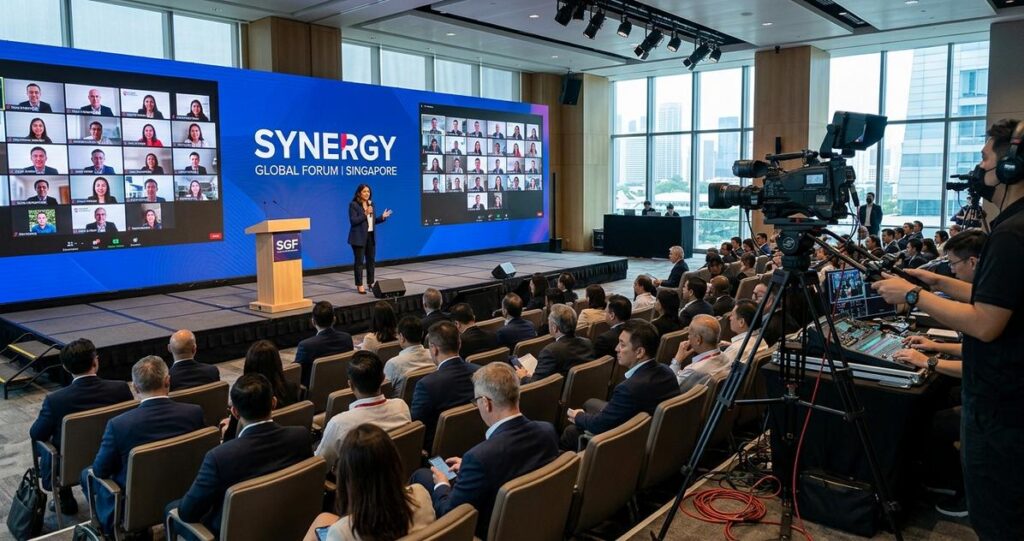
For organisations in Singapore, knowledge sharing is no longer limited to a meeting room, a conference hall, or a single day of attendance. As teams become more distributed, business travel remains selective, and professionals expect flexibility, hybrid events have become a practical way to share expertise without losing reach or depth. A well-designed hybrid event combines in-person participation with live online access, allowing speakers, employees, clients, and partners to engage in the same programme even when they are not physically in the same place. For companies, associations, educational institutions, and public-sector teams in Singapore, this format is especially valuable because it supports accessibility, continuity, and long-term learning in a city where many people balance demanding schedules, cross-border collaboration, and diverse working arrangements.
The strategic value of hybrid events goes beyond convenience. When planned properly, they can improve how knowledge is captured, distributed, and retained across an organisation. They also make it easier to include regional stakeholders from the wider Asia-Pacific region, which matters for Singapore-based businesses that operate across time zones and markets. The result is a format that supports both immediate engagement and longer-term knowledge transfer. For audience members, it means they can choose the participation mode that fits their circumstances. For organisers, it means one event can serve multiple purposes, from thought leadership and training to stakeholder communication and internal capability building.
Why Hybrid Events Have Become a Core Knowledge-Sharing Format
Knowledge sharing works best when information is delivered clearly, discussed interactively, and revisited after the event. Traditional face-to-face events can be excellent for interaction, but they often exclude people who cannot travel, who are working remotely, or who are balancing caregiving and professional commitments. Fully virtual events increase access, yet they can sometimes reduce the richness of face-to-face networking and make it harder to sustain attention over long sessions. Hybrid events bridge this gap by combining the strengths of both formats.
In Singapore, this matters because many organisations serve audiences that are geographically spread out. A professional association may have members in different parts of Singapore and across Southeast Asia. A hospital, university, law firm, or multinational company may need to train teams in multiple locations while maintaining a consistent message. A hybrid event allows the core presentation to be delivered once, while still enabling live questions, panel discussion, polling, and follow-up resources. This creates a more efficient knowledge-sharing process without reducing the quality of the experience.
What makes hybrid events strategically different
A hybrid event is not simply a livestream of an in-person programme. The strategic approach requires designing the experience for two audiences at once, the room audience and the online audience. That means planning for camera angles, sound quality, moderation, chat management, presentation pacing, and audience interaction across both channels. If these elements are handled carefully, hybrid events can improve the reach of expert content while preserving the human interaction that people value in live gatherings.
From an organisational perspective, hybrid events also support content repurposing. Sessions can be recorded and edited into short training clips, internal learning modules, post-event summaries, or archived reference materials. This extends the value of one event well beyond the live date. In practical terms, it means that a keynote, expert panel, or policy briefing can continue to educate teams and stakeholders after the event ends, which is especially useful for compliance training, technical updates, and leadership communication.
How Hybrid Events Strengthen Knowledge Retention and Participation
Knowledge sharing is not just about presenting information. It is about helping people absorb it, discuss it, and apply it. Hybrid events can strengthen retention by giving attendees multiple ways to engage. Some participants learn best through live discussion, others prefer listening to a recording later, and some need slides, transcripts, or written summaries to fully absorb key points. By offering several access paths, hybrid events support different learning preferences and practical needs.
In a Singapore context, this flexibility is particularly useful for professionals who work long hours, travel between office sites, or manage responsibilities across family and work. A participant who cannot attend the whole event in person may still join online for the most relevant segments. Another may attend in person for networking but later revisit the recorded content. This improves the likelihood that important information is actually used, rather than simply heard once and forgotten.
Interactive features that improve engagement
Well-run hybrid events use structured interaction to keep both audiences involved. Live Q&A sessions allow participants to clarify technical points. Polls can test understanding and surface opinions in real time. Moderated chat features help online participants contribute without interrupting the main programme. Breakout discussions, when technically feasible, can also deepen conversation among smaller groups.
For knowledge sharing, these features matter because they turn passive listening into active participation. People retain information more effectively when they are asked to reflect, answer, compare, or apply it. A speaker discussing sustainability reporting, digital transformation, financial regulation, healthcare practice, or employee development can use these tools to check understanding and address misconceptions on the spot. This makes hybrid events especially useful for subjects that require precision and context.
Accessibility and inclusion as knowledge-sharing advantages
Hybrid events also support inclusion. Not every participant can travel easily, sit through a long event, or remain in a crowded venue for several hours. Some may have mobility limitations, caregiving responsibilities, or schedule constraints. Others may simply be located far from the venue. By offering an online participation option, organisers can include a wider range of voices without requiring everyone to be in the same physical space.
This is not only a logistical benefit, it is a strategic one. Diverse participation improves the quality of discussion. When more stakeholders can contribute, the event is more likely to surface practical questions, real-world implementation challenges, and different perspectives. That improves the value of the knowledge being shared and helps organisations make better decisions.
The Singapore Context, Why Hybrid Events Fit Local Business and Professional Needs
Singapore is well placed for hybrid events because it has strong digital infrastructure, a highly connected workforce, and a mature business environment that often involves regional and international collaboration. Many organisations in Singapore operate across local and overseas teams, which makes a dual-format event model especially useful. Whether the audience includes executives, clinicians, educators, public officers, or technical specialists, hybrid delivery allows the message to reach people where they are.
Hybrid events are also aligned with Singapore’s practical working culture. Professionals often expect efficiency, clarity, and measurable outcomes. A hybrid format supports these priorities by reducing unnecessary travel for participants who do not need to be physically present, while preserving in-person interaction for those who benefit most from it. For associations and enterprises, this can make knowledge-sharing programmes more sustainable and more inclusive without sacrificing professionalism.
Useful applications across sectors
In corporate settings, hybrid events are effective for product training, leadership town halls, compliance briefings, and client education. In education, they support seminars, guest lectures, and professional development workshops. In healthcare and public service, they can be used for continuing education, policy updates, and multi-stakeholder briefings, provided the content is presented with proper accuracy and audience-specific sensitivity. Across all these sectors, the main benefit remains the same, knowledge can be distributed reliably while allowing real-time engagement.
For Singapore-based organisations that collaborate with regional partners, hybrid events also reduce friction caused by travel schedules and time differences. A keynote speaker may present from Singapore, while participants join from Kuala Lumpur, Jakarta, Bangkok, or further abroad. This is particularly helpful for organisations that want to maintain a consistent message across offices or markets. It also supports faster decision-making because stakeholders can align without waiting for the next physical meeting.
What Effective Hybrid Event Design Looks Like in Practice
A strong hybrid event requires more than a camera and a livestream link. The event must be designed around audience experience, technical reliability, and content structure. Organisers should think about how each segment will work for both groups. If the in-room audience is being asked to stand for networking while the online audience is left waiting, engagement will drop. If the audio is unclear or slides are difficult to read remotely, the knowledge-sharing value will be reduced. Good design solves these issues before the event begins.
Reliable audio is especially important. In many cases, clear sound matters more than high-end video because participants can tolerate average visuals but struggle with poor speech quality. Lighting, camera placement, slide readability, and moderator support also affect how well the message is received. The programme itself should be paced with enough transitions for online attendees to stay oriented, and speakers should be briefed to address both audiences directly.
Content planning for dual audiences
Hybrid programme design should reflect the fact that in-person and online participants experience the event differently. In-room attendees may interact naturally with speakers and each other, while online participants need intentional prompts to stay engaged. This means organisers should plan moments for questions, reflections, and polls that are easy to join from either side. It also means session lengths should be realistic. Long, uninterrupted presentations can be harder to sustain online, especially when people are attending from a workplace or home environment.
For knowledge-sharing events, structured content is usually more effective than informal improvisation. A clear agenda, defined learning objectives, and concise takeaways help participants know what to expect and what to retain. Speakers should explain technical terms in plain language the first time they appear, especially when the audience includes non-specialists. This improves comprehension without reducing rigour.
Technical and operational considerations
Operational reliability is essential. Organisers should test internet connectivity, audio feeds, camera coverage, display sharing, and backup equipment before the event. A dedicated technical team should monitor the online room, manage transitions, and support speakers if issues arise. Clear moderation is equally important because online participants need a pathway to ask questions and contribute without being overlooked.
Post-event follow-up is another key part of the strategy. Recordings, slide decks, speaker notes, and concise recap materials help participants revisit the content. If the event covered policy, clinical, financial, or technical information, organisers should ensure the follow-up materials remain accurate and consistent with what was presented live. This reinforces trust and helps the knowledge carry forward into day-to-day practice.
How Organisers Can Maximise the Knowledge-Sharing Value of Hybrid Events
Hybrid events are most effective when organisers treat them as part of a broader communication and learning strategy, not as one-off programmes. The first step is to define the purpose clearly. Is the event meant to educate, align stakeholders, build internal capability, or stimulate professional discussion? The answer should shape the format, speaker selection, audience size, and interaction model. Without a clear purpose, the event can feel fragmented and fail to deliver useful knowledge.
Organisers should also identify what information needs to be communicated live, and what can be shared afterward. Sensitive or highly interactive discussion may work best in the live session, while foundational explanations and reference materials can be archived for later use. This distinction improves both participation and long-term value. It also helps the event serve as a durable knowledge asset rather than a single moment of attendance.
Practical planning tips for Singapore organisations
- Design the event for both audiences from the start, rather than adapting an in-person programme at the last minute.
- Use a strong moderator to connect speakers, manage questions, and keep both audiences included.
- Keep audio quality, slide readability, and platform stability as top priorities.
- Prepare concise summaries, recordings, and resources for post-event learning.
- Choose session formats that match the goal, such as panels for discussion, workshops for skill-building, and briefings for policy or technical updates.
It also helps to think about audience behaviour in Singapore. Many participants value efficient scheduling, clear outcomes, and practical relevance. That means a hybrid event should respect time, avoid unnecessary filler, and deliver actionable knowledge. When organisers achieve this, the event is more likely to be remembered, shared, and applied.
For content that involves health, safety, legal, or technical matters, the standard should always be accuracy first. General information can be discussed in a public forum, but specific professional advice should come from qualified specialists. This is especially important when a hybrid event reaches a broad audience with different levels of expertise. Clear framing protects trust and helps participants understand what is general education and what requires individual consultation.
Hybrid events have become strategically important because they answer a real need, how to share knowledge effectively across distance, time constraints, and diverse audiences without losing quality. In Singapore, where organisations often work across sectors and borders, this model supports access, engagement, and continuity in a practical way. When planned with care, hybrid events create more than a live programme. They create a reusable knowledge platform that helps people learn, question, and act.
For organisers, the key is to design with intention. Treat the event as a learning experience for both audiences, not just a broadcast. Prioritise audio clarity, interaction, accessibility, and follow-up materials. Build the programme around the knowledge you want participants to retain and apply. When these elements come together, hybrid events become a powerful tool for business communication, professional development, and institutional learning in Singapore.

Jeremy Lee is a seasoned digital marketing director and strategist with over two decades of experience in the industry. As the founder of Sotavento Medios, I manage a diverse portfolio of over 50 businesses, helping brands grow through advanced search strategies and digital innovation. My work focuses on bridging the gap between traditional search engine optimisation and the evolving world of AI-driven answer engines.
get in touch