
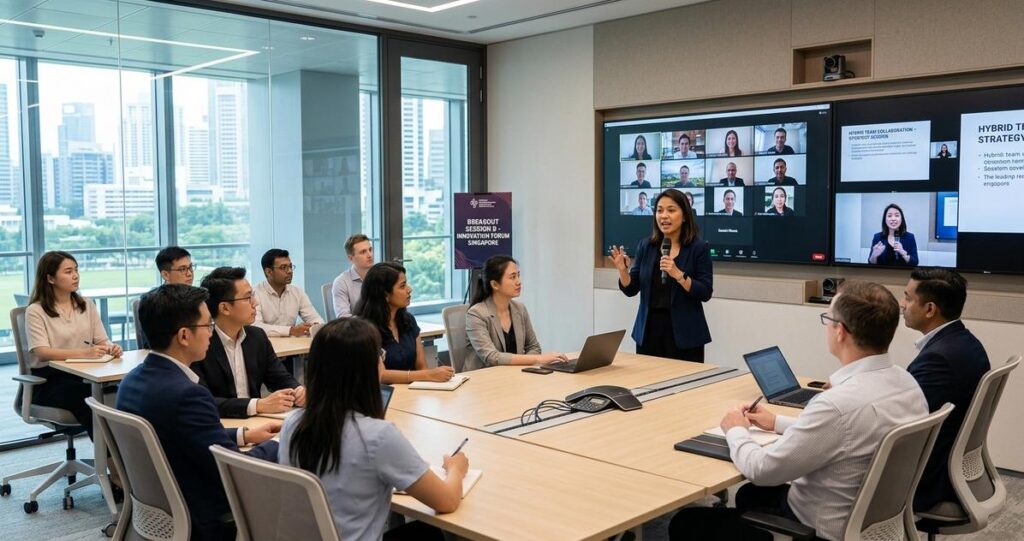
Hybrid conferences have become a practical choice for organisations in Singapore that want to bring together in-person and remote participants without losing reach or flexibility. Yet one of the most challenging parts of a hybrid programme is not the keynote speech or the main panel, it is the breakout room. A breakout session depends on interaction, timing, clear facilitation, and smooth technology, and these are harder to manage when some participants are in the room and others are joining from home, office, or even while travelling across time zones. If the breakout is poorly run, remote attendees can feel like observers rather than participants, in-person groups may dominate the discussion, and the session can quickly lose structure.
For Singapore-based organisers, this matters even more because hybrid conferences are often used for regional business forums, professional education, government-linked discussions, healthcare meetings, and association events that include both local and overseas stakeholders. The expectation is usually high: participants want the discussion to be efficient, respectful, and technically reliable. A well-facilitated breakout room can help achieve that by creating equal access, keeping dialogue focused, and making the session useful for everyone, regardless of where they are joining from.
Facilitating breakout rooms in a hybrid setting is not only about knowing how to use the conferencing platform. It requires thoughtful session design, confident moderation, coordination between on-site and virtual teams, and a clear plan for handling common problems such as audio imbalance, delayed handovers, or participant disengagement. The following sections explain how to do this effectively, with practical considerations that are especially relevant for conferences hosted in Singapore.
Design the breakout session before the event starts
A successful breakout room begins long before participants are moved into smaller groups. The facilitator needs a clear purpose for the session, because a breakout without a defined outcome often becomes a casual conversation with little value. Start by deciding what the group should produce, whether that is a list of priorities, a short recommendation, a response to a case study, or a set of questions for the plenary session. A specific output keeps the discussion focused and makes it easier to report back later.
In a hybrid conference, it is also important to decide how many participants should be in each group and how they will be mixed. If remote and in-room attendees are not intentionally balanced, one side may dominate. In many cases, the best approach is to create groups that have both types of participants, supported by one trained facilitator or co-facilitator. If the topic is sensitive, technical, or highly interactive, smaller groups usually work better because they reduce the risk of people talking over one another, especially when audio latency is involved.
Set a clear objective and time box
Every breakout should have a stated objective, a task, and a time limit. Participants should know what they are expected to discuss, what they need to submit or present, and how long they have. A time box matters because hybrid sessions can easily drift when people struggle with connectivity or need extra time to unmute, share screens, or coordinate with others. The facilitator should communicate a simple structure at the start, such as an opening question, a discussion phase, and a two-minute wrap-up before returning to the main room.
Keep instructions concise and visible. A written prompt on the slide deck or within the chat can support participants who join late or whose audio is unstable. For Singapore audiences, where events often include multilingual or multinational attendees, plain English is usually the safest choice. Avoid overloading the task with too many instructions at once.
Choose the right breakout format
Not every discussion needs the same format. A brainstorming exercise, a case-based discussion, a consensus-building task, and a peer-learning conversation each require different facilitation styles. For example, a brainstorming session can work well with a shared digital whiteboard, while a policy discussion may need one speaker to summarise points on behalf of the group. If the breakout is intended to generate a formal output, assign a note-taker in advance and decide whether the notes will be captured in a shared document, platform chat, or a reporting template.
Hybrid organisers in Singapore often run sessions for business networking, education, and professional development. For these settings, the format should match the audience’s expectations. Senior executives may prefer a concise, outcome-oriented roundtable, while technical professionals may want a more detailed working session with visuals and shared documents. The key is to match the method to the purpose.
Build a facilitation structure that works for both in-room and remote participants
Hybrid facilitation succeeds when the experience feels fair. Remote participants should not feel like guests who are waiting for someone in the room to notice them. Similarly, in-room attendees should not feel that every conversation is slowed down by the virtual platform. The facilitator’s job is to bridge the two environments so that both groups can contribute meaningfully.
A strong hybrid breakout often uses a dual-role model. One person facilitates the discussion, while another monitors the technical side, tracks raised hands, keeps an eye on chat messages, and handles screen sharing or timing. This division is especially useful for larger conferences or sessions involving important stakeholders. In Singapore, where event teams often need to deliver polished outcomes for corporate or institutional clients, having a dedicated technical support person can make the difference between a smooth flow and a fragmented session.
Establish participation rules early
At the start of the breakout, the facilitator should explain how people can contribute. This includes when to speak, whether to use the raise-hand function, how chat will be used, and what to do if someone has connectivity issues. Clear rules reduce confusion and help prevent overlapping conversations. If in-room microphones are being passed around, remind participants to speak clearly and allow time for remote audio to catch up.
Encourage inclusive participation by inviting remote attendees first at times. This simple step helps prevent the in-room group from filling every silence. The facilitator can also rotate speaking order, ask direct questions to quieter participants, and summarise contributions to keep everyone aligned. In a hybrid environment, active inclusion is not optional, because silence can easily be mistaken for disengagement.
Use one shared source of truth
Hybrid breakout rooms work better when everyone knows where the discussion record is being kept. That might be a shared document, a live note-taking page, or a designated reporting slide. When multiple channels are used without coordination, important points can be lost. The note-taker should write in real time, using short phrases rather than long paragraphs, so the group can see progress and correct misunderstandings immediately.
If the session uses platform chat, ensure that the chat is monitored and that any important written questions are read aloud for the in-room group. This prevents a common hybrid problem, where comments from remote participants remain unseen by those physically present. The goal is not to force everyone onto one channel, but to make sure no contribution disappears.
Handle the technology and room setup carefully
Technology can either support hybrid breakout rooms or undermine them. Even a well-designed discussion can fail if microphones are poor, the camera angle is wrong, or participants cannot hear one another. Before the event, test the full setup from the perspective of both audiences. This includes the platform, audio, video, screen sharing, backup internet access, and the transition between the main session and breakout rooms.
For Singapore venues, where conference facilities may be located in hotels, convention centres, co-working spaces, or company offices, it is important to check room acoustics and signal strength. A room with echo, background noise, or weak microphone coverage will make it harder for remote participants to stay engaged. If possible, use boundary microphones or table microphones for the in-room group, position the camera so it captures active speakers, and confirm that the display allows remote faces or names to be visible to the room when needed.
Test the transition into and out of breakouts
The handover between the main session and breakout rooms should be rehearsed. Participants need to know when they are being moved, where they should go, and what to do if they are disconnected during the transition. The moderator should use simple language and avoid rushing. If the event platform allows pre-assigned breakout rooms, verify the room list in advance. If the assignment is done manually, have a backup plan in case someone drops out or joins late.
Timing matters here. A delayed move into breakout rooms can consume valuable discussion time. A poorly managed return to the plenary can cause people to miss the reporting segment. A visible countdown timer, verbal reminders, and a backstage communication channel between the main producer and breakout facilitators can help maintain control.
Plan for common technical issues
Common technical problems in hybrid breakouts include audio echo, muted microphones, participants speaking over one another, and poor screen visibility. The facilitator should know how to respond without creating panic. If audio is unstable, reduce the number of people speaking at the same time and ask participants to unmute only when called. If a participant drops off the call, continue the discussion and invite them back if they reconnect. If the room microphone fails, a backup handheld mic should be available.
In practice, a calm and prepared response often matters more than a perfect system. Participants are generally understanding when they can see that the event team is in control and working quickly to restore access.
Facilitate engagement with clarity, energy, and inclusion
A breakout room is only effective if participants contribute. In a hybrid setting, engagement requires more than asking open questions. It means making it easy for people to speak, respond, and build on one another’s ideas. The facilitator should use active listening, short summaries, and direct invitations to participate. This keeps the discussion moving and prevents one or two voices from taking over.
Engagement should also be paced carefully. Some hybrid sessions fail because they move too quickly for remote attendees to follow, especially when the in-room conversation is energetic. Others fail because they move too slowly and lose momentum. The facilitator needs to watch for signs of confusion, repeated questions, or long silences, then adjust accordingly.
Use prompts that invite balanced discussion
Good prompts are specific, not generic. Instead of asking, “Any thoughts?”, ask, “What is the biggest operational challenge with this proposal?” or “Which recommendation would have the highest impact in the Singapore context?” Focused questions produce better answers and help participants contribute meaningfully within the time available. If the group is mixed between senior and junior participants, the facilitator should also ensure that hierarchy does not silence younger or less vocal attendees.
For conferences in Singapore, where many events bring together regional leaders, technical specialists, and public sector or industry representatives, the facilitator may need to balance formality with accessibility. A respectful but conversational tone usually works best. Keep the discussion professional, but avoid making it so formal that people hesitate to speak.
Support remote participants deliberately
Remote attendees often need extra attention because they cannot rely on the room environment to pull them into the conversation. The facilitator should acknowledge them by name, check whether they can hear clearly, and pause occasionally to invite their views. If the session involves writing on a shared board or document, give remote participants the chance to type while others speak. That helps maintain parity between the two environments.
It is also useful to assign a remote support role, especially in larger events. This person can monitor chat, troubleshoot audio issues, and make sure questions from the virtual audience are not overlooked. That support function is particularly valuable when the conference includes cross-border participants joining from different time zones or internet conditions.
Close the breakout with a disciplined reporting process
The reporting stage is where breakout rooms prove their value. If the reporting is vague, repetitive, or rushed, the benefits of the discussion can be lost. Before the session starts, tell participants what reporting format will be used. Will each group give a one-minute verbal recap? Will key points be entered into a shared slide? Will the facilitator summarise the group’s top three ideas? A clear reporting structure prevents confusion and ensures that the plenary session receives usable input.
When returning to the main room, the chairperson or moderator should reconnect the breakout outcomes to the conference objective. This helps participants see that their time was well spent. If multiple groups worked on similar questions, it may be helpful to cluster themes rather than repeat every point. This keeps the plenary moving and makes the overall event feel coherent.
Capture action points, not just discussion points
Where possible, the breakout should end with defined action points, owners, or next steps. Even if the meeting is not intended to produce formal commitments, it should still generate a clear record of what was agreed, what remains open, and what will happen next. This is especially important for professional conferences in Singapore, where participants often expect practical outcomes and concise follow-up.
A strong closing statement from the facilitator can reinforce momentum. For example, summarise the key theme, identify one or two noteworthy insights, and thank participants for their contributions before handing back to the main moderator. This provides closure and helps the audience transition smoothly.
Effective hybrid breakout facilitation is a discipline that combines meeting design, technical awareness, and inclusive communication. The facilitator does not need to be the most charismatic person in the room, but they do need to be prepared, alert, and able to keep both in-person and remote participants aligned. In Singapore’s professional event environment, where stakeholders expect reliability and clear outcomes, these skills are not just helpful, they are essential.
For organisers planning a hybrid conference, the most practical takeaway is simple: do not treat breakout rooms as an afterthought. Build them into the agenda, assign the right roles, test the technology, and give facilitators enough information to guide discussion confidently. When that happens, breakout rooms become one of the most valuable parts of the event, turning a large conference into a set of focused conversations that people can actually use.
This article provides general event guidance for planning purposes. For meetings involving healthcare, legal, regulatory, or other specialist subject matter, the content of the discussion should be reviewed by qualified professionals familiar with the relevant field and Singapore requirements.

Jeremy Lee is a seasoned digital marketing director and strategist with over two decades of experience in the industry. As the founder of Sotavento Medios, I manage a diverse portfolio of over 50 businesses, helping brands grow through advanced search strategies and digital innovation. My work focuses on bridging the gap between traditional search engine optimisation and the evolving world of AI-driven answer engines.
get in touch