
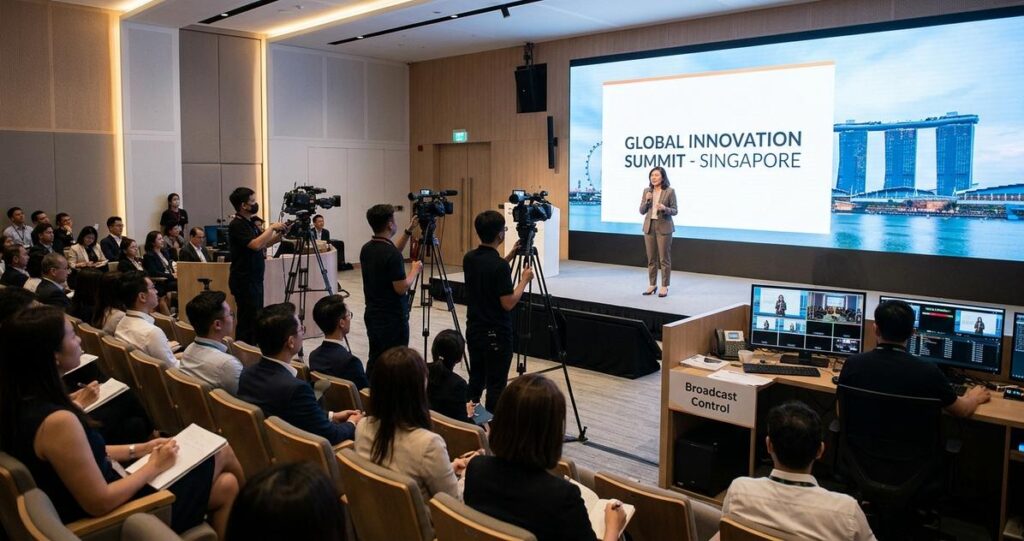
Hybrid keynotes have become a practical format for many organisations in Singapore, especially when audiences are split between a physical venue and remote participants joining from offices, homes, or overseas. For business leaders, associations, government-linked organisations, and event organisers, the challenge is no longer simply broadcasting a speaker on a screen. The real question is how to use video production to create a keynote that feels clear, credible, and engaging for both the audience in the room and the audience watching online. In a city like Singapore, where expectations for professionalism are high and events often involve regional stakeholders, the quality of video production can shape whether a keynote feels polished and memorable, or flat and difficult to follow.
Video production plays a central role in hybrid keynotes because it bridges two very different viewing experiences. An in-person audience can rely on direct sightlines, live presence, and the energy of the room. A remote audience depends on framing, sound clarity, camera movement, graphics, and lighting to understand the message and stay attentive. When these elements are planned well, hybrid keynotes can support accessibility, widen reach, and strengthen brand credibility. When they are poorly managed, even a strong speaker can lose impact because the message is not visually or technically delivered in a way that supports comprehension. For Singapore organisations that value efficiency, reputation, and operational reliability, this is not a minor production detail. It is part of the communication strategy itself.
Why video production matters so much in a hybrid keynote
A keynote is usually the flagship segment of an event. It often sets the tone for the entire programme, introduces strategic ideas, launches a product, or frames an organisational vision. In a hybrid setting, the keynote has to function across two channels at once. The physical audience experiences the event as a shared live occasion, while the online audience experiences it as a media production. That dual requirement changes everything from camera placement to speaker blocking, slide design, and audio capture.
Good video production improves message clarity first. A speaker standing on a stage may be easy to follow for those nearby, but online viewers need close framing, clean transitions, and readable visuals. If the speaker turns away from the camera to read slides, or if the presentation screen is not legible on smaller devices, understanding drops quickly. This matters in Singapore, where attendees may join on mobile devices during commutes, between meetings, or from different time zones. A hybrid keynote should respect the realities of modern viewing habits, not assume everyone is sitting in a conference hall with a large screen.
Video production also protects the credibility of the event. Poor lighting, inconsistent audio, or awkward switching between cameras can make a keynote feel unprepared. In contrast, precise production communicates competence, which is particularly important for board meetings, industry conferences, investor briefings, and public-facing events. For Singapore organisations that operate in competitive sectors such as finance, technology, healthcare, education, and professional services, production quality is part of brand presentation.
The audience experience is not identical, so the production cannot be identical
Hybrid audiences have different attention patterns. The in-room audience can absorb body language, stage presence, and ambient energy. The remote audience sees what the camera shows, and nothing else. That means the video team must actively translate the live keynote into a screen-friendly experience. Wide shots may help convey stage scale, but close shots are needed for emotional connection and facial expression. Slides that look clear from the back row may still fail on a laptop screen. Production must anticipate these differences rather than simply record the stage from one fixed position.
How camera work and shot design shape keynote engagement
Camera work is one of the most visible parts of hybrid keynote production, but it is most effective when it remains purposeful rather than flashy. The goal is not to distract the audience with constant movement. The goal is to guide attention. A well-designed camera plan helps remote viewers understand who is speaking, when a visual aid matters, and how the keynote is progressing. In many cases, this requires multiple cameras, a clear switching plan, and a director who understands both content and pacing.
For keynote sessions with a single speaker, a common production approach is to combine a main frontal camera with supporting angles. The frontal shot gives stability and direct engagement. A tighter shot helps capture expression and emphasis. A wider shot can be used for stage context, especially when the speaker moves or when visual elements on stage are part of the presentation. If the keynote includes panel-style exchanges or guest introductions, the camera plan should be able to adapt smoothly without jolting the viewer.
Framing affects comprehension
Framing is not just an aesthetic choice. It affects how well viewers interpret body language, read slides, and stay oriented. A camera that is too far away makes the speaker appear detached. A camera that is too close may feel cramped and reduce the sense of professionalism. The right framing depends on stage size, speaker movement, and the intended tone of the keynote. In Singapore event venues, where space can vary from hotel ballrooms to convention halls and corporate boardrooms, production teams need to adapt the shot design to the venue rather than rely on a standard template.
Switching should support the message
Camera switches should follow the keynote structure. When a speaker makes a strong point, a close shot can reinforce emphasis. When a slide is central to the message, a clean cut to the slide feed may be more useful. When the speaker pauses for audience reaction, the production team may use a wider angle to restore context. Over-editing can make the keynote feel fragmented. Under-editing can make it feel static. The best hybrid keynote productions strike a balance between rhythm and restraint.
Why audio and lighting often matter more than people expect
Many event organisers initially focus on visuals, but hybrid keynotes are often won or lost on audio quality. If viewers cannot hear the speaker clearly, the message becomes tiring to follow. Technical audio problems are particularly disruptive in hybrid formats because online audiences often have less patience for interruptions than in-person audiences. In practice, good audio design includes a reliable microphone system, careful gain control, monitoring for feedback or echo, and a setup that captures speech naturally.
Lighting is equally important. A keynote speaker needs to be visible without harsh shadows, overexposure, or uneven colour balance. Lighting should support both the stage and the camera. What looks acceptable to the naked eye may look flat or overly dark on camera, especially in venues where ambient lighting changes during the event. In Singapore, where many events are hosted in multipurpose venues, lighting plans need to account for room design, screen brightness, stage materials, and the colour temperature of other lighting in the space.
Speech intelligibility is the priority
Speech intelligibility means how easily spoken words can be understood. It depends on volume, clarity, microphone quality, room acoustics, and background noise. Hybrid keynotes often suffer when organisers assume the venue sound system alone will be enough. A room may sound acceptable in person but still create muddiness for online viewers. For that reason, production teams should test the full audio chain, including speaker microphones, backup microphones, feed to the streaming platform, and monitoring for remote playback.
Lighting must match the camera, not just the room
Lighting for video should not be left to general venue lighting alone. Camera sensors need consistent illumination to preserve detail and avoid grainy images. A keynote with strong lighting feels more composed and easier to follow. A poorly lit speaker may appear less confident even when delivery is excellent. This is one reason professional event streaming and hybrid production teams spend significant time on pre-event testing. They are not only checking whether the stage looks good in person, but whether it reads properly through the lens.
How graphics, slides, and motion design improve understanding
Video production supports not only the live image but also the informational structure of the keynote. Well-designed graphics, lower-thirds, transitions, and slide integration help viewers understand who is speaking, what topic is being covered, and where the presentation is heading. This is especially useful in hybrid keynotes where attention spans are split and the audience may not have the same background context.
Slides should be designed for visibility on smaller screens. That usually means less text, stronger contrast, larger fonts, and a clearer hierarchy of information. Dense slides that may work in a physical ballroom often become unreadable on a laptop or phone. If a keynote depends on data visualisation, charts should be simplified so that key trends can be understood quickly. Motion graphics can reinforce transitions, but only when used with restraint. Too much motion can look distracting and reduce the professionalism of the keynote.
On-screen information should reinforce, not repeat, the speaker
Strong keynote production treats graphics as a support layer, not a replacement for the speaker. The speaker should still be the centre of attention. Graphics can identify the speaker, segment the agenda, introduce a topic, or display a quote or statistic. They should not overwhelm the presentation. When the visual language is consistent, viewers can follow the content more comfortably and remember the key points more easily.
Singapore audiences often expect high production standards
Singapore audiences are generally familiar with polished corporate presentations, public-sector events, and regional conferences. That familiarity raises expectations. A keynote that looks improvised may weaken the perceived value of the content. Professional graphics, clean lower-thirds, and well-timed transitions help meet the expectations of stakeholders who are used to a high standard of event delivery. This is especially important for hybrid keynotes involving cross-border participants, where the production is also representing the organisation to people outside Singapore.
Planning, rehearsal, and technical coordination in a Singapore context
A hybrid keynote is only as strong as its pre-production planning. The live event may last an hour, but the work behind it starts much earlier. Production teams need to coordinate speaker cues, rehearsal schedules, slide handover, camera positions, audio checks, internet redundancy, and contingency plans. In Singapore, where venues can be tightly scheduled and event timelines are often efficient, clear coordination is essential.
Rehearsals help identify small issues before they become visible to the audience. A speaker may need to adjust pacing for camera cuts. Slides may need redesigning for screen readability. The moderator may need cues for hybrid audience questions. The production director may need to change framing because a speaker moves more than expected. These adjustments are not signs of weakness. They are part of professional event management.
Technical redundancy protects the keynote
Hybrid productions should never depend on a single point of failure. This includes backup microphones, backup recording, and a stable network strategy. Internet connectivity is particularly important for live streaming. If the connection is unstable, the viewer experience can degrade quickly. A professional setup often includes contingency planning so that the keynote can continue with minimal disruption if one component fails. For Singapore events where there may be VIPs, media presence, or international participants, this level of preparation is a reasonable standard rather than an optional extra.
Venue logistics affect production quality
Venue layout influences sightlines, cable management, camera positions, and lighting angles. A room that looks ideal for an in-person gala may still be difficult for hybrid recording. Production teams should inspect loading areas, control-room placement, stage access, and sound reflections. Singapore venues range from hotel function rooms to exhibition centres and corporate offices, and each setting has different constraints. The best results come from treating video production as part of the venue strategy, not as an add-on after the keynote is already planned.
Practical ways to make hybrid keynotes stronger and more engaging
Organisations planning a hybrid keynote can improve outcomes by approaching the event from the audience’s point of view. First, define what the keynote needs to achieve. Is the goal to inform, launch, persuade, or inspire? The production style should match that purpose. A leadership address may benefit from intimate framing and minimal graphics, while a product launch may require more dynamic camera cuts and visual support.
Second, design for both viewing environments. Ask whether the online audience can hear every word clearly, read every slide, and understand every transition. Ask whether the in-room audience can see the screens without strain and still feel connected to the speaker. These checks should happen before the event, not during it. Third, collaborate early between content owners and production teams. A keynote script, visual deck, and run-of-show should all be aligned. When content and production are planned together, the result feels coherent instead of stitched together.
Fourth, keep the speaker supported. A strong host, clear stage cues, and a calm backstage process reduce stress and improve delivery. In a Singapore business environment where many speakers have limited time for rehearsal, the production team can add value by simplifying the process and anticipating practical needs. Finally, remember that hybrid does not mean compromise. If planned well, a hybrid keynote can deliver reach, polish, and accessibility at the same time.
For organisers in Singapore, the most useful mindset is to treat video production as a communication tool, not just a technical service. Every camera angle, lighting choice, audio decision, and graphic element shapes how the keynote is understood. When these elements work together, the keynote becomes more than a live talk. It becomes a clear and credible experience for everyone watching, regardless of where they are.
Businesses and event teams planning hybrid keynotes should start with the audience experience, then build the production around that goal. If the content matters, the delivery should be strong enough to carry it. In a hybrid format, video production is what makes that possible.
General information only: This article provides general event production guidance and does not replace advice from qualified technical, legal, or venue-specific professionals. Organisations should assess their own event requirements, venue conditions, and platform needs before implementation.

Jeremy Lee is a seasoned digital marketing director and strategist with over two decades of experience in the industry. As the founder of Sotavento Medios, I manage a diverse portfolio of over 50 businesses, helping brands grow through advanced search strategies and digital innovation. My work focuses on bridging the gap between traditional search engine optimisation and the evolving world of AI-driven answer engines.
get in touch