
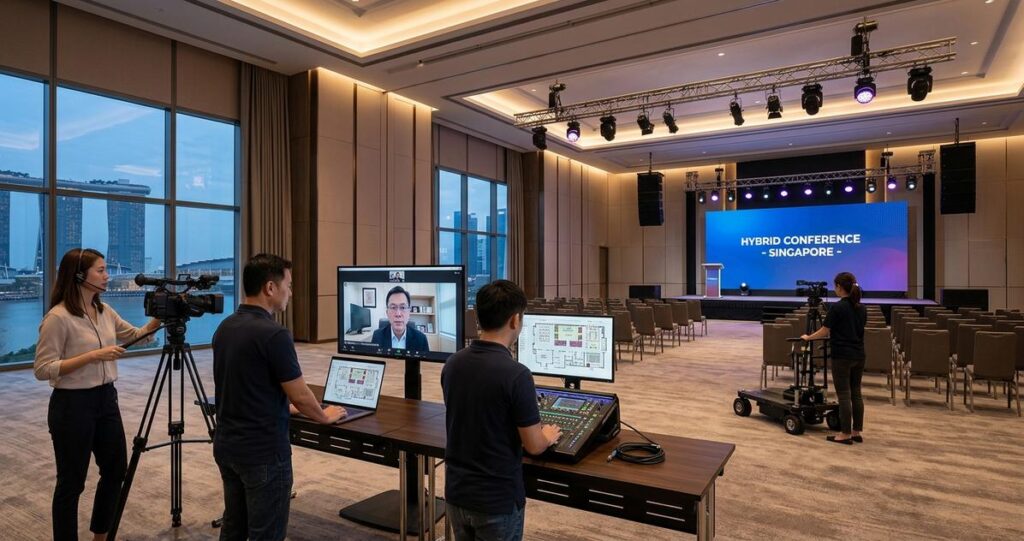
Hybrid events have become a practical choice for many Singapore organisations because they combine the reach of online participation with the impact of in-person experiences. For corporate launches, conferences, town halls, medical education sessions, and trade events, one of the most important planning steps is the virtual site visit. A well-run virtual site visit helps event planners, speakers, sponsors, and technical teams understand the venue, assess logistics, and reduce surprises on event day. In Singapore, where venues often operate on tight schedules and teams may include overseas stakeholders, a structured remote walk-through can save time, improve coordination, and support better decisions.
A virtual site visit is not simply a video call with a camera moving around a room. When done properly, it is a guided operational review of the venue environment, the technical infrastructure, audience flow, safety arrangements, accessibility features, and production needs. It should give decision-makers enough clarity to confirm whether the space suits the event format, what equipment is required, and which risks need mitigation. For hybrid events, the virtual component must also show how cameras, microphones, lighting, internet connectivity, and control rooms will work together to deliver a stable experience for both physical and online audiences.
Singapore planners often work across compact timelines, multi-stakeholder approval processes, and venues with strict usage rules. That makes the virtual site visit especially valuable. It allows teams to collaborate across offices, compare venue options, brief international speakers, and document operational requirements before committing to on-site rehearsals. A strong process also supports compliance, because accessible routes, emergency exits, crowd movement, and technical constraints can be reviewed earlier rather than discovered late in production.
Why virtual site visits matter for hybrid events
Hybrid events blend live and digital delivery, so venue assessment needs to cover both audience experiences. A physical site visit alone may not reveal whether the internet connection can support live streaming, whether camera positions will obstruct sightlines, or whether the room layout can accommodate speakers, stage design, and delegate movement at the same time. A virtual site visit gives the team a chance to observe the venue from a production perspective, while also including remote participants who may never visit the space in person.
For Singapore-based events, this matters because many teams coordinate with regional head offices, overseas presenters, agencies, and vendors. A virtual format makes it easier to involve people in different time zones without requiring them to travel. It also helps internal stakeholders, such as procurement, marketing, compliance, and executive teams, review the same information in one structured session. When the site visit is recorded or documented properly, it becomes a useful reference point throughout the event planning cycle.
What a virtual site visit should achieve
The goal is not only to show the venue. It is to confirm whether the space can support the event’s technical, operational, and audience requirements. The session should clarify entry points, load-in access, stage placement, projection or LED screen positioning, audio setup, lighting conditions, breakout spaces, and contingency options. It should also help determine whether the venue supports hybrid production needs such as encoder placement, dedicated internet lines, control desks, and camera movement.
In Singapore, where venue selection may also depend on building management rules, security procedures, and shared-space constraints, the site visit should provide enough detail for teams to plan accurately. If the event includes board members, medical professionals, public-sector representatives, or clients, the planning team may also need to review privacy, credential checks, and room segregation. A good virtual site visit surfaces these requirements early.
Planning the virtual site visit with clarity and control
Successful virtual site visits begin long before the camera starts rolling. The organiser should define the purpose of the visit, the key decision-makers who must attend, and the questions that need answering. For example, a leadership forum may focus on stage aesthetics, speaker arrival routes, and broadcast quality, while a technical workshop may prioritise camera coverage, microphone pickup, and screen visibility. Without a clear agenda, the session can become a casual venue tour that leaves important issues unresolved.
The venue team, production partner, and event organiser should align on the route, timing, and responsibilities. If possible, the virtual visit should follow the same journey that speakers, delegates, and production crew would take on event day. This includes arrival, registration, loading bays, lift access, holding areas, plenary rooms, foyer spaces, and back-of-house zones. A logical route helps remote participants understand how the event will function in real operations, not just how the space looks.
Build a checklist before the session
A structured checklist keeps the site visit efficient and prevents gaps. The checklist should cover venue dimensions, ceiling height, power availability, rigging points, HVAC considerations, Wi-Fi or wired internet options, noise sources, lighting conditions, and accessibility features such as ramps, lifts, and accessible toilets. It should also include safety points like emergency exits, fire escape routes, and any restrictions on equipment placement.
For hybrid events, additional questions are essential. Ask where the main camera positions can be placed without blocking guests, whether the venue allows cable runs across public areas, how audio will be captured from speakers and audience microphones, and whether there is a quiet area for the control team. If interpreters, captions, or sign language support are planned, those needs should be included in the checklist from the start, because they can affect the layout and technical workflow.
Choose the right format and tools
Virtual site visits can be conducted through live video calls, pre-recorded guided walk-throughs, or a combination of both. Live sessions work well when the team needs to ask questions in real time, compare options, or inspect details dynamically. Pre-recorded content is useful when the venue has limited availability or when the organiser wants a clean overview to review later. In many cases, the best approach is a live guided walk-through supported by photos, floor plans, and marked-up diagrams shared before or after the session.
The device used for the tour should provide stable video quality, clear audio, and reliable connectivity. A smartphone on a stabiliser can be sufficient for a simple walk-through, but larger hybrid events may benefit from a dedicated production camera and a team member who can narrate the space clearly. The person on-site should know the venue well and be able to answer practical questions without hesitation. If possible, test the connection in advance so that the walkthrough does not break up at critical moments.
Running the virtual site visit effectively
During the session, the person leading the tour should speak slowly, orient viewers often, and frame the discussion around event use rather than venue features alone. Instead of simply showing a ballroom, explain where the stage could sit, where the audience would enter, where cameras might be placed, and how guests would move between registration and seating. This makes the session much more useful for remote planners who are trying to visualise the event flow.
Clear communication is essential. Remote participants should know when to ask questions and when the guide will pause for feedback. It helps to assign one person to lead the walk-through, one person to monitor the virtual meeting chat, and one person to capture notes or screenshots. If the session includes multiple stakeholders, the moderator should keep the conversation focused and prevent the discussion from drifting into unresolved side topics.
Show the areas that affect production most
For hybrid events, some parts of the venue deserve closer attention than others. These typically include the main event room, the stage, the projection or LED wall area, the front-of-house audio position, the streaming control area, the registration desk, and any sponsor or networking zones. It is also important to inspect ceiling mounts, side walls, backstage access, storage spaces, and loading entrances because they affect how equipment will be installed and removed.
Lighting should not be overlooked. Rooms can look very different on camera than they do in person, especially if there are strong windows, reflective surfaces, or uneven colour temperatures from mixed lighting. Show where natural light enters, how blinds or curtains work, and whether the venue has dimming controls. For live streaming, even small lighting issues can affect image quality and readability on screen.
Audio deserves similar attention. Explain where microphones will be used, whether the room is acoustically live or echo-prone, and whether loud external noise may interrupt the programme. In Singapore, where many venues sit near roads, shopping areas, transport links, or adjacent event spaces, background noise can be an issue. A virtual site visit should not treat this as a minor detail, because reliable audio is often more important to online audiences than visual polish.
Capture measurements and document constraints
One of the most common reasons site visits fail to support planning is incomplete documentation. A successful virtual visit should produce clear records, including floor plans, measurements where available, photos, and a summary of constraints. If exact dimensions cannot be measured during the session, identify what still needs confirmation and assign responsibility for follow-up. This prevents assumptions from becoming costly mistakes later.
Document where equipment cannot go, whether any surfaces require protection, and whether the venue has rules on taping, draping, drilling, or rigging. If access is limited to certain hours, record that too. In Singapore, some venues operate within tightly controlled building management policies, so production teams need precise information about access windows and service routes. Good documentation supports smoother load-in, better scheduling, and fewer last-minute disputes.
Making the visit useful for hybrid decision-making
A virtual site visit should help the team decide not only whether a venue is attractive, but whether it is operationally suitable for a hybrid format. This requires comparing what the room offers with what the event actually needs. For example, a visually impressive venue may not have the cable routes, internet capacity, or backstage space required for a professional livestream. Similarly, a compact meeting room may work perfectly for a targeted hybrid briefing if the camera positions, sound quality, and delegate count are well matched to the format.
Decision-making should also include risk review. Consider what could go wrong on event day and whether the venue layout supports backup plans. Ask where spare equipment can be stored, whether an alternate power source is available, and how the team would respond if a camera fails or a speaker arrives late. Hybrid production is strengthened by preparation, not by optimism alone.
Include accessibility and audience comfort
Accessibility is an important part of event quality. The site visit should cover step-free access, accessible toilets, lift access, visibility for guests with different seating needs, and space for mobility aids if relevant. If the event serves a diverse audience, check whether the room layout supports clear signage, easy navigation, and inclusive seating arrangements. These considerations matter for both physical guests and the production team, because accessible design often improves flow for everyone.
Audience comfort should also be discussed. Temperature, seating spacing, glare, noise, and sightlines all affect how people experience the event. In Singapore’s climate, indoor comfort is especially important because attendees may arrive after walking from transport links or nearby buildings. A venue that looks adequate on a screen may still feel unsuitable if it becomes too warm, too dim, or too cramped during the actual programme.
Align stakeholders before moving forward
After the virtual site visit, all stakeholders should receive a concise recap of the key observations, open questions, and next actions. This can include venue comparisons, technical requirements, and any items that need on-site verification. The recap should be practical, not overly long, and should make it easy for decision-makers to approve the next stage of planning.
For Singapore organisations, this is especially useful when approvals are shared across departments or when senior stakeholders expect a clear rationale for venue choice. A strong recap turns the site visit into a decision-support document. It also reduces repeated questions, because the same information can be referenced by event managers, production teams, and vendors throughout the planning process.
Common mistakes to avoid during virtual site visits
Several issues can weaken the value of a virtual site visit. One frequent mistake is relying on a general venue showcase instead of an event-specific walkthrough. Another is failing to include the technical production team, which can lead to overlooked problems such as poor camera sightlines or insufficient power points. It is also common for teams to skip documentation, assuming that everyone will remember what they saw during the live call. In practice, even a well-run session can be forgotten unless notes, photos, and floor plans are captured properly.
A further mistake is ignoring internet stability. For hybrid events, connectivity must be treated as a core operational issue, not an optional extra. Teams should ask what connection options are available, where the equipment will be placed, and whether the venue can support the planned streaming workflow. If the event is sensitive, high-profile, or public-facing, the production partner may also need to recommend backup connectivity or additional testing.
Another common gap is not involving the right people. A venue might look suitable to a marketing lead, but the production supervisor may spot issues that affect sound, lighting, or cabling. The strongest virtual site visits bring together event organisers, technical crews, and key decision-makers so that the same room can be reviewed from multiple perspectives.
Turning the site visit into a smoother event day
When planned carefully, a virtual site visit becomes more than a planning exercise. It becomes the foundation for a calmer, more organised event day. The team enters production with clearer expectations, the venue knows what to prepare, and remote stakeholders feel more confident about the setup. That kind of clarity matters in Singapore, where event schedules are often tight and venue turnover can be fast.
To get the most value from the process, treat the virtual site visit as part of the event workflow, not a one-off meeting. Use it to identify production needs, confirm logistics, and flag risks early. Follow it with a documented action list, technical check requirements, and a timeline for any further inspections or rehearsals. If the event involves high-stakes speakers, broadcast elements, or multiple audience groups, consider supplementing the virtual visit with a brief on-site technical survey before the event.
For organisers who want a dependable hybrid event, the best outcome is simple: fewer assumptions, more visibility, and better coordination. A successful virtual site visit gives everyone the information they need to plan with confidence. It supports better technical choices, safer operations, and a more polished experience for both the in-room audience and the online viewers.
For general planning purposes only, teams should always verify venue rules, technical specifications, and accessibility arrangements directly with the venue and production partners before confirming any event plan. Careful preparation at the site visit stage is one of the most effective ways to protect quality and reduce avoidable issues later.

Jeremy Lee is a seasoned digital marketing director and strategist with over two decades of experience in the industry. As the founder of Sotavento Medios, I manage a diverse portfolio of over 50 businesses, helping brands grow through advanced search strategies and digital innovation. My work focuses on bridging the gap between traditional search engine optimisation and the evolving world of AI-driven answer engines.
get in touch