
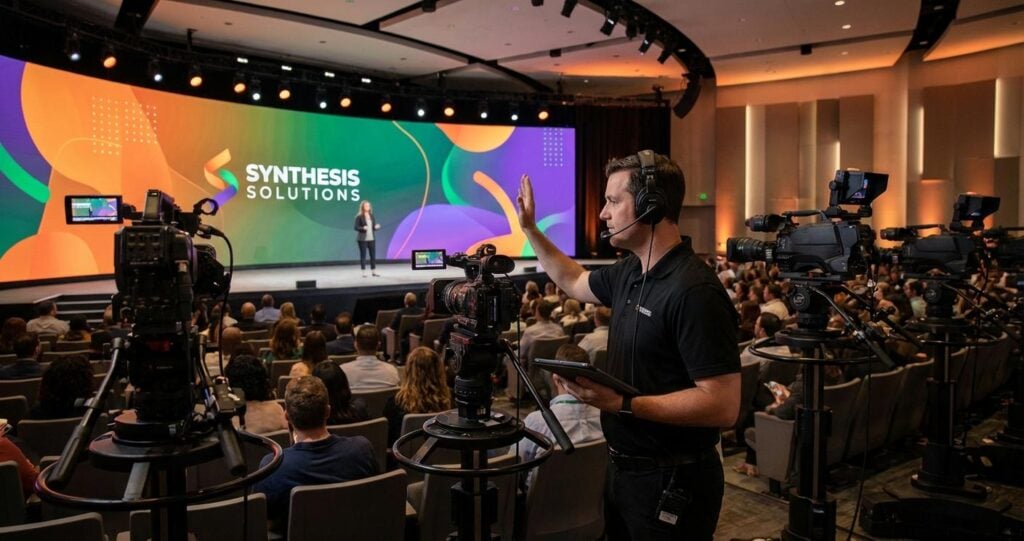
The Floor Manager: The Human API in High-Stakes B2B Town Hall Productions
In the architecture of a B2B town hall, every component, from the H.265 encoder to the bonded network uplink, is engineered for resilience and precision. Yet, the most sophisticated streaming infrastructure can be undermined by a failure at the human level. This is where the Floor Manager operates, functioning not merely as a stage director but as the critical human interface between the on-stage talent and the complex digital signal chain. For enterprise clients and production managers, understanding the technical depth of this role is fundamental to executing flawless hybrid events. The Floor Manager is the on-the-ground processor, translating the director’s commands into synchronized physical actions, managing real-time data flow to presenters, and ensuring the integrity of on-stage signal paths, from RF microphones to confidence monitor feeds. Their performance directly impacts the perceived quality, professionalism, and ultimately, the ROI of the entire production.
The Floor Manager as the Conductor of the Production Signal Chain
The core function of the Floor Manager is to serve as the physical extension of the Technical Director (TD) and Director. They are the last link in the command chain before an instruction becomes a visible or audible action on the program feed. This requires a deep, practical understanding of the production’s technical backbone, ensuring seamless integration between human performance and broadcast hardware.
Cueing Systems and Video Switcher Integration
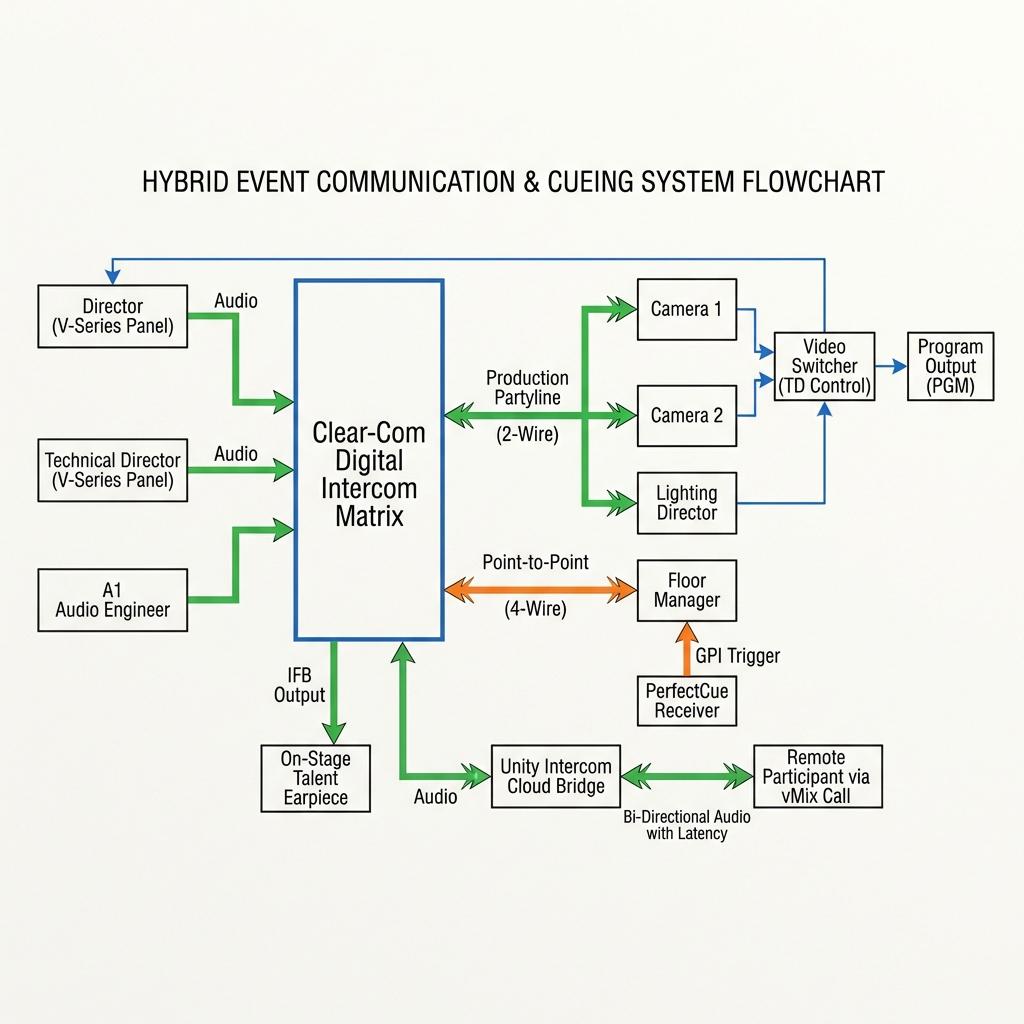
Modern cueing is far more than a simple hand signal. Professional systems like PerfectCue or Dsan’s Cue-Command are the standard. The Floor Manager operates the transmitter, which sends RF signals to a receiver connected directly to the master production environment. This receiver often has multiple outputs, such as USB for direct control of presentation software and 4-pin XLR outputs that interface with a production switcher’s General Purpose Interface (GPI) triggers. For example, a “next slide” cue from the Floor Manager can simultaneously advance a PowerPoint slide and trigger a macro on a Ross Carbonite or Blackmagic ATEM Constellation switcher. This macro might insert a corresponding lower third graphic, ensuring perfect synchronization between the presenter’s visuals and the broadcast graphics. The Floor Manager must understand this signal path to troubleshoot issues, such as a missed cue, which could be an RF dead spot, a disconnected GPI cable, or a misconfigured macro in the switcher’s control software.
Managing Presenter Teleprompters and Script Feeds
The teleprompter is a critical data display for on-stage talent, and its management is a technical task. The Floor Manager oversees the teleprompter operator, but must understand the signal flow. The script, often managed in software like ProPresenter or TeleScript, is outputted from a dedicated graphics machine. This signal is typically sent as a 1920x1080p SDI (Serial Digital Interface) feed to the on-camera prompter unit. The Floor Manager ensures the feed is stable and legible, and directs the operator’s scrolling speed to match the presenter’s natural cadence. In a hybrid scenario with a remote presenter, their script might be fed to them via a secure web-based prompter application. The Floor Manager must then coordinate with the remote talent and the TD to ensure the local and remote prompter feeds are synchronized, preventing any jarring disconnects in the event of a co-presentation.
Intercom Systems: The Critical Audio Network
The intercom (comms) system is the Floor Manager’s most vital tool. In professional productions, this is not a simple walkie-talkie system; it is a full-duplex audio matrix like a Clear-Com Eclipse or Riedel Artist system. The Floor Manager wears a beltpack connected to this matrix, providing access to multiple channels. This includes the Director’s channel (a point-to-point line for specific instructions), the production party line (for general communication with camera operators, audio, and lighting), and potentially a separate channel for stage A/V. Crucially, the Floor Manager helps manage the Interruptible Foldback (IFB) system, the audio feed sent to the talent’s earpiece. They confirm the talent can hear program audio or the director’s cues, troubleshooting issues that could range from a faulty beltpack to incorrect routing in the intercom matrix. Ensuring clear, low-latency communication across all technical departments is a primary responsibility that prevents on-air mistakes.
Synchronizing the Physical and Virtual Stages in Hybrid Town Halls
Hybrid events introduce significant technical complexity, primarily related to latency and feed management. The Floor Manager’s role expands to bridge the temporal and spatial gap between the in-person stage and remote participants, ensuring a cohesive experience for the global audience viewing the stream, which is likely delivered via RTMPS (Real-Time Messaging Protocol Secure) or SRT (Secure Reliable Transport).
Latency Compensation and Cueing Remote Participants
A remote participant joining via Microsoft Teams, Zoom, or a dedicated platform like vMix Call introduces significant latency, often between 500ms and 2 seconds. The Floor Manager cannot cue a remote presenter in the same way as in-room talent. They must work with the TD to pre-emptively cue. For instance, the director might instruct the Floor Manager, “Cue the remote speaker in 10 seconds.” The Floor Manager, communicating through a private backchannel managed by the production team, will give the remote speaker a standby command immediately. They might then provide a verbal “go” cue 2-3 seconds *before* the TD makes the switch on the board, accounting for both the platform latency and the human reaction time. This advanced coordination is essential to avoid dead air or presenters talking over one another, a common failure point in less professional hybrid productions.
Confidence Monitoring and Return Feed Architectures
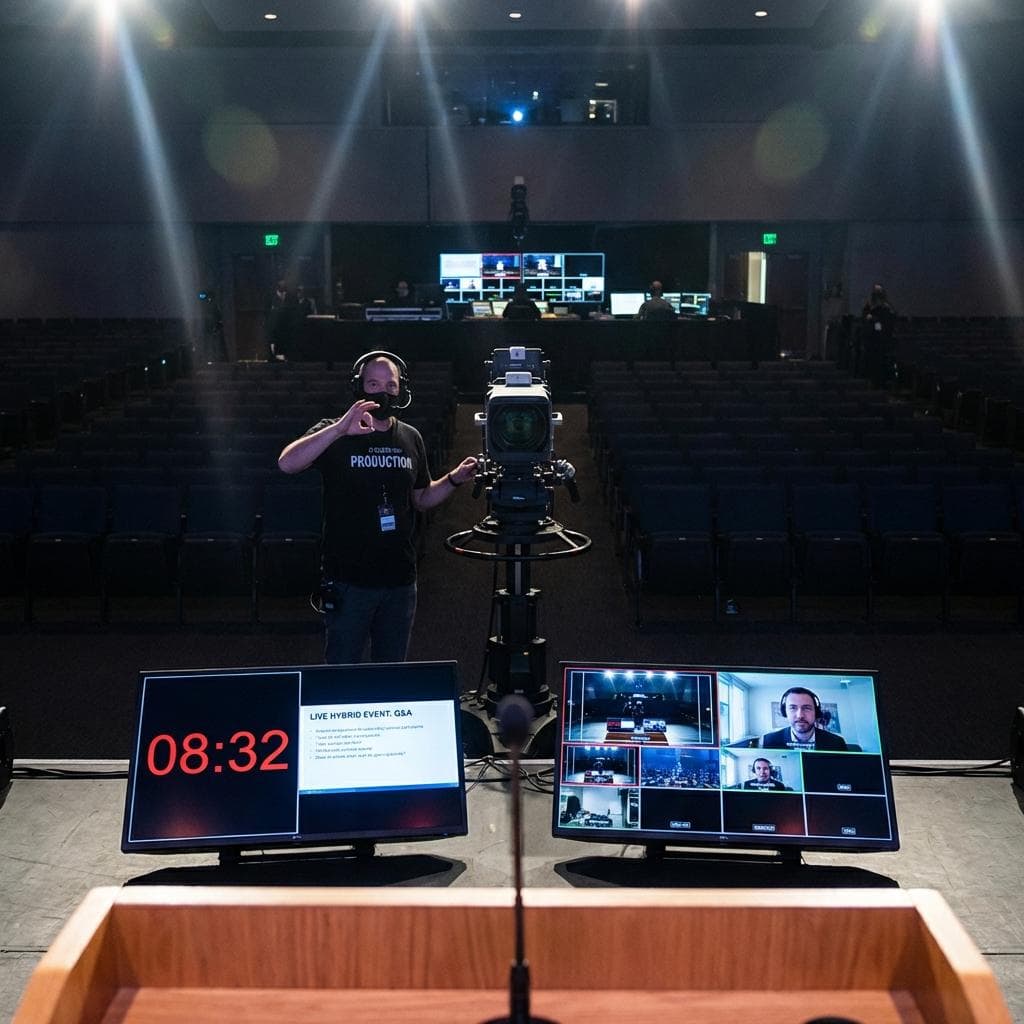
What the presenter sees on stage is a carefully curated set of data feeds, managed by the Floor Manager. These “confidence monitors” are not simply duplicating the program output. A common configuration involves routing a dedicated auxiliary (AUX) output from the main video switcher to the on-stage displays. This AUX feed can be configured as a custom multiview, showing the live program output, a large countdown timer for their segment, the next slide in their presentation, and video windows of the active remote speakers. The signal path for this is critical; it might be a 3G-SDI run from the control room or, in more modern setups, an NDI feed sent over a dedicated VLAN on the production network. The Floor Manager is responsible for confirming these monitors display the correct information for each presenter and for communicating any required changes to the TD or graphics operator.
Coordinating Camera Operations and On-Stage Blocking
The Floor Manager is the physical manifestation of the director’s vision for camera shots. They relay commands like “Camera 2, ready for a two-shot of the host and guest,” ensuring the operator can frame the shot correctly and without obstruction. This involves managing camera cable paths, typically tactical fiber or triax, to prevent tripping hazards and signal degradation. For robotic cameras (PTZs), the Floor Manager provides on-the-ground feedback to the remote operator, confirming shots are clear of physical obstructions and that on-stage lighting is hitting its marks. They guide presenters to their positions, ensuring they are correctly located for pre-planned shots, lit properly, and within the optimal pickup pattern of their microphones.
Advanced Risk Mitigation and Redundancy Protocols
In a live B2B streaming environment, failure is not an option. The Floor Manager plays a pivotal role in on-the-ground risk mitigation, serving as the first line of defense when technical issues arise on the highly sensitive event floor.
Managing RF Spectrum and Wireless Device Integrity
An enterprise town hall stage is a hostile Radio Frequency (RF) environment. Wireless microphones, in-ear monitors (IEMs), and intercom beltpacks all compete for a limited spectrum. The Floor Manager works closely with the A1 (Audio Lead) to execute the pre-planned frequency coordination plan. This involves ensuring presenters are using the correct, fully charged microphone packs and that antennas have a clear line of sight to receivers. During the event, the Floor Manager is the first to notice an RF interference issue (e.g., static or a dropout from a presenter’s mic) and must discreetly swap the pack for a pre-configured backup unit without interrupting the program flow. This requires having redundant hardware, with identical settings, immediately available.
Failover Procedures and Emergency Communications
Professional productions operate with built-in redundancy, and the Floor Manager must be fluent in executing failover protocols. If the primary digital intercom system fails, a backup system, often a simpler analog party line or even a set of pre-programmed two-way radios on a licensed frequency, must be activated instantly. The Floor Manager leads this transition on the floor. Similarly, if a presenter’s primary teleprompter fails, the Floor Manager must seamlessly direct their attention to a backup monitor displaying the same feed, or have cue cards as a tertiary, analog backup. These emergency procedures are rehearsed in advance to ensure minimal on-air disruption.
Interfacing with IT and Networked Production Infrastructure
As productions increasingly rely on IP-based workflows using protocols like NDI|HX or Dante for audio, the Floor Manager’s role intersects with network engineering. They are responsible for the physical security of network drops on stage that might be feeding an NDI-enabled PTZ camera or receiving data for a digital signage element. They become the “remote hands” for the network engineer in the control room, confirming link lights on network switches, tracing a problematic Cat6a cable, or ensuring a device is connected to the correct production VLAN port. This basic network awareness prevents catastrophic failures that could originate from something as simple as a disconnected Ethernet cable.
Ultimately, the Floor Manager’s role is one of technical translation and execution. They convert the director’s intent into precise, timed actions while simultaneously monitoring the health of on-stage production technology. For any organization investing in high-production-value town halls, recognizing the Floor Manager as a skilled technical operator, not just a stagehand, is essential. Their expertise is the safeguard that ensures the stability of the physical production environment, allowing the streaming infrastructure to deliver a flawless and engaging experience to the global B2B audience.

Jeremy Lee is a seasoned digital marketing director and strategist with over two decades of experience in the industry. As the founder of Sotavento Medios, I manage a diverse portfolio of over 50 businesses, helping brands grow through advanced search strategies and digital innovation. My work focuses on bridging the gap between traditional search engine optimisation and the evolving world of AI-driven answer engines.
get in touch