
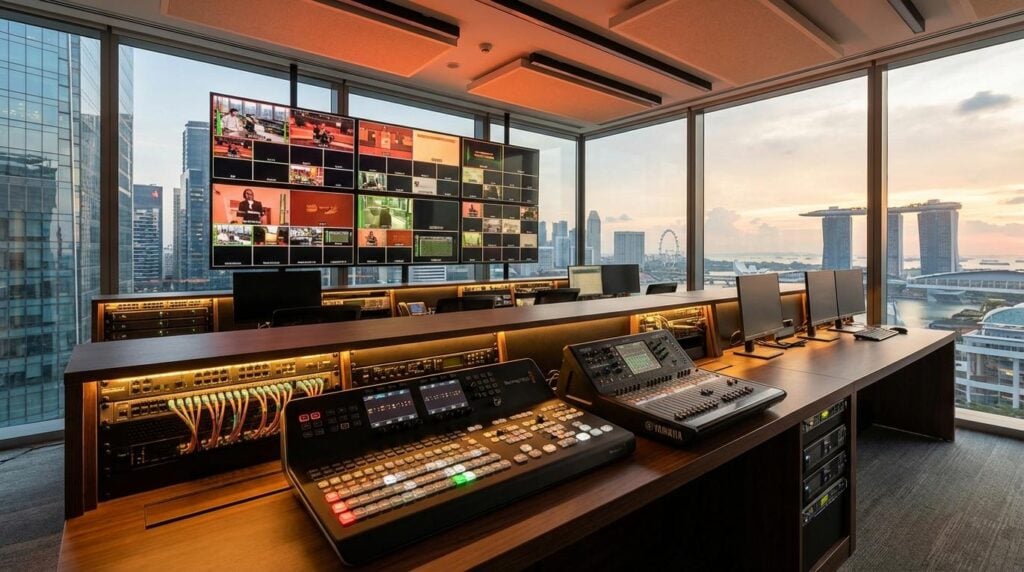
For multinational corporations (MNCs) headquartered in Singapore, the paradigm of corporate communication has fundamentally shifted. The reliance on outsourced, ad-hoc live streaming for every town hall, annual general meeting, or investor relations call is proving to be a bottleneck, introducing security vulnerabilities and inconsistent quality. The strategic imperative is now moving towards establishing permanent, in-house streaming suites. This transition offers unparalleled control over production quality, robust security for sensitive corporate messaging, and a significant long-term return on investment. A dedicated facility transforms streaming from a recurring operational expense into a strategic internal asset, enabling broadcast-grade communications on demand. This article provides a comprehensive technical blueprint for designing and implementing such a facility, focusing on the enterprise-grade infrastructure and workflows required to meet the exacting standards of a global MNC.
Core Infrastructure: Signal Flow and Physical Foundations
The foundation of any professional streaming suite is not the camera or the encoder, but the underlying physical and signal infrastructure. Decisions made at this stage dictate the reliability, quality, and scalability of the entire system. For an enterprise environment, robustness is non-negotiable; consumer-grade solutions introduce unacceptable points of failure. The architecture must be built on broadcast principles, ensuring signal integrity from acquisition to delivery.
Selecting Your Physical Space
The choice of room is a critical first step. An ideal space requires more than just sufficient square footage. Key environmental factors must be engineered. Acoustically, the room should be treated to minimize reverberation and external noise ingress, ensuring clean audio capture. This involves installing acoustic panels and bass traps. The HVAC system must provide adequate cooling for heat-generating equipment while operating at a low noise floor, preventing contamination of microphone feeds. Power infrastructure is paramount. The suite must be on dedicated, clean power circuits, isolated from general office electrical noise. A centralized uninterruptible power supply (UPS) system is essential to protect all equipment from power fluctuations and provide runtime during outages, ensuring the stream remains live during critical events.
Baseband Video Routing: The SDI Backbone
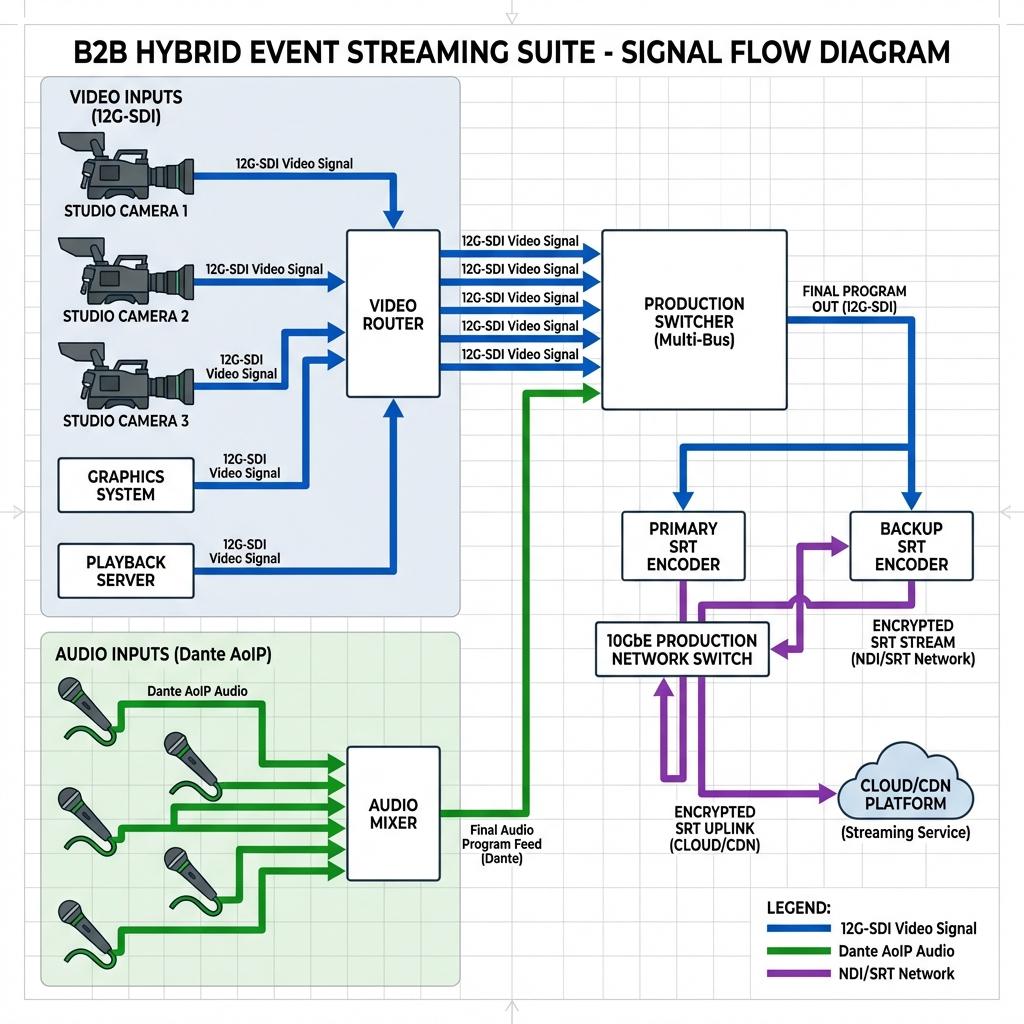
While IP-based video transport is gaining traction, the bedrock of a reliable production facility remains a baseband video infrastructure built on Serial Digital Interface (SDI). For future-proofing and handling high-resolution content, specifying 12G-SDI from the outset is the correct engineering choice. This allows for uncompressed 4K/UHD (Ultra High Definition) video at 60 frames per second over a single BNC coaxial cable. This SDI backbone connects all primary video sources, including cameras, playback servers, and graphics generators, to a central video router. The router acts as a digital patch bay, allowing any source to be routed to any destination, providing immense flexibility for different production scenarios without physical re-cabling. This centralized routing is fundamental for professional workflows, enabling complex signal chains and failover paths.
Audio Architecture: Dante vs. Embedded SDI
Professional audio requires a dedicated, high-fidelity transport solution. While embedding audio into the SDI signal is a viable option for simple setups, a more flexible and scalable approach for a corporate suite is an Audio over IP (AoIP) network. The dominant standard in this domain is Dante. A Dante network utilizes standard Ethernet infrastructure to transport hundreds of channels of uncompressed, low-latency digital audio. This allows microphones, audio mixers, and other audio devices to be placed anywhere in the facility and connected via a single network cable. It simplifies cabling and allows for complex audio routing managed through software. For hybrid events, this architecture is particularly powerful, enabling the creation of custom mix-minus feeds for remote presenters, ensuring they hear the program audio without their own voice being echoed back to them.
Production Control and Processing Systems
With a solid infrastructure in place, the focus shifts to the production control systems where video and audio signals are mixed, processed, and encoded for transmission. This is the operational core of the suite, where the technical team executes the live production. The equipment selection here directly impacts the creative capabilities and the technical quality of the final output.
The Video Switcher: The Heart of Production
The production switcher, or vision mixer, is the central creative tool for a live stream. It allows the Technical Director to switch between different camera angles, roll in pre-recorded video packages, and integrate graphics. For an enterprise suite, a hardware-based switcher is recommended over software-only solutions due to its reliability, low latency, and tactile control surface. Models like the Blackmagic Design ATEM Constellation or Ross Video Carbonite provide multiple ME (Mix/Effects) buses. Each ME bus is effectively an independent switcher, allowing for the creation of complex compositions, such as picture-in-picture effects for a presenter and their slides, without tying up the main program output. Features like DVEs (Digital Video Effects) for resizing sources and multiple keyers for layering graphics (e.g., lower thirds) are essential for a professional look.
Encoding and Transmission Protocols: RTMP, SRT, and NDI
The encoder is the device that compresses the final program video and audio feed for transmission over the internet. The choice of protocol is critical for quality and reliability. While RTMP (Real-Time Messaging Protocol) and its secure variant RTMPS are widely supported by many platforms, they are an aging technology susceptible to packet loss on unstable networks. For enterprise-grade contribution, SRT (Secure Reliable Transport) is the superior protocol. SRT is an open-source protocol that provides low-latency stream transport with robust error correction and AES-256 bit encryption, making it ideal for sending high-quality video over the public internet. Internally, within the Local Area Network (LAN), NDI (Network Device Interface) serves as a powerful IP-based video transport protocol. It allows video signals to be shared between devices over a standard Ethernet network with extremely low latency, perfect for connecting graphics systems or local recorders to the main switcher without requiring long SDI cable runs. It is important to distinguish between full-bandwidth NDI, which requires significant network capacity, and NDI|HX, a more compressed variant suitable for networks with less bandwidth.
Graphics, Playback, and ISO Recording
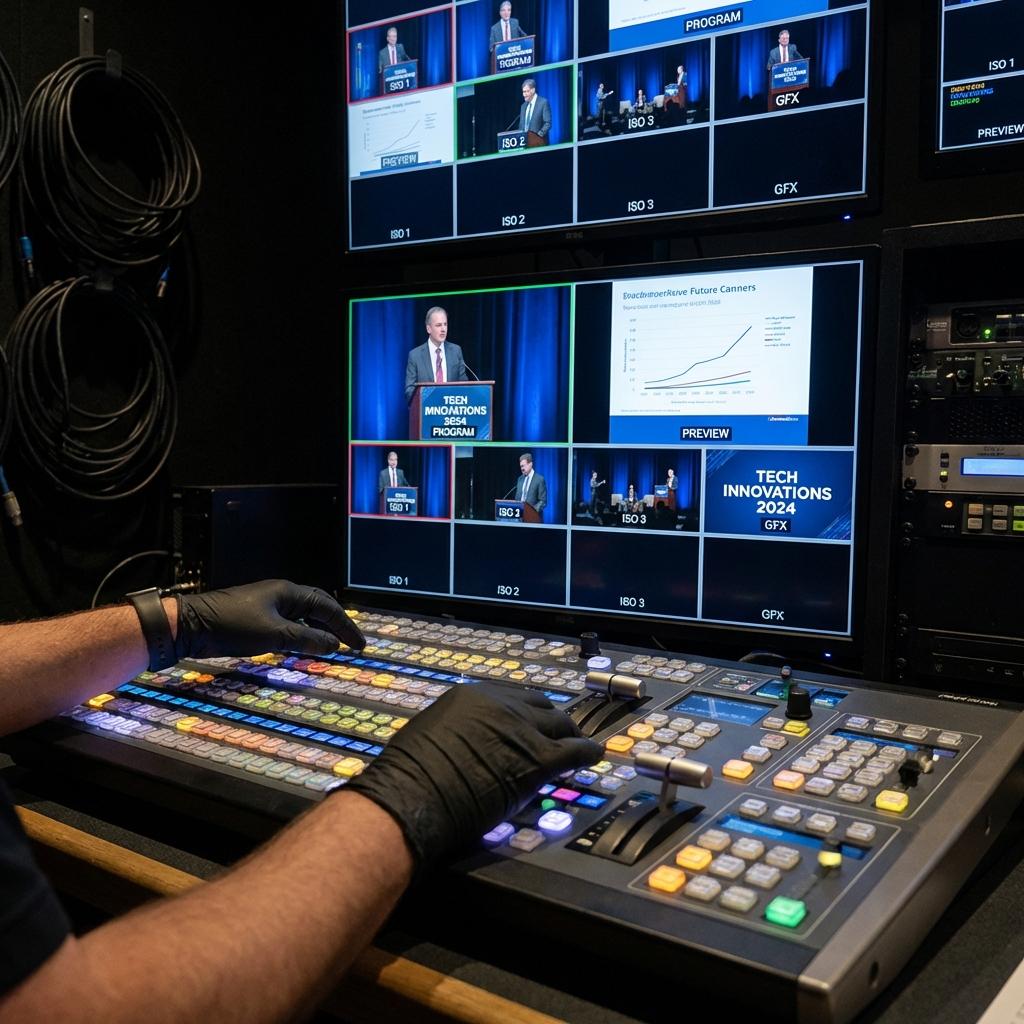
A polished corporate stream requires more than just camera feeds. A dedicated character generator (CG) system is needed for creating and displaying high-quality lower thirds, titles, and other on-screen graphics. Furthermore, a media playback server is essential for cueing and playing pre-produced video content, such as corporate profiles or executive interviews. A critical component of a professional workflow is ISO (isolated) recording. This means recording each individual camera feed directly, independent of the switched program output. Having these clean ISO recordings is invaluable for post-production, allowing for re-editing the event, correcting switching errors, or creating supplementary video-on-demand assets.
Network Architecture and Hybrid Event Integration
In the modern corporate environment, a streaming suite must not exist in a vacuum. It must be intelligently integrated with the broader corporate network and be capable of supporting complex hybrid events that blend physical and virtual audiences. This requires a meticulously planned network architecture and specific integration workflows.
Building a Dedicated Production Network
To ensure the stability of real-time video and audio streams, it is an absolute requirement to create a physically or virtually (VLAN) segregated production network, completely separate from the general corporate data network. This prevents email traffic, file transfers, or other office activity from impacting the performance of time-sensitive protocols like NDI and Dante. This production network should be built on a 10GbE (Gigabit Ethernet) backbone using managed switches. These switches must be configured with Quality of Service (QoS) to prioritize video and audio packets and support IGMP (Internet Group Management Protocol) Snooping to efficiently manage multicast traffic generated by NDI sources, preventing the network from being flooded with unnecessary data.
Integrating with Enterprise UC Platforms
A key function of an in-house suite is to elevate the quality of events hosted on Unified Communications (UC) platforms like Microsoft Teams, Zoom, and Webex. Instead of relying on a simple webcam, the entire multi-camera production from the suite can be fed into these platforms. For Microsoft Teams, this can be achieved using Teams Pro, which supports NDI inputs, allowing the program feed from the switcher to appear as a high-quality video source. For Zoom, tools like Zoom ISO can extract clean video and audio feeds from each remote participant, allowing them to be integrated into the main production switcher just like a physical camera in the studio. This enables a seamless experience where remote presenters are fully integrated into the broadcast with proper graphics and audio mixing.
Redundancy and Failover Strategies
For high-stakes corporate events, failure is not an option. A robust redundancy strategy must be implemented at multiple levels. Network connectivity should be redundant, ideally using diverse carriers. For stream contribution, bonded cellular technology from providers like LiveU or TVU can be used as a backup transmission path, combining multiple cellular signals to create a resilient connection independent of the primary wired internet. The encoding and transmission workflow should also be redundant. A common strategy is to use two separate encoders (a primary and a backup) feeding two geographically distinct content delivery networks (CDNs). If the primary encoder or CDN experiences an issue, the stream can be seamlessly failed over to the backup path, ensuring uninterrupted viewing for the audience.
Scalability and Future-Proofing Your Suite
Building a permanent suite is a significant investment. Therefore, it must be designed not just for today’s requirements but also with a clear path for future growth and technological evolution. A modular design and a strategic approach to technology choices are key to ensuring the suite remains a valuable asset for years to come.
Modular Design for Growth
Adopting a modular, rack-based design for all core equipment is a best practice. This allows for the easy addition of new components, such as more video inputs, additional recording decks, or upgraded processing hardware, without a complete overhaul of the system. This approach ensures the suite can scale as the MNC’s communication needs evolve, for example, growing from a 4-input HD system to a 12-input 4K system. Cable management and signal flow documentation are critical in a modular system to facilitate troubleshooting and future upgrades.
Cloud vs. On-Premise Processing
While the core production control often remains on-premise for maximum control and minimal latency, certain processing tasks can be offloaded to the cloud. Cloud-based platforms like AWS Elemental MediaLive offer powerful capabilities for transcoding the stream into multiple bitrates for adaptive streaming, applying digital rights management (DRM), and distributing the content globally via a CDN. A hybrid architecture, where the on-premise suite contributes a high-quality SRT feed to the cloud for processing and distribution, offers the best of both worlds: on-site reliability and cloud scalability.
Human Capital: The Technical Team
Ultimately, the most sophisticated hardware is only as effective as the team operating it. Investing in a permanent facility necessitates an investment in human capital. A professional production requires a skilled team with defined roles: a Technical Director to operate the switcher, an Audio Engineer (A1) to manage all sound sources, a Graphics Operator to handle on-screen visuals, and a Streaming Engineer to monitor the health of the outbound stream and manage the distribution platforms. For Singaporean MNCs, building this internal expertise is the final step in truly owning the corporate communication workflow, ensuring every broadcast is executed flawlessly.
By investing in a permanent, professionally designed streaming suite, Singapore-based MNCs can take full command of their global communications. It is an evolution from a tactical response to a strategic capability, ensuring that every critical message is delivered with the quality, security, and reliability that a global brand demands. Spring Forest Studio provides the technical expertise and integration services necessary to architect and deploy these mission-critical facilities.
Jeremy Lee is a seasoned digital marketing director and strategist with over two decades of experience in the industry. As the founder of Sotavento Medios, I manage a diverse portfolio of over 50 businesses, helping brands grow through advanced search strategies and digital innovation. My work focuses on bridging the gap between traditional search engine optimisation and the evolving world of AI-driven answer engines.
get in touch