
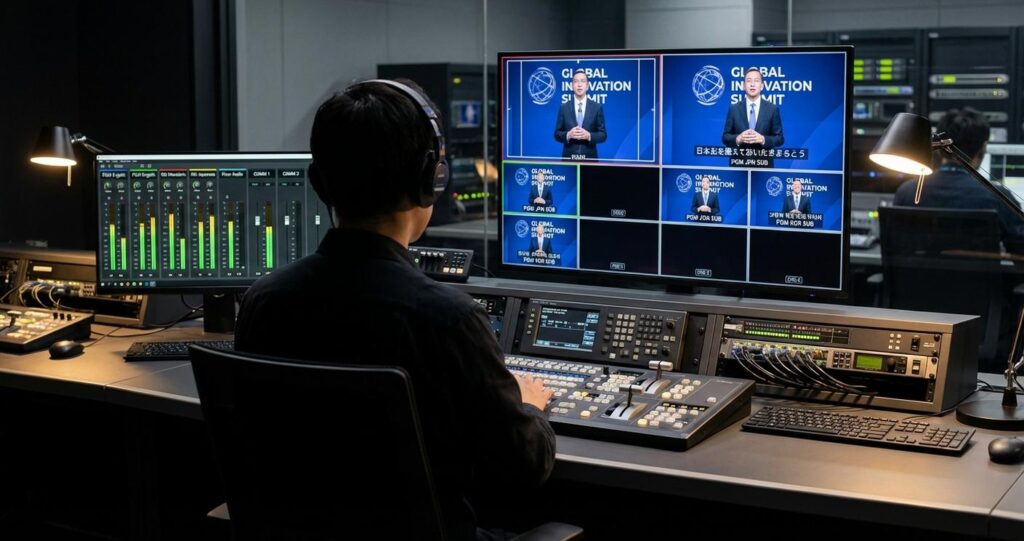
Executing a successful corporate stream for a Pan-Asian audience introduces layers of complexity that far exceed standard single-language webcasts. The challenge is not merely linguistic; it is an engineering problem rooted in signal flow, latency management, and data integration. For enterprise clients hosting town halls, product launches, or partner conferences across diverse markets like Japan, Korea, China, and Singapore, delivering a technically flawless, multilingual experience is a direct reflection of their brand’s operational excellence. Simply providing a translated transcript after the event is insufficient. The expectation is for real-time, broadcast-grade subtitles and simultaneous interpretation integrated directly into the live video stream. This requires a robust production architecture that can ingest, process, and distribute multiple concurrent data streams without compromising the primary audio/video feed’s integrity.
Achieving this level of sophistication demands a deep understanding of video and audio routing, encoding standards, and cloud-based media processing workflows. It involves creating a resilient infrastructure that can handle multiple audio tracks for interpretation and synchronized metadata for subtitles, all while maintaining low latency and high Quality of Service (QoS) for thousands of viewers on disparate networks. This article provides a technical breakdown of the infrastructure, protocols, and workflows required to implement mission-critical subtitling and translation for high-stakes Pan-Asian corporate streams, offering a blueprint for production managers and IT directors tasked with this complex challenge.
Foundational Signal Integrity: Ingest and Encoding for Multilingual Feeds
Before any translation or subtitling can occur, the integrity of the source audio and video signals must be absolute. The entire downstream workflow depends on a pristine, uncompressed, or lightly compressed source feed. This foundational stage is about establishing a clean, technically sound baseline from the production environment, whether it’s an on-site venue or a broadcast studio.
SDI and NDI for Primary Program Feed Routing
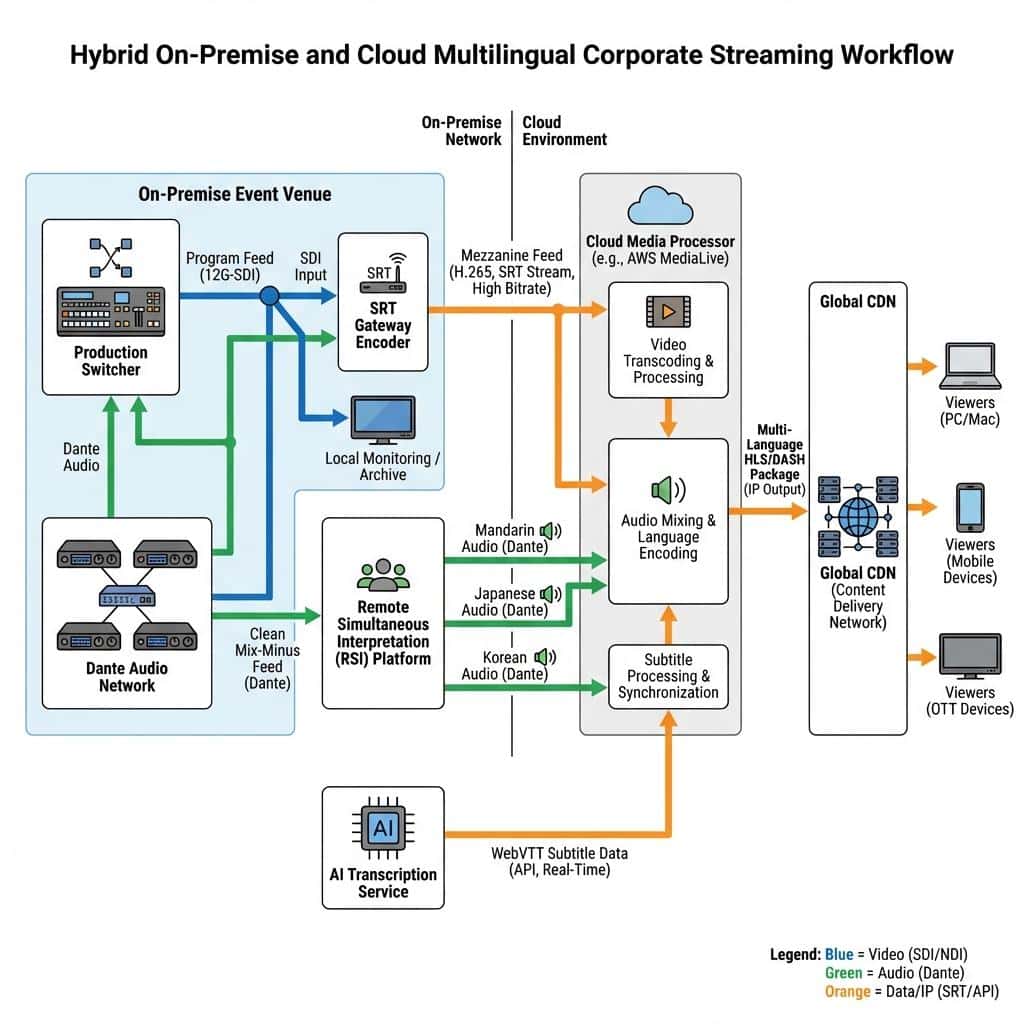
The primary Program (PGM) feed from the video switcher is the single source of truth for the visual content. For on-premise productions, the industry standard for routing this feed remains the Serial Digital Interface (SDI). A 12G-SDI infrastructure provides the necessary bandwidth for uncompressed 4K UHD (3840×2160) video at 59.94 frames per second, ensuring maximum quality for encoding. However, in modern hybrid event environments, IP-based workflows offer greater flexibility. Newtek’s Network Device Interface (NDI) protocol allows for the transmission of high-quality, low-latency video over a standard Gigabit Ethernet network. Full-bandwidth NDI can carry a visually lossless signal comparable to SDI, while NDI|HX uses a higher compression ratio for environments with limited network capacity. The choice between SDI and NDI depends on the facility’s infrastructure, but the goal is the same: deliver a high-fidelity PGM feed to the primary encoding hardware or cloud contribution point with minimal latency and no signal degradation.
Audio Architecture: ISO Tracks and Mix-Minus Feeds
The audio architecture is arguably more critical than the video for multilingual streams. A simple stereo PGM mix is inadequate. The core requirement is the ability to generate isolated (ISO) audio tracks for each speaker and a clean program feed without any interpretation. This is typically achieved using a digital audio network like Audinate’s Dante. Dante allows for the routing of hundreds of uncompressed audio channels over an IP network. In a typical setup, each microphone is an individual Dante source. The audio engineer creates a primary PGM mix for the main English stream. Simultaneously, they route the clean PGM audio (without any floor language interpretation) as a mix-minus feed to the Remote Simultaneous Interpretation (RSI) platform. This prevents the interpreters from hearing their own voices with a slight delay, which can be highly disorienting. The ability to create multiple, discrete audio stems is a non-negotiable prerequisite for any professional multilingual workflow.
Mezzanine Encoding for Contribution
Once the pristine video and audio stems are prepared, they must be encoded for transport to the cloud or processing hub. This initial encoding stage, known as mezzanine or contribution encoding, is critical. It is not the final delivery encode for the audience; rather, it’s a high-bitrate, robust stream designed for further processing. The codec choice is typically H.264 for broad compatibility or H.265 (HEVC) for superior bandwidth efficiency, which is crucial when contributing a 4K feed. The transport protocol is equally important. While RTMP (Real-Time Messaging Protocol) is still common, Secure Reliable Transport (SRT) has become the professional standard. SRT provides the reliability of TCP-based protocols with the low latency of UDP, offering packet loss recovery and AES-256 encryption. A typical contribution feed might be an 8-15 Mbps H.265 stream encapsulated in SRT, sent to a cloud media processor.
Integrating Real-Time Translation and Subtitling Workflows
With a stable contribution feed established, the next stage involves integrating the actual language processing systems. This can be a combination of human interpreters, AI-driven services, and specialized data protocols. The key is to manage these disparate inputs and synchronize them with the primary video stream.
Human-in-the-Loop: Remote Simultaneous Interpretation (RSI) Platforms
RSI platforms connect professional interpreters from around the world to the live event. From a technical standpoint, the RSI system receives the low-latency SRT video feed and the clean audio mix-minus from the production venue. Interpreters, using a dedicated software interface, watch the video and listen to the source audio, performing simultaneous translation into their target language. Their translated audio is captured using a high-quality codec like Opus, which provides excellent voice clarity at low bitrates. This audio is then sent back to a central processing point, typically a cloud media service. Each language becomes a new, discrete audio track that must be synchronized with the video. The primary challenge here is latency management; the round-trip delay for the audio must be kept to a minimum to maintain lip-sync and a seamless experience.
AI-Powered Workflows: Live Transcription and Machine Translation
For live subtitling, AI-powered speech-to-text (STT) services are increasingly viable. Services like AWS Transcribe or Google Cloud Speech-to-Text can be integrated via API. The workflow involves sending the primary program audio to the STT engine in real-time. The engine returns a stream of text data with timestamps. This text can then be passed through a machine translation API to generate subtitles in multiple languages. While highly scalable, this workflow has technical considerations. Accuracy can vary based on speaker accents and technical jargon. Furthermore, the API calls introduce latency. A buffer is required to ensure the text can be processed, translated, and formatted before being displayed, meaning AI-generated subtitles will always lag a few seconds behind the live action. For high-stakes corporate events, a human captioner reviewing the AI output in real-time (a process called respeaking) often provides the best balance of speed and accuracy.
Caption and Subtitle Data Ingest: CEA-608/708 vs. WebVTT
How the subtitle data is transported and displayed is a critical technical decision. For traditional broadcast-style workflows, captions are embedded directly into the video stream using standards like CEA-608 (legacy) or CEA-708 (modern). This data is injected into the video’s Vertical Ancillary (VANC) space in an SDI signal or as a specific data track in a transport stream. The alternative, and more common for web streaming, is using a sidecar file format like Web Video Text Tracks (WebVTT). In this model, the subtitles exist as a separate, time-coded text file that is referenced by the video player. This provides immense flexibility, allowing the end-user to toggle languages on or off and even customize the appearance of the text. Most modern cloud workflows ingest the source text and generate WebVTT files for each language to be packaged with the final HLS or DASH stream.
Production Infrastructure: On-Premise vs. Cloud-Based Processing
The complex task of combining video, multiple audio tracks, and subtitle data can be handled either with on-premise hardware or in the cloud. Each approach has distinct advantages and is often used in a hybrid model.
On-Premise Hardware Solutions
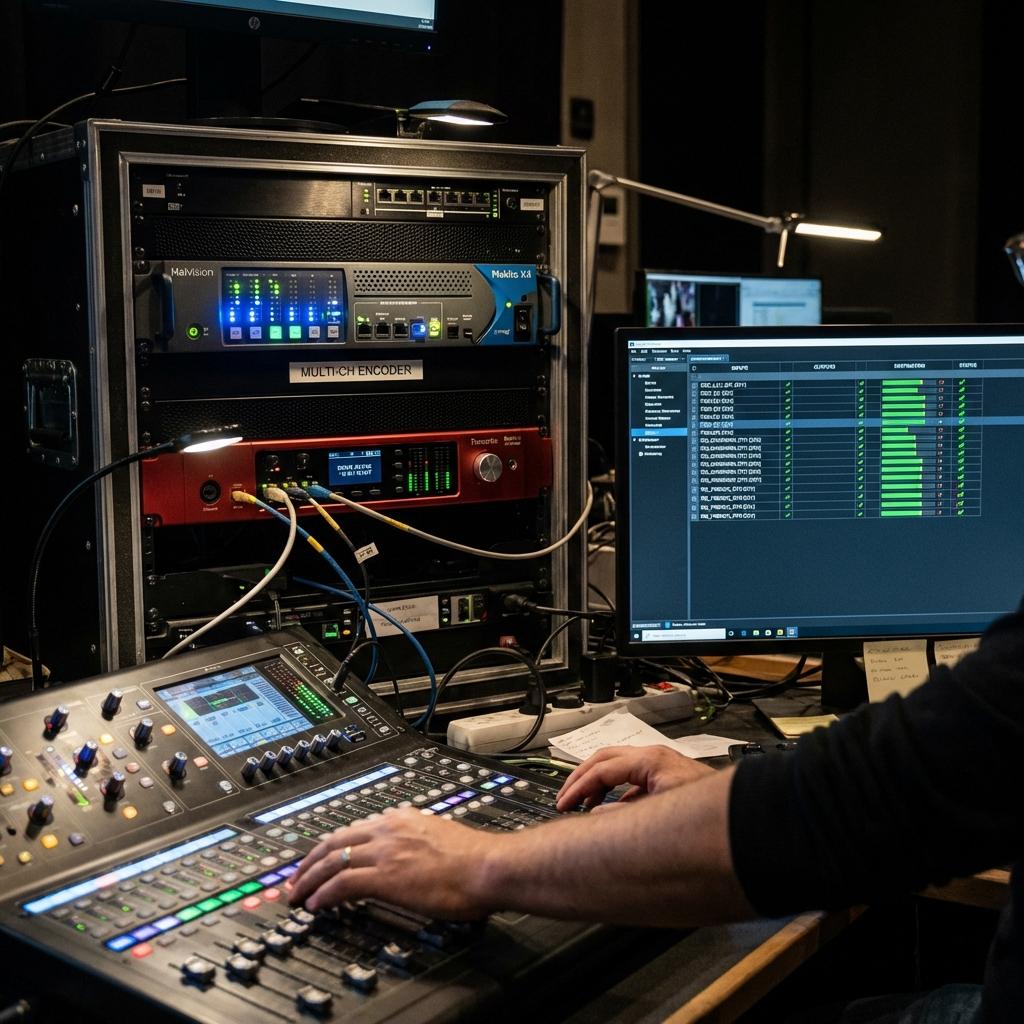
An on-premise solution offers maximum control and minimal latency. This involves using dedicated hardware encoders and media processors at the event venue. A multi-channel encoder, such as a Haivision Makito X4 or an AJA HELO Plus, can ingest an SDI feed and multiple audio inputs (e.g., from a Dante network via an audio embedder). These devices can create multiple output streams, each with a different language audio track embedded. Similarly, dedicated caption encoders can inject CEA-608/708 data directly into the outgoing SDI signal before it hits the primary encoder. This approach is highly reliable and secure but requires significant capital investment and on-site engineering expertise.
Cloud-Based Production and Processing
A cloud-based workflow provides unparalleled scalability and flexibility. Here, a single, high-quality SRT contribution stream is sent from the venue to a cloud media service like AWS Elemental MediaLive or Zixi. Inside the cloud, this stream is replicated. The returned audio feeds from the RSI platform and the WebVTT data from the transcription service are ingested by the same cloud platform. The media service then packages these elements into a single asset with multiple audio renditions and subtitle tracks. For example, AWS Elemental MediaLive can take a single video source, multiple audio sources, and multiple caption sources (like WebVTT) and package them into a unified HLS output. This allows for the creation of dozens of language-specific streams without requiring massive on-premise hardware.
Hybrid Models: The Best of Both Worlds
For mission-critical Pan-Asian corporate events, a hybrid model is often the optimal solution. The on-premise production team focuses on creating a flawless primary program feed and a resilient, redundant SRT contribution stream. This minimizes the complexity and points of failure at the physical venue. The heavy lifting of multilingual processing, transcoding for adaptive bitrate delivery, and packaging is offloaded to a scalable cloud provider. This approach leverages the security and control of on-premise hardware for acquisition while capitalizing on the flexibility and global reach of the cloud for processing and distribution.
Distribution, Delivery, and Player-Side Experience
The final stage of the workflow is ensuring the meticulously prepared multilingual stream reaches the audience reliably and with a user-friendly interface. This involves modern streaming protocols, Content Delivery Networks (CDNs), and intelligent video players.
Multi-Track Audio Streaming and Adaptive Bitrate (ABR) Packaging
To deliver the various language options to the viewer, the stream must be packaged using an adaptive bitrate (ABR) protocol like HLS (HTTP Live Streaming) or MPEG-DASH. These protocols segment the video into small chunks that can be delivered over standard HTTP. Crucially, the manifest file (the M3U8 playlist in HLS) can define multiple audio tracks associated with the video. When a viewer presses play, the video player parses this manifest, shows the available audio languages in a dropdown menu, and requests the appropriate audio segments along with the video. ABR ensures that the video quality scales automatically based on the viewer’s network conditions, which can be highly variable across the Pan-Asian region.
Player-Side Subtitle Integration and Customization
Similarly, the HLS or DASH manifest points to the location of the WebVTT subtitle files for each language. A modern HTML5 video player (like Video.js or JW Player) reads this information and populates the “CC” or subtitle menu. The entire process is handled on the client side. This is highly efficient, as the player only downloads the subtitle file for the language the viewer selects. It also gives the viewer complete control over their experience, allowing them to choose between subtitles, audio interpretation, or both, depending on their preference and the accessibility requirements of the event.
Redundancy and Failover Strategies for Pan-Asian Delivery
Delivering a high-quality stream across a vast and geographically diverse region like Asia requires a robust CDN strategy. Using a multi-CDN approach with providers who have strong Points of Presence (PoPs) in key Asian markets (e.g., Tokyo, Seoul, Singapore, Hong Kong) is essential for minimizing latency and buffering. Geo-DNS routing can direct viewers to the closest and best-performing CDN node. For the contribution side, link redundancy (using multiple internet connections) and stream redundancy (using protocols like SMPTE 2022-7 for seamless hitless failover between two identical SRT streams) are critical to ensure the source feed is never interrupted.
Ultimately, integrating subtitling and translation into Pan-Asian corporate streams is a complex, multi-faceted engineering discipline. It requires a holistic approach that considers every step of the signal chain, from microphone placement and audio routing at the venue to manifest file creation and CDN configuration in the cloud. By building a workflow on a foundation of signal integrity, leveraging the right combination of on-premise and cloud infrastructure, and utilizing modern streaming protocols, organizations can successfully bridge linguistic divides and deliver a powerful, inclusive, and technically impeccable live experience to their entire Pan-Asian audience. At Spring Forest Studio, our technical team specializes in architecting these precise, high-stakes workflows, ensuring your message is delivered with clarity and professionalism, in any language.
Jeremy Lee is a seasoned digital marketing director and strategist with over two decades of experience in the industry. As the founder of Sotavento Medios, I manage a diverse portfolio of over 50 businesses, helping brands grow through advanced search strategies and digital innovation. My work focuses on bridging the gap between traditional search engine optimisation and the evolving world of AI-driven answer engines.
get in touch